


A high point for Hot Docs from its early days was the Forum, a high voltage two-day pitch session populated by internationally recognized filmmakers selling their upcoming projects to a room full of prestigious commissioning editors from the US, Canada, England, continental Europe, Australia and Japan. For nearly two decades, industry veterans—producers, distributors, filmmakers, journalists—observed the action in a circle of seats surrounding a vast table of representatives from the BBC, CBC, Sundance, ARTE, NHK, and others as exciting new docs were presented to a group that could—and would—critique every effort while, in many cases, offering to fund the proposed films.
That was then—at UofT’s glorious Hart House. This year’s Forum is at the Hot Docs Ted Rogers Cinema, a lovely venue for showing film, but not conducive to the intense wheeling and dealing atmosphere that made the Forum a legend in industry circles.
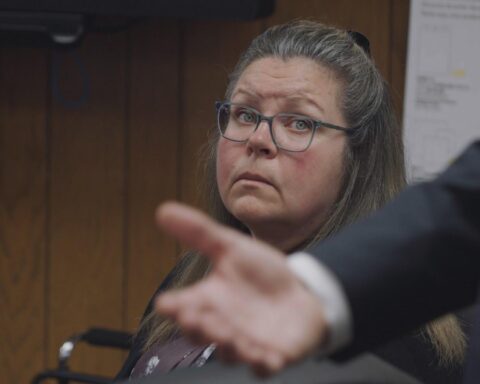
Hot Docs’s 2026 Forum began with a moderator—Catherine Olsen at first—on stage at the Cinema, introducing the filmmakers, who were tasked with representing themselves to an audience of well over one hundred industry veterans. Most of the doc directors and producers were reasonably good—and one was excellent—at presenting their project, which was shown at its best through a teaser reel of two to four minutes. Then, the moderator asked the commissioning editors and other doc experts to ask the filmmakers questions.
To say the least, the drama was lacking with this format. Instead of sitting at a table conversing with—but sometimes confronting—each other, the potential funders got up from cinema seats to react to the filmmakers, who were still on stage. The responses were understandably less forceful than before—look at the power and spatial dynamics—and not much money was being bandied about. While the filmmakers seemed to want broadcasters and funders to come on board with money for their projects, the general response was—too often—a polite criticism or question about the film, followed by, “Let’s discuss it further in a private meeting.”
The early days of the Forum were occasionally likened to early Christians being thrown to the lions. Now, it feels like a Sunday school play.
Still, there were pitches and many were quite good. There were eight in total but two were embargoed to the press so POV is pleased to present you with highlights from six pitches.
[Producer credits and company credits and order of appearance are as they were received.]
North Korea’s Joy Division
Director: Noa Im; Producers: Ann Shin (Producer / Executive Producer), Sally Blake (Producer / Executive Producer), Erica Leendertse (Producer)
Production companies: Fathom Film Group Ltd. (Canada), Films á Cinq (France)
Noa Im and Ann Shin effectively presented this project, which sadly felt a bit dated. It’s been known for years that North Korea’s autocratic and decadent Kim family have been taking advantage of their innocent youths by, first, having them train in rhythmic gymnastics and dance exercises for darker purposes than sport. Shin and Im showed brilliant and often kitschy footage of young Koreans performing in sporting, military and cultural events while some—the most attractive—were actually being groomed to join North Korea’s “Joy Division,” where they are expected to have sex with members of the country’s military and political elite.
Im and Shin have four “characters,” victims of North Korea’s sexual violence whose stories will be told on screen. TVO (Ontario) and ARTE are supporting this film and, in all likelihood, so will other broadcasters and services. Responses at the Forum came from a diverse range of commissioning editors ranging from Chris White at the US show POV, who “liked it” (but perhaps not that much) to NHK which had produced their own “joy division” doc, and was unlikely to help to fund the film.
What You Remember
Director: Pauline Blanchet; Producers: Ljubomir Stefanov & Pauline Blanchet (Producer)
Production companies: Apolo Creative Solutions (North Macedonia), Aral Sea Productions LTD. (UK)
Skopje, the capital city of Macedonia, has been transformed twice architecturally. After a terrifying earthquake in 1963, the city employed the brilliant Japanese Brutalist architect Kenzo Tange to rebuild much of the city. Then, in 2014, the “new” post-Yugoslav Macedonian state commissioned a new version of Skopje that used neo-classical forms to suggest an historical narrative for the city that evokes Alexander the Great (who was, of course, Macedonian).
To filmmaker and architect Pauline Blanchet, the neo-classical style is pompous and false, destroying the beauty of the Brutalism of a previous generation. To her, it’s “urbicide,” a killing of a city. To best tell her story of dueling architectural and historical styles, she uses AI and computer animation in her reel to show why she hates neo-classicism, which she associates with Trump and Putin in creating a false narrative of history and national pride.
Blanchet’s proposed film is a rather heady one. Broadcasters were polite but this film, if made, will likely be a labour of love.
Vuka (Rise Up)
Director: Matthew Robinson; Producers: Rehad Desai (Lead Producer), Shannon Walsh (Executive Producer), Matthew Robinson (Producer)
Production companies: Trevendy Films (Pty) Ltd (South Africa), Uhuru Productions (Pty) Ltd (South Africa)
Robinson and award-winning Canadian producer Shannon Walsh presented this humanist and artistic project, which is set in the South African townships. There, near Cape Town, in an area of poverty and little ambition, Robinson found a choir master and an array of students—singers, pianists, burgeoning conductors—who want to dedicate their lives to music.
The film (much of which has been shot) follows the choir as they go for glory in a nationwide contest. It gives this very likeable film a structure—and, hopefully, a happy ending. Critical responses to this pitch were favourable since it was so positive and, yet a unique story.
Tallawah
Director: Laurie Townshend; Producers: Amar Lohana (Producer), Habiba Nosheen (Executive Producer)
Production companies: Akelo Media Corp (Canada)
Laurie Townshend is the artist who made the best pitch on the first day of Hot Doc’s Forum. Warm and funny, she told of being a 6-year-old winning all the sport events at a local picnic contest. Her prize was a makeshift endeavour that incorporated a Pepsi Cola bottle into its “design” and was to be given to the best “boy.” That made it more confusing and wonderful for her that she won it.
To Townshend, the story represents not just her but all of Jamaica, a country that isn’t big but can have large dreams. The expression “We likkle but we Talawah” is the motif for her film about two teenage female basketball players who believe they can make it big in a sport that isn’t a favourite on the island. She wants it to be the female Hoop Dreams, which may be unlikely—but still, one should always dream, right?
The response to Townshend was positive, naturally, and it’s likely that the film will be made.
Hiding in My Cells
Director: Ali Naqi
Producers: Christina Saliba (Producer), Ali Naqi (Producer), Ariel Nasr (Executive Producer), Sergeo Kirby (Executive Producer)
Production companies: Misfit Films (Canada), Spicy Alii Inc. (Canada)
This very moving film project is set in an HIV orphanage in a small community in Belgaum, India. The film will concentrate on the charismatic Kasturi, who defies her HIV stigma and physical status to fight for her “children” at the orphanage and herself.
This project received a lot of heartfelt responses from the documentary professionals, and one expects it will be financed properly when it’s made.
The Ruin of the Earth
Director: Yannick Jamey; Producer: Ophelia Spinosa (Producer)
Production companies: Stella Maris Films (Canada)
Peadar Mór is the last monolingual Gaelic speaker on a remote island off the coast of Ireland. The octogenarian has lived as a farmer and raiser of livestock all of his life and he wants to live his “inheritance” to a 17-year-old relative. But the lad is likely to leave the island and its ancient way of life within a year or two.
The show reel footage is gorgeous: the waves from the choppy water, the darkening skies, the lush green lands are all glorious to view. This film will not be an easy one to sell. It’s cinematic and poetic but will it “sell” to producers and broadcasters? Let’s hope so.
Made in Brazil
By Tom White
The post-Bolsonaro era in Brazil has blessed the world with such critically acclaimed cinematic gems as I’m Still Here, The Secret Agent, Apocalypse in the Tropics, and Yanuni. This year’s Hot Docs showcased four docs from Brazil, as well as a panel at the Industry Conference, all under the title Made in Brazil.
Mini Kerti and partners Hugo Haddad and Isadora Canela, directors of the respective films Dona Onete–This Tiny Piece of My Heart and Solar Shadow, joined moderator Melanie Nepinak Hadley, VP at the Indigenous Screen Office, for a spirited conversation on Indigenous representation and empowerment, the Covid disruption, the challenges of funding, and how their films changed the filmmakers’ lives.
Both Dona Onete and Solar Shadow centre on Indigenous experiences–culturally and politically, as well as spiritually and intellectually. Dona Onete herself is an artistic powerhouse, earning the title “Queen of Carimbo,” despite having entered the performance arena at age 70. Hailing from Northern Brazil, she embraces the Indigenous and Black strands of her DNA in equal measure, through her earlier careers as an educator and activist to her ongoing prowess as a singer-songwriter on the global stage. “This relation that she has with nature and how she transmits that through her music–this was the start for me,” Kerti recalled.
Solar Shadow brings to the fore the work of Professor Germano Afonso, a renowned astrophysicist who foregrounded the teachings and mythologies of his Indigenous ancestors as a key to understanding the mysteries of the cosmos–and as a means to interrogate traditional Western schools of thought on the subject. “The film comes from this erasure and this desire to understand the cycles and the contrasts in non-Eurocentric world views,” Canela explained.
Hadley then asked the filmmakers about what makes Brazilian documentary cinema unique on a global stage.
“We have this mixing of Black and Indigenous cultures,” Kerti noted. “It’s a very particular culture: it’s local, but it’s global in its feelings.” And despite the dire circumstances of the Bolsonaro era, the filmmaking community kept working, nurturing their art on their own terms..
When it came to funding Solar Shadow, two mitigating factors came into play: the Bolsonaro regime and the pandemic. The day before Bolsonaro took power, the Ministry of Culture notified Haddad and Canela that they had been awarded a grant–which took more than two years to be released. By that time, the pandemic was in full effect, so the couple stopped filming for two-and-a-half years, during which time their protagonist, Professor Germano Afonso died of COVID.
For Kerti, raising money for Dona Onete was relatively easy, given the renown of the singer and her environmental activism. Kerti cited incentive laws, which allows for tax deductions for certain cultural projects, and funds from Brazil’s COP30 climate change initiative as her key sources.
One of the audience members asked how the projects changed the filmmakers. After Professor Afonso’s passing, Haddad shared, “I wanted to look for the world in another way—not only learn but observe.” For Kerti, she was going through a divorce while making a film about someone who, at age 70, had decided to make a major transformational life change. “I was identifying with her. This joy of living that she recreates at 70, I was recreating at 53. It transformed the way I am in the world.”

The National Film Board of Canada Asks: “What Does Documentary Need Right Now?”
By Barri Cohen
In mid-April, Identity & Culture Minister Marc Miller announced an 11-member advisory panel to consider the ‘modernization’ of Canada’s 19 billion dollar a year audio visual sector. This panel is expected to understand what ‘modernization’ actually means and for whom, and whether it’s only defined along indices of global reach and dollars.
One “big idea” they’ll be forced to contend with (although it’s actually an old idea) is the feasibility of a merger between Telefilm Canada, the CMF (Canadian Media Fund), and the National Film Board of Canada (NFB). The Wire has already reported that the NFB is sending strong resistance signals. Indeed, to anyone acquainted with this troika, you’re probably head scratching too, considering the lack of sensitivity shown by Telefilm and CMF to the singularity of documentaries: their highly varied development-to-production timelines as well as their scripting, funding and unique distribution challenges.
The CMF’s recent “one size fits all” market driven, tone-deaf new funding guidelines evinces the full measure of this disconnect. Not unlike the big “Mandate Review” Report of the screen sector in 1996, this “modernization” stuff is really code for that old chestnut, “finding efficiencies.” The Report’s authors considered the merger of the NFB with Telefilm then too and concluded instead that the Board better refine its mission for the 21st century or perish, and at least double down hard on production.
THE NFB/ONF’s INSTALLATION IS A VAST DISAPPOINTMENT
I had this in mind when visiting the Delegate Lounge at Hot Docs’ Industry Conference to suss out the NFB/ONF’s invitation to filmmakers, creators and industry voices to take part in what they billed as a “live, interactive installation” exploring the question “what does the documentary need right now?”
I expected a hopeful, bright display with NFB goodies and other interested filmmakers. Maybe a looped reel of stellar clips past and present, superlative titles, posters? How about 3-D goggles, crayons and white boards? A confession corner, or finger painting? Who knows! The stated goal was to contribute to a “collective portrait of where the field stands.” Okay! Sounds promising.
What does documentary need right now? For one thing, a national studio with better ideas. I was unprepared for the utterly stripped down little kiosk–yes, fitting for the very down to earth size and vibe of this year’s HD, but underwhelming, nonetheless.
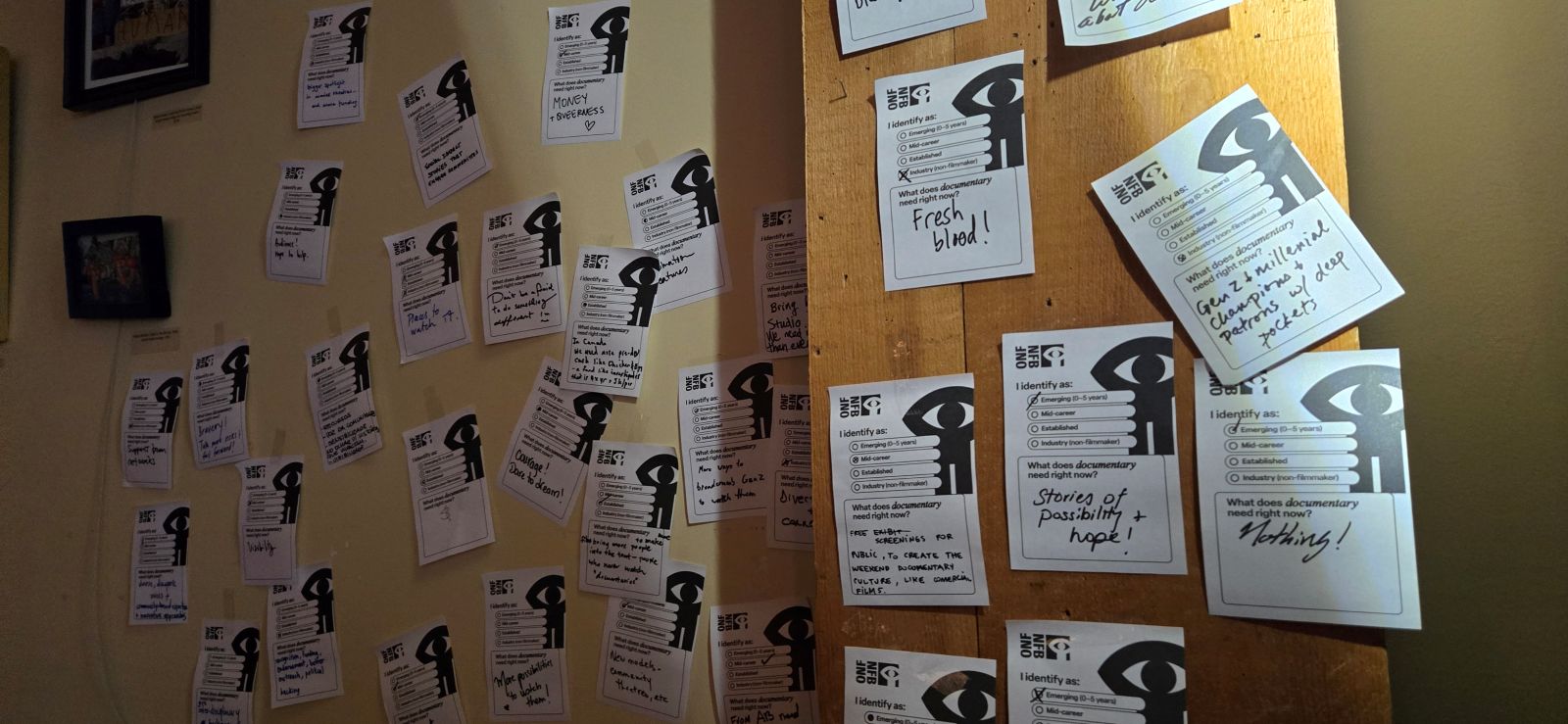
Helmed by two folks from the Board’s Ontario Centre’s marketing department, they cheerily handed out black sharpies and little note pad style single sheets inviting the curious to write down their professions (it was all anonymous), and their morsels of a want, need or wish for “what documentary needs right now.”
We were given tape to post our aperçus onto the wall. I counted some 60 such posts. Scanning the scribbles, many echoed “money”, “stories of hope,” “more access to audiences, to broadcasters,” “courage,” and “fresh blood.” Fresh anything!
Where these thoughts will end up was not clear, but this much was: that Miller’s advisors better steel themselves to unflinchingly and without sentiment, consider hard the fate of a legacy studio’s 88 million dollars a year.