



Hot Docs Forum Day Two
By Marc Glassman
Hot Docs’ reborn Forum showed how Canadians think and act differently than the Great American Bully down south. While DEI projects, institutions, and even comedians are being attacked in the U.S., filmmakers, jurors, organizers and festival goers at Toronto’s Hot Docs continue to be enthusiastic in their support of people who make works and live in unique and diverse ways.
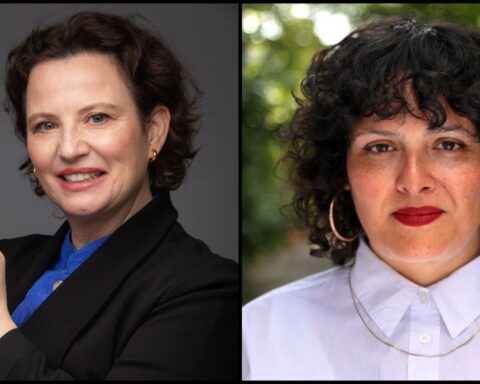
The 2026 Forum will remain memorable for its brilliant, improbable conclusion. Continuing a tradition of many years, the Forum offered a Wild Card selection to a team that put their card into a hat, which was selected at the end of the first day’s events. The selected group—in this case, the queer twin filmmakers Meaghan and Ree Wright—were given 24 hours to cut together a sizzle reel and present a project that they want to make. Usually, Wild Card winners put together something reasonably good, receive a small prize and a pat on the back. Not this year.
The Forever Chorus, the Wright women’s pitch about a non-traditional singing ensemble in Nova Scotia, was given with such honest enthusiasm that the entire audience of film veterans nearly erupted. Meaghan Wright was able to wrestle together material into a propulsive edit in less than a day and Ree’s commentary to the Forum crowd was suitably emotional yet informative. The result was astonishing—and completely appropriate.
Not only did they win the Chicken & Egg Films Special Pitch Forum prize of $5000, but the Wright sisters (and producer Melanie Wood) also garnered $8000 in the first look Pitch Prizes for a total of $13,000—a great start for a film that is still being shot. [Get the full list of Forum winners here.]
Another multiple prize winner was ExCoded (Director: Javier Lovera | Producers: Hannah Donegan & Marc Serpa Francoeur; Ina Fichman (Executive Producer) | Production companies: Airplane Mode Productions Inc. (Canada), Better Together Films Inc. (Canada). The film will deal with AI’s use of facial recognition—a new, sophisticated way of racial profiling. If someone is “ExCoded,” their lives will change for the worse as police, immigration authorities and government officials will assume they’re guilty unless proven innocent. ExCoded won the top prize from first look—$15,000—plus the CMF-HD Forum Canadian Pitch Prize worth $10,000 for a total of $25,000.
Facial recognition? A queer orchestra? What does Canada think it’s doing?
While awards are exciting and help films get funded, the Forum did host other worthy docs on Day Two. All deserve to be made—and it’s likely that most will.
Here are the other six projects pitched on Day Two of the Forum.
With Time
Director: Brit Fryer and Noah Schamus
Producers: Jesse Miller (Producer), Jess Devaney (Executive Producer), Carrie Lozano (Executive Producer), Jun Stinson Yamagishi (Supervising Producer), Jess Zeidman (Executive Producer)
Production companies: In Time Productions LLC (Producer, USA), Multitude Films (USA), ITVS (USA), Alina Pictures (USA)
Fryer, Schamus and Miller took turns presenting their project, which the audience responded to rather emotionally. With Time looks at its subject, trans non binary individuals who are reflecting back on their lives through storytelling—first in workshops and later in performances. All of the subjects are in their 50s or older, which lends a confidence and honesty to their inward gazes. The sizzle reel shows four people, one in particular—a Black performer named Egyptt—who clearly has charisma. The others are interesting, too—and this project looks like it will become a strong doc.
The response from the commissioning editors and other industry figures was quite good for this film which one person called an act of “radical kindness.” The Ford Foundation, ITVS and Chicken and Egg and the Doc Society all are backing With Time.
The Instrument
Director: Zac Manuel
Producers: Darcy McKinnon (Producer), Holly Stanton (Executive Producer), Carlos Lopez Estrada (Executive Producer)
Production companies: Gusto Moving Pictures (USA), Antigravity Academy (USA)
A jazz film with a difference, The Instrument concentrates on director Zac Manuel’s family and what AI may mean to them. Zac’s father Phillip is a distinguished jazz singer who always regretted that he never recorded his father, who was also a fine vocalist. As a filmmaker who is keen on working with technology, Zac hopes to use scattered recordings of his grandfather talking to recreate his singing style using AI. So far, it hasn’t worked but the jazz singing Phillip and filmmaker Zac have gradually become closer during the process.
Manuel and his producing partner Darcy McKinnon reflected on the power of AI to evoke the past and change the present. They also considered the role of family in Zac Manuel’s work and the impact of New Orleans on both filmmakers. To do the film properly, the two estimate that the budget should be over $800,000 (US) dollars and they’ve only raised about 140K. Funders were encouraging with Sundance urging them to re-apply and ARTE pointing out that Phillip is well liked in France, which should make the final film very interesting to French audiences.
Izhichigewin
Director: Darlene Naponse, Sage Petahtegoose; Producers: Darlene Naponse (Producer), Jennifer Weiss (Producer)
Production company: Baswewe Films Inc. (Canada)
Indigenous auteur filmmaker Darlene Naponse, most known for her award-winning drama Falls Around Her, pitched something quite different for the Forum, a seven part 30 minute TV series concentrating on food sustainability among the Anishinaabe people. Naponese is Anishinaabbe or Anishinabek, which forms a large group of nations around the Great Lakes in Canada and the U.S., and she finds the issues around the growing and making of food to be quite similar for the majority of them. She proposes to concentrate on particular areas of food sovereignty—everything from recipes to seasonal growth cycles—in each broadcast segment.
Moderator Catherine Olsen worked vigorously in support of Naponse, calling on the CBC, TVO and the NFB to support the project. Meetings were definitely going to take place after Naponse’s presentation. (To be fair, they would have likely taken place anyway.)
Mid Wif
Director: Mia Harvey; Producers: Natasha Dack Ojumu, Mia Harvey
Production companies: Tigerlily Productions (UK), Past Life Films (UK)
Midwifery is illegal for home births in Georgia, a law that is racial in origin—though impossible to prove. An inordinate number of Black women find themselves in a perilous situation while giving birth because states like Georgia won’t allow them to work with qualified midwives.
Mia Harvey’s film project looks at two midwives, Sarahn and Seksa, who are helping others to give birth—often illegally. Finally, after decades of trying to reason with the law enforcement agencies, the women have decided to take the Georgia government to court. Can they change the law against midwifery? The film will tell the tale.
The Thermocene
Director: Giorgio Ferrero; Producers: Giovanni Pompili (Lead Producer), Rodolfo Mongitore (Producer)
Production companies: Kino Produzioni s.r.l. (Italy), Mybosswas s.r.l. (Italy)
Ferrero and Pompili are critiquing climate change in a radically new way: through sound. The Italian duo climb the Alps to cleanly record the KHZs being broadcast continuously by agencies and sound providers internationally. Through an elaborate audio editing system, they are able to create a postmodernist aesthetic, turning the “noise” into something interesting, though not to everyone’s taste.
Giorgio Ferrero, a composer as well as a filmmaker, has created something excitingly new with his recordings and repurposing of random sounds. And he’s made the point: the world is far noisier than it used to be.
But can his observations be made into a film? And, if so, how will it change the world?
Widows of Living Husbands
Director: Diego Kelmann, Jussara Costa do Macuco (co-director)
Producers: Diego Kelmann (Lead Producer), Clelia Bessa (Lead Producer), Renata Lobo (Executive Producer), Jussara Costa do Macuco (Associate Producer)
Production companies: UZ Produções, Eventos & Criação Ltda, UZ Z CORP (USA), Raccord Produções Artísticas e Cinematográficas Ltda (Brazil), Aquilombei Produções (Brazil)
This is an elaborate, deeply humanist, take on slavery in rural Brazil. Though slavery was finally abolished in Brazil in 1888—the last country in the Americas to do so—an economic version of it exists today. Men—the titular “living husbands”—spend 11 months of the year working under harsh conditions, harvesting coffee or sugar cane. The impoverished lives of the men and women living in rural Brazil—in places like the Jequitinhonha Valley—is hardly better than slavery.
The film project by Diego Kelmann and Jussara Costa do Macuco is an attempt to make a film cooperatively with everyone being treated with respect. Will that happen? And will the final result—the film-match the integrity of this proposal?
This film received much approval at the Forum. Will the final film make a difference? Let’s hope so.
Meet the Funders
By Tom White
With funding a perpetual challenge in the documentary ecosystem–especially in the United States, where open season persists on all things democratic–Hot Docs convened an international panel of supporters to discuss their respective processes and priorities.
Moderated by Canadian filmmaker Vicki Lean, the panel included Nikki Heyman, film officer at the U.S. office of the U.K.-based Doc Society; Jane Mote, consultant editor with The Whickers, also based in the U.K.; Susan Mbogo, programs and partnerships director with the Kenya-based Docubox; and Elaisha Stokes, senior program manager at the U.S.-based Chicken & Egg Films.
In the lead-off lightning round of who funds what, The Whickers’ sole focus is first-time directors, from anywhere is the world, “but it has to be a story that that director has such a proximity to, or point of view of or access to them telling it,” as Mote explained.
Chicken & Egg Films funds women and gender-expansive directors running in experience from first-time to established. The three funding programs they oversee include grants, mentorship programs and labs.
While Docubox is headquartered in Kenya, the funder supports filmmakers from East Africa, at all stages in their careers. Mbogo advises Docubox grantees to enter into international co-productions, which would help fill in the budget gap. She cited Softie and How to Build a Library as Docubox projects that secured international partners.
Doc Society, as managers of the British Film Institute’s documentary funding, supports UK-based filmmakers. But the Society also manages its Climate Story Fund, which is a global endeavour, supporting projects that are in the later stages of production and that include plans for an impact campaign.
The newly launched Doc Society Fund, which is also global, prioritizes, according to Heyman, “stories that can help us understand the times that we live in, that have really strong artistic directorial vision that are dismantling our understanding of what the form of documentary is.”
Getting a bit more granular, the panelists offered advice on honing your projects. On working with some first-time directors, for example, Mote pointed out that while they have great access and footage, “they don’t quite know what they’re going to do with it.” She encouraged those who don’t secure a grant to seek out feedback from The Whickers. “Always try and see it as part of the journey,” she advised. As for the footage, “It’s that director’s touch that we’re looking for, and we can spot it really quickly.”
“You need footage, not just a trailer,” Stokes explained. “We need to be able to understand what your vision is as an artist.”
“A big part of my job,” Stokes added, “is to work one-on-one with filmmakers, to think not just what their career goals are, but what their life goals are, and how they understand what breakthrough and sustainability might look like for them personally.”
For the grant application process, “The ideas have to come from you,” Stokes maintained. “What gives you unique access? Why are you the person to tell that? How are you working with your participants? How do you see the unfolding of that film in the real world, and are you thinking about how it might impact your participants?”
Tantamount to your story and your relationship to it is your budget. To that end, The Whickers publishes an annual Cost of Docs survey. “The idea is to show what the true cost of a documentary is,” Mote stated. “What we’re finding far too often, because it makes the whole industry unsustainable, is that people do not fully cost their own time.”
“I don’t want to see a budget north of a million,” Stokes declared, citing the Trump regime’s attacks on public institutions. What’s more, she added, “a lot of the U.S. stock market is based on equity from high net-worth individuals, and they don’t want to part with their money as easily in uncertain times. I would really caution filmmakers from taking on a lot of equity right now. That can get you in a tricky situation when you try and fundraise.”