


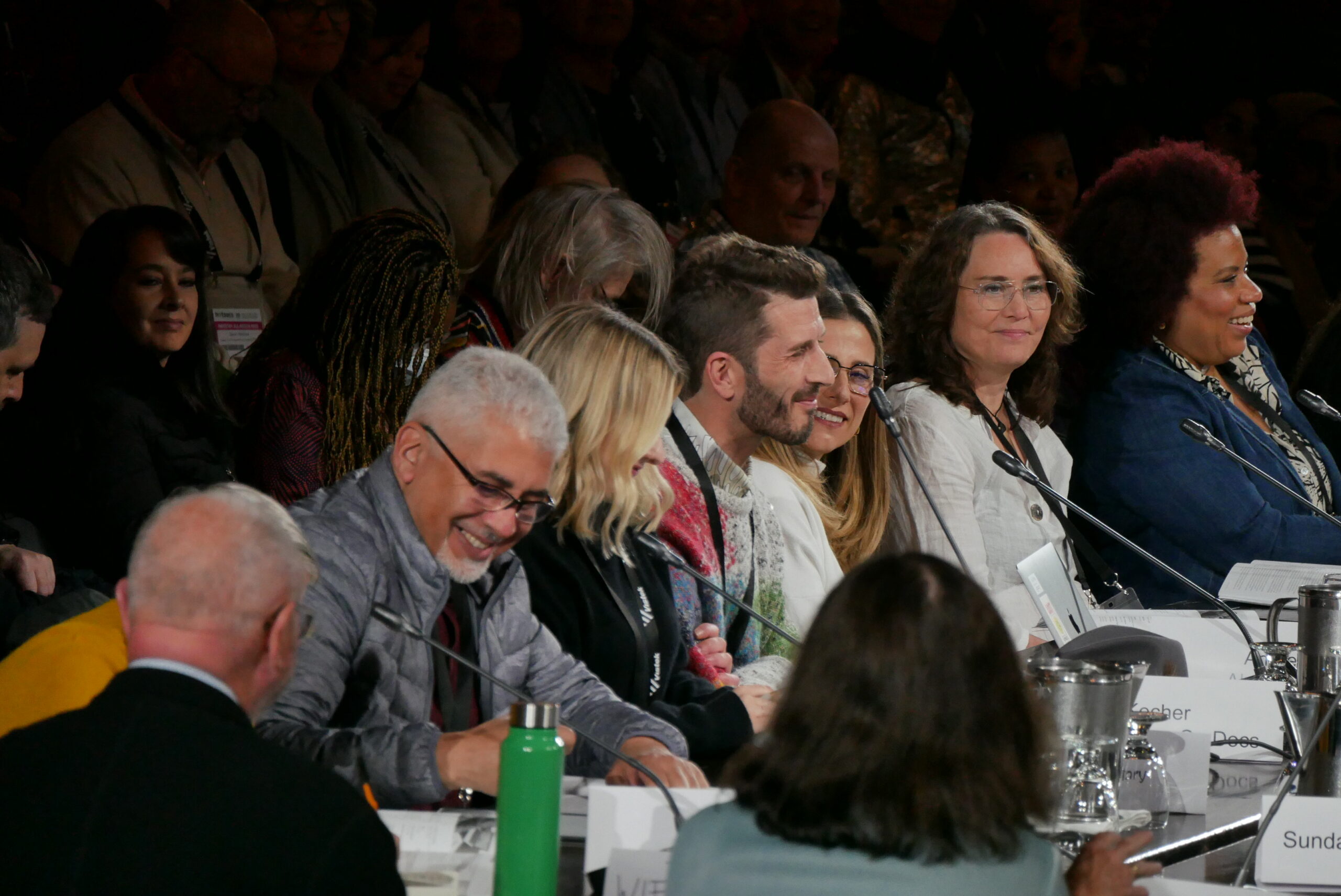

Complementing its Meet the Funders session, the Hot Docs Industry Conference surveyed the international broadcast landscape, taking into consideration format and pacing, safeguarding integrity, and engaging AI in programmatic offerings.
Moderator Tanya Blake, executive producer at Cineflix Media, steered the conversation, whose participants included Opal H. Bennett, senior producer at the U.S. public media strand POV; Magali Boccaccio, head of content at TFO (Télévision française de l’Ontario); Jean-Baptiste Dumont, head of documentary co-productions at Belgium’s RTBF; and Tomoko Okutso, commissioning editor of Japan’s NHK.
The road from festival premiere to television broadcast is a tricky one, and if you’re lucky enough to catch the attention of programmers and commissioning editors who troll these festivals for content, that’s a great beginning. But given the strictures of time slots and formats, the transition from the theatrical exhibition to home viewing poses a challenge in retrofitting your story while retaining its essence.
Okutso oversees a 60-minute slot for docs made outside of Japan, but for a Japanese audience. As she tells filmmakers, “Try to get the audience engaged with your character at the early point of your film. Don’t leave lots of question marks at the beginning. It’s also very important that the film have some relevance to our present situation; focus on that and put it into a fast-paced, condensed version.”
Landing a slot on POV entails more than fitting into the allotted time. Given the issue-driven nature of the work they present, the POV staff works with each filmmaking team to develop a comprehensive impact strategy as a deeper means of connecting with the TV audience. “We ensure that we are injecting care and a really comprehensive approach to our packaging from the outset,” Bennett shared.
As a nonlinear, digital-first platform, TFO’s Magali Boccaccio points out the service has a lot more leeway in its programming–for series as well as features. And filmmakers enjoy relative freedom to shape their pacing and structure. While TFO still maintains a linear platform, that opens the opportunity to buy more shorts to fill in the gaps.
From his perspective at RTBF, which commissions and acquires 60 docs a year, Jean-Baptiste Dumont expressed surprise when he senses “some kind of disdain for the TV version.” He contended that the European audience for docs on TV is much larger than for docs in festivals.
Shifting to the integrity of the story itself–particularly as American journalists face ongoing attacks– Blake asked the panel, “How do we protect ourselves as well in our stories?”
Although PBS has distributed POV since the series debuted in 1988, Bennett emphasized the series is a production of the nonprofit American Documentary. While public media has taken a pounding with the defunding and shuttering of the Corporation for Public Broadcasting, POV has continued its partnership with PBS, while seeking out alternative options. They will be launching an American Documentary YouTube channel later in 2026–first with shorts, and then in 2027, features will be added.
In addition, POV’s executive director, Erika Dilday, and founder, Marc Weiss, are developing an initiative called Doc Public, which is, as Bennett describes, “aiming to help build out supplementary packages for public media discourse…Our mission has been to give voice and platform to stories that you’re not going to see elsewhere–filmmakers who are telling stories that are platforming identities and experiences that are just not seen when market forces are dictating curation.”
Dumont acknowledged his platform’s responsibility to “bring hope and new insights…we’re being asked to be more solution-oriented in our documentaries,” while Boccaccio’s focus is more evergreen topics and less news-heavy programming. Given that Okutso’s slot showcases a non-Japanese perspective, she isn’t under as much pressure about politically sensitive issues as her colleagues elsewhere at NHK. That said, she is tuned to the cross-cultural resonance of what she programs, and she does add contextual information to make the films more accessible to Japanese audiences.
Over the past five years, AI has staked its claim as a transformative force in innovation and efficiency–and as a cautionary harbinger of fakery and fraud. How has the broadcast space responded and adapted?
Dumont and his team at RTBF put out a call to filmmakers to pitch projects driven by AI-generated content. But the catch: the project had to take place in 19th-century Belgium, before moving images were even a notion, let alone a reality. The experiment raised a lot of ethical questions; one project team created a fake archive, while another created film-like images out of still photos.
Bennett said that the POV team has drawn from the Archival Producers Alliance guide to Best Practices for Use of Generative AI in Documentaries and its companion, GenAI Best Practices Toolkit, in crafting their call for entries, statement of eligibility, and submission parameters. “[AI] is not something we should be afraid of,” Bennett maintained. “It’s never a good thing when you have a technology that becomes this ubiquitous to just stick your head in the sand. We need to keep creating safe playgrounds within which to experiment and learn, particularly in the nonfiction space.”
Boccaccio and her TFO team produced an AI-generated series for young viewers on trailblazing women in Canadian history. Given the lack of visual material of these women, AI was a viable option. But she asserted, “The subject matter and the intent of the show need to drive the use of this technique, and not the other way around.”
One audience member circled back to the question of festival films and broadcast films and if festivals like Hot Docs can help bridge the gap. One Hot Docs programmer in the audience responded, “Festivals are curating towards local audiences, but also towards industry audiences, to help support new voices and established voices. It’s a different thing than trying to curate towards a much broader audience for broadcast.”
Okutso pointed out that international distribution companies and sales agents are effective in advising filmmakers how to make a TV cut from a feature-length film. “I appreciate that a lot of distributors do that work for us, because they know exactly what the broadcasters are requiring, and they know exactly what works for a festival.”