



It may seem like a simple story, but no story is ever simple. Stories are like mazes. They lead us where we least expect.
—Mike Tunalaaq Gibbons, Nuisance Bear
Mike Tunalaaq Gibbsons the Inuk elder who narrates Nuisance Bear (2026), the feature debut of directors Gabriela Osio Vanden and Jack Weisman, could have said those words above about any of a number of compelling films to come out in recent years that shine a fresh light on the Arctic, showcasing the intersections of culture, community, climate change and socio- and geopolitics in the northernmost region of Earth.
The Arctic should be understood throughout the world as a region whose Indigenous inhabitants are generally bound less by politics than by culture and geography. It encompasses the Inuit, living in Canada, Greenland, and parts of Alaska; the Yupik and Iñupiat in northern Alaska; and the Sámi people of the European Arctic (Norway, Sweden, Finland and Russia). The stories that emerge from these neighbouring but disparate groups are equally wide-ranging.
Myriad issues of political and cultural self-determination, climate change, resource extraction, cultural and historical loss and preservation and socio-economic injustice all coalesce and collide in the films from and about the northernmost communities on the globe. Often, these films reveal unexpected aspects of life or counteract established stereotypes by reclaiming narratives in their own unique voices.
One famous example is 2016’s Angry Inuk, directed by Alethea Arnaquq-Baril, which follows young Inuit as they tackle the stigma around seal hunting as understood by Western animal rights activists by using smart social media strategies, highlighting their cultural heritage and rights as Indigenous people whose ancestry goes back thousands of years. A rousing film, it harnesses emotion and rhetoric as part of a strategy to make liberal Canadians understand that the seal hunt is an ancient tradition and one that still has a profound economic impact on contemporary Inuit.
Angry Inuk, Alethea Arnaquq-Baril, provided by the National Film Board of Canada
Back in 2020, The Last Ice, directed by Scott Ressler, documented the gradual loss of traditional seal hunting knowledge as veteran practitioners began to pass on without the opportunity to train younger members of the community. Ressler’s film movingly shows—in a way even more relevant today—the attempts by the Inuit to protect the rapidly melting sea ice bridge between Canada and Greenland due to the environmental devastation of climate change. But it also grimly highlights the looming industrial gold rush represented by the loss.
The melting of the Arctic ice is opening geopolitical fissures within the “Arctic Five” nations (Canada, Denmark, Norway, Russia and the U.S.) around potential new shipping routes, and, even more importantly, access to the world’s last remaining untapped oil and gas reserves. Essentially, the environmental disaster of the melting Arctic is already opening the potential for even more catastrophic events, as the race to control these resources could lead to international conflicts as well as ecological damage from global warming.
But displacement via extractive development has been the story of colonization from the start, and the story of capitalism alongside it. For the Indigenous peoples who live in the northernmost parts of the globe, what is unfolding now is a painfully familiar story.
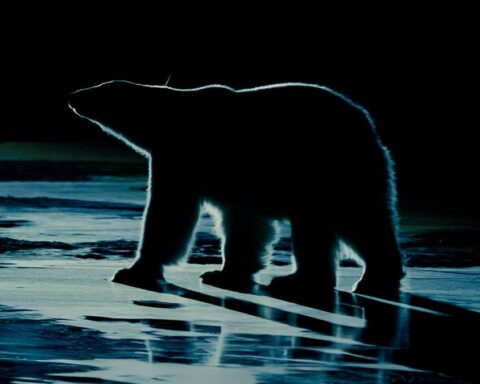
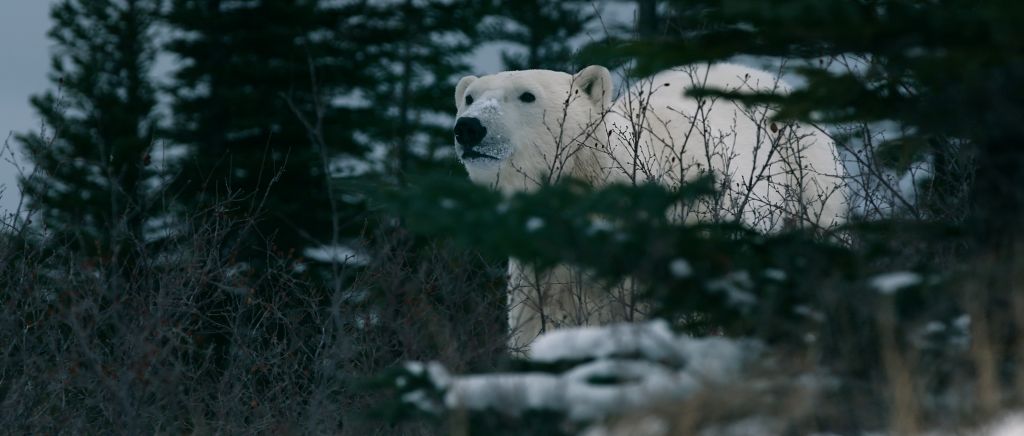
Nuisance Bear, which has been collecting a steady stream of accolades since its Sundance premiere, is, on the surface, about how historical colonial violence is mirrored in the displacement of polar bears in Churchill, Manitoba, due to environmental and geopolitical disruptions. Every year these massive creatures venture deeper into human settlements in search of food, as the warming temperatures prevent the ice from solidifying in time for them to follow their standard hunting patterns preying on other sea creatures.
As a consequence, these landlocked bears become seen as a nuisance—indeed a menace—for the very real, and sometimes fatal, danger they pose to human communities in the vicinity of their usual habitats, leading to the introduction of hunting and culling practices to mitigate the risks.
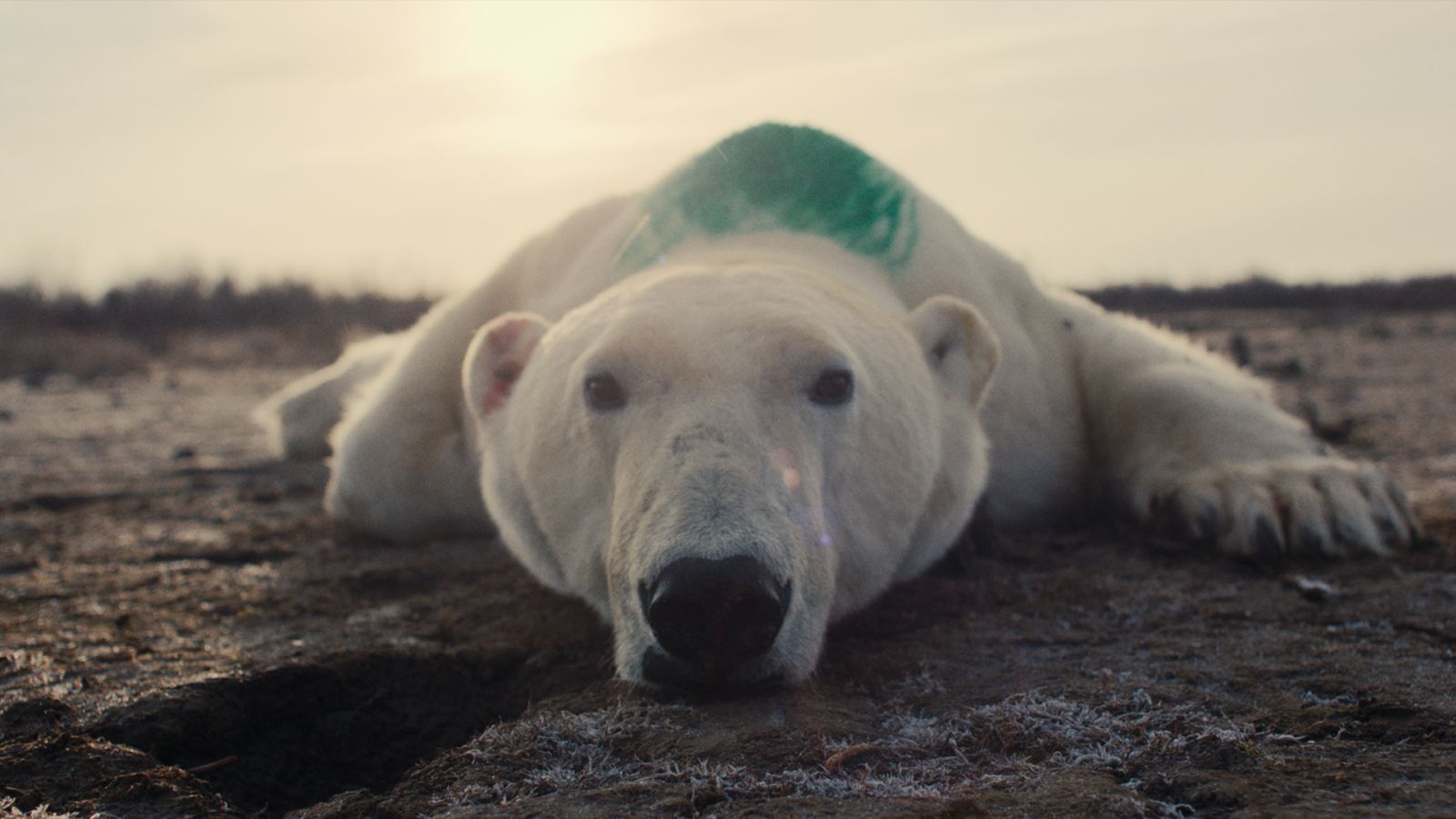
But the bears in question, including the film’s “protagonist,” a young male tagged at one point with green paint and a satellite tracker in his ear, are almost a metaphor. Their plight represents all who have been displaced from their way of life by the extractive, capitalist policies embedded in the nations of the Global North.
The film is buoyed by Gibbons’ lyrical narration, whose storytelling weaves from the historical relationship of mutual arms-length respect that the Inuit had with polar bears in the pre-colonization era, to the often-fatal consequences of what is happening now, as the bears become desensitized to human settlements. Along the way, he weaves in parallels to how the impact of colonization displaced the Inuit themselves from their land, culture, and even language, in much the same way the bears have been disrupted across multiple factors of their own existence by human-driven climate change.
The undeniable truth of climate change is that this has never been a sustainable way to exist on this planet. Currently we are living through the consequences of rapidly escalating climate disasters around the globe. Conflicts are already being fought—whether overtly or secretly—over finite resources like oil, gas and, increasingly, water.
Climate change remains the biggest common factor for Arctic residents, but Indigenous leaders are also aware of the lust that two of the Arctic Five—the U.S. and Russia—have for the resources they possess.
When U.S. President Donald Trump talked about buying Greenland in the first year of his second term in office—and after months of “jokes” about making Canada the fifty-first state turned into a very real tariff war—the response from Greenland was swift and decisive: We are not for sale. Trump’s response? “If we don’t do it the easy way, we’re going to do it the hard way.”
Since then, the U.S. has aggressively escalated its resource ambitions, from taking over Venezuela (ostensibly for democratic reasons to remove a dictator, but more practically for access to the nation’s oil), to the current U.S.-Israel war against Iran, which controls one of the world’s most important oil and gas shipping routes in the Strait of Hormuz.
Even China has entered the ring, becoming an Arctic Council observer in 2013, then designating itself a “near-Arctic state” in 2018 with its Polar Silk Road initiative, followed by investments into Russian Arctic projects.
With these global disruptions playing out in real time, it becomes clear that the films emerging from the North are not simply concerned with climate change and decolonization, but also underscore the rapid emergence of a new global imperialism in the North, the race to control the Arctic and its natural resources, and the future of what is at stake in the region, as well as who gets to control that future.
While these unsettling times paint a worrying picture about the imminent future for those living at the epicentre of the new global battle for the future’s energy resources, these films are also a reminder that fighting for survival is not new to the region.

In Walls – Akinni Inuk, Indigenous displacement takes a very different turn, as filmmakers Nina Paninnguaq Skydsbjerg and Sofie Rørdam explore Greenland’s complicated relationship between Indigenous people and the Danish state through an intimate story that takes place mostly within a Greenlandic prison. While the former colony of Greenland has a semi-autonomous status as a territory of the Kingdom of Denmark, with local governments and self-rule for the most part, the criminal justice system continues to be controlled and administered by the Danish government.
The film follows Ruth, an inmate being held in indefinite custody at a correctional facility in Greenland and explores the realities of having the criminal justice system continue to be controlled and administered by the Danish government. In this case, the practice of indefinite custodial sentencing is put under the spotlight, a jarring feature to a justice system otherwise touted as more humane than other custodial approaches.
The film begins with a statement about how the criminal justice system prides itself on the rehabilitation and reintegration of inmates back into society as fast as possible, and as such prisons are partially open. We see this early in the film, with inmates living in rooms with unlocked doors and access to cell phones, common areas, television and outdoor activities, as well as relaxed visitation policies.
But we also begin to see how the lingering impacts of paternalistic colonial-era policies towards Indigenous Greenlanders, now codified into laws, continue to reverberate and shape lives, and liberty, in the present.
For instance, Ruth’s initial conviction and five-year prison sentence was for killing her abuser, after suffering sexual abuse since childhood. But the action that led to Ruth being placed in a decade-long indefinite custody, as of filming, was an assault and battery charge after her release on the prior conviction, on a person she believed killed her mother.
Walls is a poignant, bittersweet film that on one level, neatly captures the major limitations of carceral justice for victims of sexual trauma, and reveals how early trauma without support can beget lifelong tragedy, the unforeseen consequences of the (bad) luck of the draw. But on another level, it also subtly condemns how the paternalistic criminal justice relationship between Denmark and Greenland can leave people like Ruth stuck in permanent limbo, lost in the gap between two systems, two cultures, and two ways of being.
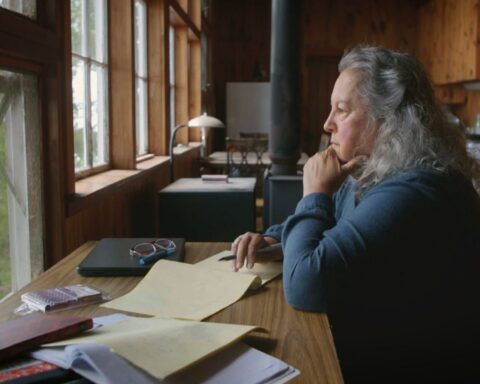
Indigenous self-determination on a larger scale is the focus of the film Nechako: It Will Be a Big River Again (2025). Indigenous scholar and filmmaker Lyana Patrick documents the latest salvo in a decades-long fight by the Stellat’en and Saik’uz Nations to reclaim control of the Nechako River in British Columbia, which was dammed and redirected for use in iron ore smelting, but is now the subject of a major legal challenge to restore it to its original flow. A story combining environmental urgency with the tangible impacts of colonization affecting present day communities, it beautifully showcases another element of the interconnected experiences of what it means to belong to the Arctic North.
Nechako: It Will Be A Big River Again, Lyana Patrick, provided by the National Film Board of Canada
Meanwhile, Sara Dosa’s latest film Time and Water adds another thoughtful facet to the conversation around the Arctic. A visually poetic ode to the grief of coming to terms with an irrevocably changing world, it features Icelandic writer Andri Snær Magnason, using the narrative framework of a time capsule to contemplate the inconceivable loss of the world’s glaciers due to climate change.
The film swings between intimate, personal, human stories and the all-encompassing, epochal scale of climate change. It gives a breathtaking perspective on the sheer scope of history contained in the Arctic ice, and a sobering, sublime look at what the endless future might possibly hold.
Because even within the framework of loss, the concept of a time capsule is itself an indicator of hope for a future where it will be found.
“We will never meet because we live in different times. I cannot send you a glacier, but at least I can send you this,” Magnason says in voiceover.
Many other important films on the Arctic have appeared this winter at the Available Light Film Festival in Whitehorse, Yukon. The largest film festival north of 60°, it celebrates Northern Canadian and international films, and champions films by, for and about the people of the North.
For example, Wədzįh Nəne’ (Caribou Country), a film by Luke Gleeson, uses starkly beautiful cinematography and multiple narrative perspectives to discuss the dwindling caribou populations in northern BC. The film positions the culprit as being a perfect storm of excessive logging, conservation policy failures, and decades of human encroachment on the caribou’s forest habitats, combined with increasing predation by overpopulated wolves and bears. But it presents no easy answers for an undeniably complex problem.
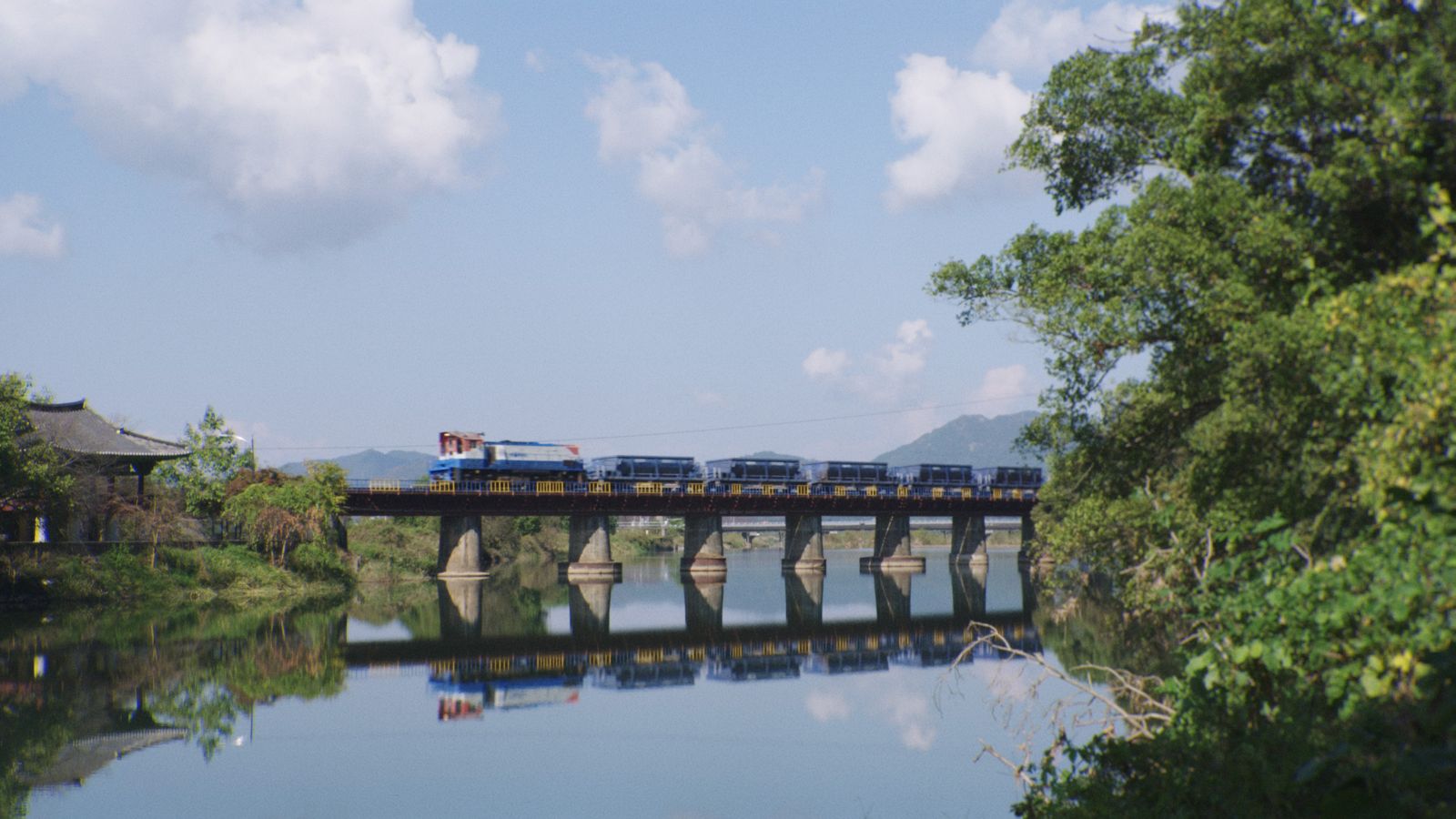
The contemplative and visually kaleidoscopic Tuktuit: Caribou, directed by Lindsay Aksarniq McIntyre, takes an experimental approach towards decolonization and conservation. The film is shot on handmade film emulsion made of gelatin sourced from processed caribou hides and uses lichen as a developing compound. It features stunning visuals and poetic subtitles that comment on the mutually sustaining relationship between the Inuit, the caribou and the land (including the lichen that migratory caribou feed on). It presents the displacement of caribou herds in Nunavut due to climate change, habitat disruptions and forest fires, while also drawing attention to the inherent brilliance of traditional Indigenous scientific practices, by reworking and indigenizing the very medium used to create the film itself.
Back to the Sun by Marty O’Brien tackles the twin concerns of climate change and the fossil fuel energy crisis. A small, remote Yukon community on the border of Alaska, led by members of the White River First Nation, points the way towards Indigenous energy sovereignty via renewable solar energy. Beaver Creek is a place of extremes, which requires year-round generator usage to survive the harsh climate. But years of collective effort to end dependence on fossil fuels leads to the breakthrough construction of a massive solar power facility, slashing their diesel usage by over 50%. Despite being one of the smallest and most remote northern communities in Canada, Beaver Creek becomes a proving ground for a practical, renewable energy future.
Resilience, shared history, and determination in the face of impossible odds are common threads woven through Arctic Indigenous experiences, and these films are a brief, kaleidoscopic glimpse into that reality.
If the challenges of the North are the canaries in the world’s coal mine, then through the stories told in films like these, perhaps the Indigenous resilience, spirit and undying ability to resurrect and restore forgotten histories can be the example the rest of the world looks to as our global political and environmental landscapes shift beyond recognition.
Returning to Nuisance Bear, towards the end of it, Mike Tunalaaq Gibbons says, “This is not a story of extinction. We must show them we are still standing.”
Once again, his words ring true for all the people who call the Arctic home.
Where to Watch
Angry Inuk and Nechako: It Will Be a Big River again are streaming from the NFB (see embeds above)
Back to the Sun is on the festival circuit.
Nuisance Bear has its Canadian premiere at Planet in Focus on Oct. 20 and streams at subsequent festivals and event screenings before opening in Canadian theatres Dec. 4 ahead of its MUBI release.
Time and Water and The Last Ice are on Disney+.
Tuktuit: Caribou is on Criterion Channel.
Walls – Akinni Inuk is on VOD.
Wədzįh Nəne’ (Caribou Country) is on Knowledge Network.