


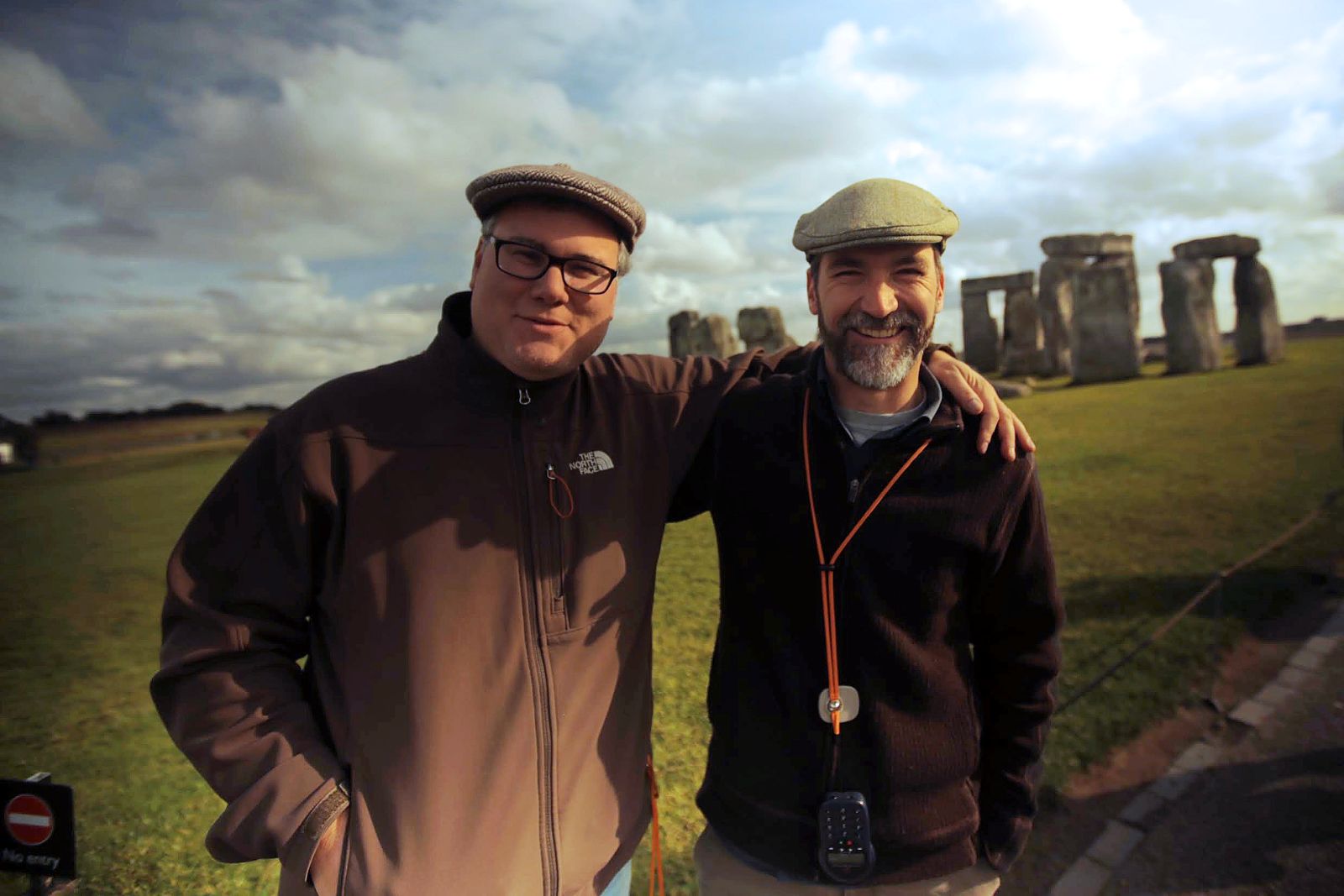

It was a typically gorgeous late August morning in Banff, Alberta—the sky a clear bright blue—when Liam Romalis and Jason Charters, the Toronto-based producers and directors of Riddle Films, met the Parisian string quartet Quatuor Magenta, for a film shoot. The ensemble had been selected to be part of an elite gathering of nine groups at the prestigious Banff International String Quartet Competition (BISQC).
Lights and microphones had already been put in place, as had a track to add movement and velocity to the scene. As Romalis chatted with the four women, Charters worked with camera operators Erik Sirke and Derreck Roemer to coordinate the coverage. The Jeanne and Peter Lougheed Building, where the shoot was taking place, has a recording studio and production spaces ensuring high professional standards. In the sound booth, Pouya Hamidi was ready to record and monitor every take. Riddle Films’ smoothly functioning team was ready to capture the magic of the music and the stylish Parisian string quartet.
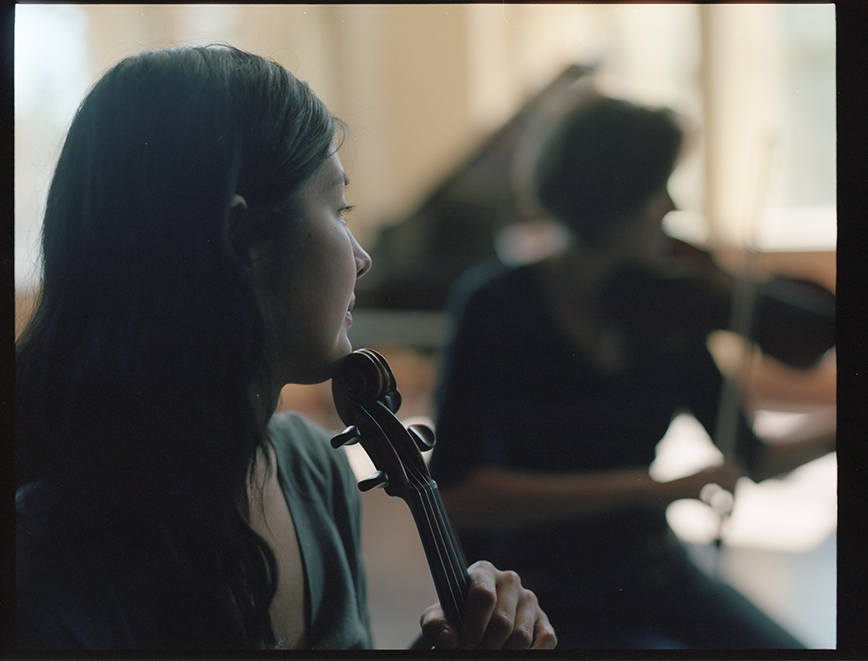
When Charters signaled for the Quatuor Magenta to play, DOP Kiarash Sadigh created a stunning dolly shot while Romalis pushed him on a track. The music of Robert Schumann wafted over the room. When it concluded, Romalis asked which member of the quartet wanted to be interviewed. The cellist Fiona Robson was happy to do so. Although she lives in Paris, Robson is Canadian and remembers fondly attending a Banff music event when she was a child; it was an inspiration to her. When the interview—polished but with intimate moments—finished Quatuor Magenta were thanked and dispatched, to be followed by another group from the Competition.
All of the string quartets were stylishly captured by Romalis and Charters, their performances intercut with interviews that offer the essence of each group. The films form part of the prizes offered by BISQC to the ensembles. Each string quartet has already received the video produced by Riddle from Banff, which they can use for promotional purposes on their website and through social media. Although Riddle Films has produced feature documentaries for Banff and may do so again, this was a commission, done with sophistication but with no expectation of anyone, apart from colleagues in the media and music world, being aware that they had made the work.
***
Riddle Films is celebrating their silver anniversary this year, and this is the first retrospective article written about them. Quintessentially Canadian, they don’t trumpet their successes. Romalis and Charters are content to be known in the broadcast, festival, faith and production communities as professionals who get their jobs done efficiently and effectively. It’s not that they don’t want acknowledgement—both know that recognition can open doors and fund projects—but they are so focused on getting their work done well that they haven’t ever evolved a masterplan. What they have done since 2001 is consistently create work in areas that interest them: classical music, performance, gospel, art and Holocaust education.
The list of Riddle’s satisfied partners is deep and speaks to the extraordinary craftsmanship that is a byword with the company. Over the past twenty-five years, Riddle has worked productively with the Banff Centre for Arts and Creativity, the Azrieli Foundation Holocaust Survivors Memorial Program, the McMichael Canadian Art Collection, the Royal Conservatory of Music, Bravo! FACT, the Necessary Angel Theatre, the Toronto Symphony Orchestra, Against the Grain Theatre and Bell Media. They have made music videos, feature-length documentaries, episodic doc series, animation, interactive work, installations for galleries, podcasts and projections for multimedia theatrical pieces. In a time when film companies are struggling to survive, Riddle’s story is one of resilience and adaptation. They have maintained high standards while creating work that has depth, art and humanity.
***
The ever-genial Romalis has a knack for telling stories and clearly enjoys origin tales. After years of working in corporate communications for IMAX and its innovative team led by the legendary Graeme Ferguson, and as a “lackey” for documentary guru Ron Mann’s Sphinx Productions (“whatever Ron wanted, I did”), Romalis was ready to make films of his own.
That didn’t rule out partners, which given his gregarious nature wasn’t difficult for him to find. Quite quickly, he found two: Richard Spence- Thomas, an audio expert who remains Riddle’s post-production sound expert, and Darren Laberee, who eventually moved to Victoria and exited the company. Before that happened, a naming had taken place. Romalis recalls, “We were looking for a name and Richard’s now wife, wrote down Richard, Darren and Liam and circled our first initials. And I said, ‘Riddle.’”
The naming may have been done but the proper working arrangement for Riddle took place several months later when Charters made his appearance. “I was producing a Samba Squad music video directed by Joel Goldberg,” Romalis remembers. “I first met Jason at 401 Richmond Street West, where Samba Squad had a studio in the basement. Jason knew Joel’s girlfriend; she made the connection. He had a notebook and a pencil and asked great questions. After about an hour, I said to him, ‘You shouldn’t be a production assistant. You should be the PM (production manager) on this.’ And he did a fantastic job PMing it. He was organized, focused, patient, all of the skills that you need. A problem solver.
“Soon after, I had a light bulb moment: Jason would be the perfect producing partner. Even though he had no producing experience, I thought he would be ideal. I asked him and he immediately said yes. That’s when Riddle Films was truly born.”
Charters brings different skills to the table than Romalis. “I studied to be an actor and did that for 10 years,” he recalls. “Somehow, I developed an affinity for organizing. At the time that Liam and I met, I was working as an actor, but I also had begun doing gigs for the Toronto International Film Festival. I had found my way into the programming department. I was the submission coordinator, and it was a good gig. I worked at TIFF for a few years. It gave me a really good set of skills for managing a group of people.
“I think that came in handy. It’s a very transferable skill to production management. And then my theatre background helped as an AD (assistant director); on set I had a big voice. I wasn’t afraid to talk to people and give orders or let people know how the day was going to work.”
***
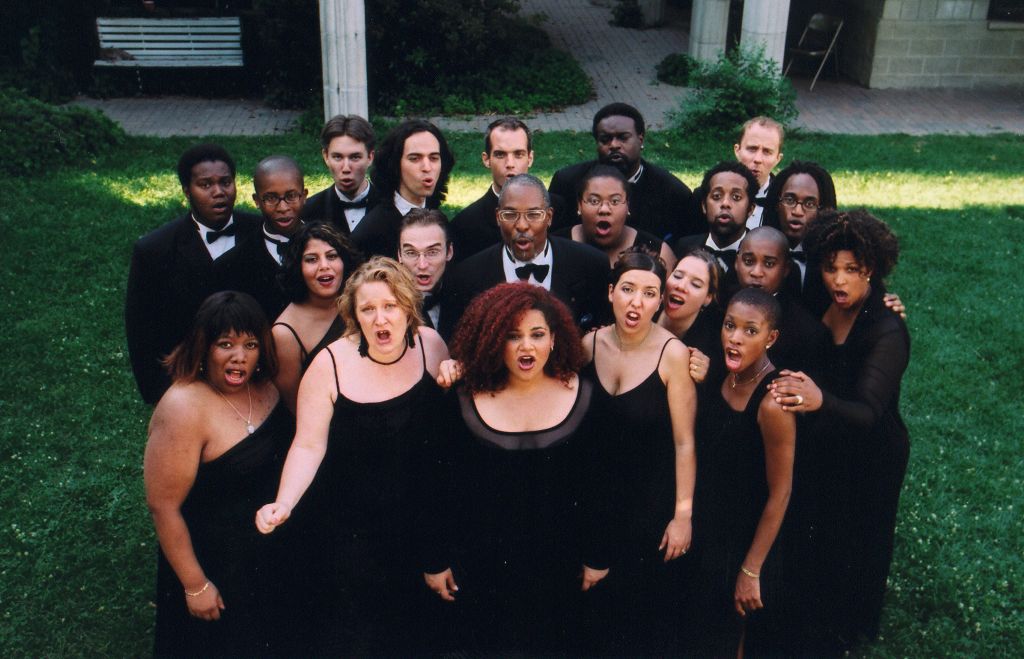
Romalis and Charters agree that the big breakthrough for Riddle Films was Carry Me Home: The Story & Music of the Nathaniel Dett Chorale (2003). Sensitively shot by Gerald Packer, who co-directed the film with Romalis, the musical sequences of the twenty-person vocal ensemble singing brilliant compositions by the acclaimed Black Canadian-American R. Nathaniel Dett retain their beauty and power.
The film came about in a style that is typical of Riddle. Romalis attended a concert by the Chorale at Roy Thomson Hall and was “blown away. I knew a member of the group and told him that I wanted to make a film. Then, I submitted a proposal to Bravo FACT. They financed it. We made two beautiful music videos at St. Anne’s Anglican Church on Gladstone Avenue in Toronto, which had murals by the Group of Seven, that tragically has since burned down.”
The story of Riddle and Romalis and Charters is full of moments like this where out of a desire to capture something artistic or historically important, they make a short film. It feels naïve and Canadian—and true to the documentary tradition of this country.
What happened next is what Charters calls “pure luck.” Romalis recounts: “Out of nowhere, I got a call from Vision TV from Joan Jenkinson, who said, ‘I saw your videos on the Nathaniel Dett Chorale. We would like to acquire them and make them our holiday Christmas campaign.’ So, I said, “You can have them on one condition. Give me the opportunity to come into Vision and pitch a longer documentary. That became Carry Me Home.”
Not only was Carry Me Home successful, but it also started a fruitful relationship with Vision TV’s executive producers Joan Jenkinson and Alberta Nokes. Charters continues, “They asked for a gospel series. That became Gospel Challenge (2006). When that went well, we did a series called Sex + Religion (2010), a 13 parter. And then we made God’s Greatest Hits (2012-13), which had 17 episodes.”
***
As a pair of Jewish producers who have a passion for art and theatre and music, Romalis and Charters were always likely to make a film about Jewish music. Dreaming of a Jewish Christmas (2017) arose in an unlikely way, however: it started with gospel music.
Charters recalls: “On God’s Greatest Hits, we were working with a wonderful guy, Dave Wall. He’s a great gospel singer and came in to work with us on it.
“We started talking about all of us being Jewish and doing this series that was largely about Christian hymns. And somewhere in there, Christmas came up. We had always thought the idea of Jewish songwriters who wrote Christmas songs was just a really interesting idea. Dave had written a song about it to go with an article for the Globe and Mail. And the song is great. So, one day on set, we said, ‘We’ve got time and a band. Let’s record and shoot the song and see whether we can turn this idea into something.’ We created animation and brought it to the Berlin Film Festival’s Avant Premiere performing arts market.”
Larry Weinstein, the auteur director of countless music documentaries, was in the audience when Riddle screened their short film. “I was so jealous. I didn’t know if the film was finished already. I went up to them, and I said, you guys, I would have loved to have been involved in that film. And Jason and Liam said, ‘Larry, it’s only a demo. On our plane trip on the way here, we thought, who would be the perfect director for this? And we actually said Larry would be a great director.’ And without even thinking, I said, ‘I’ll do it.’”
With encouragement from Romalis and Charters, Weinstein included “some weird stuff, like having Tom Wilson as a homeless guy singing Rudolph the Red Nosed Reindeer. And a psychedelic version of Silver Bells and having a Chinese line dance.” The film was nominated for the International Emmy in Arts Programming and Weinstein garnered Best Direction in a Documentary Program at the Canadian Screen Awards.
***
One of the most significant aspects in Riddle Films’s ongoing arts and education project is their relationship with the Azrieli Foundation’s Holocaust survivor memoirs program, one which operates in friendship—and often in synch—with Spielberg’s famous USC Shoah Foundation.
Charters explains: “The Foundation publishes the memoirs of Canadian Holocaust survivors and distributes them across the country free of charge to students and schools. They actively support the books by flying survivors all over the country to meet with kids in person.
They organize academic conferences.
“And they began many years ago commissioning short films to accompany each of the books. That became a really amazing relationship with Riddle making films of the memoirs. Every book has a film of five to ten minutes; many are profile documentaries in which we would interview the survivor. If possible, we’d get the survivor to read an excerpt or have an actor read one, accompanied by an animated sequence.
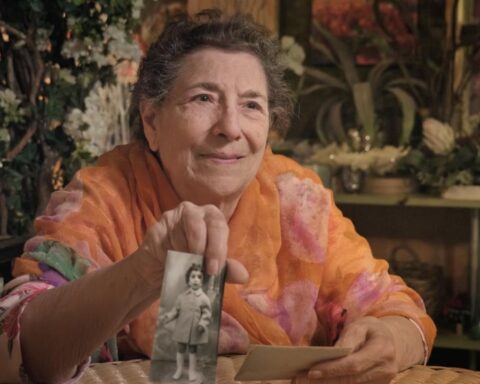
“It took years for the right book to come along. We found it with Escape: The True Story of Morris Schnitzer (2025), which follows his journey through Nazi occupied lands during the War.
View this post on Instagram
“The main task is always meant to be support material to help students understand the topic. The pandemic changed a lot of things because then the survivors couldn’t go to classrooms anymore. So, what could we do to keep their voices out there? I think it was Liam who came up with the idea of doing audiobooks. That began a partnership with Penguin Random House and the Azrieli Foundation, and now we produce audiobooks just for them.
“It’s led to our first podcast series, Liberated (2026), an eight-parter, which shows the Holocaust through first-hand accounts by survivors.”
***
Romalis is an easy-going individual, particularly for a producer, but he does have his moments of pride. “When we’re working with Barry Shiffman, the director at BISQC, he says to us, ‘I’d really like to tell the story of our incredibly loyal audience this year.’ Great, we figure it out. We know who to interview and where the crowds form before or after concerts. We’re not taking up a lot of Barry’s bandwidth. And we take ownership of how we conduct ourselves and ensure that we produce totally professional work.”
Romalis’s first encounter with Shiffman fits perfectly into Riddle’s list of getting people on board with their projects. It happened decades ago when Romalis was inspired to make a music video with the St. Lawrence Quartet after reading an eloquent article on them by Alex Ross. He phoned Shiffman, then the second violinist in the acclaimed quartet to persuade him and the group.
Romalis recalls, “Barry said to me, ‘No one makes music videos about string quartets.’
“I told him that we would do it right, with a steady cam and all of the tricks in the music video language. He loved the idea and we made a music video with them of a Tchaikovsky piece. It was a great experience.
“After that, I didn’t talk to Barry for ten years. Out of the blue, the phone rings. ‘Liam, it’s Barry Shiffman.’ As if no time had passed. He said, ‘I need you to come to Banff for the String Quartet Competition,’ which was due to start in two weeks. Barry wanted us to spend all eight days there, following all the quartets throughout the festival. He wanted the Banff experience, inside and outside the concert hall. It was a great offer but crazy for us because we were supposed to deliver the first episodes of Sex + Religion.
“The next day I had a conversation with Barry that probably lasted about fifteen minutes. When I hung up the phone, Jason asked me. ‘How did the call go?’ And I said, ‘Pack your bags; we’re going to Banff.’
“It’s been an incredible relationship with Barry over the years. It started at Banff and continues at the Royal Conservatory where he is now Dean of the Glenn Gould School. It has opened up the world of classical music to us in a way that we couldn’t have imagined. We’re at Banff for BISQC every three years. Two seventy-five-minute films have come out of that. Riddle is often at the Conservatory and Koerner Hall for other performances. It’s allowed us to do more filming of string quartets and chamber ensembles than almost any other production company in the world.
“It’s led to The Conservatory, a feature documentary in which we will follow eight music students for a year in their lives. We’re in development with TVO and Larry Weinstein will direct.”
***
Riddle’s story is one of quiet success in a tough media climate. Romalis reflects: “There has been one side of the company, which is our self-generated projects. The second side has been partnerships with organizations and institutions. I think one of the reasons why we’ve built such important relationships is because we think of them less as clients and more as partners.
“We’ve been lucky enough to have partners like the Banff Center and the Azrieli Foundation and the Royal Conservatory and to keep being able to support artists in a way that has been so important to us. After twenty-five years, I still feel that Jason and I are two kids who have been handed the keys to the candy store.”