



What’s it like to go back to your family’s roots and find the effects of war and devastation? Serene Husni’s personal history brings her to Jenin, Palestine, where one of her grandfathers, Najeeb al-Ahmad, was a landowner and activist before being forced into exile in Jordan for 25 years. A Canadian citizen and graduate of the Documentary Media program at Toronto Metropolitan University (formerly Ryerson), Husni has won awards for such shorts as Zinco (2013) and Brown Bread and Apricots (2021) before embarking on her first feature doc, Jenin and the Nakba Between Us, which recently premiered at IDFA.
In 2016 and 2023, Husni travelled to Jenin with cinematographer Mashal Kawasmi to document life in Jenin, an area that was the scene of a major battle with Israel in 2002 during the Second Intifada. Despite that, her work doesn’t deal directly with warfare. Instead, she focuses on the life of ordinary people—farmers, workers and children. Husni’s film is about life, survival, and families—not specifically about war and killings.
POV’s Marc Glassman interviewed Husni, whom he has known since she was in TMU’s Documentary Media program, leading up to the film’s premiere.
POV: Marc Glassman
SH: Serene Husni
POV: Your whole family is Palestinian and yet you don’t have a Palestinian passport. Does that anger you?
SH: Yes.
POV: Was that part of the motivation to make a film?
SH: No, because having a passport is not gonna change anything. Whether I make the film or not, it’s not going to change my status on paper. And the minute you have Palestinian ID, it doesn’t matter what other nationality or passports you may have, Canadian or German or whatever, you have to go through immigration checkpoints with the Palestinians. It does come with its own restraints on your freedom of movement but having a passport also means that you could live there indefinitely.
The passport was not the motivation. The main questions are whether you have ID, whether you’re already living on the land or whether you’re diasporic. For me, the film was putting into practice a return, however deformed or incomplete or even symbolic, and documenting it.
POV: You show us monuments in Jenin and, when you return years later, they’re destroyed. We see a statue of a horse and several roundabouts and the Arch of Return. These are very powerful symbols. When you come back after seven years, they’re all gone. What does that mean to you?
SH: The whole idea is to show landmarks for Palestinians. What do they signify? For Palestinians, they are sites that have now been erased, and they symbolize the fragility of the Palestinian home. The Arch of Return and the Jenin Horse weren’t beautiful constructions. They’re reminders of something, and their significance is not just purely gesture when you see that the army actually destroyed them. Why did the soldiers target these first before October 2023 was finished?
All of these landmarks were the first things to go. It’s interesting that they were they were the very first landmarks that were built after the 2002 Second Intifada incursion when the Jenin camp was also reduced to rubble. There’s a stubborn intimacy between the Palestinians and the Israelis, the colonized and the colonizer, because they know the value of things: the land, the landmarks, the life in the city.
POV: I was struck by that idea of the land and of agriculture as a cultural practice. My next question will seem crazy to somebody who has not seen the film: Why are watermelons more important than cucumbers to the people of Jenin? Why do they prefer picking watermelons besides the fact that it’s the famous old crop of the region?
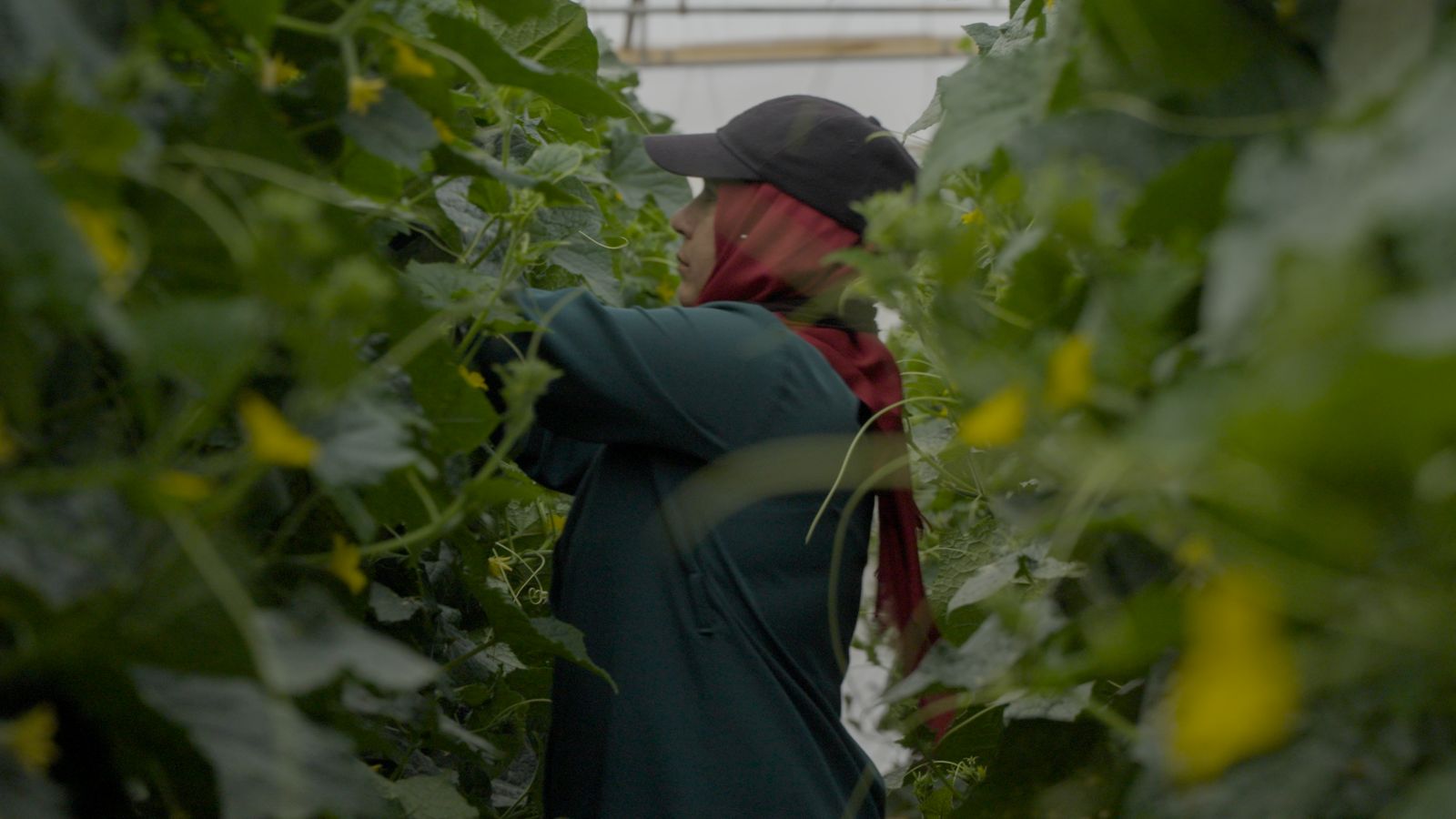
SH: Part of it is historical, of course. But part of it if is purely physical and part is economic. Cucumbers are very hard to pick. You need to bend down and pick them by hand. They require a lot of workers. Then there’s the specifications of Israeli factories. They have to be very small. So, it doesn’t matter how hard you work, they’re not gonna weigh very much whatever you pick throughout a day’s work.
Part of it is that watermelons are big, they require less labour, less working hands. There’s a higher return on investment, if you think about it. So, they’re easier to pick and you make more money from selling watermelons. That’s purely economic numbers, the dry logic of it, of why watermelons are more valuable than cucumbers. Then there’s the tradition of growing watermelons on the land. We talk to a farmer, Abu Saleh, who says Palestinians are stubborn and he wants to grow watermelons even if he loses money. That’s true for him even if he’s using Chinese seeds to grow the watermelons. Then you’re talking about what the watermelons represent. It is actually the indigenous crop from the time of my granddad, and now it’s been replaced by cucumbers, which are being used to make pickles.
The dynamics of agriculture are global. I don’t know if the Israelis grow their watermelons from American seeds. Both crops are symbols for the global power play between the superpowers. They represent indigeneity and food sovereignty. There’s another crop I don’t get into, which is tobacco, but it’s also very big in the region. And then, finally, you have the significance of my personal family who grew watermelons and exported them.
POV: It’s fascinating to discover through archival footage that your grandfather was such a major figure in the region. He was a member of the PLO (Palestine Liberation Organization), spent time in prison, and was exiled to Jordan for 25 years. Were you aware of his significance before going to Jenin in 2016?
SH: Yes and not just my grandfather. I also have an uncle who worked in the Palestinian authority. His son has continued to work in the Palestinian authority, which is completely despised by a lot of Palestinians in Jenin and in the diaspora. Many see the Oslo Accords as a capitulation and so I think my grandfather’s legacy is twofold. It represents a somewhat problematic history, which is coupled with the fact that my family were feudalist landlords, who charged farmers to use the land.
When the PLO signed the Oslo Accords, he had hoped to bring all his children—I think there were nine—with him. It was gonna be this big return but then the Israelis only allowed my aunt because he was so old and needed someone to care of him. They only let her in because she was not married and didn’t have children, so it was a lot less people. I keep an arm’s length approach to him. For many, the Oslo Accords were a fatal mistake for Palestinians; it’s very contentious. I try not to comment on the family history, but I can’t help but think that a lot of people respected my grandfather. So many people showed up to greet him when he returned so he must have had some popular support.
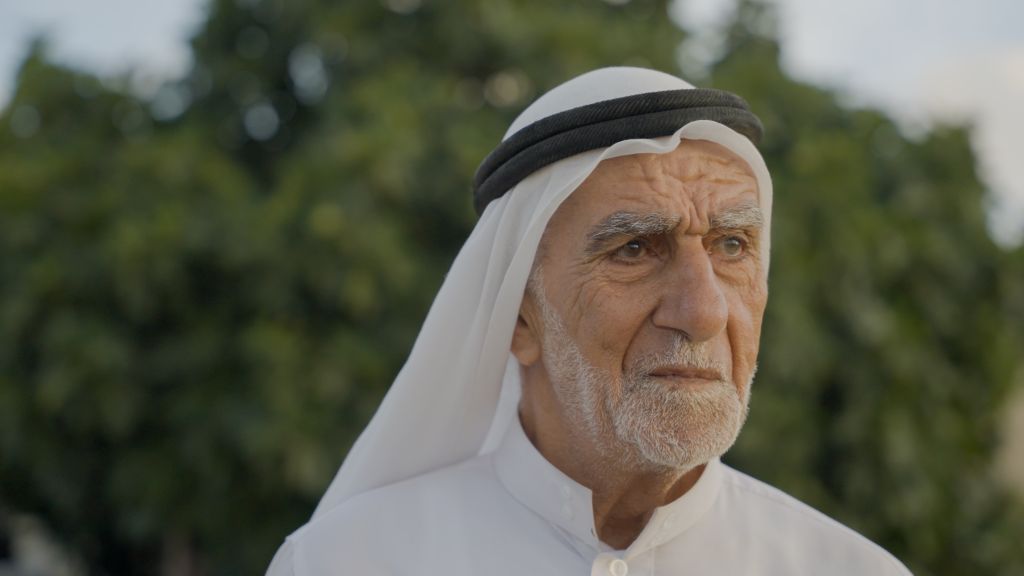
POV: I was very impressed with the historic footage. Lots of local people showed up, honking horns and calling him “sheik.” He seems like a beloved figure.
SH: Definitely, especially considering it was towards the end of his life. It’s almost as if he stayed alive so he could be buried at home. His tombstone is there. It’s humbling, for sure.
POV: Can you talk about your approach to the film? It seems like you’ve decided to show us a slice of life in your ancestral area of Palestine. There isn’t one set of characters in the film, apart from your family. It looks like you deliberately went out of your way to find a diverse group of people and to get a variety of different stories. Can you talk about that choice?
SH: I think my work process is very chaotic. I rely heavily on chance encounters and what everyday people say to me. I’m not looking for experts to explain the geopolitical situation in Palestine. I’m looking at how the systems of oppression translate into the banal and the everyday. What’s it’s like having to wake up at four in the morning so you can get to work on time, or what it’s like to have a bus station where everything goes south because of borders that are artificially erected?
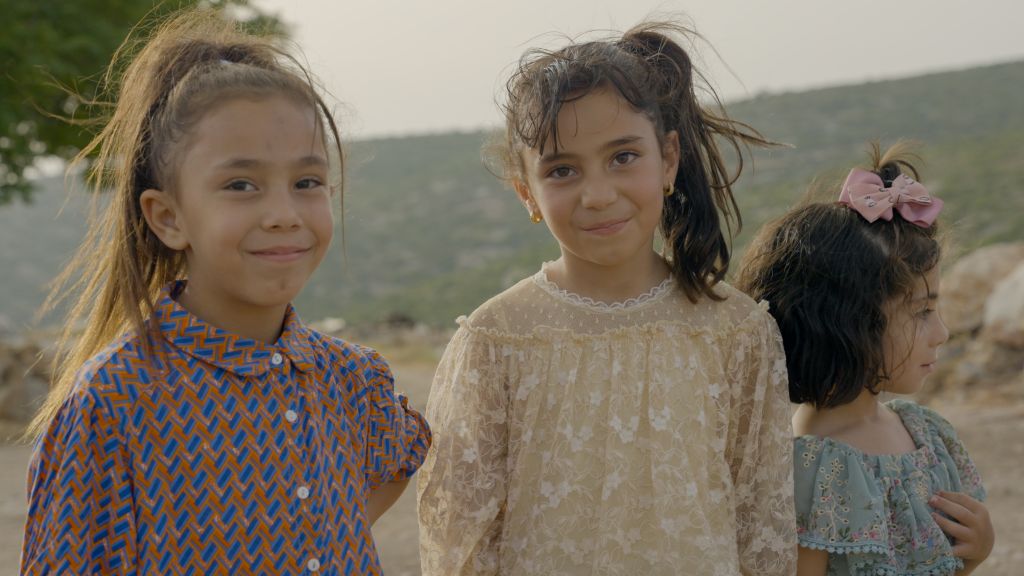
POV: There are many scenes with little boys and little girls. You have kids riding bicycles and girls posing for the cameras and getting their pictures taken. Why?
SH: There’s an issue around the whole idea of photographing the Palestinians and under which circumstances. Is there a point in showing people nearly drowning in sewage in Gaza? Does it help? Why take their dignity away from them?
We have a scene in a checkpoint where many Palestinians were on their way to work. We were very conflicted. Did we have a right to photograph these people? You can’t get consent from hundreds of people trying to cross a checkpoint. Do you get a release from one person to represent them all? Is that constructive?
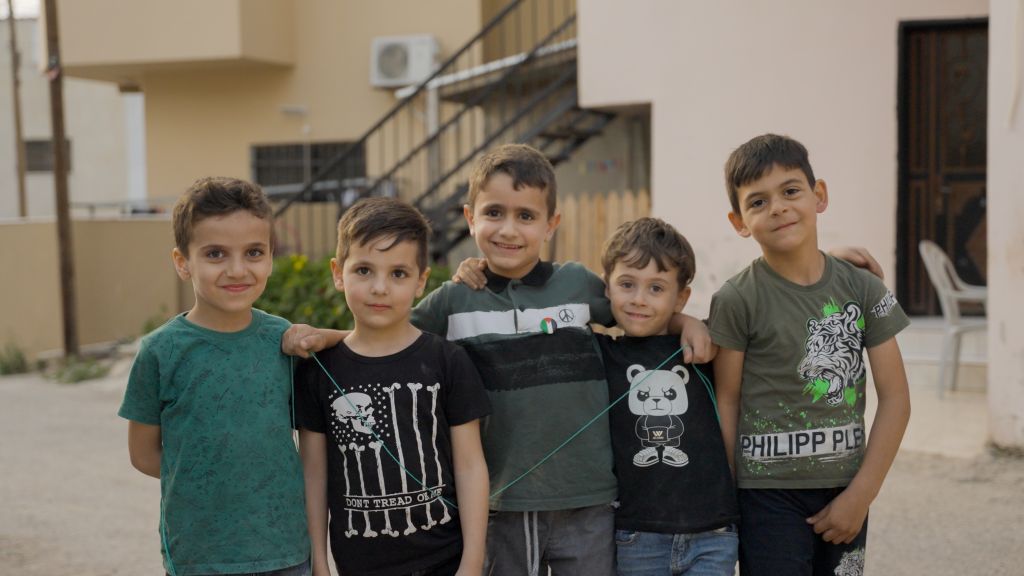
It’s similar with the children, though. They want to be photographed. But is it okay to do it? You see them wanting to be in the frame, wanting to perform for the camera. And so, it is a struggle. Do we have that right or not?
At the end of the day, you can’t take away the agency of people who want to be documented and tell their story. My grandfather kept an archive, which he wanted to be used. The kids have their bits to say though their presence. It does raise questions on the problematics of the image. It’s nice to see the joy in the children but even they are aware of very dark themes. They talk about death. There’s a scene where a boy raps about four of his friends who have ascended to heaven, and he names them as he’s performing.
POV: The film is made up of two shoots, one in 2016 and the other in 2023 and archival footage of your grandfather. What crews worked with you?
SH: For both, I worked with Mashal Kawasmi as my cinematographer. It’s fascinating that he was able to work with us the two times. There were only three of us the first time but for the second shoot, there were four including a professional sound person who also picked up a camera sometimes and a fixer, or researcher, who accompanied us as we traveled across the land.
POV: How did the fixer help? You can speak the language.
SH: I don’t completely get the particularities of life in Palestine. I’ll give you an example. I didn’t understand the implications of getting near the wall that runs throughout the land. It looks like an eight metre cement block, but it’s actually bigger than that. You’re not allowed to go near it because then you’re posing a threat, right? You’re a threatening presence, so it becomes the physical wall plus the psychological wall that’s even bigger. My father’s reading of it was that the Israelis had to build an “Iron Wall” between them and the Palestinians, so the psychology became “Don’t come near the wall.” What I’m saying on a practical level is that I’m not used to being on the ground in the same way that a Palestinian living under military occupation would. I didn’t grow up near the wall.
POV: In the film, you never deal with the Israelis, you never deal with the army, you never show violence. We never even see a soldier. Why?
SH: It’s not what I was looking for. I was not looking for the confrontation. I wanted you to see a purely Palestinian map. Even if you see the effects of the settler colonization, I wanted to tell a Palestinian story.
POV: Can you talk about the ways you describe the oppressors who we never see?
SH: I made a deliberate choice to never say Israel in my own narration not because I think Israel doesn’t exist. Obviously it exists, but I was building a Palestinian language. I wanted to problematize the narrative by unlearning things. What is occupied Palestine? Is the West Bank really a thing? Is Gaza Strip a thing? What are the borders of Jenin? I want to learn and unlearn these terminologies.
Jenin and the Nakba Between Us premiered at IDFA 2026.
Please check your local listings for additional festivals, event screenings, and broadcast dates.