



“Sometimes the movie is the fuel in the tank,” says The Eyes of Ghana director Ben Proudfoot. “Those 24-frames-per-second make people look at it in a different way and say, ‘Oh, it really did happen. I’m seeing it with my own eyes.”
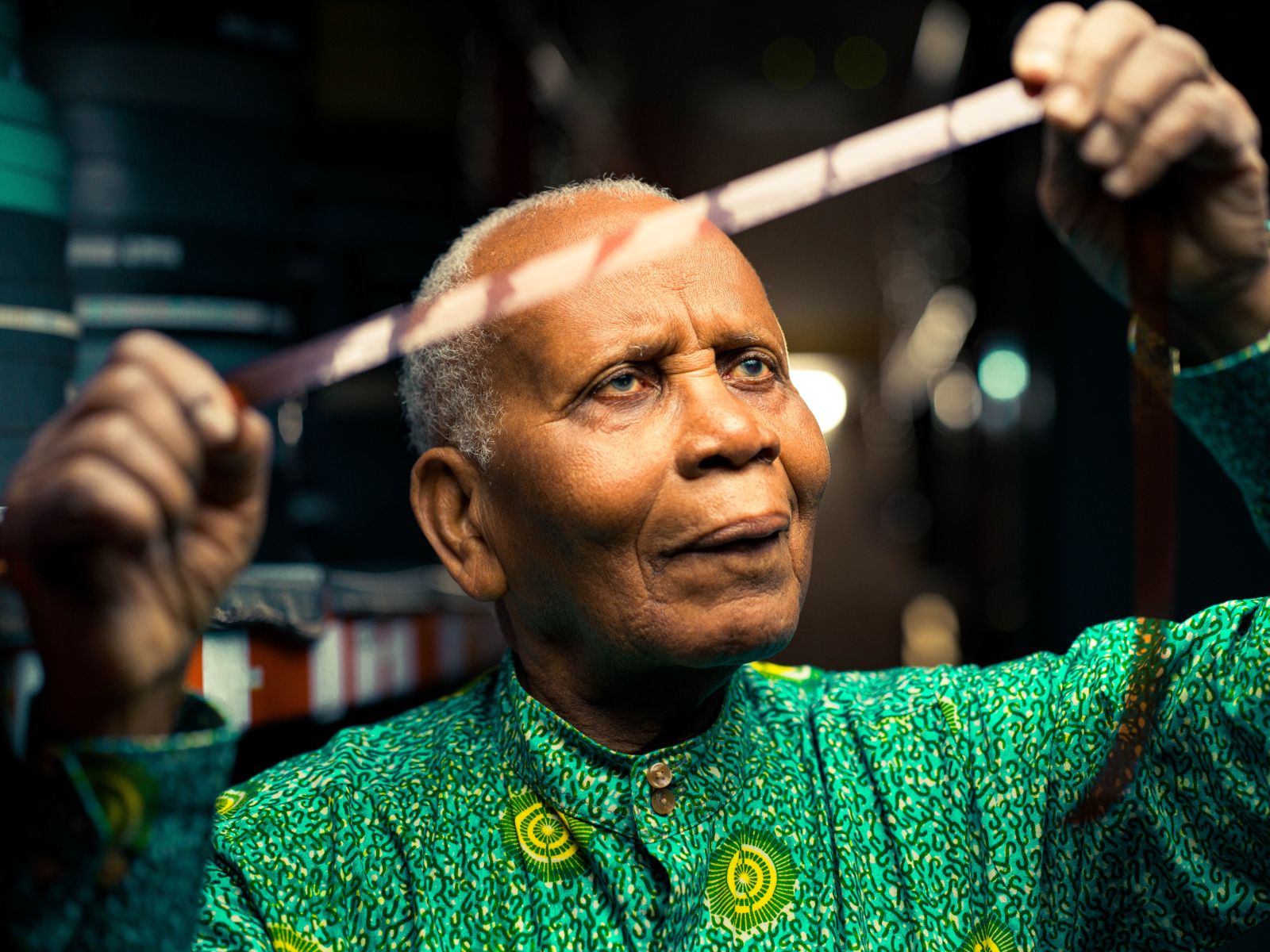
Seeing is believing in The Eyes of Ghana, Proudfoot’s portrait of cinematographer, filmmaker, and cultural historian Chris Hesse. The documentary gives the 94-year-old filmmaker long overdue praise as a chronicler of a formative chapter of African history. Hesse, a wily figure with a twinkle in his eye, shares the story of how he became the official documentarian for Kwame Nkrumah, a revolutionary political figure who led Ghana through its return to independence following a long period of British rule, and was elected the nation’s first president. Hesse tells how he was witness to history in the making and captured every second of it.
Hesse tells a story amiably and persuasively enough for one to believe them, but as The Eyes of Ghana presents clips from newly restored films from this great body of work, the impact of images hits on another level. It’s a story about what it means to use a camera responsibly and keep them rolling with an objective lens, even when life takes turns from which we’d rather look away. Hesse says it’s up to audiences to decide what stories his films tell.
The Eyes of Ghana refreshingly lets people around the world see this chapter of history as the film debuts on the I Show Speed YouTube channel following an acclaimed run on the festival circuit. It’s an unconventional release for a film, but a smart one in a shifting distribution landscape that sees less room than ever for documentaries in the theatrical space. Moreover, as Proudfoot’s second feature following a run of short documentaries that proved huge hits on streaming services through the New York Times’ Op-Docs and YouTube over the years with films like his pair of Oscar winners The Queen of Basketball and The Last Repair Shop, it’s a logical platform with which to share Hesse’s story, archive, and belief in the democratic power of documentary.
POV spoke with director Ben Proudfoot and producer Nana Adwoa Frimpong via Zoom ahead of The Eyes of Ghana’s streaming release.
POV: Pat Mullen
BP: Ben Proudfoot
NAF: Nana Adwoa Frimpong
This interview has been edited for brevity and clarity.
POV: I like the end credit card that says, “Introducing Chris Hesse.” What does it mean to “introduce” a filmmaker who is in his 90s and has such a notable body of work?
BP: The editor of the trailer, I think, had that suggestion. It was such a delightful idea at 93 years old to be “introducing,” which usually is reserved for a child actor or something like that. It’s his first time stepping in front of the camera, so we love that idea. That’s such a joyful and sparkly moment at the end of the movie. In many ways, that’s what the movie is: It is an introduction. So many people who don’t know about this period of history are being introduced both to Chris and to his films and to this part of history. That felt like the right word.
POV: It does seem appropriate. What was the process of getting to restore his works? Can both of you talk a bit about the evolution of the restoration process as your own work with the different shorts over the years grew?
BP: It was September 2021 when I met Chris. It was after we shot The Queen of Basketball.
NAF: You were in Ghana when I met you then. We corresponded when you were shooting [The Story of] UNICEF.
BP: That’s right. This project has taken a long time. When I met Chris, nothing had been digitized. Then, out of the budget of the movie, we could afford to digitize 45 of the films in 2K, which you see some of in the movie. Those were the ones that Chris had identified as the key films that are either closest to going vinegar, that we’re going to lose, or the films with key images that are his greatest artistic achievements. There’s a film called the Panoply of Ghana that has those textures in the end credits of the Kente fabrics rolling out or different artifacts or pieces of art. Chris actually called that out saying, “These would be good for credits.” It’s this amazing filmmaking collaboration over the course of decades.
Then, of course, our goal as filmmakers was to use the film as an advocacy tool to get the Ghanaian government to follow through on a promise they had made before, but they hadn’t taken the step of actually funding the digitization process. It was announced and had been signed and I’m really thrilled to say has now been funded. The rest of the archive will and is currently being digitized in London. That was our initial goal and that we’ve achieved that. Now it’s really the goal of sharing that story with the world.
POV: Were you able to be in the room with Chris when he first saw the restored archives? What was the experience like of getting him to see his own work on a level he never got to experience it?
BP: It was profound. We knew that it was this big moment when, after 60 years, he was going to see the films. The last time he saw it was when he was shooting it. These little shadows, these little flickers of light embedded in the celluloid had sat there silently for decades, and it was the first time that light was going to shine in them again and meet his eyes so many years later. We had multiple cameras set up for this moment. He walked in and it’s an incredible moment that’s captured in the movie where he’s just watching them. He’s overcome with emotion and he can’t believe that he’s seeing this. In particular it was a film called Voice of Peace that he picked out that he remembered well because it was his first time travelling to New York when Kwame Nkrumah delivered a speech at the United Nations, which opens our film.
It’s really hard for me to describe how momentous that was. It felt like finding a treasure. There was an electricity in the air that you could feel.
NAF: I’m thinking too of the ending when we’re in Rex Cinema and Chris Hesse is seeing his work. It’s been brought back to Ghana and he has his friends and family around him. That was another big moment of, “Wow, his dream has come true.” I would also say the moment we showed him [this] film for the first time was one of those moments. It was the same feeling. He’s been waiting so long for this story to be told and he’s always understood the importance of it and now everybody else gets to bear witness.

POV: The Rex Cinema plays such a great character in the film, especially the nice parallel with its own restoration. What was it about that theatre specifically as the in-movie exhibition place?
NAF: I think were there four or five other prominent cinemas at the time. That was the place where people went to see movies. Now, when you go to Ghana, there’s Silverbird Cinemas [a theatre chain] in Accra Mall, but the old arthouse cinema culture that we know in Canada and in the U.S. is not there anymore. These places now are being used as churches or some people just live there. In the case of Mr. Otto, he lived there too. There was a lot of history and purpose to those places. It wasn’t just a place to watch films. It was a place to gather, a place for people to feel inspired. It’s where Mr. Otto worked. It’s where Dr. Nkrumah would go and watch movies and there would be celebrations.
I don’t think we knew from the very beginning that it would play such a key role. Definitely not that Mr. Otto would be in the film. We met him and he immediately was a great character: the guardian of cinema and that person in everyone’s family who you think isn’t really making sense, but actually is the smartest person in the room. That’s who he is. It became very clear that he could show us this other aspect of what the film was doing, which was the love of cinema and what was possible now. When it came to the ending, it was about a group of volunteers coming together to restore [the cinema] for one night only, essentially, to be able to fulfill Mr. Otto’s dream and Chris Hesse’s dream.
BP: One of our goals was to shoot this repatriation moment on 65mm film. 65mm film is not going to expose in a dark movie theatre, even an outdoor one. Brandon [Somerhalder], our cinematographer, figured it out because, as documentary filmmakers, you always try to stay out of the way of what’s happening. But in this case, we also needed ambient light, so we had to put some lights on the scaffolding and coordinate with the fireworks people to make sure that we were not getting in each other’s way because there’s two productions happening simultaneously.
The other thing that became clear at that point is that, when you’re making a documentary that’s objective and showing the good and bad side of everything, it’s really important to stay out of it. In our case, it’s pretty clear whose side we’re on. We love Chris Hesse. We love what he’s doing. And we were happy to be part of that community of filmmakers who helped restore the Rex. We chipped in for paint. Our crew lugged chairs around. It was one of the most meaningful experiences of my life to see Chris Hesse finally achieve what he had wanted to do from the beginning. That’s also when the filmmaking and the film, the story, blend together into one. The film did expose very well, so we’re excited about that.
POV: You’ve worked with archive in other films, but how is the experience of working with archival images with the person who shot them versus, say, using archival by someone who’s passed?
BP: One of the very technical things is the colour correction. There’s a number of films in here that are black and white, but there’s also quite a few colour films. When you sit a film in the archive for 50 years or 60 years, certain elements of the celluloid will decay at different rates. It’ll come out super red or super blue, etc. And we usually have to guess of what the reference is in terms of what it is supposed to look like. What was the intention of the original filmmaking team? But here we had the cinematographer. That was one thing in terms of the restoration process and making sure that it looked accurate to what was originally intended: We had the person who could definitively tell us the answer. It was somewhere between an archival process and also a B-roll process—parts of our movie had been shot 60 years ago, and we had a cinematographer/director really telling us, “this film covers that” or “that film covers that,” which is a very different thing from the cold archival process that we’re used to, which is literally searching for things or asking an archivist. It was a huge luxury to have Chris’s memory, which is very sharp in pulling that all together.
POV: Were there any parts of the archive that you were especially excited to encounter?
BP: Another fascinating part of this process was that we needed to track down footage of Chris. This is something I’m so proud of our team and of Gabriel Rivera, our archival producer, for getting. This is a movie about a cinematographer. We have his films, but he’s never shooting in a mirror. So how will we tell his story? One thing that we realized early on was that we’re seeing all these cinematographers from other countries in the background of Chris’s films.
Somebody said, “Well, where are those films? Where are those newsreels from America or France or UK or Russia?” There was a huge effort on our archival team’s part to find those films with the hope that Chris Hesse might be in the background. And, sure enough, we found dozens of examples of that, even some really good close-ups of Chris.
That is total magic. That sequence, which plays in the movie shows him walking around, but if you really start to think about how hard it is to find those clips, it was an incredible treasure hunt to find those things. Chris Hesse was not such a significant historical figure that anybody was training the camera on. It’s just by happenstance that he was in the background of those films. So for all of those films to even have caught Chris, let alone to have survived and be searchable, shows the incredible fabric of archival and preservation efforts that led us to be able to tell the story. Those are all special part archival aspects of this film that we’re extremely proud of.
POV: That is something I was wondering while watching the film: where the archival bits that he hadn’t shot were coming from. That’s pretty amazing.
BP: They came from all over: Russia, former nations that no longer exist, that were not in the non-aligned movement, multiple cameras that were at press conferences on the tarmac. A really special spot for us was the tarmac at the airport because almost always there were five or six different state photographers and cinematographers who were there filming Kwame Nkrumah coming off a plane, meeting whoever he was meeting. Those are important enough films that the newsreels were preserved. And Chris Hesse was there and they were there. And then news conferences and press conferences where multiple leaders were speaking. You see that incredible beat of John F. Kennedy. Kwame Nkrumah was the first world leader to visit John F. Kennedy in 1960 at the White House. I’ve never seen motion picture footage of JFK that clear. I’m looking at the details of his sideburns—those were all just amazing discoveries where we were jumping up and down and cheering throughout the post process.
NAF: And we’re still finding too, which is cool. Also, an exciting part of the process has been to speak to scholars who say, “I’ve never seen that before.” You hope for something like that. So for our film to be excavating a part of history that people spend their whole lives studying is very cool.
POV: How would you tell the story of Chris Hesse without the archives? Could you?
BP: Initially, I thought it would be a short because I didn’t expect us to get the archives. It was this impossible thing of 1300 films. It took a while to figure out that we can afford to digitize some of them and that would give us film to put in the movie. It’s a similar challenge to what we had with The Baddest Speechwriter of All, which is we didn’t have any archive of Clarence B. Jones in the back room talking or writing speeches from Martin Luther King. So in that case, we went to animation.
There’s a few tools that you can have to keep the visual imagination titillated as somebody tells the story to you, but there’s not that many. It was so integral to the process that we get this archive because it’s really a movie about how seeing is believing. The footage of Kwame Nkrumah being elected from prison, for example. It’s one thing for somebody to tell you there were tens of thousands of people that lifted him on their shoulders. And then you see the shot and you’re like, “Whoa.” Or, “He met with John F. Kennedy.” As human beings, we’re not convinced until we see it. You can tell stories all day long, but until you see it and hear it, you almost don’t accept it.
I’ve had that experience many times as a filmmaker. On The Queen of Basketball, Lucy Harris’s story had been covered in newspapers. There were some photos of her. It was in the written record, but until you saw her playing and saw her running down the court and sinking basket after basket, that’s what really made people pay attention.
POV: One thing I like to ask when you make films about filmmakers, is what did you learned about filmmaking while immersing yourself in Chris Hesse’s story?
NAF: The first thing that comes to mind is how extraordinary the ordinary is. When you zoom out, he was literally filming the liberation of the continent and this leader changing everything for Africans; Africa; Ghana, specifically. But I also think he was capturing people in the everyday and their joy and their pursuit of themselves and their families and what Ghana could be. Seeing Hesse’s images reminded me that what we choose to, as storytellers, point our camera towards or write about matters. If you don’t even know it in the moment, it can matter maybe 60-plus years later.
BP: One of the big things that this movie affirmed for me is that I’m obsessed with filmmaking and I have been now for 20 years. There was something about becoming friends with Chris and hearing his total devotion to what he did that connected me to a legacy of filmmaking and a global shared filmmaking community. Living in Los Angeles and seeing the Hollywood sign on my way to work every day, it can feel like filmmaking is centred here in Los Angeles. He taught me that cinema belongs to everyone. It is not owned by Hollywood. It’s not an American art form. It’s something that is uniquely human. The other thing I learned from him is when you really believe in what you’re documenting and you believe that what you’re documenting is important in your heart, sticking with it and continuing to film and continuing to persevere, you can’t really suppress the truth. It will come out. His persistence and his dogged commitment to the stories that he wanted to tell is endlessly inspiring.
POV: I think you have to be a bit obsessed to tell these stories over 60 years and then translate them for new generations.
BP: I’ll also point out that most of these thousand films and all of this conversations, these are short documentaries, right? You know me. Chris Hesse was making short documentaries. These are not feature documentaries. They’re short documentaries. My question to everybody, even though we’re here to discuss a feature, it really comes down to the images and the moments that are captured, not necessarily the end run time of the piece.