



“It feels like I went to film school for the first time in making this film” reflects filmmaker Mila Aung-Thwin when talking about his experience working on his wonderful documentary The Ultra Runner.
Reluctantly unlocking a door that he purposely wanted to keep closed, the documentary filmmaker and producer, who never went to film school and always rejected the idea of it, had to open his eyes to a different approach to filmmaking with his latest work. Considering his over 25 years of experience in the industry, including co-founding EyeSteelFilm with Daniel Cross, Aung-Thwin had firmly established how to effectively tell a story without incorporating some of the academic traits that he felt hindered the genre. However, this particular project forced him to approach the material from a perspective with which he was not initially comfortable.
“It took me quite a long time to understand how to make [this] story,” admits Aung-Thwin. “I’ve never made a film with reenactments. I’ve never made a sports film. I’m working in a place that I really don’t belong. So, it was not a natural fit for me. It took me a while to find my footing in it, to be honest.”
His sense of stability within this shaky new terrain ultimately came from the guide rails of the film’s subject himself, a person that understands better than most the importance of taking the time to plan before embarking on a journey beset with multiple unknown variables. The Ultra Runner documents the life of Romanian ultramarathoner Tiberiu “Tibi” Ușeriu, whose past was just as harrowing as the grueling ultra races he now regularly runs. Growing up in communist Romania, Ușeriu endured regular isolation and abuse at the hands of his father. After a few failed attempts to run away, including one with his brother Alin who was fortunate enough to live with their mother after their parents divorced, he eventually fled his homeland in search of a better life.
Ending up in Yugoslavia in the early 1990s, Ușeriu found himself immersed in a life of crime similar to the ones depicted in the Jean-Claude Van Damme action films he idolized. Living life on the edge, and escalating from car thefts to bank heists, it was only a matter of time before one misstep would send him tumbling to the ground. Arrested and sentenced to 23 years in the same inescapable prison where war criminals are sent, the young man found himself in solitary confinement. Trapped with only his thoughts and the four walls of his cell, Ușeriu’s only sense of freedom came from running around the prison yard.
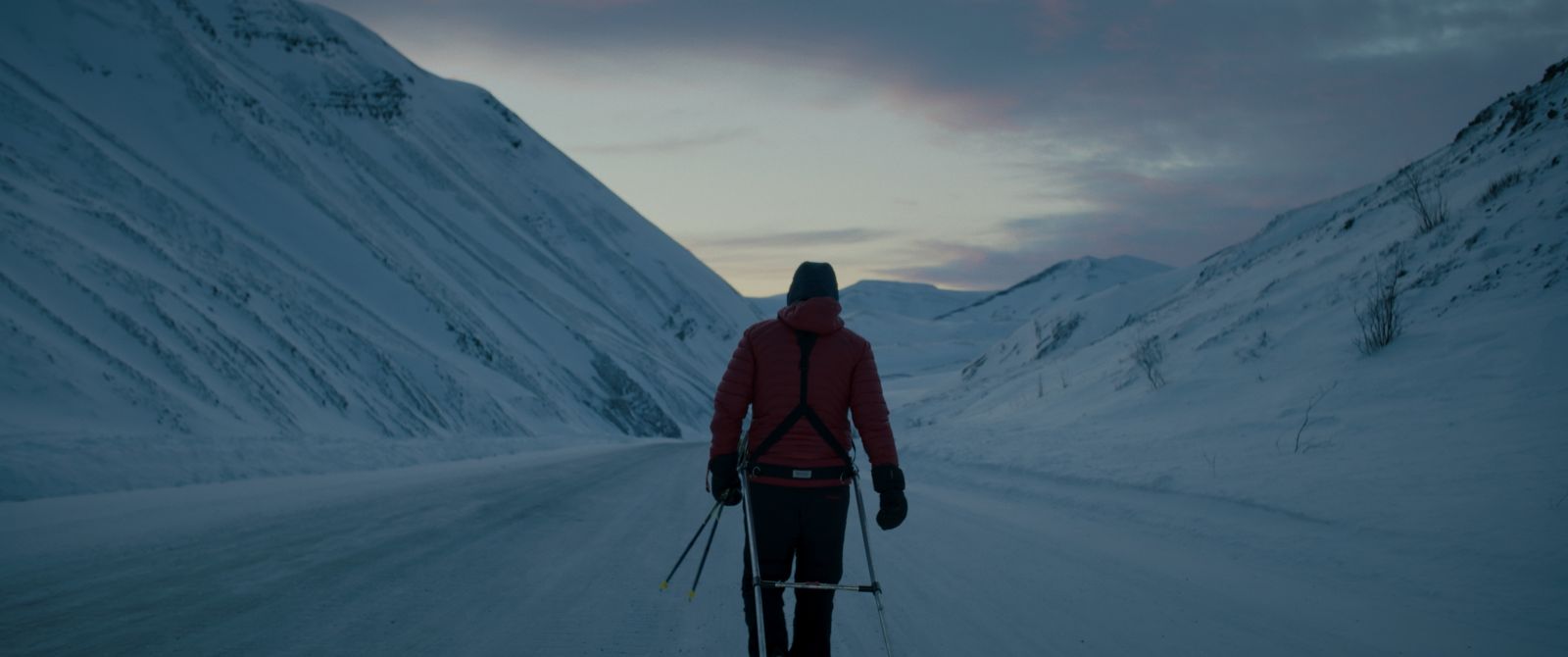
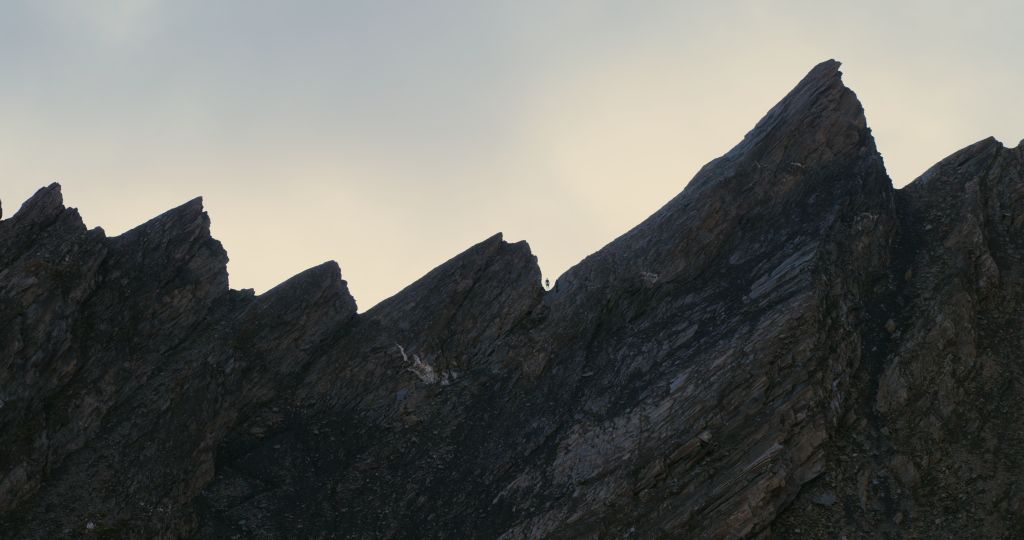
Continuing to use running as a form of therapy once released from prison, he eventually started competing in ultramarathons that would test the fortitude of his body and mind. Participating in competitions like the 6633 Arctic Ultra in the Yukon, where contestants run 612 km, much of which is on icy roads, over nine days in -30ºC or below weather with nothing more than the limited supplies their sleds can carry, Ușeriu used running as a tool to both explore his own conscious mind and make him feel alive in a way that fascinated the director.
“Runners think that ultra marathons [are] actually 90% mental. It’s not even physical endurance. It’s just mental endurance because your mind is always telling you, ‘Okay, you can stop anytime. You can just stop now,’” states Aung-Thwin. In the director’s eyes, Ușeriu’s knack for pushing through the dissenting voices is a unique type of superpower. “Tibi’s ability to do that was forged in his childhood and then in years of solitary confinement. It was so darkly poetic to me,” he adds.
Inspired by the memoir that Ușeriu wrote, Aung-Thwin wanted to bring audiences into the runner’s thoughts through the film. He captures both the laser focus of the competitions, and the ways Ușeriu’s mind is constantly navigating isolation and the past issues and demons in his life. “It’s funny because a couple times we left microphones on him while he was running, just as an experiment. He talks to himself and it’s such an interesting train of thought,” Aung-Thwin continues. “We’ve used snippets of that in the film here and there; he’s hyping himself up… he’s getting dark and then he’s coming up with ideas for things he’s going to do in the future.”
Understanding the role that communism played in some of the past hardships Ușeriu is still working through today, the filmmaker tried unsuccessfully to coax the runner into talking about politics. It was his brother Alin who would frequently bring it up. “[Alin] was hyper aware of politics, of communism, of what replaced communism, of corruption… he was always talking about what life was like under communism,” states the filmmaker.
Although Ușeriu came from a very neglected place in Romania, one he wanted to escape from, Aung-Thwin makes it clear that his story wasn’t unique. Many who grew up in that generation had similar experiences. The filmmaker points to his casting director who had her own traumatic upbringing. “She was like, ‘Let me tell you about my father and how mean he was to me and how much abuse [there was].’ Everybody in Romania seems to be able to relate to that story because communism was so dark,” he states. “It really drove people into very dark places.”
Highlighting how Ușeriu always dreamed of a life beyond what he grew up in, it was important to Aung-Thwin to provide context to the changing political landscape around his subject. In some ways Ușeriu is a man who, though the format has changed to ultra races, never stopped running from the horrors of the past.
Given full access to Ușeriu during his various races, while still adhering to the strict rules of each event, Aung-Thwin captures not only the runner’s persistence, but the harsh conditions he endures along the way. The audience practically feels the snow caked onto his mask and observes the squirm-inducing physical toll that he takes on his body. Although some races allowed for providing food to competitors outside of checkpoints, the filmmaker did not assist Ușeriu at any point during his competitions. “We weren’t helping him in that way because we were too busy trying to survive ourselves,” he recalls.
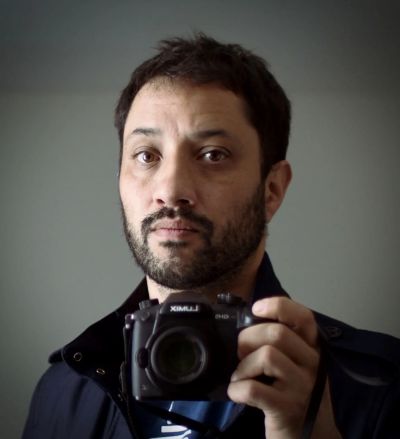
Considering the locations where the races occurred, capturing the footage came with its own challenges. Ușeriu would try to walk the director through the intricacies of the race, and point out which spots offered beautiful vistas at specific times, but his perspective was that of a participant not an observer. He viewed everything as a straight journey, without factoring in that the filmmaker would need to take different paths to reach the same destination. As a result, a lot of orchestration was needed to ensure they captured the shots they needed. “We would arrive early at the race, and we’d plan it out a bit like a heist,” says Aung-Thwin.
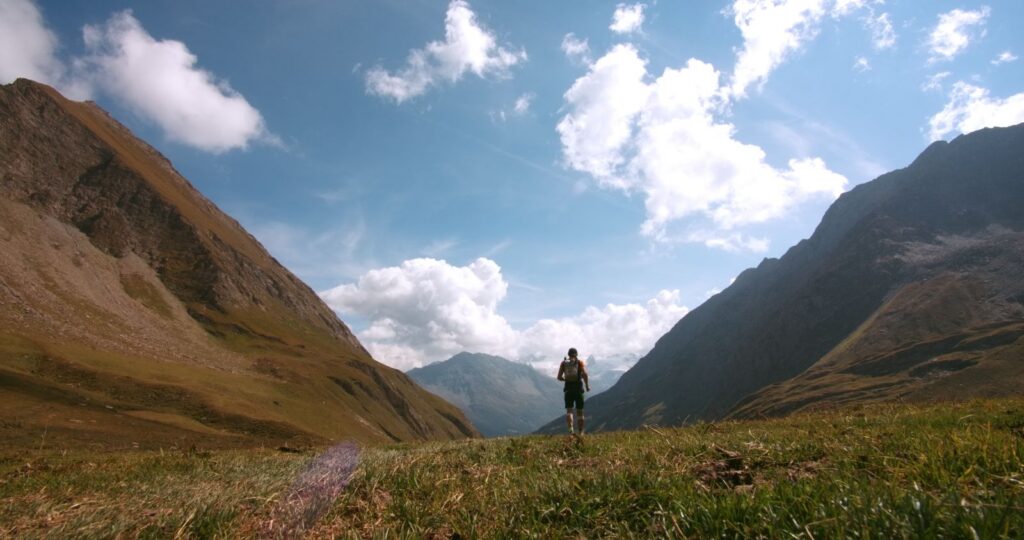
Even when they had a blueprint of their plan of attack, cracking the safe that held the best shots still proved to be quite difficult. “When we filmed with him in Tor des Géants (in the Italian Alps), we [did not] realize how difficult it is to sleep and how to judge where the person’s going to be and how to get to that place.” Sometimes the filmmaker would have to embark on a five-hour journey of driving and climbing just to reach one of the race’s checkpoints in the Alps. The long trek would sometimes bear little fruit as Ușeriu would simply pass them by before he could get the shots he wanted. “So, in a race that lasts about a week, how many times are you going to cross his path? A dozen, maybe less, maybe more… it’s unlike following any documentary subject I’ve ever seen because it’s even hard for someone to explain what the race is like.”
The Ultra Runner may sprint in the lane of a sports documentary, but its strides prove to be anything but conventional. Part of this is due to the fact that ultramarathons defy normal logic. “The first thing I learned in [filming] one of these races is that there’s almost no traditional reason to do one of these races,” says Aung-Thwin. While most sports have built in narratives that play up rivalries and build up to victories that will be recounted for generations, ultra competition is about individuals competing against another version of themselves with little fanfare.
“[Ușeriu] pays his own entry. He is his own doctor, basically. He has to figure all that stuff out and there’s no crowd,” Aung-Thwin adds. Considering the length of the competitions, reaching the finish line often feels anti-climatic as the only applause comes from the organizer, who puts a medal around the participant’s neck, and a few volunteers working the race.
The parallels between the lack of traditional satisfaction one gets from winning a race and getting out of prison is apparent in Aung-Thwin’s film. The solitary nature of Ușeriu’s highs and lows are presented in vivid detail due to the documentary’s strong imagery. “I approached this film more from a visual sense than anything else I’ve ever worked on,” notes the director. Comparing the editing work on his previous films to a radio documentary in the sense that they are usually governed by a lot of interviews and dialogue that make the viewer feel something, he knew he needed a different approach here. Envisioning something along the lines of Wim Wenders’ Paris, Texas (1984), where you watch a guy in a red cap walking through the desert, but are unsure of why until the end, Aung-Thwin did not know if his main character would even speak on camera.
“I didn’t quite get to make that extreme of a movie, but I think that’s why I got some visuals that I’m quite happy with,” Aung-Thwin continues. “I forced myself not to have subject matter content script ideas and interviews first. It was more like, ‘No, what are the visual ideas I want to get across? And then if I’m good at visuals, I’ll figure out a way to put them together.’”
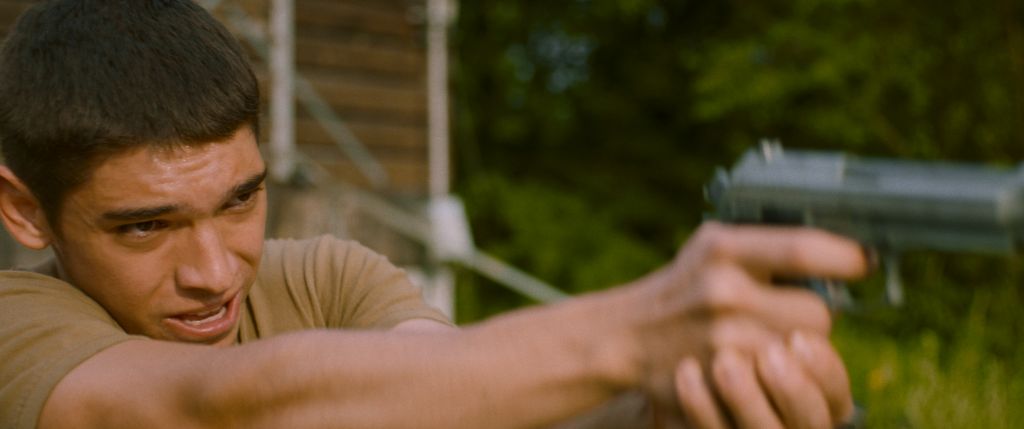
Aung-Thwin may have visualized a particular aesthetic, but he had a harder time seeing the use of reenactments at first. Coming from a cinema verité mindset the filmmaker and producer has always been hesitant about incorporating that particular tool in any of the over 50 films he has worked on at EyeSteelFilm. “You have reenactments that look good but distract from the actual characters in the movie,” he notes.
Aung-Thwin’s views were the opposite of his producer Bob Moore who, along with Mike MacMillan, first brought the project to the director’s attention. Frequently enjoying going on runs with Aung-Thwin whenever they attended film festivals, Moore long wanted to make a film about running when the story serendipitously fell in his lap via a Romanian producer. Moore envisioned raising enough money to have the best reenactments possible.
The idea of working in the world of fiction, despite dabbling with it in some productions, left a sour taste in Aung-Thwin’s mouth partly due to the negative experiences he had as an extra on Montreal sets when he was of college age. Aside from the unfair hierarchical structure and the horrible way people were treated, he found those productions were too precise and lacked any fun.
Constantly wanting to bring his documentarian perspective to the reenactments, the filmmaker found himself frequently at odds with the fiction unit. “They were there to make sure everything got done on the two-week schedule we had in Romania and the three weeks or whatever we had in Montreal. And I was always fighting them,” recalls the director. Whether recommending using non-actors for some scenes or making suggestions that would pose logistical problems, Aung-Thwin had to navigate working with a fiction unit that had specific processes they needed to follow. “I was like, ‘what if we just shot in a different location at the last minute?’ And they were like, ‘There’s no permit for that place.’”
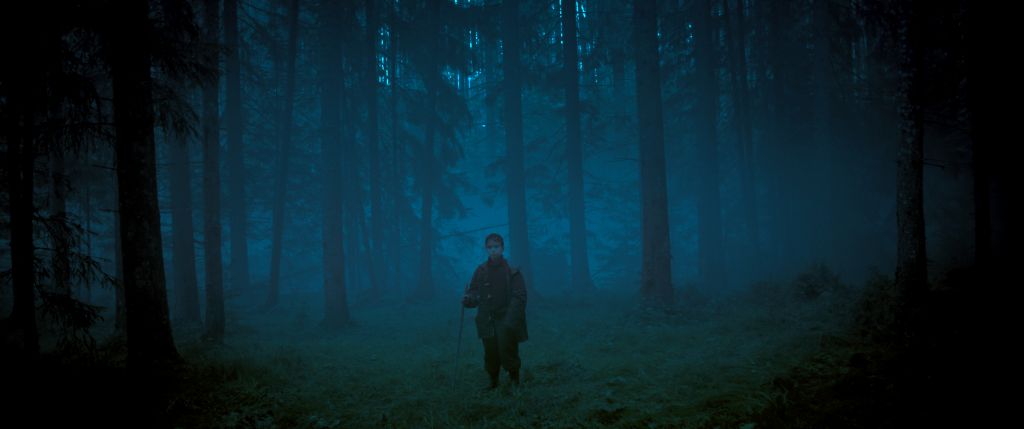
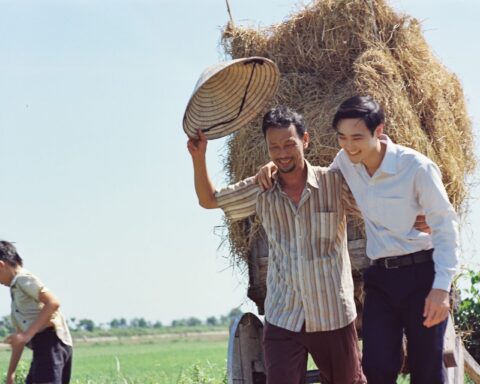
The tug of war between the structured side of filming fiction and the spontaneity of his own style of documentary filmmaking did pull some unexpected magical moments in his direction. One of Aung-Thwin’s favourite moments shooting involved a sequence where a boy is tending sheep in Romania at the beginning of the film. Curious as to how the sheep were going to be transported to the shooting location, a creative spark ignited when he realized that the shepherd was walking them across several miles of countryside. “I just saw them coming down the field and I was like, ‘Look, that’s the shot I want.’” Although the boy they cast to play young Ușeriu had never worked on a farm, but was already in costume, Aung-Thwin had him run into the field and take instructions from the shepherd on the fly.
“To me, [it’s] one of the most magical moments because it was completely documentary style… what I was trying to accomplish when I was doing recreations.”
Dipping his toes into waters that proved to be far more soothing than appeared at a distance, Aung-Thwin learned to embrace many of the aspects of hybrid filmmaking. “I overcame some phobias I had of working with a bigger set. It wasn’t huge, but at some points we had 50 people and we shut down streets in major cities. We had armoured cars and police and guns. To me, that was another kind of filmmaking,” says Aung-Thwin.
While not quite ready to put his verité influences on the shelf just yet—he considers it the purest and most exciting form of filmmaking— Aung-Thwin has become more open to exploring this side of storytelling. “I’m very excited to do it again if I have the chance,” he says. “I know how the unit works, I know how the military precision of the assistant director works, and I know what all the roles are.” Similar to a martial artist who can utilize different techniques depending on the opponent, the director/producer now sees hybrid filmmaking as another tool that he can pull out. Not only is he now open to working completely in fiction, but this experience has reshaped how he will approach documentary filmmaking moving forward. “When I do work in documentary, I can be more deliberate. So, it’s not a default state anymore of how to make films.
The Ultra Runner premiered at the 2026 Toronto International Film Festival.
It screens at RIDM on Nov. 21 and 29.
Please check your local listings for additional festivals, event screenings, and broadcast dates.