


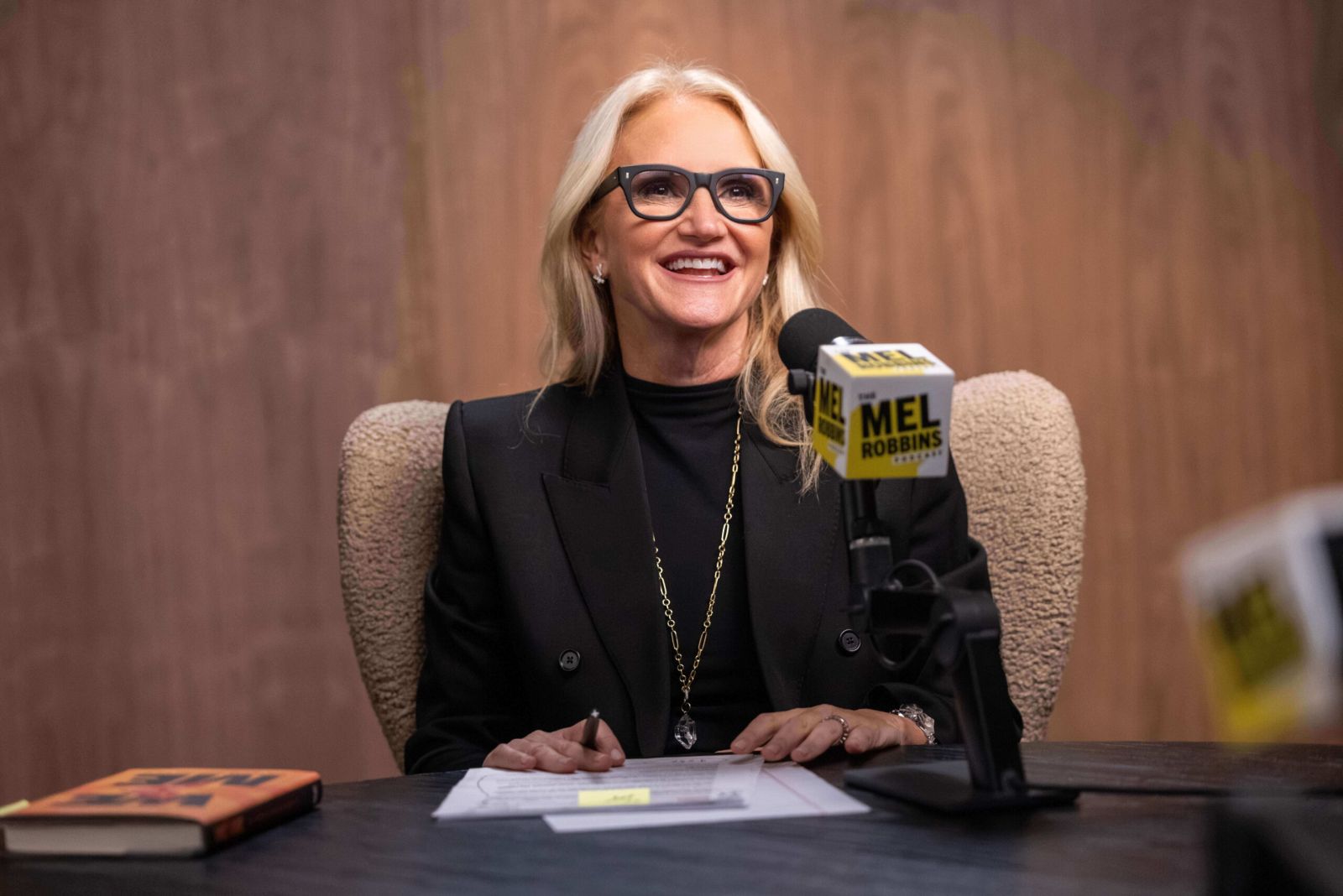

What makes a podcast the most widely shared show on the internet? Mel Robbins says that the secret ingredient that inspires her audience to forward her podcast to friends comes from a strategy her team built into the show from the beginning. Robbins, speaking with POV via Zoom, says that The Mel Robbins Podcast “reverse engineers” every episode and interview for the self-improvement show that publishes twice weekly to nearly millions of listeners across podcast channels, social media, and a newsletter. (Robbins cites 11 million listeners during our conversation, while her website notes 40 million online followers across platforms.) This means that the hugely popular and Golden Globe nominated podcast draws listeners into Robbins’ signature life advice by giving them exactly what they seek.
“We reverse engineer based on what people are looking for online, not about [a speaker], but about life,” Robbins explains. “And then we read all the memoirs and we look into their life and we reverse engineer the interview so that the stories we’re talking about actually teach to the things that people are interested in learning about.”
In the age of SEO and analytics, hits from somebody searching at night for answers to questions like, “How do I reinvent my life?” or “What if my business is failing?” or “How do I believe in myself?” provide the groundwork for audience-ready episodes and, moreover, stories that listeners will pass on to their own networks
Robbins says that approach keeps the show evergreen and frees it from the press cycle or people’s book tours. It’s about finding the right person for the topic, rather than finding a topic with a hot guest.
So, say, an episode with a financial advisor might provide the answers for someone Googling, “How do I get out of debt?” Then Robbins and her team find a participant who speaks with authority about debt reduction. They then embark on a long conversation that usually finds its fuel in engaging, usually anecdotal perspectives. The chat leads to advice and affirmations with which the listen and correct his or her course.
“We can then think about the person coming on, whether they’re the world’s greatest sleep expert in a clinical research practice or it’s Ina [Garten] or it’s Oprah [Winfrey], and we set up the interview so that the answers actually serve as a story or a takeaway or a piece of research that might help somebody searching for that,” says Robbins.
Robbins references a recent episode with Barefoot Contessa chef and author Ina Garten that I name-checked at the top of our conversation. While this regular listener tunes into The Mel Robbins Podcast by habit rather than happenstance, Garten’s conversation on the podcast provides a through line for our own talk. For example, Garten’s advice about forgetting a five-year plan to focus on the present resonates with my own sense of directionless. The point leads to a question about how podcasting and having these self-improvement convos help Robbins focus on the present, too.
She says that podcasting impacts her profoundly. It’s hard to avoid framing the conversation with a personal slant, since the podcast itself draws so much upon Robbins’ openness with escaping the rat-race and climbing out of a hole of debt while searching for a vocation that gives life meaning.
“I was a person for the majority of my life who, for a number of reasons was always in a state of anxiety and running around like a crazy person, always thinking about what’s next,” observes Robbins. “It’s exhausting. It’s exhausting to live your life like that. And one of the things that I’ve learned from the experts is how powerful it is to literally take a giant breath and constantly come back to the present moment. It’s not something that comes naturally to me. What I’ve found to be interesting is how quickly you feel better when you stop worrying about the future and you come back to this moment and you train yourself to notice what’s going well right now.”
It’s great advice, doubly so since Robbins’ voice and cadence lend the podcast the aura of self-improvement ASMR. But Robbins peppers in some cusses and layman turns of phrase that help listeners both casual and new feel like they’re with a circle of friends, rather than in a clinical therapy session. (Each episode also includes a necessary disclaimed that Robbins isn’t a therapist.)
The Mel Robbins Podcast does for audio storytelling what The Oprah Winfrey show did for daytime television. It’s no wonder, then, that Robbins has a fan in Lady O, who appeared on the show herself in an episode that partnered with her own podcast. Moreover, in a move that illustrates the lay of the land, Oprah flew to Robbins’ Boston studios to record on her home turf and paid her the ultimate compliment from a self-help guru: Oprah said she saw herself in Robbins.
“I had to throw my underwear out after that,” laughs Robbins with a characteristically vivid choice of phrasing. “She didn’t have to say that, and so for her to say that to me on my show, for her to come to Boston, I don’t even have the words to describe to you. To be able to co-create that episode with her, she actually sent me a voice memo afterward and said of the thousands of interviews she’s done, that was ‘the single best thing she’s ever seen herself do.’”
But whether it’s one of the world’s most recognizable media personalities or an unknown field expert doing the same, Robbins says that Winfrey’s candour reflects the point of the show. “The intention is not about virality or gotcha [moments]. It’s really about impact, and that’s what her life has been about,” says Robbins. “And when the two of us join forces with that shared intention, something magical happens. People come on this show and they share things. John Grisham came on and told a story about his life that his publisher of 26 years has never heard him tell publicly.”
Robbins recounts a story about how the author of bestselling legal thrillers like The Firm and The Rainmaker is incorrectly believed to have failed college English. He told a story about how he was accused of plagiarism by his English [department]. “He couldn’t defend himself,” explains Robbins. “And what’s interesting is he said that there are golden moments in your life where something happens, a light goes off, and it changes your life forever. And I said, ‘Well, you never would be able to write novels from the point of view of a white guy in South and deeply understand what it feels like to be wrongfully accused without that experience.”
There’s a persistence of positive spin to The Mel Robbins Podcast that inevitably invites some naysayers and requires a sense of caution for folks in search of answers. But anyone craving an antidote for cynicism does themselves a favour by clicking play.
Robbins says she doesn’t take the choice to tune out and tune in for granted. That’s why every episode begins with a sincere thank you to listeners for joining, whether it’s for the first or umpteenth time. Robbins favours direct address throughout the episodes and volleys the conversation to the audience listening in.
“Every other show, they tape an interview and allow you to eavesdrop. That’s not what I’m doing,” Robbins explains. “I start the show with you in mind because podcasting is one of the last few mediums where there’s an intentional act to hit play and 99% of the consumption is still audio, which means it’s one person listening. And so the setup of the conversation is actually speaking to you.”
Robbins circles back to the conversation about the Ina Garten episode and addresses me by name in a way that virtually nobody does during junket interviews. She paints a picture of her walking with Garten around the author’s house. “I’m actually on a walk with you, Pat, and you’re talking about reinvention and you’re talking about some topic. And I’m like, ‘Hold on, that’s Ina’s house. Let’s invite her on the walk with us,” says Robbins.
“We coach and direct the people on the show. I want you to feel that because the entire intention is that you feel that this is for you and we are speaking with you. And I don’t ever want anyone to feel like they’re on the outside of some group. I don’t want anyone to feel stupid for hearing a concept for the first time. That’s all on purpose because the intention is to welcome you in and get our arm around you and to make you feel like you’re walking with us.”
And for anyone who tunes in during their daily walks, The Mel Robbins Podcast surely helps a person get their steps in.