


Listen carefully to the opening frames of Time and Water. A crackle appears on the soundtrack, followed by another. The crackling intensifies, and it sounds as if someone shifts through a box of broken pieces—maybe old china plates, some bits of metal, and a few shards of glass. A hand-written letter then appears in the frame: “To my loved ones: If you find this time capsule, please press play.”
It turns out that the sound is actually the cry of a glacier as it breaks. The ensuing images of Time and Water invite audiences to grieve for the loss of the elements that held a sense of permanence until only recently as they regulated the temperatures of the world.
“Our hope is that in the future, in this speculative framework of the time capsule, if this film were to be discovered, it would still be in a world where ice is still alive where glaciers still exist,” observes Time and Water director Sara Dosa, speaking with POV via Zoom ahead of her film’s premiere at the Sundance Film Festival.
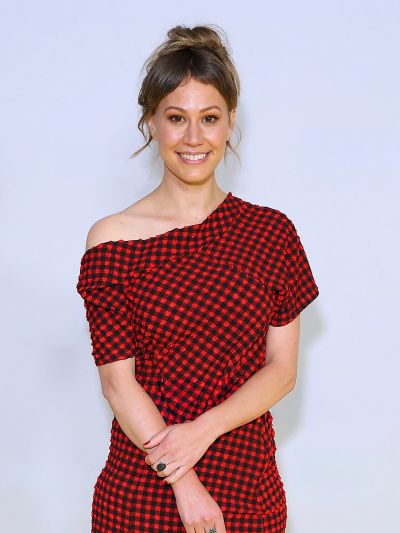
The director taps into elemental natures shared by humans and our natural world in Time and Water by considering the life and death of glaciers, but also the memories they hold that are lost to time as their layers melt away. The film marks a striking companion to Dosa’s 2022 Oscar-nominated wonder Fire of Love, which told the story of volcanologists Maurice and Katia Krafft and their shared love for volcanoes.
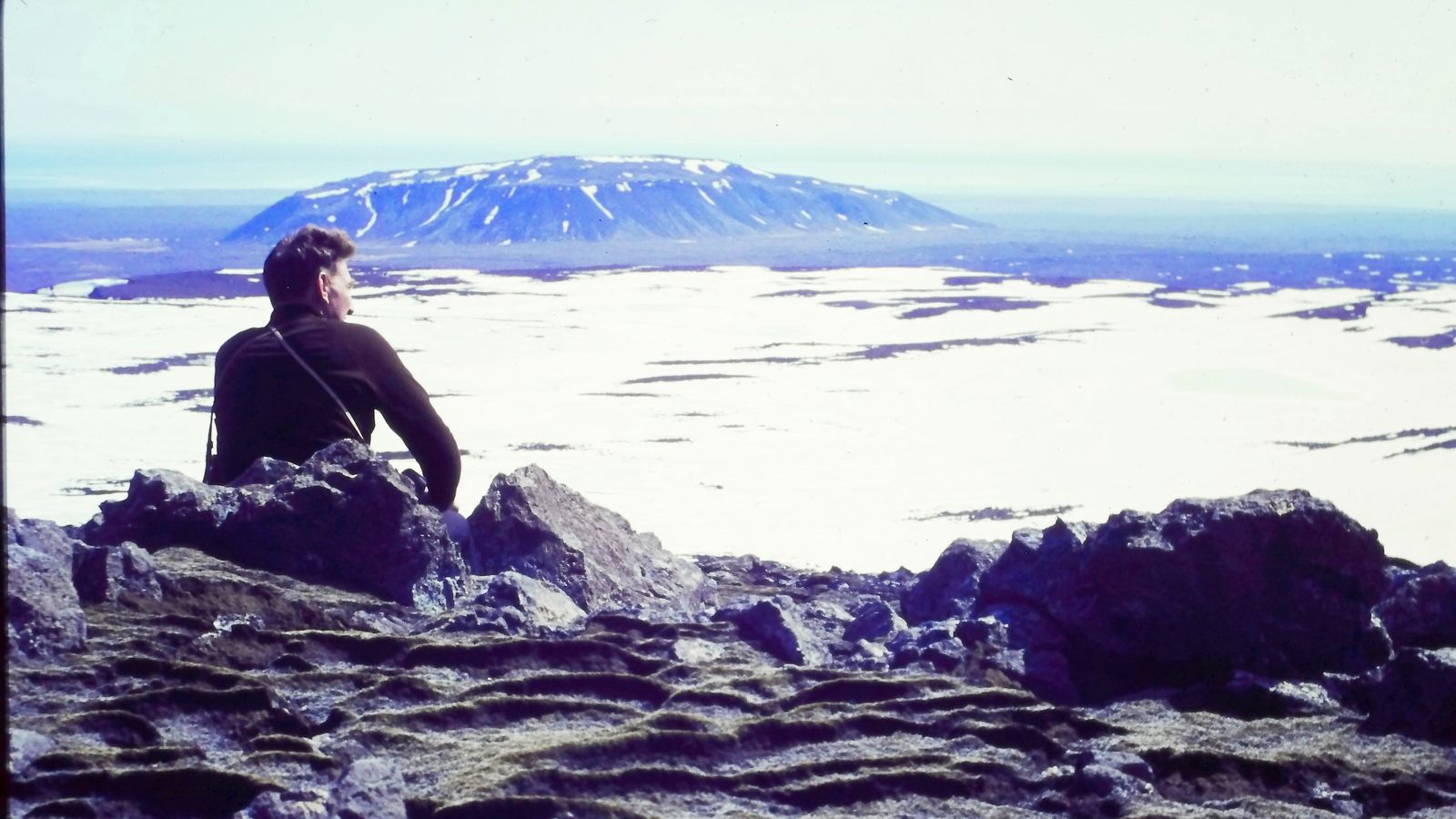
Time and Water, like Fire of Love, harnesses the memories housed within archives as Dosa mines the family movies of Icelandic writer Andri Snær Magnason as he considers the parallels between the loss of the glaciers and the ways in which his own family history melts away with the passing of grandparents and great grandparents. Time and Water finds a fitting counterpoint to the bravura visuals and adrenaline-rush of Fire of Love as these images invite audiences to pause, consider the passage of time, and experience an elegiac sense of loss.
Dosa says she didn’t conceive of the works as sibling films, but acknowledges their complementary nature and the awe they both inspire. “There’s a kinship in terms of how we’re telling a story that centres the sentience of nature. I love volcanoes, but we’re showing the aliveness of glaciers, which so many people who don’t live in glaciated areas might think of as a block of ice,” says Dosa.
Although Dosa says her ideas for Time and Water were in the works prior to Fire of Love, she shifted gears to the archival volcano doc when the COVID-19 pandemic made production impossible. But she notes that working on Fire of Love gave her new ideas to apply while exploring the limitations and gifts of archive as a medium. “Archives are treated very differently in Fire of Love, yet at the same time, they both relate to cinematic time, how memories can be encoded in archives and yet will never be enough,” Dosa explains. “There’s definitely some similarities perhaps between the two films in terms of the use of archival material and how it’s layered into our natural landscapes.”
One difference between the two archival sources, however, is that (spoiler alert) the Kraffts passed during their adventures, while Magnason is very much alive—and is an active participant in the film as narrator and writer. His book On Time and Water inspires much of the inquiry as the documentary explores three generations of family archives.
“One of the things that I love most in the home videos is that everything that Andri was pointing his camera or phone at was something he loved and was truly trying to capture,” says Dosa. “It’s the same starting with his grandfather, Árni. He loved glaciers and thus wanted to capture them and he loved his family and was very meaningfully collecting images of them as well. There was a real sense of intimacy that you get from the home videos. The Kraffts were doing something similar because volcanoes were their home. They felt that making a connection with volcanoes.”
Meanwhile, while Fire of Love draws mostly from the footage that the Kraffts shot out in the field and had minimal material of the Kraffts in their home aside from one interview given their 24/7 dedication to their research, Magnason’s family chronicles their adventures in the field and their time at home in equal measure.
“In Time and Water, we were enmeshed in this intimate sphere through the lens of family imagery that was wonderful for us to play with. At the same time, it was a challenge for our edit because the archive was so expansive,” notes Dosa. “Even though the Kraffts’ archive had its limitations, they were about volcanoes and there we knew the arc. With Time and Water, there were so many different directions we could go. That ultimately speaks to how the messy beauty of life defies narrative containers.”
Magnason echoes this sentiment in Time and Water when he faces an enormous task. After Iceland’s Okjökull (aka Ok) glacier was declared dead in 2014 due to its increasing thinness and its inability to withstand movement, Magnason prepares to write an inscription for a plaque that will mark the death of the glacier. The film observes as crowds gather for Ok’s funeral in 2019—a chillingly surreal event, but also a refreshingly significant one.
“I was very interested in the concept of something called disenfranchised grief, which is the idea that ritual can provide a way of collectively mourning and finding meaning out of that which seems to not have meaning—the senseless, the absolutely tragic, the ineffable,” observes Dosa. “In this unprecedented time of the Anthropocene, there’s so many new losses that we don’t have languages or rituals around, so how do we build community? How do we mourn? How do we make sense of the ever-shifting crisis-driven parameters of our world? A funeral for a glacier, while absolutely devastating and surreal, can at once provide a way of gathering to process our moment.”
Magnason reflects this challenge to articulate something new as he finds the words to provide closure for the crowd. As he marks the glacier’s death, he issues a call for this new event to be that last. “How do you say goodbye to what you never thought you could lose?” Magnason asks in his pensive voiceover. His query reflects the sense of saying goodbye to a parent or grandparent who has been a point of constancy throughout one’s life, just as the glacier’s sustained the environment.

Dosa credits film editors Erin Casper and Jocelyne Chaput for intimately connecting these threads of Magnason’s family story and the larger history of the natural world. Associate editing evoke subjective memories that open up his line of questioning to the bigger picture. Moreover, having worked with Magnason on her 2019 film The Seer and the Unseen, Dosa said she had a relationship with the writer that she could lean into to further explore the layers of memory housed within both tales. “One of the things that always just especially spoke to me about his book was how he spoke about his grandparents,” says Dosa.
The director says that she drew from Magnason’s book for inspiration for the narration, while at other times, she, Casper, and Chaput interpreted the archives, extrapolated some voiceover, and flipped it back to the writer to see if it reflected his ideas and experiences. Similarly, Dosa says the collaborative process helped upon up the archive. If Magnason was unsure that audiences might not identify with his grandfather’s story, Dosa says she could find ways to relate the archives to her own family and create universal threads to connect audiences with the film’s exploration of generational memories and the grief associated with such losses.
“The writing process allowed the film to have a sense of playfulness, even though it’s ultimately about the death of our landscapes and grappling with human mortality,” says Dosa. “His perspective and his way of thinking allowed a lot of levity and humanity to come into the project.”
Time and Water strikingly and cinematically explores the life and death of landscapes and human mortality alike with a thread of contemporary footage woven between the archives. The film features dazzling close-up shots of the glaciers as cinematographer Pablo Álvarez-Mesa gets intimately, almost invasively close to the ice. Macro-level shots allow viewers to see the lines of history embedded in the layers of the ice, while the serene blue hue illustrates the health of the glaciers.
Dosa notes the cinematographer’s ability to observe and connect elements of the natural world and imbue them with a sense of presence, especially water like he does in his award winning documentary The Soldier’s Lagoon. “We had a lot of conversations before filming about the sentience of ice, what it means for our glacier to be both abiotic, but also contain a life force,” says Dosa. “It does have a life cycle. It does move. The way glaciologists talk about glaciers is in terms of life and death.” The doc explores the lives and memories of ice through a mix of digital footage shot on Arri and 16mm film shot with a Bolex to create a dialogue between Magnason’s archive and the themes of planetary memory and the sentience of glaciers.
Meanwhile, the closer one gets to the ice, the more one hears the groans, or the thrilling snap, crackle, and pop of the glacier as it moves. “We thought that in order to make people understand what it means to have a death of a glacier, they needed to first feel the life,” adds Dosa. “That was key towards our cinematic approach, but also in doing that, we had to meaningfully engage sound and we had incredible sound recordists on our team, including our sound designer and re-recording mixer Björn Viktorsson, who was also with us in the field. You can’t really perceive the way glaciers move, so we needed to rely on sound because you can hear it. That sound animates the movement and attunes your eye to see the imperceptible creep of the ice. That is key to understanding that it is alive.”
When asked about casting her glaciers to capture that sense of aliveness when Time and Water stars a body of ice that’s been declared dead, Dosa gets a bit emotional talking about the shoot her team had at Okjökull’s remains. “There’s still patches of dead ice up there, but it was so ghostly. It was just fog was swirling all around us,” she notes. “That’s the cycle of water. It evaporated and is now the clouds. We felt that sense of water cycles and life cycles, as well as the hauntedness of what once was while we were on Ok glacier.”
The living glaciers in Time and Water include Vatnajökull, the largest glacier in both Iceland and Europe, and its outlet Breiðamerkurjökull, known as the wide forest glacier because the ice crept far enough to engulf a birch forest. As the glacier melts, trees reveal themselves to local residents.
“The layers of both time and memory and myth all in this one place felt like the richest package of story and human memory and ice all in one,” Dosa says of Breiðamerkurjökull. The glacier also serves as a site of memory in Magnason’s family archive. “But devastatingly, while all of the glaciers are in rapid decline, Breiðamerkurjökull especially is melting even faster than the other glacial outlets of Vatnajökull. That’s because it has a direct thoroughfare with the ocean, so when salt water comes in, it increases the melting.”
As the glacier melts and Magnason’s own family fades away, Time and Water poignantly circles back to the letter that opens the film. This documentary could very well be an historical record for the world’s changing landscape in the face of climate change. “There can be perhaps an acceptance of loss, but not an acceptance of what’s happening,” says Dosa. “That can inspire the fight to protect and to care for what still remains, I’m inspired by this kind protest art.”
As the film imagines the glacier enduring as water, whether as liquid or as droplets, Magnason’s voiceover ask if the memories housed within ice will evaporate as the element changes form. While there’s an elegiac sense to that ending, Dosa hopes that the idea of a time capsule resonates with audiences.
“Our initial conception was to dream up a world where glaciers will always exist, so a hope of ours is that it can show what is still here, what we do need to be fighting for, what is still remaining,” says Dosa. “The image of a calving glacier is quite used a lot in climate storytelling. And yes, they’re collapsing, but also they’re still here and they’re mighty power. Let’s revere the force that provides so much life connected to water across the planet.”