


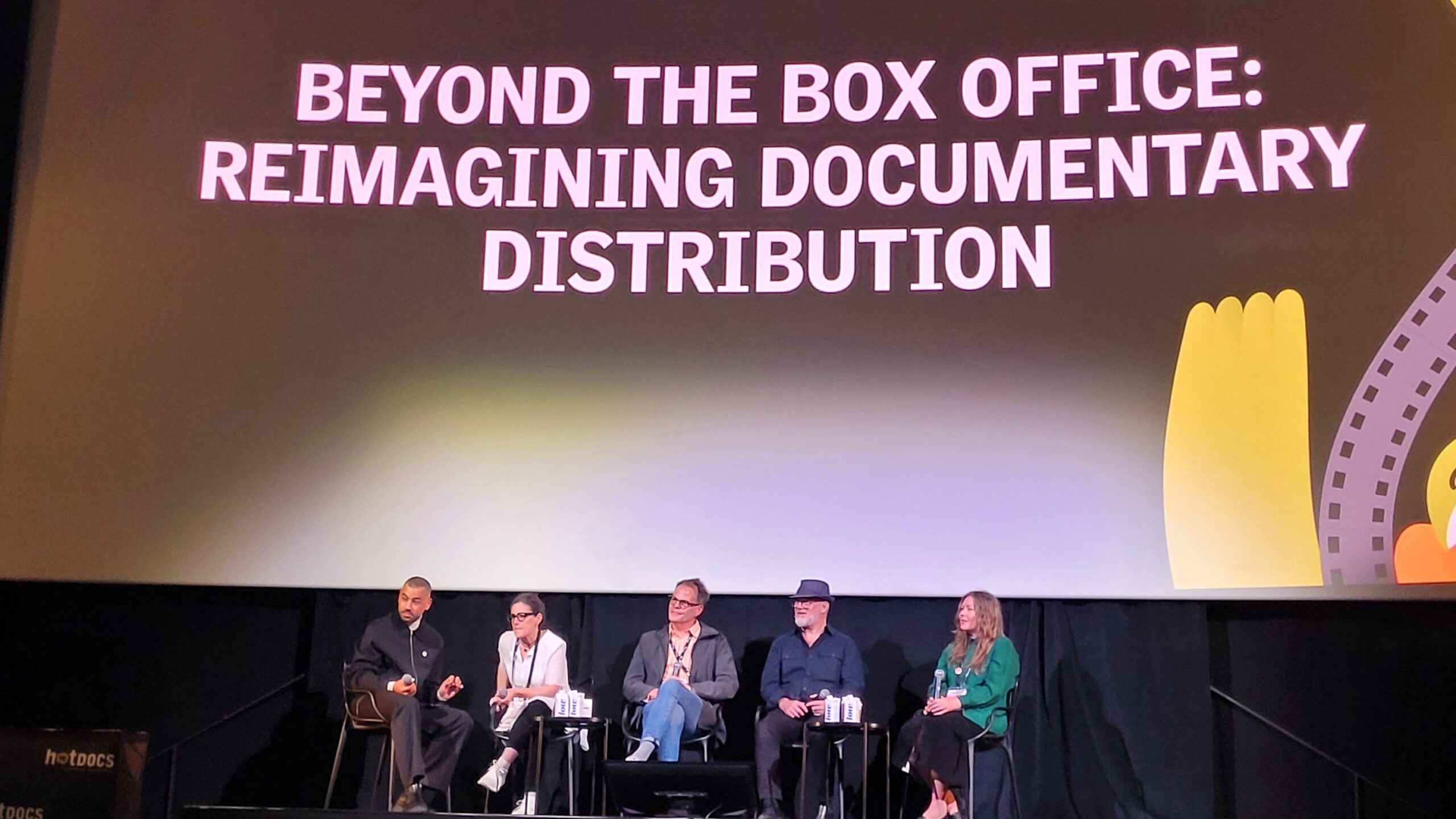


Monday’s Industry Events consisted of two panels, both held at the Hot Docs Cinema. The first was “Beyond the Box Office,” moderated by Julian Carrington, executive director of DOC (Documentary Organization of Canada) and the second, “Bold Visions, New Voices,” had as its moderator Poh Si Teng, the director of American Doctor. POV covered both events.
BEYOND THE BOX OFFICE
Report by Barri Cohen
With moderator Julian Carrington, Documentary Organization of Canada; Sue Biely, of Story Money Impact; Jessica Hallenbeck, from Lantern Films’; Sylvain Lavigne, from Les Films du 3 Mars; Robin Smith, of Blue Ice Docs | KinoSmith
How many times must documentary filmmakers and producers endure dour prognostications at festivals over the withering of distribution audiences? The struggle is real, especially in light of the Canadian Media Fund’s (CMF) improbably mad turn to a more “market driven” approach to doc funding. CMF actually looks ridiculous and disconnected from on-the-ground facts: as the Session blurb put it, “the sector grapples with fragmentation and regional gaps,” amid the collapse of legacy media’s coverage of docs (except of course for POV Magazine!). Into this breach, however, comes a cavalry of innovation minded hewers of audiences who are here to deliver a message of hope: people ARE hungry documentary film, “we” (our partners too) have just been looking in all the wrong places.
Co-presented by the DOC, the session’s participants all echoed a few hard truths. One, things might be a lot better for everyone if we could finally dispense once and for all with the fantasy that most (or any) docs can, should or will make money! The re-think has been staring at us for a long time: docs are in fact largely a not-for-profit enterprise. Face this fact and a number of possibilities could really open up.
One, that engagement campaigns can draw a network of viewers across the country in the most unlikely of places and Telefilm and broadcast partners have got to recognize this. DOC’s Carrington did say Telefilm is finally on the cusp of funding engagement campaigns. Indeed, the very inspiring Sue Biely of the Story Money Impact was able to say that she reaches thousands of viewers (“who want more!”) through an ad hoc network of community screenings in novel spaces and places, not theatres with “nailed down seats.” She’s after real engagement and she’s getting it. Films she takes on are seen in schools sure, but also daycares, hospitals, coffee shops or bars, libraries, community centres: the old NFB style “church basement”. You name it, she’ll book it. Coast to coast to coast.
Similarly, Lavigne’s Les films du 3 Mars approach to is book a day or three, spread out over months sometimes, with a title in a cinema house in Montreal, allowing word of mouth to build and build, creating word of mouth momentum Robin Smith of Blue Ice Docs/Kino Smith distribution says most of the legacy media partners and funders are so woefully behind the times that they don’t realize that having small theatre runs, or festival runs, or multiple platforms and engagements should all be considered not competitive for audiences but additive “conduits” for them.
Two, it would help if our foundation and tax regime radically changed how they saw us, to allow productions access to fund IP or at least engagement campaigns, much the way US filmmakers are able to access flow through tax credits from foundations.
If our Prime Minister can loftily intone that we have to think differently and look elsewhere for our bread, the least we could do is the very same thing in designing a sustainable future for Canadian documentary built on new, grassroots non-profit networks with community collaboration working alongside not-for-profit alternatives like Lantern and Story Money Impact.

Bold Visions, New Voices: Developing Stories Beyond the Studio
Report by Tom White
With Moderator Poh Si Teng, director American Doctor; David Shadrack Smith, Part2 Pictures; James Costa, producer; Tatiana Battaglia, Grifa Filmes; Cathy Ni, EST N8 Studios
As the dreaded and dreadful Paramount engorgement of Warner Discovery lurches towards its fateful conclusion despite fierce opposition from the creative community in the form of a blistering open letter, the Hot Docs Industry Conference is maintaining a countervailing force through indie verve and out-of-the-box vigour.
Monday’s second session, “Bold Visions, New Voices: Developing Stories Beyond the Studio,” brought together a quintet of enterprising artists and executives who are figuring out ways to tell their stories and find audiences for them, despite the daunting odds.
Moderator Poh Si Teng, here at Hot Docs with her directorial debut, American Doctor, came to her project following a multifaceted career as creative executive, documentary commissioner, funder, and producer. “I didn’t want to do any of those jobs anymore,” she shared “I wanted to go back to being a creator, something that means something to me. But what was the way in?”
She considered the longstanding popularity of medical dramas like The Pitt as an entry point to documenting the endeavours of three intrepid American doctors who travel to Gaza to save lives amidst impossible and heart wrenching circumstances.
Like Teng, David Shadrack Smith, a seasoned producer whose company Part2 Pictures has created hundreds of hours of programming for streamers and cablers alike, felt the urge to pursue his own passion project: Public Access, about the heady, audacious history of public access television. “Running a business, you’re chasing those buyers, you have your relationships, you’re trying to place your ideas,” he explained. “But having the idea that nobody wants, only you…Your sense of, ‘I have to make this film’ is the driving force, and then [you try] to figure out the path that that takes.”
From the financing side, James Costa, a producer with 50 films to his credit, is, like just about everybody in this business, not in it for the money. “If I can make some money back on one or two of them that can pay for the rest, that’s fine with me. What’s more important is the exposure these films get.”
Tatiana Battaglia, head of international production and business at Sao Paolo-based Grifa Filmes, stressed the importance of partnerships–both as a means of amortizing costs and as a means of accentuating the universal resonance out of a local story.
Cathy Ni, head of sales at EST N8 Studios, a force in Asian content in the international marketplace, suggested that producers seek out advice from distribution companies or sales agents, who would have a visceral idea of markets and new audiences. “They develop, they finance, they produce, and they do all things Global–TV and film,” she explained.
So, despite the dire straits, there are less explored slipstreams. American Doctor just landed Watermelon Films, an upstart player in the niche distribution game, for a national rollout. “Every once in a while, you’ll find a disruptive decision maker that’s doing something very interesting,” Poh Si Teng noted. “Support that, because ultimately, if they succeed, it will support this.”