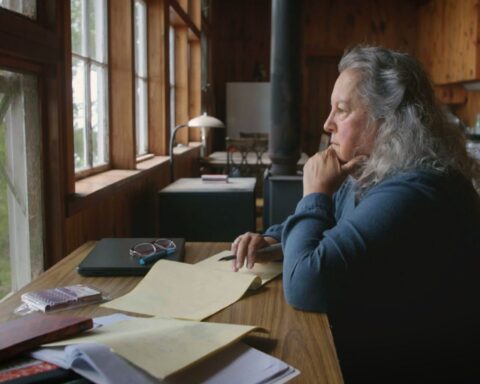



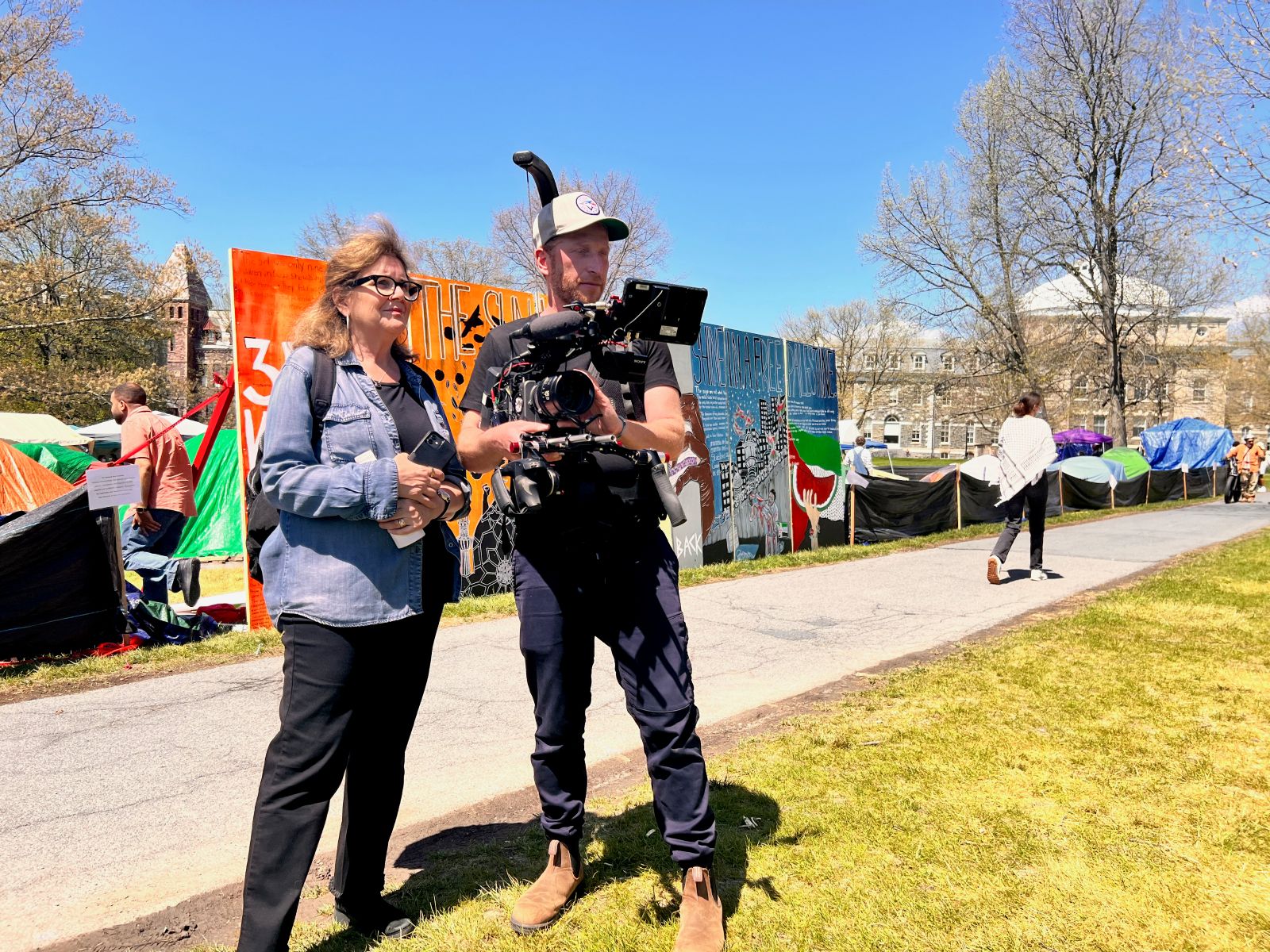

Montreal-born Ric Esther Bienstock is one of Canada’s most decorated documentary filmmakers. In her cabinet are Emmys, Amnesty International Awards, back-to-back Edward R. Murrow Awards and the Gordon Sinclair Award. She is an Order of Canada recipient and, in the fall of 2024, was inducted into the Emmy Awards’ Silver Circle.
I first met Ric when we were both on the executive board of the Documentary Organization of Canada (under its then name, the Canadian Independent Film Caucus). I was awed by her intrepid spirit—she was then about to trek into a deadly virus-ridden zone in the Democratic Republic of the Congo (DRC)—and her sense of humour. It was the mid ’90s, I was just starting my first film, and was on the lookout for new lightweight cameras. Ric found one: “You just have to schlepp to Jew-ville to get it!” I’d never heard anyone refer to a Jewish neighborhood like that, and I howled with laughter.
Ric’s ability to make space for complexity has proven to be the key to her gaining access to so many difficult communities and situations throughout her long career. Her openness to debate and ability to see from multiple perspectives feels more urgent than ever in this contemporary moment so polluted by social media and corrupt power. That atmosphere of censorship and cancellation is the subject of her current work in progress, the feature doc Speechless, which has Alex Gibney signed on as executive producer.

BC: Barri Cohen
REB: Ric Esther Bienstock
BC: You just got the Emmy Award. Congratulations!
REB: Thank you. The first thing I thought was that I wish my parents were alive. It was just an incredible honour being recognized by the National Academy of Television Arts and Sciences in the US.
BC: You also got the Order of Canada.
REB: It all feels very surreal. These are recognitions that come from juries comprised of people that have no personal ties to me. They don’t know me at all, which makes their acknowledgement even more meaningful.
As filmmakers, we may not change the world, but by choosing to work in documentaries, we commit to bringing important stories forward in the hope that they inspire change. When you and I were coming up in this industry, we never really used the word “impact.” But we still focused on organizing screenings in schools, government offices, and with NGOs, hoping to reach the right people who could turn awareness into action.
That’s why I’m incredibly grateful for these awards—not just for recognizing my work, but for affirming the influence and impact it has had.
BC: Tell me about Speechless.
REB: It’s still a working title, but I think I’m going to keep it. It started with an article I read in the Atlantic in 2015 called “The Coddling of the American Mind.” Around the same time, I came across a few pieces in The New Yorker about how students were becoming increasingly resistant to engaging with ideas that challenged or offended them. One example that stuck with me was a Harvard law professor who recounted how some of her students didn’t want to see questions about rape on their law exams because it was triggering. I found that fascinating because when I was in school, we loved arguing and if there was a speaker we disagreed with, we liked nothing better than challenging them with questions.
Now, I’m seeing that some professors, particularly if they don’t have tenure, are cleansing the curriculum of anything remotely controversial because it isn’t worth the risk of getting reported or cancelled. While this kind of tension has always existed in some form, it seemed to be intensifying in higher education. That realization planted the seed for the project.
I did a demo in 2017 about the intersections of free speech, viewpoint diversity, academic freedom, and how fundamental they are to democracy. Mostly I was interested in the impact on academia because that’s where our future citizenry is being shaped. Things were bubbling up and I wanted to see if I could capture that. A lot of people see criticism of academia as a right-wing issue, but that wasn’t my experience. Most of the people I spoke with leaned progressive—and they were feeling the heat just as much.
It wasn’t an easy pitch. I don’t think I fully grasped at the time just how controversial it would be perceived. Looking back, that was very naive of me. Essentially, I was stepping right into the culture wars playing out on campuses everywhere, which meant navigating issues of race, gender, and all the sensitivities that come with that.

There were a handful of people who were intrigued, but ultimately no one wanted to touch it. So I put it on the back burner and moved on to other projects. I produced The Accountant of Auschwitz (2019), then worked on Enslaved (2020), a mini-series about the transatlantic slave trade for Associated Producers. Then came COVID, then George Floyd—both of which had a huge impact on campus life. And, of course, October 7th. With each of these watershed moments, the film had to keep evolving. At its core, it’s about our ability to speak across differences.
We used to have duels to the death. Then we realized that we can use speech to hash things out. Now, social media is where the duel happens, because what you get is a social death, and the fear of being ostracized by your community is devastating, and really compels many people to keep in line—even if they don’t agree.
BC: Given the difficulty of pitching, how is it being financed?
REB: It’s been challenging. I’m very grateful to have the CBC and the BBCinvolved. And I’m working with the Why Foundation out of Denmark. They do a series based around a certain theme every few years. My film is part of their Why Freedom? initiative. It was Alex Gibney who hooked me up. They had worked together on his film, Taxi to the Dark Side, which won the Oscar.
Honestly, being at the epicenter of an Ebola outbreak was easier than this film!

BC: Take me back there.
REB: [My first job was] with Simcha Jacobovici doing everything from office work to budgeting to applications. There wasn’t much documentary production and none of us knew what we were doing. Then I applied and was accepted to U of T law. But an old friend of Sim’s, Henry Gold, ran an NGO that did development projects in Africa. He had suggested that we do a film on Canadian development projects in Africa. So, to my parents’ chagrin, I decided to go to Africa instead of law school. Roger Pyke was the director and the film was called Burden on the Land. At the time, many countries in Africa plagued with AIDS weren’t really acknowledging that there was an AIDS problem. We were able to go in under the auspices of doing Burden on the Land and film an AIDS project under the radar.
We were shooting on film. Thirteen weeks in Africa. I did the budget. I’d never done a budget before. I was just doing the logistics and research and watching Roger direct. I learned on the job. We went to Malawi, Ethiopia, Rwanda, Burundi, Zaire, Mali, Kenya and Ivory Coast. There were no cell phones, no computers. We had to do the research on the ground—to go and find the characters and the stories.
It was just completely trial by fire. We really wanted to film a water project with a Tuareg tribe in Timbuktu, but there were no flights there. So I chartered a passenger airplane with something like 20 or 30 seats but we couldn’t afford it. So I went and stuck up posters at the American Embassy, and the British Embassy to sell plane tickets to Timbuktu. And I sold out the plane!
With documentaries, the people part is really 70% of it. You have to develop trust and a relationship where people actually want to talk to you. There’s always a human connection. You’re talking across cultures and trying to share and laugh together and sometimes cry. So that solidified for me that I wanted to do this.
It was, for me, completely life-altering. And I came back thinking, I want to make documentaries like this. So I deferred my acceptance to law school for a year, and then never went.
 BC: What was the first film you directed?
REB: The first was Ms. Conceptions, and it’s still my favourite. I had a clear idea of the tone and how I wanted to talk about a serious social issue, but it wasn’t so serious that we couldn’t have some fun with the idea of sperm banks and how, if you’re a single mother by choice, you can get pregnant. Today that film wouldn’t land, because we’re now so familiar with these things, but this was 1993, ’94. It came out in 1995. At the time, there weren’t a lot of films without narration, and there weren’t a lot of films that were documentaries that were a little bit funny.
BC: I remember it was very cheeky.
REB: Single mothers by choice was a phenomenon then; it was part of that Murphy Brown moment. And Dan Quayle was negatively commenting on it in prime time! It was in the zeitgeist.
But before directing that film, I produced Deadly Currents with Simcha and Elliott Halpern. It was directed by Simcha. We shot in Israel and the West Bank during the First Intifada. It was theatrically released by Cineplex, which was quite rare for documentaries at the time. We filmed many sides of the conflict. We followed an Israeli battalion, a Palestinian family, an Israeli dance troupe, a Palestinian theatre director, a group of settlers—left wing, right wing, radicalized—and we covered the media covering the Intifada. It was a very honest and raw look at all the currents at play in the Middle East in 1989. The only way we were able to get access on all sides was to park ourselves there for months. So that’s what we did—we rented a couple of apartments and stayed there for around five months. That was my training ground.
The second film I (field) directed was The Plague Monkeys (directed by Elliott Halpern), which won an Emmy. I went to Africa to try and find survivors [of an Ebola outbreak in the 1970s] and to film the missionary hospital in the bush where the outbreak began. I would go ahead of the crew to figure out what we would be filming and to meet people and make connections to figure out content, transportation, food. The next film—1996’s Ebola: Inside An Outbreak—was about a real active outbreak in the DRC. Because I was familiar with Ebola and how it spread and the history of the last outbreak, I was like oh my god, I gotta go. Because Associated Producers had won an Emmy for Plague Monkeys, they were able to get CBC and PBS’s Nova involved right away. It was three weeks after my honeymoon!
BC: It would give many filmmakers and crew serious pause. I recall being floored that you went.
REB: I instinctively wanted to get there. Of course, it was very difficult finding a crew. You’re talking about something really virulent and deadly in a remote area with limited resources. And it’s spreading quickly because, one, as people die, the funeral rites are infecting the rest of the family. And two, people associated the hospital with death, so they didn’t want to go to the hospital.

I told the crew “we’re going into an outbreak, I’ll protect you as much as I can. But you have to be open to doing this. I don’t know about quarantine when we come back.” One crew member started freaking out about quarantine. So we had to let him go and find a replacement to meet us in Zaire. We then flew to Brussels to meet with the Zairean consulate to get the visas to go.
BC: You spent a month in Kikwit, sleeping in an abandoned house.
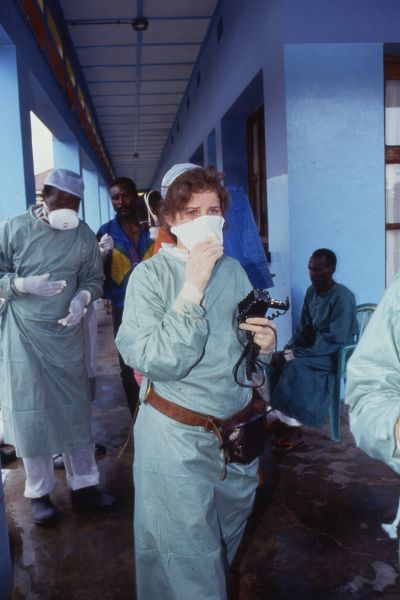
REB: Five weeks. Many news outlets were reporting on the outbreak from Kinshasa, the capital, as there were no flights to Kikwit. There’s no proper airport. So I found a company in Kinshasa that had plantations near Kikwit and I just went to their offices unannounced and said, “I want to speak to the president.” I asked if they had any planes going to the interior near Kikwit. They were heading out in a couple of days in a small plane and agreed to take me and the crew and our gear and to land at the airstrip in Kikwit. So we get on this plane with all our gear and it’s an old Russian plane. It probably hasn’t been maintained in forever. Even the pilot says, “Oh yeah, we’ve crashed before.” We land. And of course, the World Health Organization had taken up every single hotel. But a local contact helped me find an abandoned house. It was just this shell of a house, but I had come prepared for this because I had been there before. We had our own little world. There was a water reservoir on the top of the house and we took a plastic bottle and punched holes in it and that was our shower. And we hooked the house up to the generator so we could charge our batteries.
Once we got settled, I had to familiarize myself with the lay of the land. Basically I wanted to tell a ground zero story of how to contain a deadly outbreak in a place that has no electricity, no running water, no television, etc.
It was very intense. The CDC was there taking blood samples, trying to figure out where it came from. Médecins sans frontières was working with the local doctors trying to contain the virus and isolate people, the World Health Organization was there. Everybody had their role. I’m running around in a t-shirt and a mask on and gloves and I’m trying to get access and I’m shooting. Obviously, initially, nobody wants media around. But eventually, when you’re not a pain in the neck, you start becoming invisible.
There were different people I was trying to embed with, like the local doctors. They’re the frontline but they often got shut out of decision making. So we had to capture the politics of all of that. And then we started finding bodies.
BC: I believe the film reveals that 316 people were infected, and 244 died.
REB: It was misery. The story was very, very tragic. But there was a real tale to tell on how this happens and how the work these people and these groups do is incredible. And you can’t be embedded in that and not become part of the environment. The family members of Ebola victims are camped outside the hospital because there’s no catering in Kikwit so they have to be there to make food for their family members who have Ebola. I would go and bring powdered milk and food. You’re not just documenting, you try and help wherever you can.
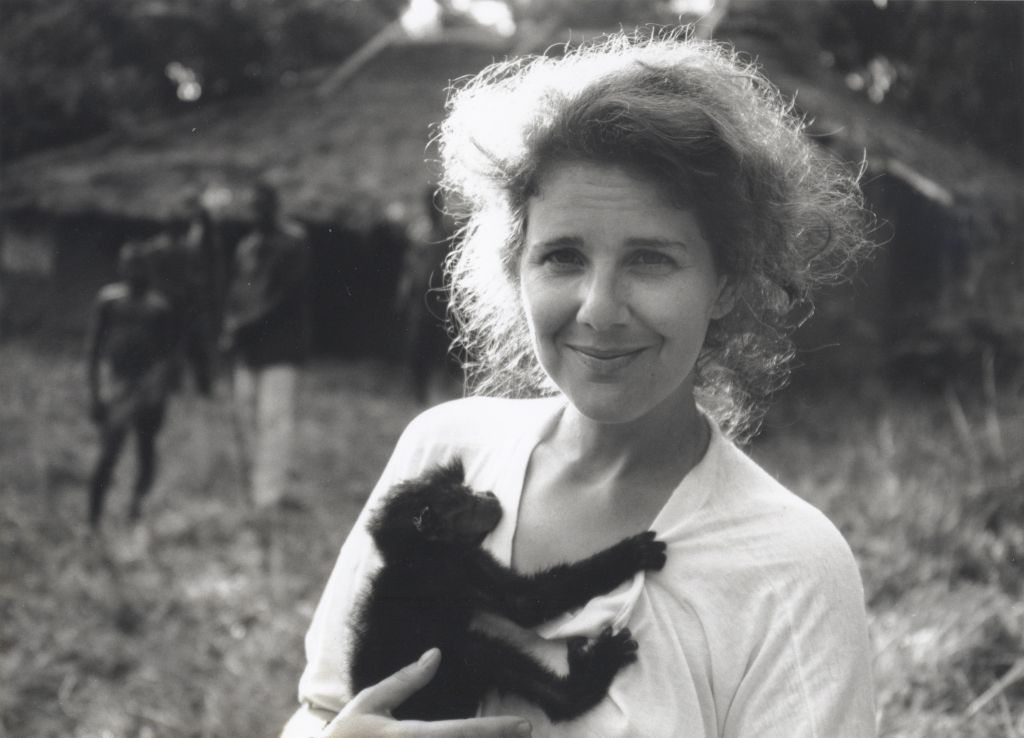
BC: Apart from documentaries about AIDS, those docs on Ebola were the first that I can recall in the English-speaking world that alerted us to the modern way of understanding viruses and their power to infect across continents.
REB: It was well received. I got a DuPont Columbia award for the film.
BC: And then everyone started calling you to direct.
REB: I don’t know how you feel, but even when people came to me, I kept thinking, I’m not going to be able to do this. I’ve always had this imposter syndrome that I can’t do this again.
BC: People ask me after my last film, “What are you thinking about next?” And I’m like, “I’m not thinking about anything. I’m resting.”
REB: I don’t really enjoy the process. I’m miserable when I’m shooting. I’m miserable when I’m editing. I’m miserable when I’m writing. I’m only not miserable when I’m finished.
BC: I do love being on location, the camaraderie and creativity of the team.
REB: I’m glad to hear that. I love the teamwork too, but not the agony to get there! I can get into the zone in the edit, depending on how well it’s going. But the anxiety around the planning and the getting there, it can be so miserable. I’m working with a phenomenal editor now, and I’ve worked a lot with Steve Weslak, who’s been part therapist and part editor for me.
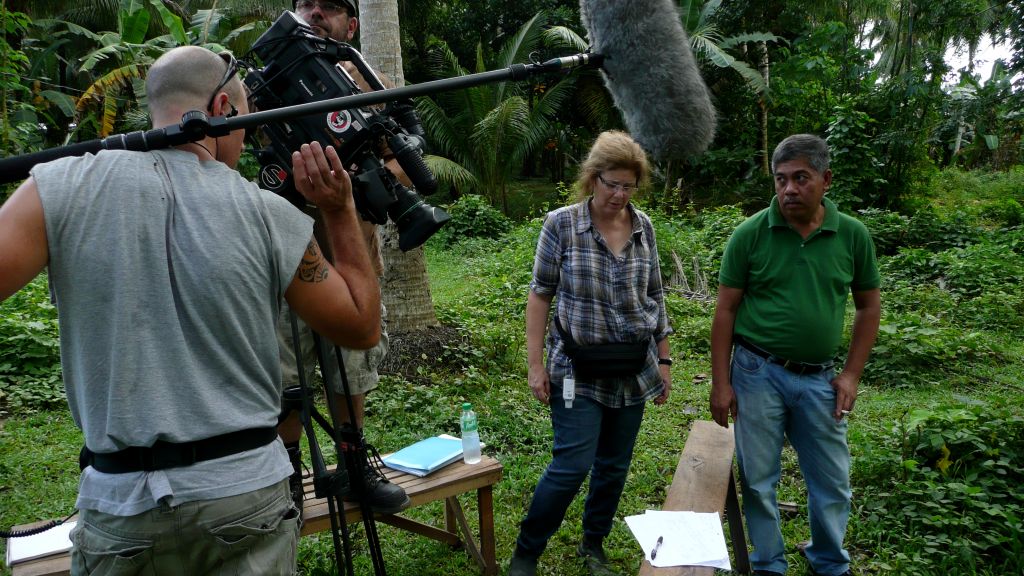
BC: He is legendary.
REB: He cut Tales from the Organ Trade, Ms. Conceptions, Ebola and Deadly Currents. I think he’s a genius and I consider him a friend. He will work with a lot of emerging filmmakers. He’s unique that way. He doesn’t have that ego and hubris and he really tries to get at what you’re trying to do. I credit him with a lot of my success.
BC: If the misery is always there, why are you doing it again? What’s the addiction? To the outcome or the misery or both?
REB: I think you can do a whole separate article on that! It is a neurosis. It’s like having a child, right? And then like childbirth, you forget the pain when it’s done.
BC: You’ve leveraged your humour and sense of irony, but you’re drawn nonetheless to dark stories.
REB: I am. I’m always resistant at first. I don’t want to do it. But Simcha and Elliott were always like “just do it.” And that was important to me. Simcha taught me to think big and international, so we were able to get these films on BBC and Channel 4 and CNN and HBO and really shoot for the stars.
I went from Ebola to porn! I did the Money Shot episode for Barna Alper’s series, The Sexual Century, which was produced by Alex Gibney. That’s how I met him. The thesis of my episode was the mainstreaming of pornography. This was 1998, and I was looking at how porn is the first to adopt and push every new technology.
BC: You have, until now, stayed away from the personal “POV” doc.
REB: People always said, “Your mother was in Auschwitz, don’t you want to make a film about the Holocaust?” But I did not want to tackle something so personal. I don’t know what that says about me, but I didn’t want to, it was too close to home. But then I did produce The Accountant of Auschwitz.
BC: Maybe the distance of producing and not directing it was tolerable.
REB: That was part of it, but also, the producer/writer of that film, Ricki Gurwitz, had never made a film before and she approached me to work with her. And I said no several times, but she was very persistent. She’s very smart and charming, and she was trying to say something new with this film, and she finally convinced me to come on board. The team didn’t have any experience with this kind of documentary, but they did a fabulous job and we ended up with multiple Canadian Screen Awards. But again, I wouldn’t have embarked on that project without Ricki’s persistence.

BC: Can you talk about what hopes you have that documentaries can continue to have impact on people’s knowledge and on discussion and debate?
REB: The two films that I’ve made that I think have had the most impact are Sex Slaves and Tales From the Organ Trade. They were both heavily investigative films on topics of real human importance. They were stories of desperation and of criminal activity. My partner in crime on location for those films was Felix Golubev, who produced with me. I couldn’t have made the films without him. I also have been fortunate to work with incredible teams—Ihor Macijiwsky, Mike Grippo, Peter Swade, so many more. Those guys trusted me and went to the ends of the earth to get the stories we needed.
For both films, I was very gratified by the after-life of the projects. I did a lot of speaking engagements and screenings with law enforcement around the world. I spoke at the Hague and presented to the Danish Parliament. I worked with the US State Department about trafficking and addressed the judiciary in Greece. So I felt that the material was really being put to good use socially. But I had no budget and no team to help at the time. It was very ad hoc.
BC: I don’t think we’ve been very good at funding impact campaigns.
REB: I ran Associated Producers for many years, so I could have the semblance of a normal income and have the ability to do films like Sex Slaves and Organ Trade.
BC: That’s why I ended up making about a hundred hours of series television as a showrunner. And then I burned out, managing just a few times to make films.
REB: We can’t underestimate what it means to have had your hand in doing something meaningful. I’m sure this is a feeling shared by many documentary filmmakers who tackle difficult human stories. Sometimes the experience of making them is very emotionally and intellectually hard. That’s one thing I remind my kids all the time: It’s often hard and miserable to have an interesting life. And I’ve been very fortunate to be able to be miserable making documentaries all these years.