


“Most of them have sacrificed a lot to continue bringing the truth and working for the future of a country to which they may not be able to return to for decades,” observes Julia Loktev. The filmmaker speaks about her comrades in arms who fuel the essential documentary My Undesirable Friends: Part One – Last Days in Moscow. This gargantuan documentary, which now streams on MUBI after making the recent Oscar shortlist, offers an extraordinary capsule of the efforts of independent journalists to safeguard the truth in Loktev’s native Russia. At five-and-a-half hours, the doc flies by as it chronicles the months leading up to Russia’s invasion of Ukraine and the machinery that Putin’s government put in motion to control the flow of information. The film radically reflects the fine line between journalism and documentary as Loktev’s observational reportage captures a collective effort to speak the truth.
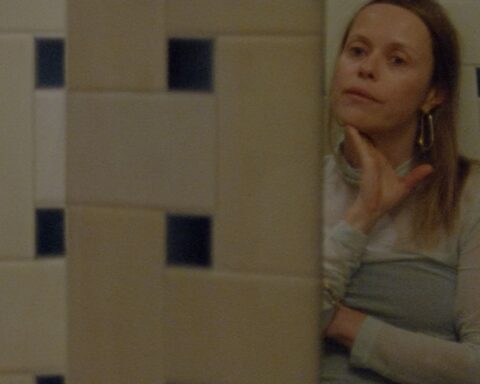
Chief among the participants is Loktev’s friend Anna “Anya” Nemzer, who reports on the progressive channel TV Rain. Anya’s mission is to put on record the voices of Russian activists who fight for progressive causes against the forces of Putin’s regime. However, My Undesirable Friends observes how these journalist operate in the face of state machinery. Putin’s government has escalated its stance against truth-tellers by adopting a Friday night ritual in which citizens are labelled “foreign agents.” This designation upends their lives with constant surveillance and fear with an aim to silence them.
The journalists explain how the foreign agent moniker requires them to label all reporting—everything from TV shows to Instagram stories—as the work of a foreign agent. They must also register themselves as entities and, beyond that dehumanizing effect, submit extensive budgetary reporting to account for every ruble they spend. Despite this targeted harassment, Loktev witnesses a group of devoted persisters as they continue to correct the flow of information even as their country escalates a full-blown war they felt in their bones, but never saw coming. POV spoke with Julia Loktev via Zoom ahead of My Undesirable Friends’ streaming release on MUBI.
POV: Pat Mullen
JL: Julia Loktev
This interview has been edited for brevity and clarity.
POV: You were observing several journalists during the advent of Russia’s invasion of Ukraine. What was that experience like being on the ground as that was unfolding?
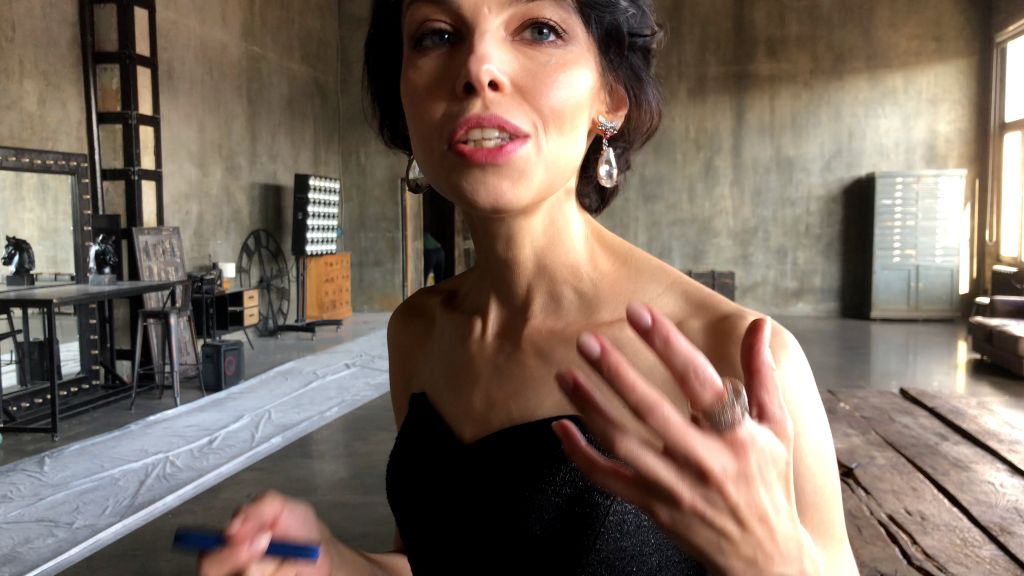
JL: I feel like I had this incredibly rare opportunity to capture history unfolding live through characters that we had already come to know and to live through it with people. All of these journalists were, prior to the full-scale invasion of Ukraine, fighting to speak truth to power, opposing Putin’s regime. Nobody actually thought it was possible—the kind of war that Russia has been waging in Ukraine for four years and more now, the kind of criminal war, nobody could imagine it. Even as people were saying, “This might happen, this is going to happen.” Everyone, and I think that goes for a lot of people in Ukraine too, thought it was utterly, utterly impossible. Bombing Kiev was impossible, even though there had been a war going on since 2014, for almost eight years at that point, which is part of why this felt impossible.
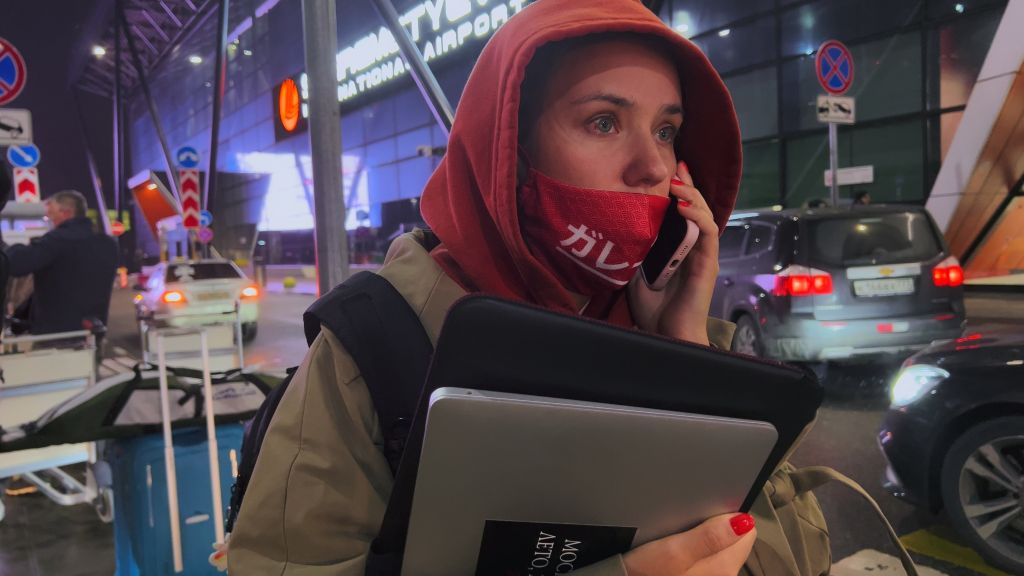
When Russia invaded Ukraine, the journalists that I was filming were fiercely opposed to it. They were mortified, horrified, ashamed. They somehow felt guilty that they didn’t stop it, even though there weren’t enough of them. They all tried to keep reporting. The task at that point was to live another day to keep offering Russians an alternative to propaganda. Meanwhile, the Russian government was making it increasingly impossible to report. Every day there were new restrictions. You had to report only what the Ministry of Defence was saying was true. They would find themselves showing images of buildings being bombed, apartment buildings. And then they would have to have this disclaimer: “The Russian Ministry of Defence says it’s not bombing apartment buildings.” Or they couldn’t use the word “war,” so they found ways of saying “war” without calling attention to it because each day meant you’re getting to report the truth another day. Ultimately, what happened is that Russia shut down all independent media and all the journalists faced a decision: Do we go to prison where we will not be useful as journalists or do we leave the country in a matter of hours so that we can report from outside? As a filmmaker, I had the great honour or fortune to capture it live. It is very rare that you get to capture history unfolding live.
POV: Where might the story have gone had Russia not escalated its activities in Ukraine? Are there stories that are being overshadowed?
JL: Everything changed when Russia invaded Ukraine. Everything changed in Russia. What had been am increasingly fast slide towards authoritarianism turned into full-scale fascism. Everything changed. The Russia that you see in the film doesn’t exist. I captured the last months when it was possible to work as the opposition out in the open in Russia. It’s impossible to imagine that now. It’s hard for me to imagine that world even existed because everything that they are doing in the film, they would be immediately arrested for now.
It changed so quickly. It’s hard to know where it would’ve gone. We’re watching this story where we know what happens, but the characters don’t because they think what is happening to them is some kind of crackdown. They think it’s aimed at them. They keep thinking, “How long can I stay here? Can I work another day? How will I know when it’s time to leave? Is it going to be tomorrow or should I have left yesterday?” All of them are negotiating this through the first months, and the first three chapters are about this building crackdown and people trying to figure out how long can they keep working in their country.
POV: That’s such an interesting aspect of the film, how we know what’s coming and they don’t. You see how the impact on their reporting is a piece in a larger design. With everything we’re seeing now in the States with Trump, are there warning signs from what you observed following journalists in Russia that people should be concerned about in the States right now?
JL: Oh my God, there’s so many warning signs. We’re beyond the warning signs. It’s like a big warning alarm going off. Trump will proudly post on Truth Social all the ways that he has managed to make media come to heel: “Here are all the lawsuits we’ve got against media. Here are the ways we’re threatening to take away licenses.” That’s what Putin did. You don’t start by jailing journalists or assassinating journalists. You start by suing journalists. You start by using all the tools of the state bureaucracy to repress journalists. But so much of what Trump does, including the public shaming of journalists, the attempt to discredit journalists, is an echo of what Putin has done.
POV: As an outsider, how does the foreign agent designation impact the way you tell a story, but then also capture the stories of people who are living daily with that label?
JL: I’m not quite an outsider. I think what allowed me to tell the story is I have this really unique position as an insider/outsider. I was born in Russia. Russian is the language I speak with my mom, but I haven’t lived there since I was nine years old. I’ve visited there, but people are comfortable with me because it’s my native language and they feel at home with me, it seems. At the same time, they have to explain everything to me because I don’t live there. I didn’t live there. It creates, I think, a very unique perspective.
I started out with this idea of these young journalists who were being labelled foreign agents, that’s where the film started. I started with the title that ended up being the first chapter title, “The Lives of Foreign Agents.” It was going to be a film about these young people who had been designated foreign agents and were fighting back with humour and resistance and joy and community. Little did I know when I started working on this film that four and a half months later, they would have to flee their country.
POV: There’s a generational element to the journalists we follow through the film. They’re all quite young or younger, I guess. But can you speak a bit more to that element of the film? We see veteran journalists in some elements, like in Zoom meetings, the New Year’s party on TV Rain, and in Anya’s interviews, and but is this a distinctly new generation of journalists taking on this fight for indie-alt news?
JL: The characters in the film are extremely young. A lot of them are in their 20s, some as young as 23. Our oldest character was 40 when we started filming, and that was an outlier. Everyone else was in early 30s, 20s, mostly Gen Z. They talk about Harry Potter all the time. They grew up under Putin. One of the characters says, “I was in first grade when Putin came to power.” They’ve never known any other Russia, and yet having grown up under this, they still thought that they needed to do something every day to try to change this society to make it better, to speak truth to power.
POV: The participants in the film are now in exile, so what does that mean for the state of journalism in Russia today? What news are people in Russia getting?
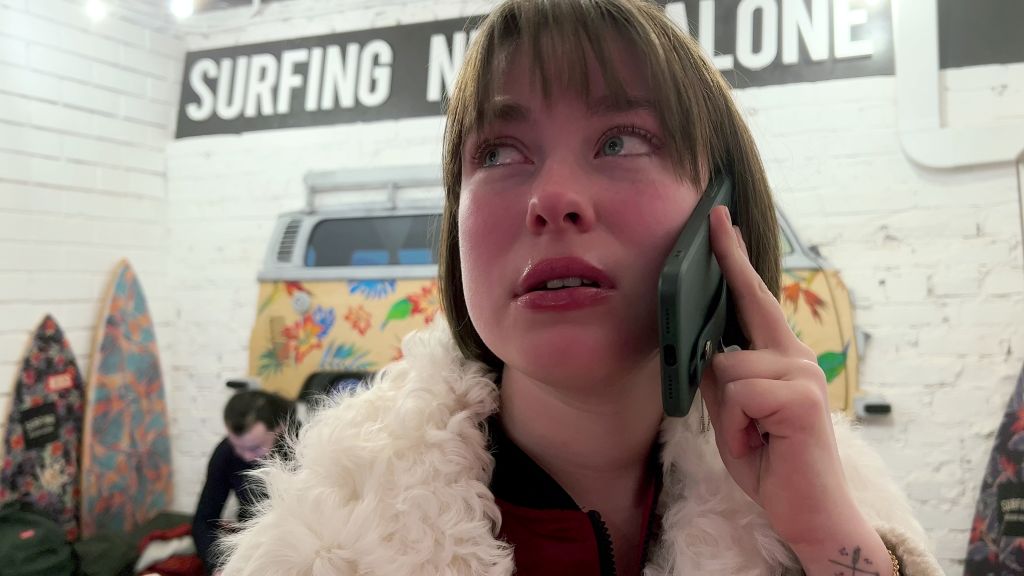
JL: It’s an everyday struggle to get people in Russia the truth about this criminal war. It is an everyday struggle. A lot of these people consider it their mission. They’ve given up their home, their country, the ability to live near their families so that they continue to offer the truth to Russians. Obviously, if you watch state television in Russia, you’re not getting the truth. All of these journalists are now working in exile. They talk about Russian war crimes in Ukraine. They try to give Russians an alternative. Now, of course, it’s a game of whack-a-mole of how people can get this information because they use YouTube, then Russia slows down YouTube; then Telegram, but now Russia’s blocking Telegram. They have their own apps, but it’s a constantly changing landscape.
For example, the last few weeks, Russia has been blocking the mobile internet in Moscow. They’ve just cut off the internet on your phone. You can’t use Google Maps, you can’t text anyone if you’re in the centre of the city. It’s now come back for a while, partially, but who knows? It’s a constant effort by the Russian government to not allow people to get information, and yet people do. People have VPNs, and then the Russian government battles with VPNs. They would like to make it a closed society, and all of the characters in the film continue to try to battle that and get through those walls.
POV: Can you give us a sense of what’s coming in My Undesirable Friends: Part Two?
JL: I kept filming straight through. I was in Moscow during the first week of the full-scale invasion where so much happened. Within a matter of a week, all the media was shut down. All the characters I was filming fled the country, most within a few hours carrying on suitcase. And I joined them a day later. I would’ve flown with them, but I had to stay behind a day because I needed to upload my footage. I didn’t want to come to the border with a drive. So I sat there in hotel with very slow Wi-Fi uploading my last shoots because I didn’t want to lose it. It was really great.
Then I joined them a day later in Istanbul. It was one of the few places they could fly to from Russia because planes were not flying to North America. They weren’t flying to Europe. They still aren’t, obviously.
They have no media. Their media have been shut down, they have no jobs, they have nowhere to write for, and they have no idea what country they’re going to next. Their bank cards don’t work, and yet they feel like they have to get back up on their feet as soon as possible to continue reporting. We start there and we follow all these characters from the first triage days of exile into the longer story as they get back on their feet and continue to report on the war. Most of them have criminal cases against them. None of them can go back to Russia.