



The Pervert’s Guide to Utopias
(Ireland/UK/Slovenia/Netherlands/Norway, 133 min.)
Dir. Sophie Fiennes
Prod. Katie Holly, Evan Horan, Martin Rosenbaum, Shani Hinton, Sophie Fiennes, Jožko Rutar, Miha Cernec, Lisette Kelder, Ineke Kanters, Andrew Grant
Programme: TIFF Docs (North American premiere)
Sickos rejoice. The great Slovenian philosopher and movie buff Slavoj Žižek returns to school audiences on movies and the meaning with life. Žižek reteams with filmmaker Sophie Fiennes for the third part of their big ideas trilogy that began with The Pervert’s Guide to Movies (2006) and The Pervert’s Guide to Ideology (2012). One doesn’t need to have seen the predecessors to appreciate The Pervert’s Guide to Utopias, and going in cold will be as much fun and equally insightful as approaching it after undertaking the forerunners. This series offers must-see enlightenment for cinephiles eager to expand their minds.
Žižek and Fiennes get back into the groove with the third instalment whisking the philosopher to a cabin in Norway. In close proximity to mining and nuclear activities, he imagines the perfect world to counter the apparent end of days that surrounds him. As Žižek begins his playful lecture, he tells the audiences that movies are key to understanding humanity. If aliens ever arrived, he’d pick three films to help them understand the human race.
It’s equally funny and depressing that the films he’d show aliens range from Melancholia to Jeanne Dielman, although the latter might be a great way to test their patience with Earth’s environment. Žižek offers free-wheeling analysis of movies both major and minor that offer entry points to theories of the perfect society. To understand utopia, he generally looks to anarchy, rebellion, and the apocalypse. One can imagine the perfect world by truly comprehending the limitations of society’s present state.
People who aren’t well-versed in movies, however, should brace themselves for spoilers. Žižek drolly advises that a film about the end of days inevitably needs to discuss the endings of movies. So, he notes, if you haven’t seen these films, too bad for you!
A dive into V for Vendetta considers the need for citizens to rise up against authoritarianism, while a segment on The Handmaid’s Tale reflects upon the suppression of women’s rights. Žižek and Fiennes hardly limit the enlightenment to mere textual analysis though. Perverts weaves cultural commentary within the film criticism. Žižek unpacks the pathetic villainy of Trump and contrasts him with baddies from the movies. He says that Trump can’t be a real authoritarian because he lacks moral authority. Meanwhile, Žižek cites the “Women, Life, Freedom” movement as an example of real-world action that these movies could only imagine. He observes seeds of rebellion that could indeed lead to a perfect society.
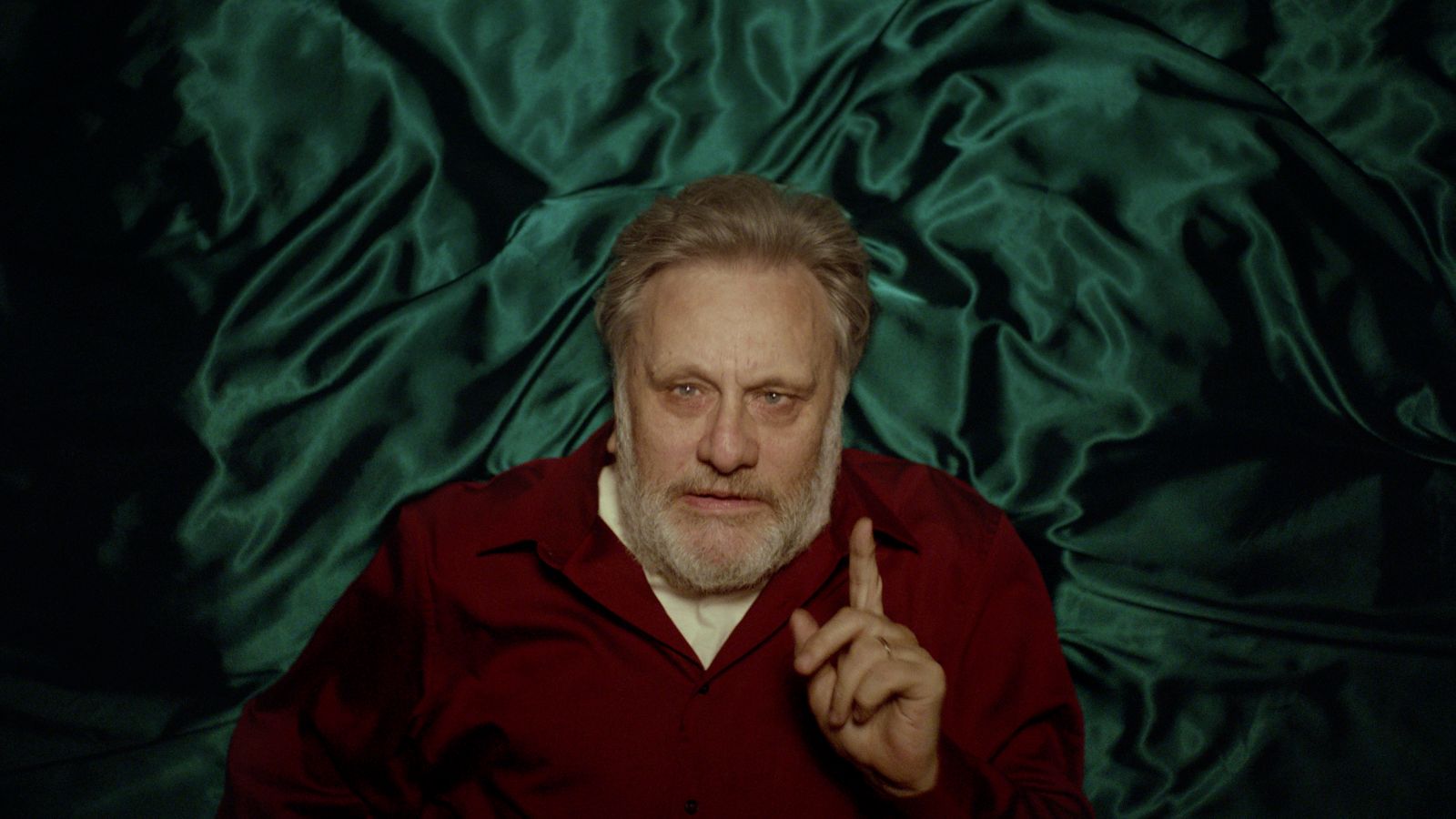
Fiennes proves as playful as her participant, too. The director again places Žižek in vignettes that insert him in the world of the movies he critiques. Sometimes that involves stylish chiaroscuro lighting to evoke the humidity and the horror of Apocalypse Now or classic black and white to situate him within the moral fable of Sullivan’s Travels. Other times, Žižek appears like a fish-out-of-water and invites a great belly laugh from a viewer. After discussing a scene of forced impregnation in The Handmaid’s Tale, for example, the camera views him from a high angle as he lies on the bed bewildered, mirroring Offred’s state of shock in the Atwood series.
Equally likely to inspire a spit take is his look for the Melancholia chapter: a wedding dress and a bathtub. Žižek doesn’t make light of these dire situations. Rather, the humour accentuates the bleak realities that have crossed over from fiction to reality in the years since these cultural productions.
The Pervert’s Guide to Utopia engages with huge ideas through a wonderful sense of play. As Žižek moulds and stretches his cinematic texts like Play Dough to enrich his brain, the film invites audiences to enter these worlds. Whether movies provide escapism or a mirror, Žižek invites us to see them as valuable tools to enter and help us understand the flaws of civil society, as well as the potential for human experience.
He also stresses how movies allow audiences to enter the world of another. Utopias illustrates the surrogate power of movies quite humorously when it brings Žižek to the tiled kitchen of 23 quai du Commerce, 1080 Brussels. He sits down at the little kitchen table with black coffee and a bottle of milk while basking in the quotidian rituals of Jeanne Dielman. His reflections upon Chantal Akerman’s acclaimed chamber drama positions Jeanne Dielman as an ideal text to give the aliens. It’s an accurate reflection of human life and one that illustrates the social systems and gendered roles that define much of organized society.
However, as Žižek muses, Akerman might have given Jeanne’s story more power by tweaking the ending. After Jeanne kills the john in her apartment, Žižek suggests that Akerman could better expressed her heroine’s emotional fragility with a needle drop of “In-a-Gadda-da-Vida” and playing the 20-minute Iron Butterfly in full while Jeanne sits and her dining room table and brings the film to a close. Funny as it is, Žižek illustrates the tiny artistic choices that distinguish kitchen sink realism from gallows humour. By the time he finishes with Jeanne Dielman, he gives that bottle of milk a sniff and finds that it’s soured.
The philosopher relishes the opportunity to expand our horizons anew, and The Pervert’s Guide to Utopias offers an illuminating and entertaining exploration of possible worlds. Žižek clearly has a lot of fun going full Werner Herzog here, too. His thick-accent and deadpan delivery make even the bleakest observations easy to swallow. When the guide to movies and humanity says Melancholia has a happy ending, that says all one should know about the potential for the human race should the aliens ever use the movies to study us. But to Žižek’s credit, the last time I watched Melancholia and saw the world go out with a bang, I, too, was smiling.