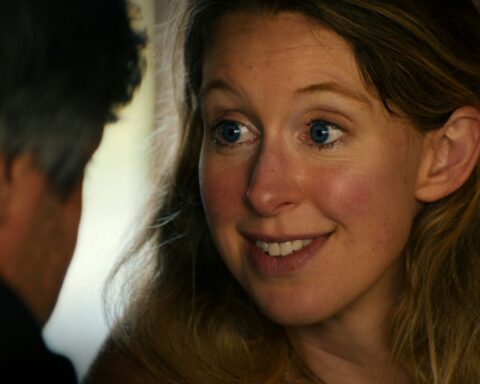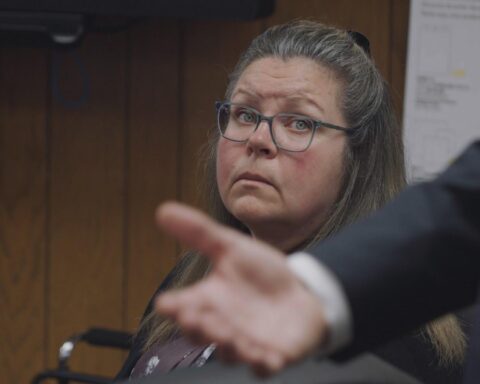



At the beginning of the riveting documentary American Doctor, director Poh Si Teng receives a stern challenge from participant Dr. Mark Perlmutter. The doctor wants to show Teng some photographs of Palestinian children murdered amid the genocide in Gaza. Teng audibly expresses concern. One hears the filmmaker work out in her mind the ethical wrestling match before her. She doesn’t know if she should see the photos just for reference or include them in a film. Dr. Perlmutter, however, issues a stern challenge. He says that to withhold the images amounts to complicity and journalistic malpractices.
Teng shows the photographs. They’re extremely difficult to see, but with Dr. Perlmutter’s pointed view, American Doctor similarly issues a challenge to audiences: to turn away from the evidence is to become complicit in the crimes.
Teng, speaking with POV via Zoom from the Sundance Film Festival where American Doctor premiered in the U.S. Documentary Competition, says that scene took place only on the second day of shooting with Dr. Perlmutter. She admits it was a useful wake-up call. “I had cut it aside to keep for myself as a reminder. You need to show certain things and at the same time you need to show it with dignity, but you have to show the truth as well,” says Teng. However, she says she kept returning to the scene, while colleagues consistently saw it as essential material.
“The camera doesn’t point at my face,” she continues, “but I’m actually crying and I’m very disappointed in myself because as a journalist, for so long I worked for Al Jazeera English. Even at the broadcaster, we would pixelate and blur images to protect the dignity of those who had died and their families, so to be told you are part of the problem, it was a teaching moment.”
The humbling perspective says a lot about Teng, who makes her feature directorial debut with American Doctor after many years on all sides of the documentary and journalism scene, including as a producer of the Oscar-nominated St. Louis Superman and executive producer of the Emmy winner Patrice: The Movie, as well as years as a documentary commissioning editor for Al Jazeera English, the grants lead for the International Documentary Association, and creative director at ABC/Disney, among other roles. Teng says this background finally prompted her to make a documentary of her own after seeing the horrors unfolding in Gaza.

“A year into the genocide, it became really hard to see day in, day out what’s happening in Gaza and then seeing colleagues I respect being targeted and executed,” observes Teng, noting colleagues like Samer Abu Daqqa who were killed covering a war that has been the deadliest to date for journalists with three more reporters killed by an Israeli strike on January 21.
“I just didn’t want to do my job anymore,” says Teng. “I was a studio executive and I was disengaged, demoralized and I just didn’t want to continue.” Teng says she quit her job, grabbed her savings, and decided to make a film to wake herself up.
Instead of looking at journalists, though, American Doctor sees the situation in Gaza through the eyes of frontline healthcare workers. The film follows three doctors—Jewish Dr. Mark Perlmutter, Palestinian American Dr. Thaer Ahmad, and Zoroastrian Dr. Feroze Sidhwa. They hail from different walks of life but are united in their belief to provide care amid the human rights crisis of our time and have made several trips to Gaza to volunteer their services. Teng says she took notice of Dr. Perlmutter on social media and was struck by how “un-doctorly” he appeared in interviews, providing blunt perspectives when asked about, say, the legitimacy of Israeli’s ceasefire pledges.
“I noticed on social media he was going to be a keynote speaker at the Palestine Children’s Relief Fund (PCRF) in New York, and I live in New York, so I thought I would go see him,” explains Teng. “He was there in Sony Hall speaking to a room mostly Palestinians and Muslims who had come to support PCRF, and when he spoke, it was pin drop silence. I realized what an incredible storyteller Mark was. And I looked around, everybody was just in tears.” Soon afterwards, introductions were made and one doctor led to another in a story of personal and collective action.
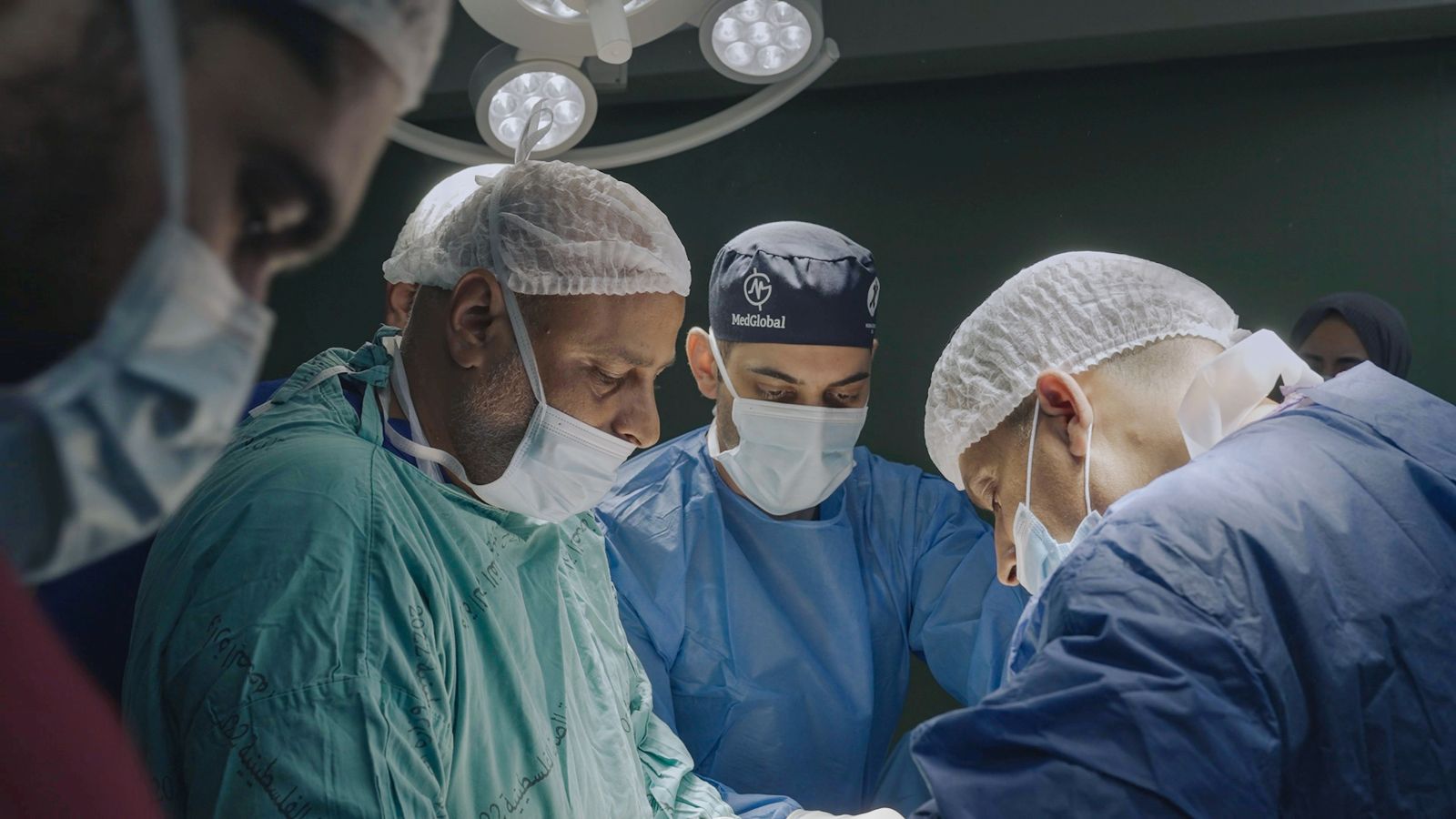
American Doctor observes as the doctors travel to Nasser Medical Complex in Khan Younis. There they busily serve among one of the largest and most heavily targeted hospitals in the Gaza Strip. Between saving lives and providing urgent care, the doctors also become default spokespeople from the war zone. The film sees each doctor give interviews with Western media as they seek to amplify how hospitals are being targeted and children are dying among Israel’s strikes.
“I’ve seen the three of them transform over time because they’re not spokespeople, they’re just regular Americans. They’re just doctors,” says Teng, who followed the doctors from December 2024 to December 2025. “None of them chose this path. They were compelled to do something and over time they got really good at it.” The doctors sometimes fumble with the media, as Dr. Perlmutter and Dr. Sidhwa notably have different approaches with the former being more confrontational with Western media and the latter more pragmatic, while Dr. Ahmad becomes an understated leader in his native Chicago.
Dr. Ahmad’s storyline adds a distinct perspective to the film. He plans to join his colleagues in Gaza, and makes it to Jordan, but he gets flagged at the last minute as a Palestinian American. He’s denied entry even though he’s Chicago-born and raised. Teng says there wasn’t any question of keeping him in the story, and his work for Palestine from outside adds a compelling dynamic about the politics of access for providing care.
“It really broke my heart when it was Thaer who got rejected, knowing the amount that he had shared with me, the level of discrimination that he had been facing,” admits Teng. “He allowed me to film with him at such a painful moment. It was another slap in the face, not being able to go into Gaza and then coming back and being taken aside by Homeland Security even though he’s an American.”
Teng says she didn’t follow the other doctors into Gaza, but worked with them and filmmakers in the field to get the story out there. In the early days, though, she says that Dr. Perlmutter optimistically planned to get her into Gaza as a scrub nurse. “I was like, ‘Dude, that’s never going to happen,’” laughs Teng. “Anybody who does a cursory search in my name would see New York Times, Al Jazeera English, ABC News. This is not a legit scrub nurse.”
But Teng says those credentials, especially with Al Jazeera English, helped her film in Gaza from afar. “I called my friend Reem Haddad [one of the film’s producers], who’s also a documentary commissioner,” explains Teng. “She looked after the Middle East and North Africa and she had worked with this incredible team on the film Rescue Mission Gaza. I asked her, ‘Can we work with this team?’”
Enter Palestinian cinematographer Ibrahim Al Otla and co-producer Mohammed Sawwaf who deliver some gut-wrenching material from the war zone, including one scene that sees a direct hit on Nasser Medical Complex when Israel targets a patient and Dr. Sidhwa narrowly escapes death. He describes the 15-year-old patient he was about to see as having been incinerated by the attack. But that’s the tragic reality: a teenager survives a bombing only to be killed in another one while recovering from the first.
While American Doctor demands that audiences bear witness to these atrocities, it weaves back and forth between the frenzied action in the hospitals and the frustrating on-camera sessions with western media. But while the doctors understand the limited effect that their words may have on the violence they face daily, they make the most of their platform to sway public opinion back home. The film observes the slow progress of public perception on the genocide.
“When I started filming in December 2024, it was a very different time,” says Teng. “I think journalists, mainstream media, they still didn’t necessarily have the language and the right framing to speak on how things were in Gaza. But that’s changed. Even for me filming back then, it was a lonely experience, but six months into it, society changed. Entities changed, institutions changed, funders changed, and so I’m hopeful that the narrative has changed. Social media is forcing its way into mainstream media. And then you have these doctors, and we can all agree: don’t kill doctors, don’t bomb hospitals, don’t target healthcare workers. We can all agree to that, so it felt like the best way to tell the story and to bring Gaza to the United States.”
Teng adds that her experience as a commissioning editor in documentary taught her to consider what’s popular in the mainstream, so over the course of making American Doctor, she kept in mind the Emmy and Golden Globe winning series The Pitt—the intense medical drama about doctors and nurses saving lives in a Pittsburgh hospital. One can see echoes in the shooting and the cutting as American Doctor captures the real doctors in action.
“In my previous job as a studio executive, we watched commercial films, we watched series, and we watched why things travel and connect with people,” says Teng. “There’s something about hospitals and doctors and being vulnerable: every viewer at some point is going to end up there. The human drama there is fascinating.” It’s an effective way to examine the human costs regardless of one’s politics.
The question of politics with a film about Gaza also invites a pressing query for the former executive producer and commissioning editor turned director: At a time when industry feedback says there isn’t an audience for overtly political docs, and distributors are shying away from tougher films, especially docs about Palestine, how does one navigate an increasingly apolitical climate for what is an inherently political art form? Teng says it was a matter she had to confront throughout production.
“When I started, I knew nobody was going to back the film, at least not in the early days,” says Teng, acknowledging that docs often struggle for backing in early stages unless one has deep connections. “Even for somebody like me, I think I am experienced. I knew this was going to be hard, but I’ll be honest, I didn’t think it was going to be that hard. It was harder than I thought.”
However, going “all chips in” with her own savings and navigating her network in the documentary community, Teng says that funding came together with a lot of dedication and sacrifices from the crew, as well as some trips home to her native Malaysia where peers gave their support for the project. Over time and as the documentary evolved and public perception of the situation in Palestine shifted, people saw the urgency in the project. Confidence grew and she got the support of Hamza Ali from Watermelon Pictures, a label devoted to stories of resistance, along with support from bodies like the Center for Asian American Media, the Doha Film Institute, and the Sundance Institute.
“People are not afraid. We can see it for what it is, what’s going in Gaza,” observes Teng. “I went out to all my friends and contacts from various jobs. I was like, ‘Help us together. Let’s make something. This is the genocide of our time. Can you give?’ And people willingly gave.”
Teng, sporting a button during our call that reads “Free Dr. Hussam Abu Safiya” to raise awareness for the Palestinian pediatrician who was kidnapped by the Israeli military in December 2024, hopes the film inspires audiences not only to have compassion for those whose lives are affected overseas, but also to understand the complicity at the local level. “I just wanted to honour him and tell everybody who’s come to watch our film that we need to stand up for healthcare workers,” says Teng. “Ultimately, American taxpayer dollars are being used to buy 2000-pound bombs to drop on children, and that the United States government is supporting an ally that’s blocking lifesaving aid and resources into the Gaza Strip, and that’s allowing a military to detain pediatricians. Is this who we are? That’s not who we are.”