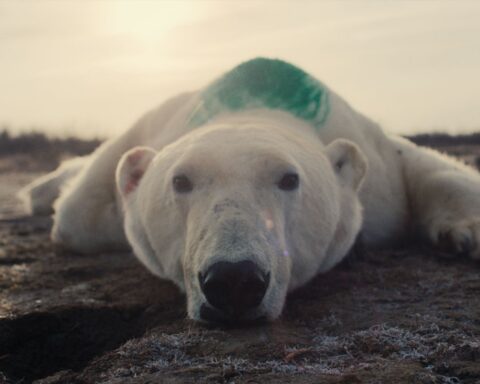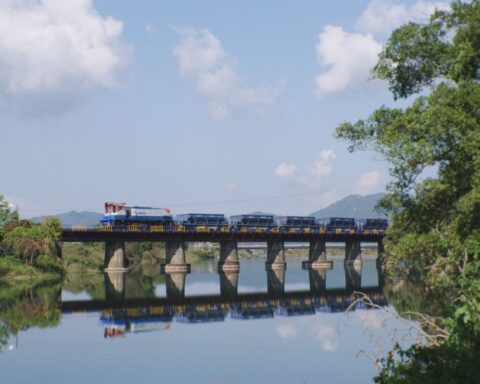



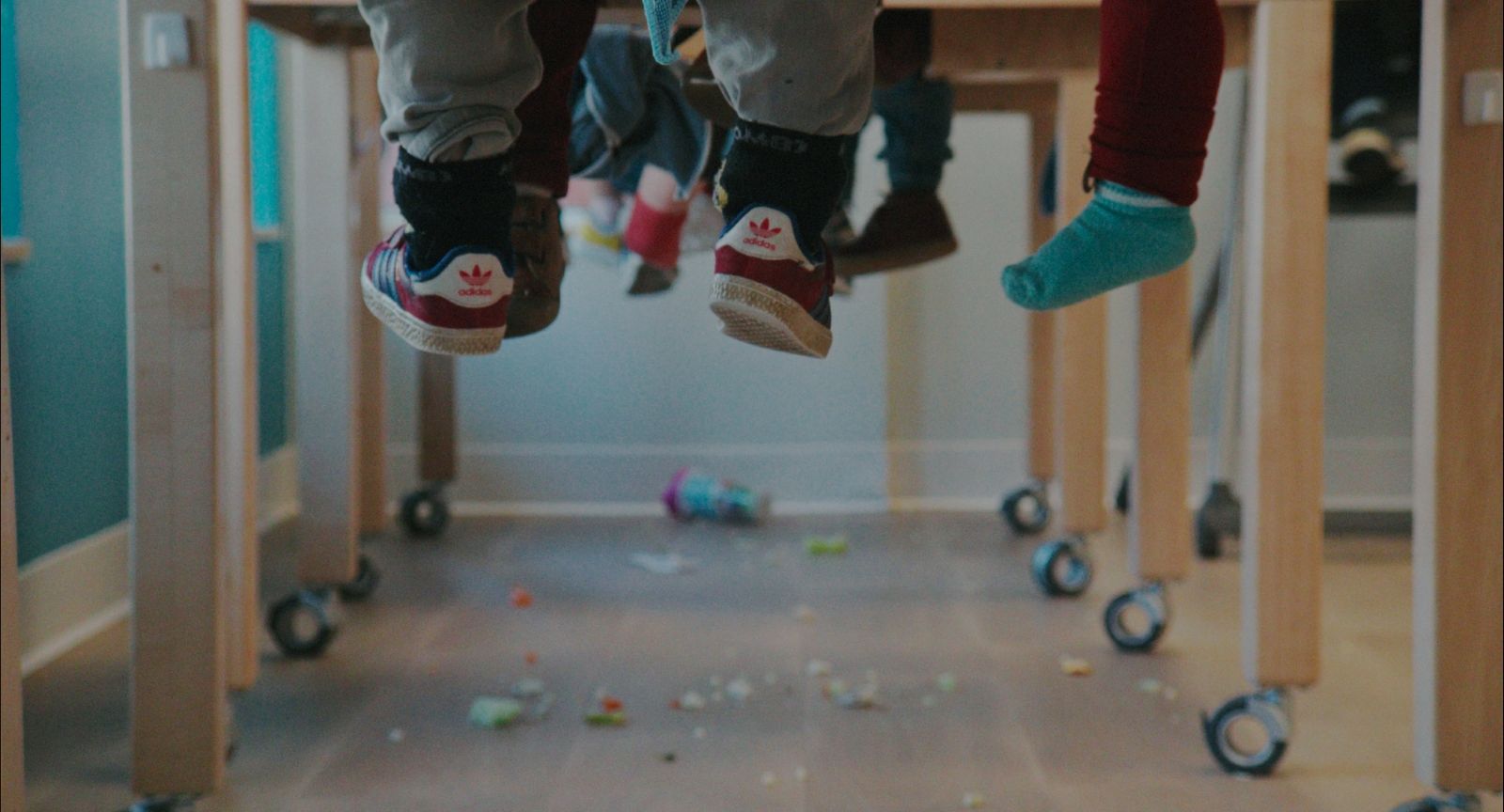

The word kindergarten, deriving from a German phrase meaning “garden of children,” was coined by the pedagogue Friedrich Fröbel, who believed children should be nurtured like plants and that play is essential to the expression of the development of their souls. That astute observation is quickly evident in Kindergarten, the new feature from Quebecois filmmaker Jean-François Caissy, who has been making a series of observational films about the significant milestones in life for over 20 years including Guidelines (2014) and First Stripes (2018). From late winter to early spring, Kindergarten pays close attention to children across various age groups in a kindergarten in Montreal, capturing their violent fights and fits of tears, their moments of private joys and glimpses of their maturity.
Nicolas Canniccioni’s vivid cinematography—which often utilizes zooms—and Jérémi Roy and Guillaume Bourque’s swooning score immediately lend the observational film a lean, youthful tone that provides a glimpse into the evolving minds of these children. The film delivers delightful surprises, as in a toy dinosaur lying in a melting patch of snow, or a shoe sole that lights up the partial darkness of nap time, or that feeling of washing your hands of acrylic paint that has begun to dry. For 84 minutes, Kindergarten becomes a portal to nostalgia and of unique insight: permitting us to witness humanity at its most primal, pure and free.
Although Caissy’s interests have ranged from adolescents navigating high school (Guidelines) to a retirement home community (Journey’s End, 2010), this film—limited by its younger participants—pushes his cinematic language further than before, relying on deep patience, fast instincts and a deliberate focus that mirrors an inner isolation within us. His films bring to mind the work of documenteur Frederick Wisemen, but rather than turn his gaze towards institutional functions, Caissy’s distinctive—and engrossingly sensitive—behaviourist approach favours the shot rather than the edit to craft his argument. What emerges in Kindergarten is a slice of life returning us to a state of curiosity and a period of incessant growth, where faces are kicked, chalk is eaten and tears dry on their own. Here, even the littlest things, like a loose string in a glove, evoke total wonder.
POV spoke with Jean-François Caissy via Zoom ahead of Kindergarten’s Ontario premiere in the Canadian Spectrum section of Hot Docs.
POV: Nirris Nagendrarajah
JFC: Jean-François Caissy
This interview has been edited for brevity and clarity.
POV: First Stripes—the previous film in your on-going “Lifetime” series—observed a group of civilians becoming soldiers. How did you go from the military arena to becoming interested in this stage of infancy?
JFC: For me, every new film is a reaction to the previous one. A few years ago, I did a film about elders (Journey’s End) and afterwards I had to do something with teenagers (Guidelines) just to have other options to work with while filming. So, after doing a film with the Canadian Armed Forces, which has this very rigid environment and structure, I needed some sort of chaos, but beautiful chaos. The kindergarten gave me that option.
Of course I’m doing a series about different stages and milestones of life, and I’d long wanted to do a film to do with early childhood. Actually, during the process of shooting First Stripes, I became a father myself, so I had done the research for daycares in my own experience of becoming a parent.

POV: Is your child in the film?
JFC: He was supposed to be, but then the pandemic arrived so we had to stop everything. I was supposed to shoot Kindergarten at the beginning of 2020, when we were doing some test shooting, but we had to stop for two and a half years. By then my kid had aged-out of the film. But he does have a small cameo actually, at the very beginning, during that montage of the landmarks. At one point you see a submarine and there’s a kid running, that’s my kid. He was helping me out with those shots.
POV: How did you choose where to film? What were you looking for?
JFC: I went to visit quite a few places during the scouting and I was mainly searching for two things. The first was the physical aspect of the building: I needed space to be able to be a bit further and not too close to the subject. The other thing I wanted was the lighting and for it to have these big windows to get natural light, which is important to me. I was also looking for some enthusiasm from the people there, the director of the centre and also the staff. I know how demanding it can be to shoot a film like this, I have the experience and it’s days and days of shooting. So I really needed them to be on my side and enthusiastic about the film.
The place I chose is called CPE [Centre de la Petite Enfance] La Ruche. CPE is a [non-profit, government-subsidized] daycare in Quebec and “La Ruche” translates to “bee hive.”
POV: Some of the windows are hexagon-shaped.
JFC: Yes, some windows are like that. I went with them because they actually have two buildings. There’s two places on different streets and I was able to shoot in both buildings. For me it was a way to get a bigger pool: more people and characters to play and work with. We wanted to be able to leave them alone sometimes and go to the other building so that we didn’t take too much time and space with one of them. Because I know how busy it can be at the daycare, we didn’t want them to feel that we would add an extra stress on the day-to-day routine. We would shoot two days in one building and then go to the other for the rest of the week.
POV: What were the conversations you had with the parents and children prior? Why did you decide not to pay attention to the staff as well?
JFC: Usually, when I shoot a film, I tell people one basic thing: “Just do as if we’re not there.” Of course, we talk a lot and we create this relationship where they trust us and we share so many things. But when we finally begin shooting, they do their own thing. With the kids, though, it’s not possible to do that. For the parents, I actually wrote an email and described what I intended to do with this film. I included links of my previous films and I was quite surprised to find that a few parents actually knew my work, which was very touching. So they understood what I was trying to do.
As a parent, we are quite used to signing release forms when one of our kids goes to kindergarten or school. We get that paper at the beginning of every year agreeing that your child will be in pictures. Of course, mine was much more elaborate for the film, but the kindergarten staff actually took care of handing out the forms to the parents and about 95% of the parents agreed to it, which is quite a large amount of a positive response.
It was much tougher to get the release forms for Guidelines because we were working with teenagers, whose parents still have to sign for them. I had given them the paper and those papers were buried in their school lockers. It never found its way home in order to get back to me. But for Kindergarten it was surprisingly easy.
POV: When I heard about your film, I thought about the work of Frederick Wiseman. But when I saw the film, I quickly realized you have a different approach. You decide not to attend to institutional matters. Why?
JFC: For me, it was clear from the beginning that I didn’t want to make a film about how the daycare operates. That was 100% clear because I’m not interested in that as a filmmaker, and as a cinephile as well. What I wanted to do was to observe kids outside of their home without parental control looming over them. I wanted to film them in a place where they could be with other kids, since kindergartens are their first sites of socialization.
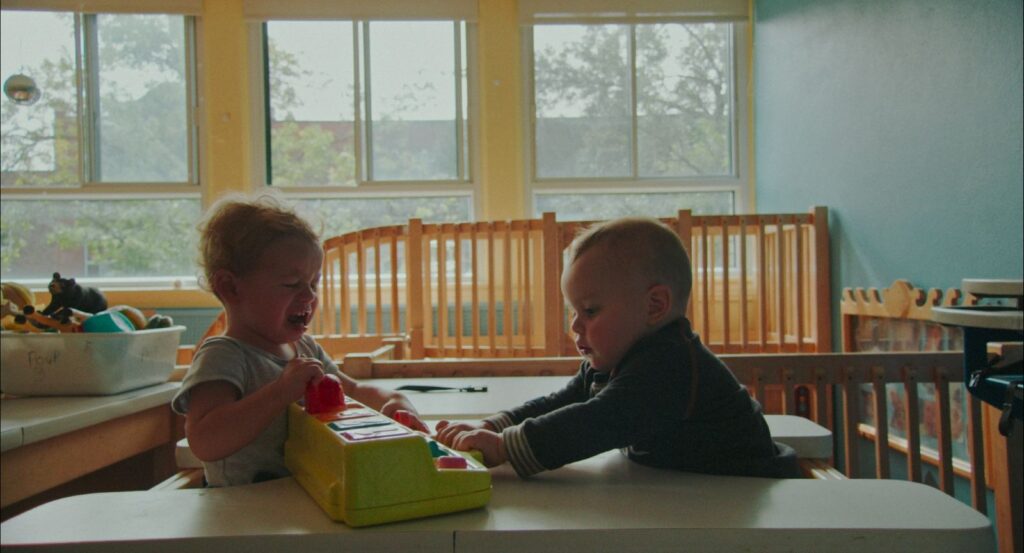
We hear the workers, we see them, their hands, and we have a sense that they care. But by explicitly deciding not to include them, we could focus on the single individual and be able to focus on the bubbles around their minds. In my previous films, I usually have these wide shots that include many people, but for this one I’m getting very close, isolating them within the frame so that we can capture them reacting to the surrounding world.
Of course, if you do a wide shot in a kindergarten, with 10 kids at the time, there will be five kids staring at the camera the whole time. The idea was to isolate them and to—as an adult—leave behind all the preconceptions that we have, to let ourselves go and try to imagine what they see and how they would react to things. Often those kids are seeing objects and encountering situations for the very first time in their life. I wanted to capture that.
POV: What were some principles that you and your cinematographer Nicolas Canniccioni had in place as you began to shoot? When did you know it was time to look away? Who decided when to zoom in and out?
JFC: I’ve been working with Nicolas since the beginning of my career, for over 20 years now. This is our fifth film together. He knows how to react when I do weird signs with my hands or gesture with my face. Technology has progressed a lot nowadays. I do the sound on the film too, so I am able to see the live image from the camera on my cell phone, which I attach to my recorder. As we were shooting I could see the image from the camera and I didn’t need to be behind Nicolas like I had in the past. I could be somewhere else seeing other things. What we did for this film was I put a small microphone and Nicolas had some headphones so I could talk to him. Often I wasn’t saying anything, because Nicolas is amazing and we have a similar sensibility, but sometimes I would direct him, saying, “OK, slowly go over there and move that way,” like in a fiction film. We were able to work like that and I think it worked quite well for Kindergarten.
For instance, there is a scene when the toddlers are facing each other fighting over a toy. Nicolas and I were quite close to each other for that one. We were stuck next to the wall, but for this moment Nicolas wanted to stay on the kid because, at some point, one of the kids pulls the toy and before he drops it behind him, he’s still holding it, not strong enough to put it back on the table. Nicolas wanted to stay on his face because he was saying, “No, that’s amazing, there’s so much happening on his face right now.” But I said, “No, pan down to the toy. I want to see the toy falling down.”
POV: The film begins with a montage of notable sites in Montreal and the Quebec countryside, and it is framed by this back-seat view of a girl going to and fro the kindergarten. What were you and editor Mathieu Bouchard-Malo’s intentions with this style of weaving the footage?
JFC: The film follows the seasons. We tried not to interrupt with the natural flow of things, because it would be too disturbing. The film starts with the young ones, and as we go along the age group changes. The first 20 or 25 minutes are focused on one-year-olds and afterwards we move on to the taller kids. That was the main idea. I don’t know if you noticed but the aspect ratio of the film also opens up slowly.
POV: I hadn’t noticed!
JFC: So it starts nearly square—a 1:33:1 ratio—and every time there’s a switch with the age it opens up in accordance with the musical transitions. By the end it’s a full frame: 1:85:1 ratio. We wanted to mirror the fact that as they grow up that their vision of the world is expanding in that space.
Whenever I start the research process of a project, I always try to find ‘keys’ that help me structure the film. It could be, for instance, the car rides in the back-seat, which we shot a lot of, actually. There was this idea, in the beginning, to structure the film with that, so that after 20 minutes we would go back to the car and ride home with another kid. There were many different things I tried to find prior to shooting to give the spectator a structure to hold onto. In other films, it’s been phone calls that have helped provide some information about what’s going on. Those are key scenes that I try to place in different places in the film. Of course we had to shoot a whole bunch of those scenes to realize that we only needed two of them. Somehow, for us, the film is framed as this big journey, like a big day.
As for the intro, with the landmarks, I wanted to show the contrast between macro and micro. The children’s universe is so small but they live in a much bigger universe. Places like the Olympic Stadium are quite extraordinary, but they also look like toys somehow. We wanted the audience to see as the kids do, as if for the very first time.
POV: There is an important argument that develops, which has to do with possession and ownership. We see it, at first, with the infants, who fight over a toy with no language capacity; then, with a stick, we get the language and the tears; and finally there is a block to build homes that sees the development of this theme on natural human behaviour; a central metaphor really. When did you realize this would be the core of the film?
JFC: I knew the film would circle around their relationships with each other, because they have to learn that from scratch. I was interested in digging into that. For instance, at the beginning, with the very young kids, they don’t play together. They sit next to each other but they don’t really play together. They sometimes want what the other wants and we are of course also like that as adults. I had read about it and I saw it in my own kid as he grew up and I thought that it was going to be a great metaphor. As they grow we’d noticed that they slowly start to want to play with others because they understand that the other one has something to give them.
While filming, we discovered a whole bunch of those moments, and I was happy, at the very end of the movie, when they build this big tower with oversized LEGO, that they do it together. It’s the first and only time in the movie that they do something together and that’s the end. They go to the next stage, they have their graduation, but when we saw that, when we filmed that, I understood and thought: “I have enough material to be able to play with this, to work with this, to craft an evolution with that.”
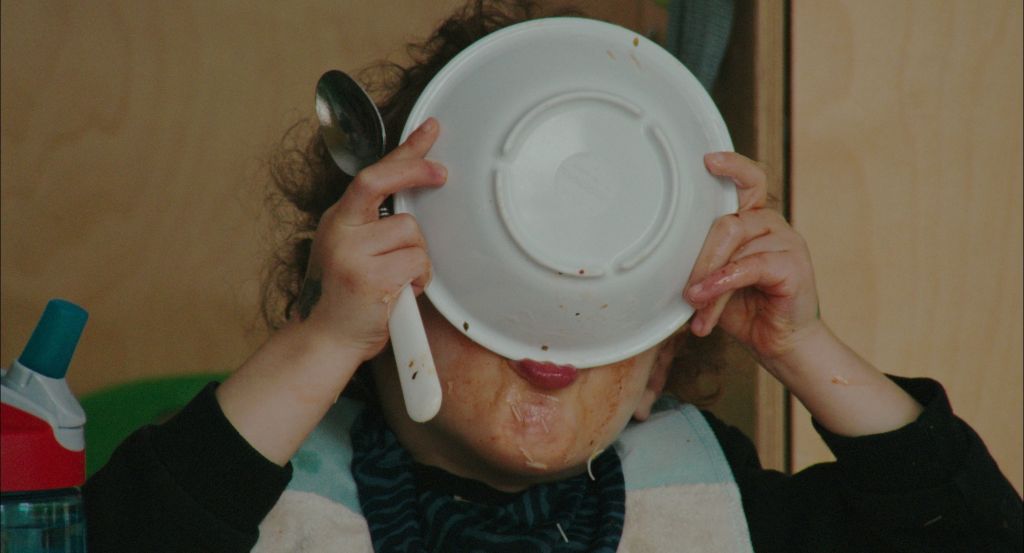
POV: The children cannot offer consent, thus a film like this necessarily poses an ethical question: do you intervene when something is happening? When the children fight, they often look up and into the lens, seeking adult intervention to help resolve this crisis they are experiencing. How do you contend with that very distance that makes the film so compelling, but draws us to consider the ethics of spectatorship?
JFC: It’s funny because I’ve heard this before. Some people feel it is as if I am a war photographer in the kindergarten. For the children, it is a war in a sense, but [they’re] arguing over a toy or fighting with each other. But I was more interested in seeing how they could solve the problems by themselves, and, oftentimes, they are able to do that. As a parent and as caretakers, we often have this impulse to overprotect them, but this is something we must learn: to let things go a bit, to a certain extent. I wanted to see that.
There were actually a few instances when I told the daycare people, “Let’s wait and see what happens.” Quite often, nearly 100% of the time, the kids can solve the problems by themselves. You learn by doing that. For me, those scenes are like finding gold, because they are more engaging for an audience. We know that the kids are going to be dealing with it and that the fire cannot just be extinguished by an adult. Life is hard and we have to deal with different problems. It translated to real human behavior for me.
POV: What surprised you about making this film?
JFC: They act and react like we do. Of course, there are many behaviours that come from imitation.
POV: Like when the girl puts the wooden block to her ear and talks into it like a cellphone.
JFC: I was very happy when I captured that. This comes from looking at their parents, and some behaviours are from that, but there’s also a part of them, deep inside, that is intrinsic and instinctive. We are born like that. To me, it was very challenging and beautiful to see the difference between imitating older people and what we have inside of us. The day we’re born, we want things and then we come to want the things the other has. These are behaviours we carry with us all our life and try to contend with, to find our place in society and to be civil for others. To be a good person. We have to come to learn that, but we really don’t know that from scratch.
Many people who worked on the film at different stages, like the foley artist and such, would say: “Oh my God, they act like us.” It was so amazing to see how they think and it’s quite surprising. It makes sense, but it was interesting to see that they’re a raw, miniature person and everything is already there. They just have to learn how to deal with their emotions.

POV: Earlier you said that every film is a reaction to your other films. What is on your mind for your next film?
JFC: I want to keep working on this series. I actually have two projects and it’s the first time I’m working on two different projects at the same time, but I’m working on a film about adult life. The working title is Film D’Adults (Adults Film). I’m very enthusiastic about this one. And I’m also working on an essay about sports and it will be called In Competition.
POV: Watching the film, I was reminded by a line in a poem by Louise Glück: “We look at the world once, in childhood / The rest is memory.” Is there a childhood memory that emerged while making the film?
JFC: I actually have like a pretty vivid memory of that period in my life, even more than my teenage years for some reason. I remember moments, places, objects, people, and I think it somehow reflects on how I currently make films. But I do have a memory that connects with Kindergarten.
When I was very young, I used to pass by this old motel called The Ranch Motel. There was a big plastic cow on top of it. This place had a big impact on me because I liked to stare at the cow and, approaching it, I knew where the cow was before I would arrive. I was always on the lookout for it. This is maybe at the beginning of my kindergarten years. And the landmarks that we see at the beginning of the film—the Olympic Stadium, the Orange Julep and those dinosaurs—it did remind me of that moment in my life. What’s funny is that, later on, as I grew up and I started making films, my own grandmother moved into The Ranch Motel, which was no longer a motel because it had become a retirement home. The cow was gone.
That’s the reason why I shot Journey’s End in that place, because this building and the cow on top of it had a big impact on my childhood. I guess there’s always connections like that and I try, as a filmmaker, to follow those instincts and those connections that life gives me. In Kindergarten, with those shots, it’s coming from this souvenir.
POV: That’s crazy.
JFC: I know it’s weird to start a film like that, but it was something I had to do. When I heard the song that I used (“LOUNA’s iNTRO by DOMi & JD Beck) I instinctively thought: ‘That’s the opening and I’m going to do this.” So it started with hearing that song from that American jazz band.
POV: And finally, Jean-François, what would you tell your childhood self?
JFC: Besides giving me some tips for the stock market, I would simply observe myself and try to see what part of me from today is still present there. I would be curious to see what kind of person I was, so I would not tell myself anything, but I would just like to observe and see how I really was, because that would be so nice, no? I’m 48 now and I would be so curious to see how I was and see how my behavior and whether or not I’m still the same person. Something as simple as that.