


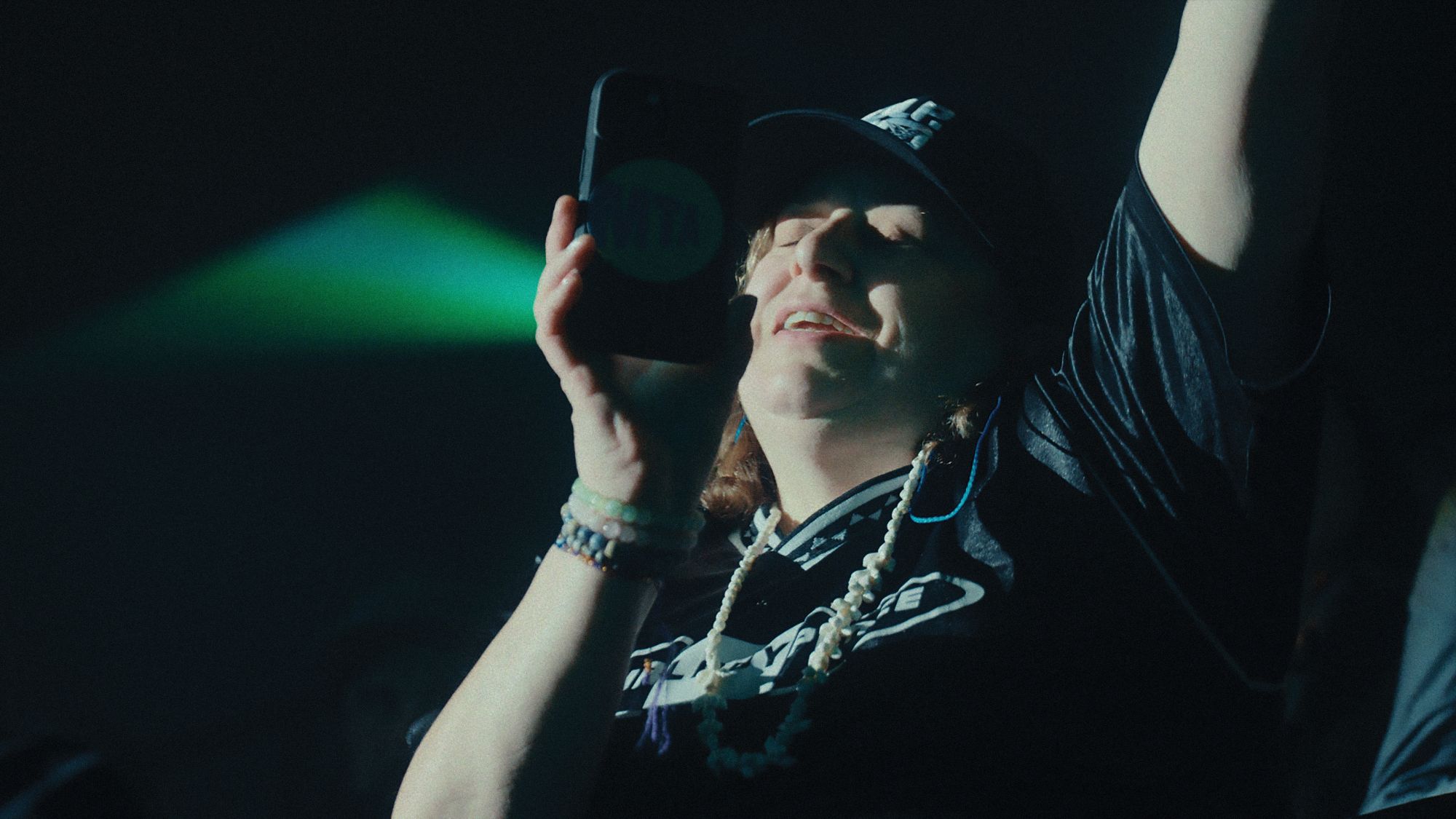

There was no bigger divide at this year’s Toronto International Film Festival than the paltry description in the programme book and the glorious film than that for Michael Maxxis’ Gail. Describing it simplistically as the story following one fan’s journey through a leg of an Our Lady Peace tour may be an accurate take superficially, but this rich, warm, extremely engaging film is far more than a mere précis can convey, and is truly one of the great music docs of the age.
As POV’s Pat Mullen noted in his review, “The film harnesses an infectious sense of joy by observing Gail as she follows her passion,” providing an “endearing window into the band.” Yet her passions and complexities go well beyond one Canadian ‘90s-era rock band, speaking to deeper issues that bind artists with their fans, with what’s owed to those that give their all to the objects of their fascinations, and so much more.
POV spoke to Maxxis following his film’s premiere at this year’s Toronto International Film Festival.
POV: Jason Gorber
MM: Michael Maxxis
POV: How did you get involved with the project, and how did you find Gail?
MM: It actually all originated with the band. They were wanting to make a documentary commemorating the band’s 35th anniversary, but they didn’t want to make a traditional live show doc. And so Raine Maida sat on it for a couple of weeks, and then it kind of hit him to follow this mysterious fan. His wife, Chantal [Kreviazuk], actually called me first and said Raine’s about to call me and he has one of the best ideas he’s had in years. She’s never done that before, and I’ve worked with them for years.
Raine called and said they have this fan in New York and that I am going to be really interested in her. He knows I love characters, I love idiosyncratic stories. He knows I love pretty locations and we’ve worked a lot on location. I did a video with him and Chantal in New Orleans. I’ve shot a lot in Memphis and Detroit. Raine and I are friends and he knows I love these underexplored places that are textured with mysterious histories, and the characters you find out there in the real world. My family has the most extreme characters I’ve probably still yet to meet!
POV: When did you first connect with Gail?
MM: We setup a Zoom call, and within two minutes, I was hooked. She took the call on the front steps of her three story walk-up in Yonkers in New York. It’s at night, it was foggy, and this place had this cool paint-chipped vibe, green glowing windows. She cried a couple of times early just under the pressure of expectation of making something on her and her relationship with Raine, and immediately seemed complicated. And then another resident of the building tried squeezing past her and she told them off and I just thought, “Oh, my God, this person has all of the ingredients you need for good drama.” She creates tension instantly, and is very unpredictable. I knew she was going to be fascinating to follow and explore and learn and shape something around. But at first, my initial instincts for what we’d make were so different and so inferior to what we ultimately made.
POV: So what were your initial instincts?
MM: My initial instincts were probably conventional clichés. This lady, 60 years old, lives alone in the Bronx, loves rock and roll, listens to Our Lady Peace by herself, doesn’t have a TV or anything. She travels across Canada in the dead of winter by herself. This very portrait, tableau based film, bleak, remote landscapes, silent, lonely dinners in diners in Saskatchewan and Manitoba, waiting in the long lines behind the venues by herself to wave goodbye to the band, kind of writing in a notebook, very kind of cliché, beautiful, patient, snowy, visual film. I had no idea what was in store when it comes to the real Gail and how much more exciting and dynamic, confrontational, strong, bold, philosophical, she is. I don’t know if I said complex, but complex. She’s prophetic.
POV: Complicated.
MM: She’s complicated, yeah. And for someone who sets out on their own to create so much connection and friction and interaction with people and the environment is incredible. She was just a gift, and it was all real, that’s how she is. It took a while to figure out the best way to capture it beautifully and cinematically, but we did and I feel really good about how that all came out.
POV: Can you talk about some of the roads that you went down that didn’t, and how you ended up with this? Was it during the editorial, was it during shooting?
MM: It was during shooting. I went there with all of these preconceived notions. I developed instincts over 20 years of doing music videos and preparing to do narrative features, so breaking down films I love for years.
POV: What films?
MM: Midnight Cowboy is one of my all time favorite films, but I’m a big Cassavetes fan, I’m a big Fellini fan. 8½ is, to me, the most perfectly designed film of all time, Wong Kar-wai, Days of Being Wild, the way that’s covered, it is organic and there’s a lot of handheld shots, but it’s totally designed, I’m fascinated by the blocking and the staging and the ways it’s covered and how everything is lit perfectly although it feels naturalistic. I love the quirky idiosyncrasies of Buffalo 66, of Alexander Payne films, and, ironically, Jason Reitman films. There’s a tenderness, charm, as well that I find exists in all of those films that’s essential to me.
POV: How did these influences then play out, and how did you dial some of your initial instincts back?
MM: I had these kind of ideas baked in, the type of locations I wanted. I did all of this research. She’s in the Bronx, she told us she’s preparing for the tour, and that’s one of the reasons she didn’t want to shoot it. She needed three weeks to prepare. That immediately had me interested, as what are you doing to prepare? She said she had to get her hair done, to get her nails painted with OLP colours, to launder her OLP gear, to put her mail on hold, and to get two teeth pulled. So this is everything to me.
My favourite film is Rocky, so here we’ve got our Rocky montage. But I also love all of these kind of more indie, dark comedies, and we’ve got that now, all of the ingredients for the perfect story. I did all of this preparation in locations that match my preferred aesthetics, by bringing in the Wong Kar-wai elements. I researched this turquoise-walled Puerto Rican salon with the ladies with long fingernails and got permission to shoot there. I found the perfect old Angel Heart diner from Alan Parker’s film, from one of my favourite all-time directors and filmmakers and films. I found all of these locations that matched Buffalo 66, the kind of bleak streets and dreary locations in Yonkers, which is not built up like Manhattan.
I showed up with Gail and I said, “Here’s where we are, here’s where I want to shoot the nail scene, and she’s, like, ‘What?!’” She had an instant explosion or resistance, like a paroxysm. “No, I’m not letting anybody touch my hair! Nobody touches my nails except my stylist! I’m not doing this! I’m not doing this!” She had zero patience for me interfering with her routine and her life.
POV: And here’s the difference between you making a music video about her, or directing video rather than allowing the subject to continue. The difference between fiction and non-fiction in a nutshell.
MM: That’s it. I wanted to make a music video with her in my mind, or a fictional film. I’d ask, what about this cool diner I found? She’d say, “Uh, no way, I’m never going there again. One time, they shortchanged me, they didn’t put chocolate chips in the chocolate chip pancakes and they wouldn’t refund me. I’ll never step foot in there again.” So it was really tense.
She’d telling us we can’t shoot at [her] work, we can’t shoot at her house, we can’t shoot her doctor appointments, we can’t shoot at the dentist, we can’t shoot anywhere. So all she’ll do is some interviews and that’s it. She’s not willing to budge. So we go to pick her up the next morning. She says be there at 6:00am. She comes out at 8:30 in the morning and says, “I can’t shoot today, I’m late. We need to go to a specialist appointment that just popped up.”
What followed was the cliché sleepless night. For the first time in my life, I considered quitting something. I was mad at the band. I felt like they set me up, that they weren’t really transparent with what they were sending me to work with. I love challenges, crazy challenges. I’ve shot in jungles, I’ve shot in swamps, I’ve been surrounded by alligators. This was harder than all of that. It felt like it was going to collapse.
And then the sleepless night led me to the realization that I just have to trust Gail. I just have to go with what she says, let her lead the way. I had to let go of all of these little cool shots that I wanted to do, and all of this perfect lighting through dirty windows, all of this stuff had to just be flushed, and just trust her leading the way. And I told her this the next day – I called her and there was an immediate thawing that took place and she lit up and she said, “Ok, let’s do this.”
She began inviting us to follow her places. And all of a sudden, all of the locations for the most part that weren’t available, were available. She was willing to sneak us into her work. We had to do it respectfully, and shoot from across the tracks and do things, but it was better because we didn’t ever put the cameras in her face, which allowed for her to just be herself. It turns out her stylist and her salon were a million times better than the one I would have faked because the things she has to say with the people that she’s known for 20 years helped tell the story. The lady doing her nails says how long have you been following these people, 20-something years? That says so much more than just some quirky Puerto Rican turquoise-walled salon with blasting music. It’s way more authentic, way more interesting and true.
As soon as we did that, things opened up, and her world is interesting. Her locations are spectacular. The places she does eat at are beautiful and her work is stunning and very cinematic. She just led us down a path that I could have never imagined. When Gail’s leading the way, it’s much more unpredictable than the production that have it all planned out.
POV: I’ve noted that I think this is the Grey Gardens of music docs.
MM: It’s one of the greatest compliments I’ve ever received, honestly.
POV: You are creating something that is unafraid to show the beauty of this person’s humanity, but her incredible, deep flaws as well. It’s an incredible rumination on fandom, parasocial relationships, all of these things. I’m wondering at what point in time in the production did you realize that you are seeing something here far more than simply a music documentary, far more than just a character piece, but something fundamental about mental health, about all of these other elements that are coming into play, which are way beyond you trying to make a band look good?
MM: First of all, I never thought I’ve gotta make the band look good. I only thought I want to make a Michael Maxxis film. My notes that I refer to constantly are full of story reminders, stuff I’ve learned over the years on set for how to interview people or how to compose things, or how to communicate with actors. First and foremost, I just wanted to make the film my way and follow my heart, not follow my mind. I was led by my intuition and feeling the entire time and trusted instincts that have been developed over the years for creating the aesthetics and the technical craft of the filmmaking.
Now, when it comes to the deeper themes that were revealed, we see ourselves in our protagonists and in stories. What I started to see in Gail was actually someone who was wholeheartedly devoted to something that seems absurd to the rest of the world and everyone around her. Well, that’s me. From Edmonton, business school, raised in a very conventional way, no exposure to independent art of any kind, until I started discovering it myself in my early 20s. I have walked the same path. I also see the virtues I aspire to in Gail. This is not me just trying to hype Gail or gloss over the depth or the complexities, but to celebrate her constancy, her childish perspective and playfulness, her toughness, her adventurousness, her curiosity. These are all things that I aspire to and when I feel I embody these qualities, I’m at my best as an artist and as a human being.
POV: But do you also see her jealousy, do you also see her inability to recognize when good things are happening and only thinking of the things that didn’t happen? Are you able to see in yourself, that maybe believing that one is so close to a piece of art that somehow the artists owe them something, do you see that in yourself as well?
MM: Every project I’ve done over the course of my life, it appears for a reason, and it’s a mirror. And it’s a mirror of the things that you need to work on the things that need to be sublimated I think. And not just unconsciously, so yes, I see those qualities. With Gail, after this spectacular premiere weekend we just had, with the band, with her, with the producers, all of the fun, all of the recognition, the celebration, the incredible response, I got a text from her yesterday that she wasn’t in one of the photos and she felt left out and disappointed that she wasn’t there and it was a complaint. And it was a photoshoot she missed because she was late for the premiere. And it was a photo that took place right before the screening. So, yes, that is a fascinating quality of hers. [Laughs.]
POV: It would have been easy to soften Gail’s edges, or to lean into them further. You seem to have pulled of the balance between her flaws and charms perfectly.
MM: I like the balance. I’m not interested in pantsing anybody. Also, there’s not one rotten foul thread in this film of sales, hype, promoting the band. It’s unbelievable, because they’re a commercial alt-rock band. I directed a bunch of music videos, and a film that has not been released, and then now I’m making this about a fan that they didn’t really know who’s never been on camera, and they put a lot of money into this. That’s a wild, crazy investment and concept. That’s what excited me and my creative team about it being Our Lady Peace and the approach that they were embracing. They didn’t think themselves out of the idea, out of the creative instinct.
POV: Docs are always reshaped in the edit, yet this one seems to have some unique challenges.
MM: A lot of docs are created with archival material shot over periods of time. This was shot in sequence from beginning to end. The “Odyssey of Gail” started and ended, and that’s what we shot. I didn’t just ask her every question on day one. I had made a lot of notes, I had all sorts of strategies for when to ask her what, but we just shot it, and some of the things she talked about, like seeing art in her room and tying it to a photo of Raine, that just happening to be the night before the concert where she has front row seats. That was just divine intervention.
There’s a few of those moments that came together like that, and the editor shaped some of that a little bit, but it was really kind of there. Our editor, Cole Grom, was brilliant. One of the executive producers, Shane Reid, was a seasoned and successful editor and was very involved in the cut and post. They had tremendous ideas for how to open it. That cold open? I wouldn’t have thought of that. It introduces the film with this poetic, internal experience of Gail, and then it’s like, boom, we’re into the outer reality. We tease the inner world, but now we’re in the stark outer world of the New York Bronx subway and we don’t know her yet. Another big piece that happened in postproduction was the music and the commitment to classical score.
POV: That’s the beauty of documentary. If you had an actor being Gail, it would feel forced, but the way that you capture her with the symphonic grandeur of her incredibly simple environment. It’s a beautiful decision.
MM: And you say you can’t make up Gail, just the way she watches the band, and she’s watching them like a mother watching her child play hockey. Like with pride.
The classical music is representing her inner experience. As an only child and someone that spent lots of time alone traveling, eating, and loving it because of the inward feeling where you’re sort of adrift in your own world and it’s just an amorphous sort of thinking and feeling experience that has highs and lows. That’s what that sort of music allowed, to create that feeling. We bring in the band’s music when she goes to the concert with her friend. So there’s intention behind those music choices too.
POV: This is a film that almost didn’t happen.
MM: We went out for funding and were denied, and it looked like it wasn’t going to be done. Three weeks before the shoot the band said they would pay for this themselves.
POV: How did Jason Reitman get involved as a producer?
MM: Our producer Shane Reid, Natalie Allan, and Jason Blumenfeld have worked with him. Jason Blumenfeld was first AD on Juno. Shane edited the last Ghostbusters film, and oversaw our post. Once we had a cut that we felt was locked, we suggested a screening at Reitman’s house. We took it there, he loved it, and he said Gail right away is one of the most fascinating characters he’s ever seen in a character-driven doc, but the film’s not done. There’s work to do. A lot.
We cut for another four months, with Reitman giving us notes and also coming to the edit suite, sharing some of the family secrets, which again, more treasure, life-changing for me. This cut would not be the version we see today without his influence and without Shane and Cole. It would have been a little more deadpan, it would have been slower, more awkward if I was left to my own devices.
I really realized you can’t leave a director with final cut, because this final version is so much better.
POV: What’s it like to see this journey on the big stage here at TIFF?
MM: I sat beside my wife and beside Gail and her friend Shirley who joins her in Ottawa. I was surrounded by this crowd, and experienced the laughter at the right points, the right kind of fun. It was warm laughter, ranging from the obvious jokes to people howling at the subtle ones, which are the most satisfying to me, or comedic beats. It was great hearing Gail and her friend laughing as much as everybody else in the theatre, to me is the most important thing.