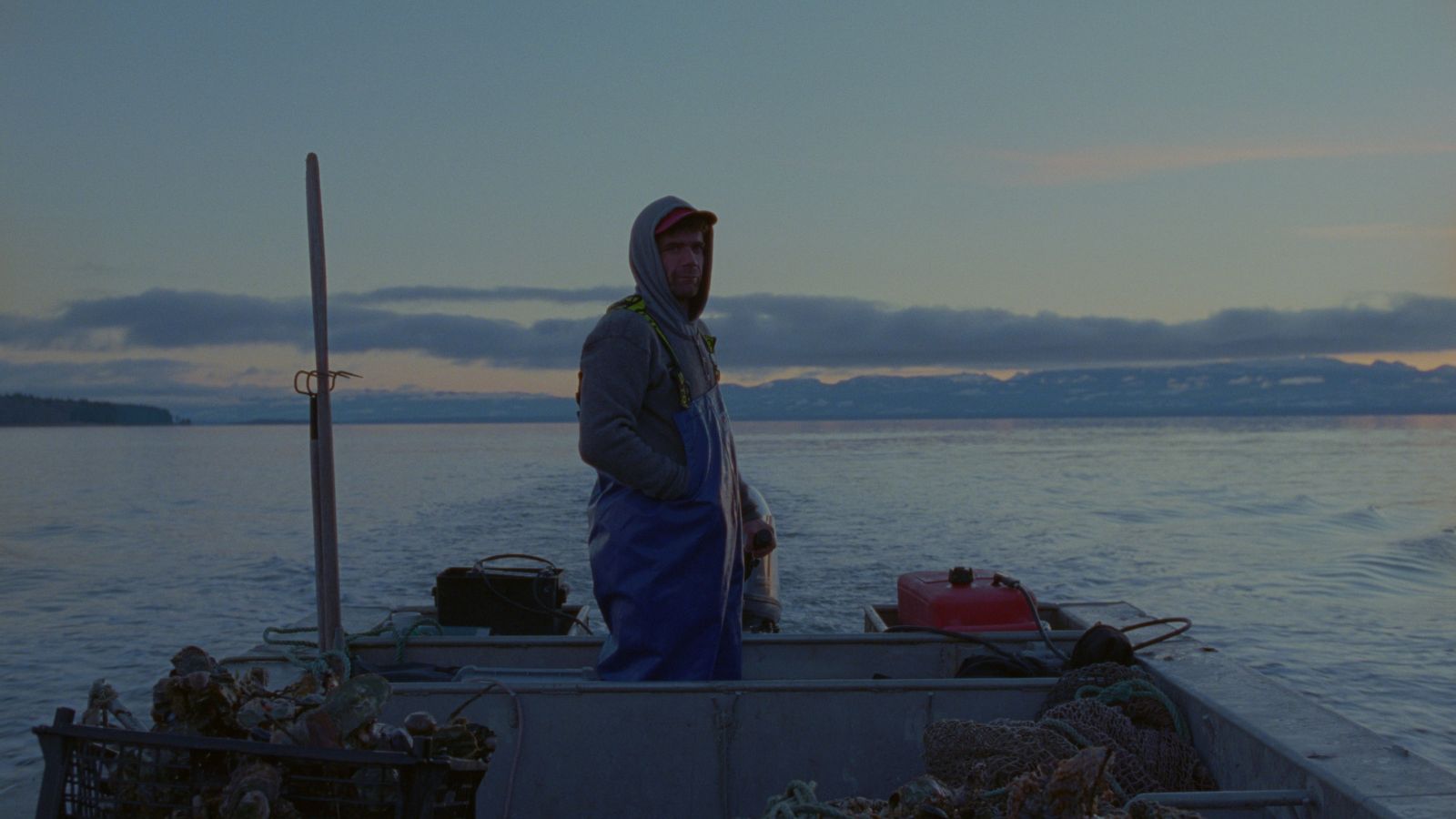



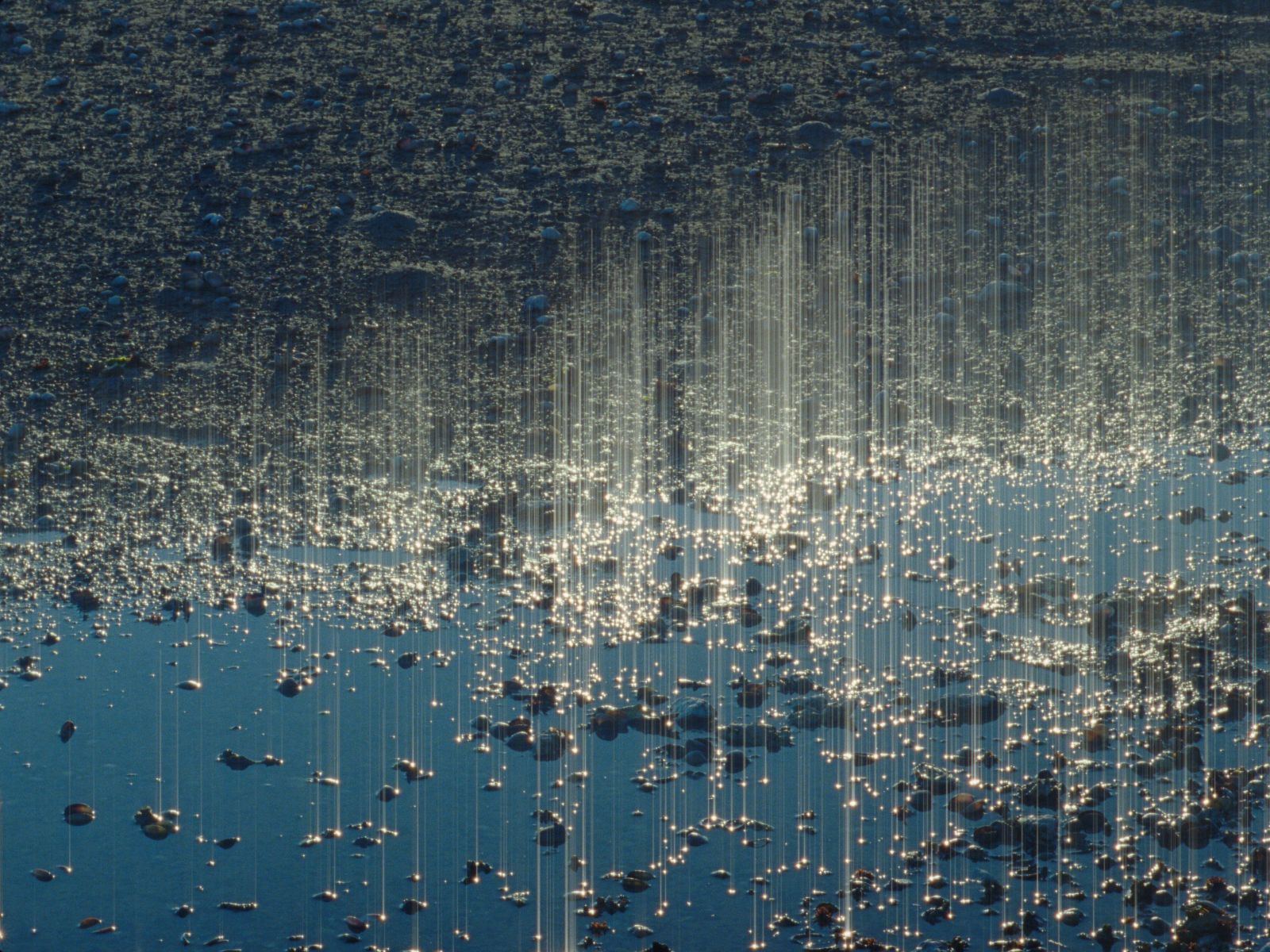

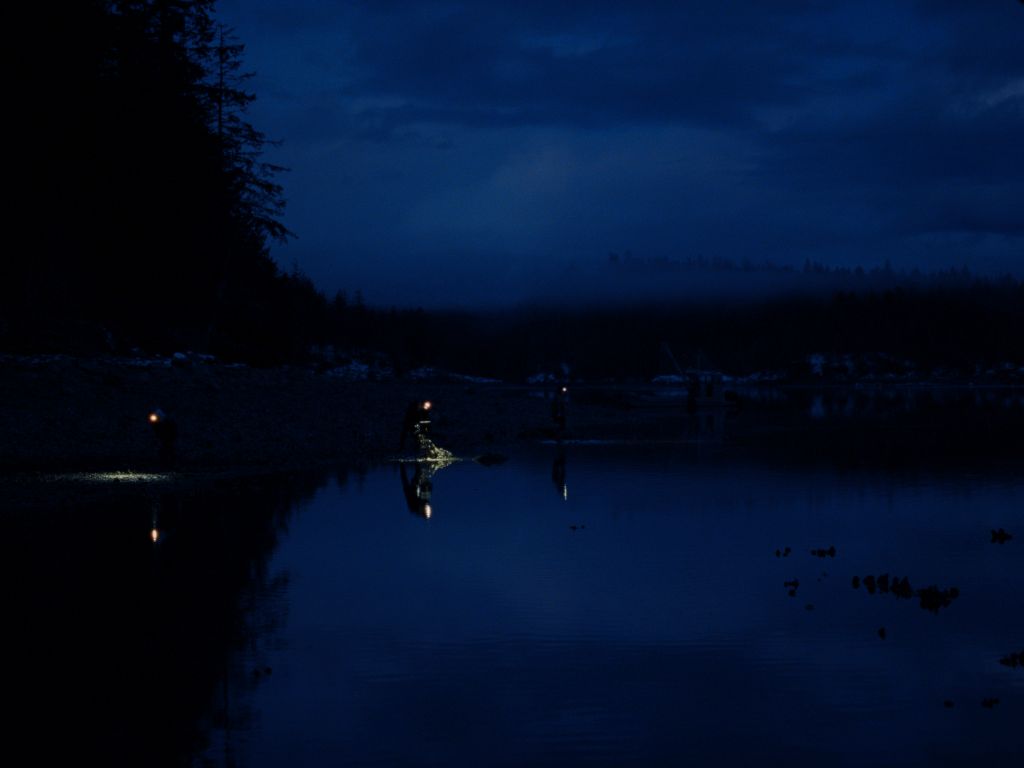
At night, Cortes Island, located off the southwest coast of British Columbia, is a thing of spectral beauty. This perception patiently comes into focus—along with the light—in the opening scenes of Concrete Turned to Sand, the sophomore feature documentary by Jessica Johnson and Ryan Ermacora, which premiered at Hot Docs and screens at Vancouver’s DOXA Festival. In this part of the world, in the winter months, the tide is specifically very low at night, so the waters of the Salish Sea creep onto the shore shimmering, enveloping the Pacific oysters in its wake. It is only a matter of time before the gumbooted farmers, with their headlamps, arrive along the periphery and begin filling their nets.
“Jessica is in that shot,” Ermacora tells POV. “She’s one of the people with the headlamp on. I remember I was standing on a mud flat with this sixty-pound camera that had a thousand-foot magazine on it and everything was sinking into it. I couldn’t lift my leg, so I started leaning back because of the weight of the camera and our assistant, Ryan Clough-Carroll, was nearby. I called for him as I was falling in slow motion, and about to dump the camera but, at the last second, he swooped in and saved it before I fell back in the mud.”
In Concrete Turned to Sand, Johnson and Ermacora, who have been making films together for over a decade, turn the probing, structuralist powers of their cinematic imagination onto the workers of Cortes Island and Bee Islets: a collective of oyster farmers making a living through their relationship with the landscape. With one dazzling image after the other, the film observes the natural rhythms of Cortes and the stillness of the farmers’ routines, and unobtrusively suffuses information about ocean warming and acidification that has had drastic effects on the local aquaculture vitality.
“You can’t point at something and say, ‘this is climate change,’ because it’s so large,” Ermacora says. “In a film like this you could try and have a heroic story about someone fighting climate change, but, in reality, it’s impossible to fight it as an individual. For us it’s more interesting to look at the little aspects of the world where climate change manifests itself and this is just one of those pieces. But you’re not seeing the whole, because you can never see the whole.”
***
As with their 2022 debut feature Anyox, which explored a ghost town impacted by mining facilities, the filmmakers turn their gazes toward environmental resilience and the peripheries of industries. When asked about what attracts them to these particular contested landscapes, they share that their relationship develops during an extensive pre-production process. “We really do like scouting a lot,” Johnson said. “Before we had even started filming we would canoe around this lagoon. We would go out, harvest oysters and do some clamming on our own. Spending time in that space was a really interesting way to see the tide filling the lagoon back in. That was a very impactful experience, spending night after night there.”
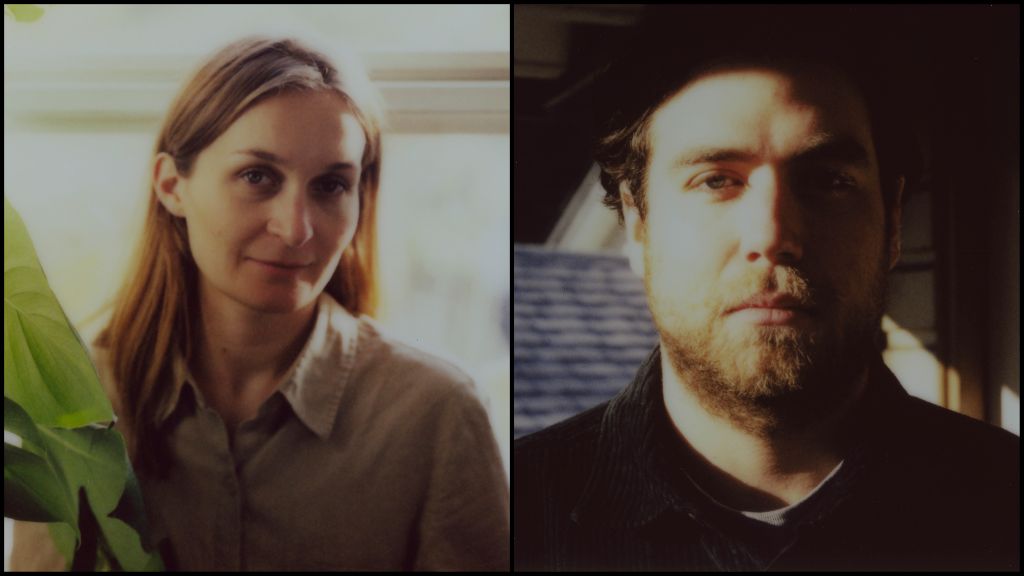
Simultaneously shot and edited over three winters, along with a crew that often only consisted of an assistant and cinematographer Jeremy Cox, their process-based approach entailed repeatedly returning to various locations. “There’s no real way to make a film like this on a single shoot,” Ermacora says. “While we’re working, the participants will reveal things that become new, interesting ideas of how to shape the film. We’d created rules around shooting various proximities, ensuring we always shot something very close, something in medium and extremely wide. We wanted those options so we could cut between the micro and the macro throughout.”
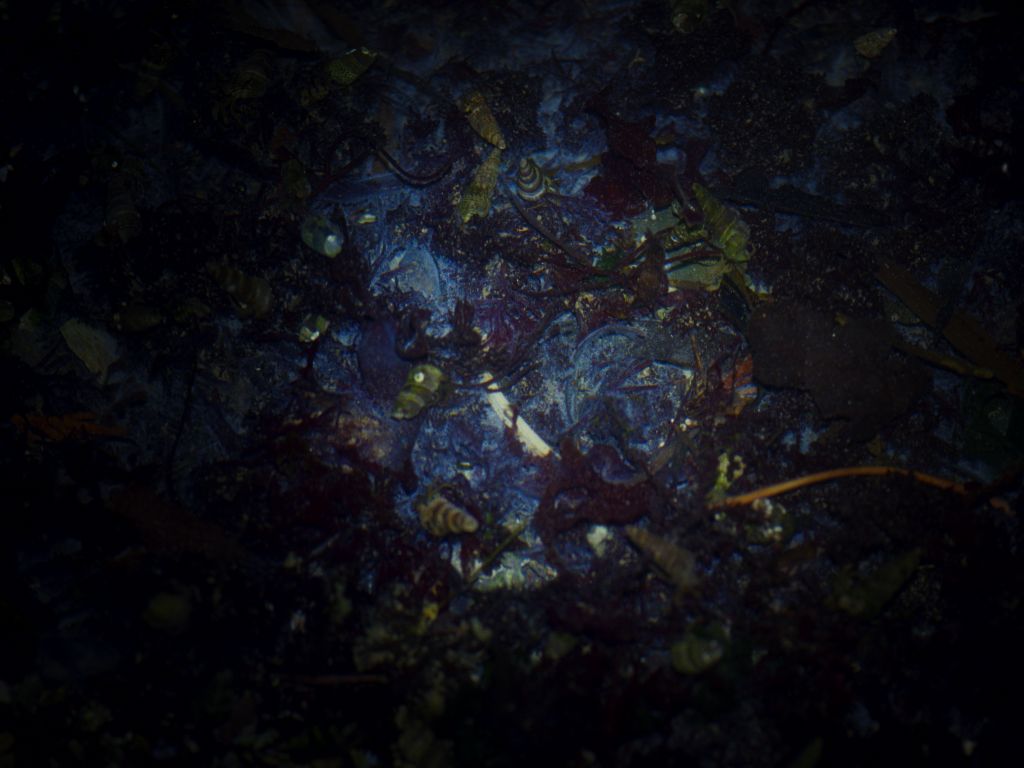
What results in the film, shot on 35mm, are juxtapositions: squiggly phytoplankton in a laboratory with the vastness of flora and fauna along a variegated lagoon; the fixedness of a wavering tree with a farmer’s throttling commute; lush oyster garlands with a wordless boat ride. The film leaps from night to day, close and far, suddenly fast then so slow. It freely toys with perspective, packing in threads of visual resonance, from colour, composition and graphic matches, within its hypnotic seventy-three minutes.
“We’re not resisting the experience of time,” Johnson says of their intentions behind the effect of their deliberate editing style. “We’re flowing through it.”
***
A notable sequence in the middle of the film features a portion of an interview with the research scientist Wiley Evans in a voiceover. “This perturbation we are forcing onto the system—there will be a rebalancing,” he warns. The pace of the editing suddenly picks up, delivering a succession of mesmerizing shots of the intertidal zone, producing a dynamic tension within the viewer between the demands of visual and auditory attention. “Rather than representing what you’re hearing we’re always interested in visually representing something separate,” Ermacora says. “Then maybe representing what you were hearing later and hoping there’s connections made between something you heard in voiceover earlier that you can visually connect to later, but that they’re lingering in your mind as you’re moving into new sections of the film.”
Instead of straining to shape a conventional narrative trajectory, the filmmakers, who have recently been teaching at UBC, cite Ursula K. Le Guin’s seminal essay “The Carrier Bag Theory of Fiction” as a formal influence. For them a film is an occasion to create a constellation from a carefully curated collection of information, images and sounds to stimulate reflections “We’re always aware that a film is a construction,” Ermacora says. “What we’re trying to say is through that construction. With each shot we’re trying to think about how to look at the world and have it feel strange, scary almost. The intertidal zone can almost feel like an alien landscape.”
Johnson cites distanciation—the explicit estrangement of the spectator to the filmic representation—as an aesthetic principle that led them to consider how their vision could be realized on screen. “We were interested in the idea of the microscope and the fact that film is also a mediation between filmmaker and subject,” Johnson says. “[Cox] brought us these filters that had honey in them, which would slowly morph the landscape as you turned them. That idea of visual distortion brought some of the concepts and themes we were thinking about into the image.” Other influences include Stephen Gill’s book Coexistence, American artist Sharon Lockhart, Italian filmmaker Vittorio de Seta and Kazuhiro Soda’s 2015 documentary Oyster Factory.
***
Two years ago, Erik Lyon, one of the film’s participants, asked Johnson and Ermacora when they were going to finish Concrete Turned to Sand. In all, it took the filmmakers three years. “Well, that’s perfect,” he’d said to them, “because it takes three years for an oyster to get to the market.” Laughing, Johnson adds: “It felt fitting that we were working on the same timescale as the subject matter.”
The film’s title, which evokes a sense of reversal and deep time, derives from a line in Bill Callahan’s song “Jim Cain.” “In the film, [Evans] talks about how the last time there was this much ocean acidification it took 100,000 years to return to normal,” Ermacora says. “[The title] was a way for us to think about larger time scales and try to shift our perspective between what we’re looking at: is it the ancient intertidal zone or the intertidal zone of the distant future?”
On the question of hope for the future, they hesitate. “Hopeful for the cockroaches,” Ermacora jokes. Behind them are framed posters for Anyox and Kenji Mizoguchi’s Ugetsu. “That there is an ability to rebalance is hopeful,” Johnson says. “It will happen one way or the other. It might have nothing to do with us, and it probably won’t. Yeah, not hopeful for us, but hopeful.”
As the final images of the film—a heady encounter, a blooming ecology of visuality—suggest: all that will be left behind, in the end, is the darkness of a natural dispossession.