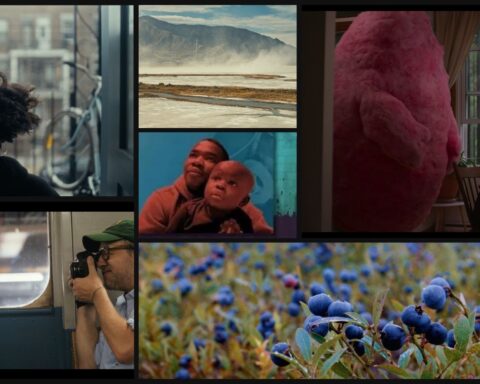

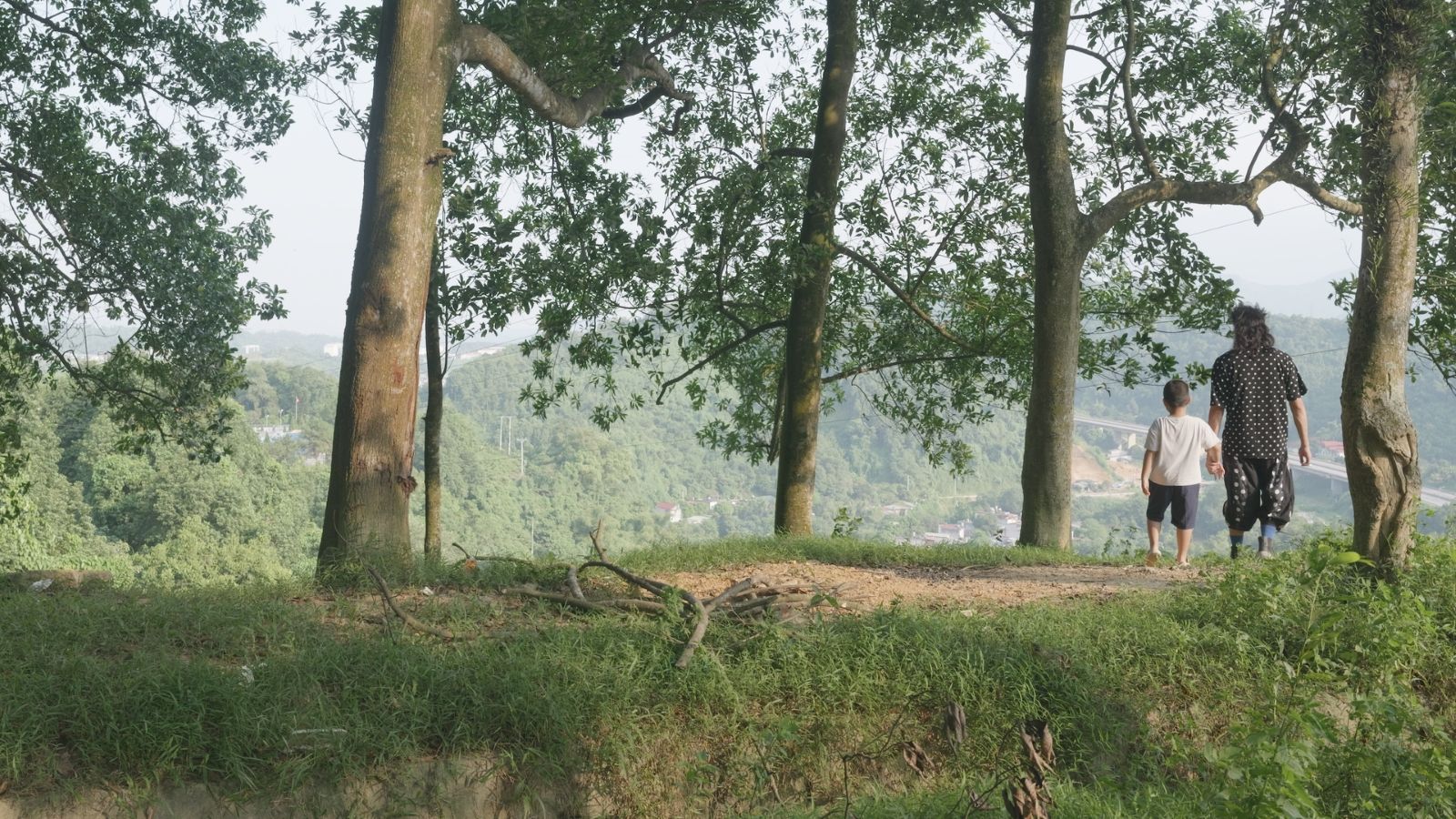
Family love, selfless love, and unfailing love fuel the tender documentary Baby Jackfruit Baby Guava. This deeply personal feature debut by Nhật Quang Nông probes his family’s story at a pivotal moment as family dynamics change. Quang’s older sister, Mai, shares that she is pregnant. It’s an exciting bit of news, but her baby forces the family to confront the fact that Mai is neurodivergent, a reality that their mother, Cuc, has largely swept under the rug.
Nông relates to his sister’s situation. He poetically explores his life growing up while knowing from an early age that he is gay. Despite living openly, fabulously, and flamboyantly, his parents don’t really discuss his queerness. Cuc especially treats it as a burden as she frets about whatever she did in her past life to have a gay son and a crazy daughter.
However, Quang finds great empathy for his sister as he relates to life as an outsider. As he interrogates the culture of silence in their family and in Vietnam more broadly, he can’t contain his excitement over becoming a guncle. The baby presents a new phase for the family, too, as Cuc lets down her guard and takes efforts to learn more about Quang’s life as he films intimate moments with the family.
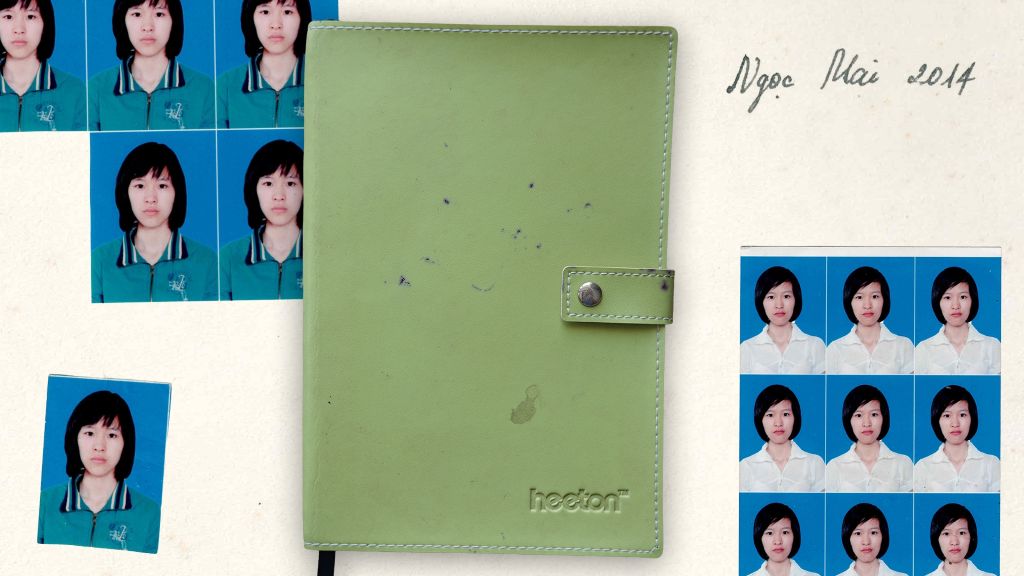
Baby Jackfruit Baby Guava, which had its North American premiere at Hot Docs in the International Spectrum after winning the Special Jury Award at Visions du Réel beautifully explores layers of shared history–old photos, diaries, artifacts–as the family participates in a tough, but necessary exercise in expressing the love they have for one another that’s gone unacknowledged for too long. Add tough love to the list of affections that Quang, Mai, and Cuc deal with throughout the film—it’s perhaps one universal form of love to which all families can relate.
POV spoke with Quang at TIFF Lightbox following the premiere of Baby Jackfruit Baby Guava at Hot Docs.
POV: Pat Mullen
NQN: Nhật Quang Nông
This interview has been edited for brevity and clarity.
POV: At what point, as you were filming your life and your family stories, did you see that there was a larger project to shape into a movie?
NQN: I was interested in telling my mom and my sister’s story when I realized our relationship changed. First when my sister received her diagnosis [that she is neurodivergent] and I started taking pictures. My fear then was that I would lose her. It started with photography. When she recovered and then she got pregnant, I started filming because we were encroached by the unknown. Each of us reacts differently. My mom researched about the impact of antipsychotics on fetal development. I reacted by picking up the camera and documenting because I realized this is one time that a shift in family dynamics could happen.
After I developed and filmed for a while, I realized my storyline’s going to be in the film too because I can’t pretend to be objective when I’m the son, the uncle, the brother. I’m forever going to be subjective. So might as well own up to that subjectivity and then let the audience in through my gaze. In terms of the language of the film, I also was interested in documentaries that used archive creatively. I watched a lot of those when I attended festivals like IDFA. I had lots of inspiration, actually, in Canadian films: Stories We Tell by Sarah Polley. And there was My Dead Dad’s Porno Tapes [by Charlie Tyrell]. I did my research!
POV: I like the parallels and the personal lens through which you explore your sister’s story because it confronts the ways that we often don’t talk about things in families. How did your experience coming out and navigating queerness with your family help you to understand what your sister was going through?
NQN: We’re all pathologized, aren’t we, like queerness and neurodivergence? At one point, being gay was considered a disease. And then same for neurodivergence. And our parents are doctors by the way, both of them. They approached me and my sister as not just children, but also as patients. My mom actually talked to my dad about sending me for corrections. My dad said, “That’s not his fault. This is his gene’s fault.” He’s a very cool and chill person. But we are all outcasts in a way that doesn’t fit in the norm of what people should be like for different reasons. But I was self-aware first and she was there to help me. She was the one who confided with all my secrets. I don’t know her world, but I can observe and listen. We’re outcasts for different reasons. It’s like a full circle moment.
POV: How did you decide to make your mom more of a primary character in the film and your dad a secondary one? Why focus on your mom over your dad?
NQN: I was always interested in my mom and sister because that dynamic is the bombastic one in the house. My dad is so chill. I was tiptoeing around that because I didn’t know how he would react to my homosexuality, but he’s just chill. When my mom and my sister fight, that was the major conflict when I was growing up. That’s why I was interested in her story, but it was only in the edit that my mom emerged as such a compelling and strong character.
POV: There’s a great moment in the film when your mom talks about how your sister said that she owes her love. Is love something we owe our parents and our families and each other?
NQN: Oh god, is love something we owe each other? I never thought about it like that. I just want to give this film as a gift. As a gift, it’s not something people ask for. It’s not something you can expect them to react to the way you want. Love might be the same way. You can give love away and you can receive it, but how people react to it is not within your control. My mom loved me the way she does. My mom loves my sister the way she does, but whether or not we could receive it, it’s not in my mom’s control. And the love that we give back to her, what we think is love might not be what she receives as love.
POV: How have they reacted to the film?
NQN: They didn’t get to see it yet. I finished very close to the festival. Earlier this month [in April], I was in Bangkok doing DCP, final mix, and colour grading. I flew back home and then I found my visa in time and then I flew over here. At the same time, they were also dealing with some health issues, unrelated, but they obviously know about the film.
They took part. It was a participatory experience for them working with me on the film, but they didn’t get to see the final version yet. I feel like they deserve to receive it when they have the capacity to see it and then it has the chance to be a mirror to see themselves. But I don’t want to say, “I have a film festival coming up. You need to see the film. Let me know how you feel, so I can enter the audience.” That would be the ethical thing to do: Let the protagonists watch it first. But the timeline didn’t allow for that. The award at Visions made my mom feel good about herself. She loves competitions. She told me, “I’m so happy for you. Now you can go to school and study and get foundational knowledge
POV: You’re self-taught. What was your “film school”?
NQN: I’ve made six documentaries before this, but all shorts, all are queer. Some were about youths or marriage equality in Vietnam. I learned my doing, really. Through the making of this film, I got to go to development last around the world. So obviously you talk with iconic filmmaker, Kirsten Johnson was one of the people who gave feedback to me. She was so kind. So I got an iconic mentor for this film. That’s how I learned. That’s my film school. And then I see all the modern documentaries at festivals like IDFA, Big Sky, and Visions. Seeing that really informed with the current practices, what my peers are doing. Access to cameras change over time and it is so much more democratized: The tools we have access to changed, how we can operate as a film crew changed, and how you can be a solo filmmaker. I go home and shoot alone for the whole time, basically. And we have some shoot where I have crew, but the whole time it’s just me and my camera.
POV: How has your relationship with Leland developed since you introduced him to your family? A big part of the film is bringing that relationship out into the open.
NQN: In April 2019, my sister gave birth to my nephew. I first started shooting. In June 2019, I went to America for the first lab at USC with American Film Showcase, and they really helped me understand the whole film lab system. After the program, I went to San Francisco because—GAY!!!—and then met him in a bar. I told him about the film and then we started dating. He’s the first person even before the producer joined to know about Baby Jackfruit Baby Guava. We’ve been together for seven years. It’s been great. He actually went to visit my family.
We choose to end on a more open-ended note because I don’t want the focus of film to be about him. It’s not a film about our relationship. The fact that I blurted about Leland to my mom was an accident I happened to capture on camera. For the next film, I actually want to make a film about his family. He’s biracial and then my mom doesn’t understand racial nuances, and the whole story about Black and white people in 1967 when Loving vs. Virginia passed and allowed interracial racial marriage, and then he was born. I want my mom to understand that history where my partner is coming from. The best way I do that is in the form of the film.
POV: There’s a great documentary about the Loving story
NQN: Exactly. But also it’s our story.
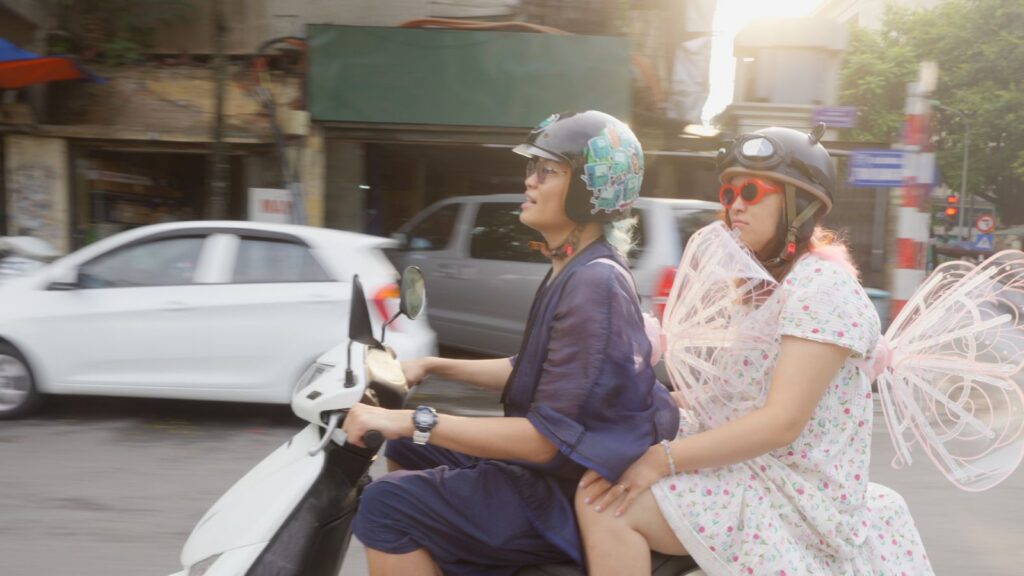
POV: You also integrate the story of your mother and her mother later in the film. Why was it important to include that storyline as well?
NQN: By the time we got the news that my grandma was ailing, with or without the film, I was going to capture it anyway.
POV: That’s what filmmakers do.
NQN: Exactly. We are documentary filmmakers because we document and then we make a film. I documented that, but I also knew we had a structure that was going to be more dreamlike, that we’re going to go into parallel timelines. We’re going to do a jump into past. We always had that ending. But leading up to that, there was space for my grandma’s funeral then. I was there with my cameraperson, my friend, and we decided to choose one short moment: The time that my mom sleeps next to her mother’s casket. That’s the essence of the whole film. It’s a cycle. My grandma was 103 when she passed away. She lived a long life. It felt like she’s going to be here forever. I didn’t expect her funeral to be in the film but I shot for long enough.
POV: That’s a long time! Those are good genes. The ending of the film also brings it back to the story about Devastated Baby and Defiant Baby that opens the film. What is the story behind those characters?
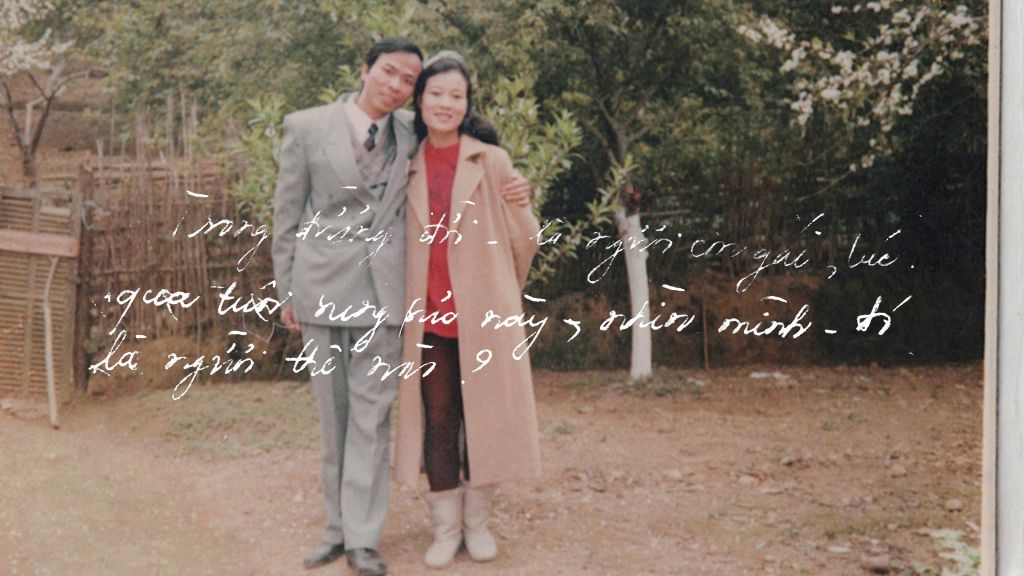
NQN: That’s actually the Vietnamese title. Baby Jackfruit Baby Guava has been the working title from the start because I was at first interested in when my sister had a baby. Baby Guava is a nickname because my sister had a guava craving when she’s pregnant, and my mother nicknamed my sister Jackfruit because she was craving jackfruit. It’s called Jackfruit and Guava because of baby names, but that also equates my sister and her son. I wanted to see mothers as babies too—adult babies. I’m interested in showing who our mothers were before they became mothers. This film shows Baby Guava what his mother looked like before she became the mother that he would grow up knowing. And I was interested in knowing who my mother was as well before she was a grandmother per se.
I needed a different, more conceptual title. In English, it sounds quirky enough. The Vietnamese title translates to The Flamboyant Baby, the Defiant Baby, and the Devastated Baby. My sister had a catchphrase where she calls her youth “defiant, dreamy, and rebellious.” That’s how she sees her youth. Her being neurodivergent and then actually with our overbearing mother, it could sound like a drama where she’s a victim. But she’s not a victim, she’s defiant. And I’m flamboyant, and our mom always see herself as this karmic burden person who is paying off debt from her past life because all her kids are devastating to her.
POV: Has making this film and seeing your sister become a parent made you want to be a parent?
NQN: No, no, no, no, no, no. Not because of films. I’m not interested in vaginas!
POV: That’s a big part of it.
NQN: [Laughs.] I’m not interested in vaginas, but I feel like films are my babies. A film takes so much time. Babies take so much time. I can’t make films and babies. It’s hard thing to be gay and try to have kids legally. No, I’d rather put money in my film. Putting all my resources into filmmaking is already hard enough! [Laughs.]
POV: What is the situation for LGBTQ rights in Vietnam? We’re seeing things go backwards everywhere.
NQN: Well, we don’t have any rights to begin with, therefore, there’s nothing to go backwards to. There are discussions and we want to encourage acknowledgment of the rights of same-sex couples, children of same-sex couples. In 2014, Vietnam abolished criminalizing same-sex weddings. It wasn’t criminalized in the sense that you go to jail for being gay. It was more like they don’t allow that kind of ceremony to take place. So in 2014, they abolished that, meaning that if you organized a same-sex wedding, it’s not going to cause a problem, but there’s no recognition. There’s zero legal protection, recognition, rights. It’s 2026 now, so we’ve been campaigning for years to get more recognition that we exist. Gay people co-parent. What about the children when they go to school? The kids only have one parent on their papers. What about health insurance and all that? People are starting to encourage that dialogue.
So that’s where we’re at right now, but it’s not the worst place to be gay. In general, the attitude is very accepting in the sense that people mind their own business and I don’t face any overt discrimination. The most difficult part of being queer in Vietnam is probably within the household because that’s no longer your own business. It’s your family’s business now. People are very tolerant towards people out on the street, but at home, it’s difficult.
POV: And I think that the film reflects that really well and it’s effective because it comes from such a personal place. What advice might you have for filmmakers who are trying to break through and going the self-directed route that you took?
NQN: By choice or by circumstance? I’m circumstantial. I’m hungry and I can’t wait, but I can’t afford tuition. I come from a place without infrastructure, but I’m hungry, so I navigate and I push myself and propel myself outward. Hunger was what drove me. And luckily as an Asian, I went through a lot of competitions, so I had that mindset to figure out the system. But also self-analysis and self-improvement, constant learning was important.
If by choice, if I had resources, I might as well not have had to go through so much to get my film made. But it’s been rewarding because I get to work with so many talented people. If I limit myself to my circumstance—I have a shitty camera, but the first half of the film I shot on a Sony A6300 in full HD in a shitty codec. But then over time funding came through and then I got a better camera. But the first half of the film is entirely shot like that and it works. By the time we got this film made, I think is the first documentary co-production to travel around. Children of the Mist was entirely Vietnamese. But this film is a co-production that travelled through these festivals and won an award at Visions, and doing Visions and Hot Docs in competition at the same time. And it’s not one of those historical doc, which is prevalent on Vietnamese TV, but something up to date with what the current slate of documentary language has to offer, which I acknowledge and am proud of. Self-propelling with your hunger allows you to reach places you would only imagine.