



“We’re in a shitload of trouble,” observes Musk director Alex Gibney. The Oscar winner’s epic documentary delivers a comprehensive distillation of everything evil and troublesome about its subject. While the film inspires a sense of dread, if not powerlessness with the sheer scope of Elon Musk’s unchecked quest for world domination, the filmmaker hopes that the documentary offers a five-alarm wake-up call.
“But fight the power,” Gibney tells POV during the Toronto International Film Festival in September where Musk had its North American premiere. (Read our TIFF review here.) “We have power. We have collective power. We can exercise. We can fight back. But the key thing is understanding how these mechanisms work and how people like Elon Musk take and aggregate this much power and being willing and able to see through it.”
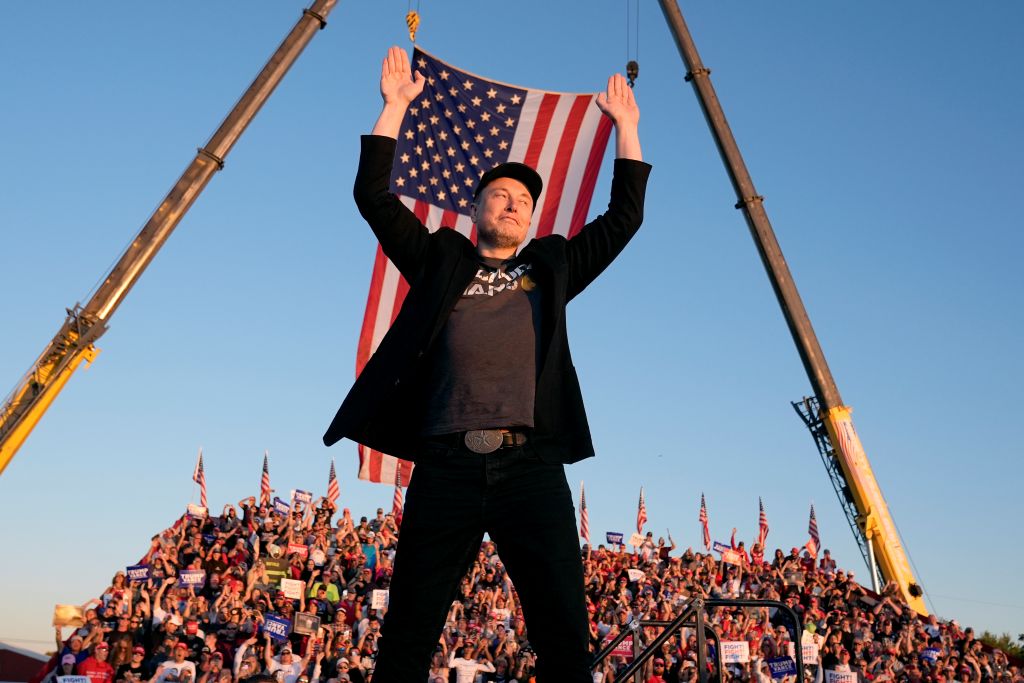
The film charts the ascent to power of entrepreneur and megalomaniac Elon Musk as he bulldozes through early start-ups and then major tech businesses including PayPal, Tesla, X (né Twitter), and SpaceX before infiltrating America’s democratic systems as co-lead and “ideologue” of the Department of Government Efficiency (DOGE). But while Musk’s official time with the Trump administration was short-lived, it’s emblematic of the wake of damage he causes in relatively brief windows. Gibney’s film interrogates how Musk got there and what it means for everyone that such an erratic, self-important blow-hard rose to such a position of power through his well-documented history of failing upwards. Gibney, however, puts it far more eloquently and pragmatically.
“Going in, I was intrigued and attracted by him,” says Gibney. “He was a maverick. He was doing it his own way. He was challenging the big three stultified organizations [General Motors, Ford, and Chrysler] and he was going to deal with electric cars, which is going to help solve the global warming of the planet.”
Gibney observes similar encounters with Tesla fans who have to reckon their love for the technology with their feelings about Musk. “It’s as if somehow there’s a psychological transference process that says, ‘Oh, because you like your Tesla, you’re supposed to think that Elon’s a good guy,’” he explains. “Maybe a lot of engineers at Tesla built that Tesla, not Elon. Or maybe he built a good car, but what he’s doing to the federal government is not so good.” The film lays out many reasons to avoid conflating the man and the machine.
The filmmaker speaks with a surprising degree of pragmatism for a subject, who, at the beginning of the film, calls the project a “hit piece” in a missive posted to X while Gibney was putting the documentary together. Both in the film and in conversation with Gibney, what resonates is a sense of curiosity about the alarming fall of an entrepreneur whose early gambles suggest altruistic purposes.
“They were fun electric cars to drive. I owned a Tesla—solar panels and power wall—so I was kind of intrigued and invested in him,” continues Gibney. “But over time, I came to a different view. And still even in the film, I wanted to portray his rise to be able to understand how he accreted the power that he is now abusing.”
Gibney acknowledges that a four-hour essay about Musk might be a tough sell for audiences. However, he thinks the hard truths of the film are necessary to confront. “They should [want to see it] because what he has done in terms of amassing that amount of power, what it pertains to all of us and how we’ve been responsible for letting him attain that power, is really a critical thing for us,” observes Gibney. “We need to understand it in order to be able to steer against it.”
So ensues a dizzying account of Musk’s trajectory. Gibney gets interviews with key players from Elon’s wake of terror. Colleagues from Musk’s early online enterprises evoke a Wolf of Wall Street type charlatan who hustled and cashed in big when the company flopped.
Meanwhile, Tesla co-founder (the real one) Martin Eberhard describes in riveting detail how anyone can basically call himself the founder of a company. Without actually having a hand in creating Tesla, Musk’s self-appointed founder status made his name synonymous with the company that revolutionized alternative energy vehicles. The film shows how Musk’s Tesla days largely consisted of allegedly conning the government and lying to consumers. Former Twitter employees illuminate how Musk seemingly bought the social media platform seemingly to destroy it, like a child whacking his new toy to smithereens. The list goes on.
Gibney notes that one inspiration for this portrait is actually Guillermo del Toro’s Frankenstein. “The Oscar Isaac Dr. Frankenstein is not particularly sympathetic, but it’s interesting to watch the journey that he takes and how he intersects with power and how he intersects with trying to do something very dangerous,” says Gibney. “And so by telling that story, I think it’s compelling to all of us to try to understand what the fuck happened.”
The details are too numerous and complicated to convey in a single article, especially regarding a man with such a history of litigious behaviour. However, the most captivating revelations arguably come from Musk’s first wife, Justine. She characterizes the corrupting nature of power that warped the principled man she fell in love with—one who’d later turn on his children and exploit the death of his own infant for pity points on social media. But her early reflections of their honeymoon period make the downfall doubly persuasive. “That was the purpose of charting his early rise,” observes Gibney. “He was a much more, I think, sympathetic and intriguing character.”
It’s icky stuff, but the sheer volume of on-the-record material makes clear why Gibney’s doc demands the scope—the breadth and depth—of its analysis. Moreover, Gibney admits that making a Musk movie finds itself in a curious place when seeking interviews regarding a man climbing to troubling layers of power and accumulating wealth the world has never seen.
“In some ways, it was a double-edged sword,” reflects Gibney. “It was always hard to get people to talk for this documentary because Musk is so rich and, therefore willing to sue, that people were afraid to talk. That seems deeply ironic when you think about this is the guy who claims to have bought Twitter because he’s a free speech absolutist. But they were deeply afraid to talk.”
At the same time, Gibney suggests that Musk’s use of free speech as both weapon and shield inspires action. “I think Elon cultivated that fear unless it accorded with his narrative, which he was carefully building up. But when he hitched his wagon to Trump and when he did what he did at DOGE, the existential damage of that, I think, encouraged people to talk because they felt they needed to. They felt they needed to say something about a character who was doing so much damage. They needed to speak out.”
The documentary’s final act digs into the DOGE days. Gibney’s interviewees outline how Musk assembled a group of minions who were barely old enough to order drinks, let alone drive major administrative decisions by tearing up federal contracts, axing essential services in the name of efficiency, and steamrolling unions and Congress alike, often via notices that Musk fired away via Twitter.
One simple solution in the face of Musk’s presence may be to simply refrain from buying what he’s selling. That’s not so easy for Gibney, though, who stayed on X while others migrated elsewhere during Elon’s early days. Gibney says that staying is a matter of journalistic interest.
“As a journalist or as a filmmaker, it’s my job. So if you want to follow Elon, that’s the platform to be on because it’s his service. So I have to be there,” he says. “I have all the poop emoji pictures that he’s posted.”
The documentary also illustrates how Musk’s insistence on having the last word makes X a fair channel for communication when the tech titan refuses to participate with an interview. Musk fires missives at Gibney, providing a kind of documentary subject 2.0: a reluctant participant who engages on his own terms.
“He’s still participating and I’m still watching everything that he’s doing,” says Gibney. “My job is to observe and to reckon. And if you want to know what Elon’s doing, you’ve got to be on X.”
Musk’s prolific vitriol yields a treasure trove of soundbites, but the documentary builds a compelling sense of the alternate reality that he creates for himself. His contradictory statements and flat-out lies offer one doozy after another. Gibney says the documentary inevitably was a rigorous exercise in fact-checking, but also of using this material in the name of fairness.
“That was the job at hand. I allow him actually a lot of airtime in the film to give his point of view, but I also invest in other people’s point of view,” he notes. “We did a lot of fact-checking and digging to figure out what was going on because he started out from being a person who shaded the truth to being a complete and total bullshitter so that he could literally lie to millions of people in a way that resembled gaslighting more than anything else.”
Musk leans into Elon’s penchant for gaslighting by flipping his own words against him. In the absence of a mano a mano interview, Gibney brings Musk into the film via an animated avatar. The uncanny CGI Elon sits in a video game world—a metaphor that Gibney uses to convey Musk’s climb to top-level boss status—and spouts the tech titan’s own words. The avatar mines every interview Musk has done. The reluctant participant becomes a surprisingly forthcoming one.
“One of the reasons we’re doing the avatar character is to lean in to some of these contradictions in Musk’s character,” says Gibney. “He believes in a simulation. He believes in the idea that we’re living in an existential video game. So we created a video game avatar character for the simulated interview, but also playing with this idea of reality and unreality and this notion of uncanny valley. All of that felt like it invested in the contradictions that the film was exploring. It was a cinematic device to invest in the contradictions that the film was exploring.”
Gibney explains that the avatar doesn’t choose Musk’s words at random. The conceit could be misinterpreted as generative AI, in the sense of a filmmaker saying, “Claude, answer this question as Elon Musk might,” especially since the doc builds upon Musk’s own work in AI and the implications that brings when his self-driven cars start killing people.
“It’s sort of like playing in his sandbox and using his toys to do something different than he would do,” adds Gibney. But the filmmaker clarifies that the simulated interview comes through the work of human hands.
“I didn’t ask the avatar questions and then get answers back,” explains Gibney. “We had this massive database of audio and then we made the editorial decisions to put certain audio bits in various places in the narrative. So that’s not an AI decision. We didn’t leave that up to AI. AI was used primarily as a syncing mechanism for the face.”
Working with a team that included editor Michael Palmer and the VFX wizards at MakeMake, Gibney created the look, location, and mood for the interview in terms of costuming, lighting, and expressions. “As we were doing that, we’re choosing audio tape sequence and bits to use in the movie,” notes Gibney. “Very often ones which are argumentative, purposely.”
After that comes the animation. “What happens then is it spits out slightly different versions and then you can change the prompts in order to be able to get a facial performance that you feel is more in line with what we want. We went with something that was relatively understated and not cartoonish.”
Ironically, there comes a point in Musk that one forgets that one is watching a simulation. The avatar conjures a version of Musk in which the man seems most authentically human.
“That becomes the most authentic Elon. That was purposeful,” observes Gibney. “I was hoping that that would happen. At some point you get comfortable with the image and he becomes almost more authentic as the avatar than as Elon the real person.”
Musk himself seems to struggle with being a human versus and the omnipotent avatar who rules the Twitterverse consequence-free. For example, one of the film’s big reveals comes from Ashley St. Clair, a former conservative influencer and mother to one of Musk’s many children. (The doc includes an account of Musk’s bizarre agenda to impregnate as many women as possible so that he can amass his own civilization, seemingly to populate Mars with an army of bloodline loyalists.) St. Clair shares text message exchanges in which Musk more than insinuates election interference. He writes about unleashing “an anomaly in the Matrix” and references lasers in space.
The exchanges suggests that the superpower weaponizes his own SpaceX and Starlink technology. Coupled with his cozy relationship with Trump and their combined erratic behaviour, and St. Clair’s revelation offers a big canary chip.
The “lasers in space” stuff seems to be a sensitive spot for Musk, too. Following the documentary’s Venice premiere, the tech tycoon threatened Gibney with a lawsuit. Naturally, Musk hasn’t seen the film.
However, Gibney thinks it’s telling that Musk zeroes in on those claims out of all the information distilled and synthesized within the film. “It tells me that he’s nervous about inquiries into roles that he may have played in the elections of the past and may be playing in the elections of the future,” says Gibney. “In the film, as opposed to what his lawyer maintained, we just report. We’re not saying that we know what SpaceX or Starlink did in the 2024 election. We are saying that he texted this stuff about space lasers and the anomaly in the matrix. What does that tell us? Well, maybe we should explore it more and also maybe we should be worried about what he’s doing. But I think his visceral reaction shows that he’s deeply concerned about the possibility that he would be investigated not only about that election, but about the 2026 election.”
With midterms approaching, Gibney says he hopes Musk acts like Toto and pulls back the curtain on the Wizard. “We’re about to have a midterm election and that’s one of the alarm bells I’m sounding because it may be that he has access to data and we know he had access to data,” says Gibney. “We don’t know whether SpaceX obtained it, but enormous amount of data on American citizens and that data fed into an AI could have enormous consequences for the 2026 election. If a journalist, if you’re a citizens’ group or if you’re a member of state government, look into this now.”
The conversation returns to Musk’s claim made at the beginning of the documentary: If Musk isn’t a hit piece, then what is it?
“It’s an inquiry,” says Gibney. The director also notes that serving Musk’s accusation offers a way of including his voice within the film.
“At the end of the day, it is my point of view, but as my hero Marcel Ophuls once said, ‘I always have a point of view. The trick is showing how hard it is to come to that point of view,’” says Gibney.
“I have a point of view about Elon. I think it’s clearly stated in the film, but I also have a lot of material from Elon pushing back and I intentionally put it in there. So that’s not a hit piece, that’s a dialogue. That’s exploring contradictions is what I would say. A hit piece is when you use your subject as a human piñata. This was a thorough going investigation, which is fact-based and really rigorously done and steered against my original impression of who I though he was, which was more heroic.”
I point out that many people would probably like to whack to an Elon Musk piñata. Gibney laughs. Because what else is there to do?