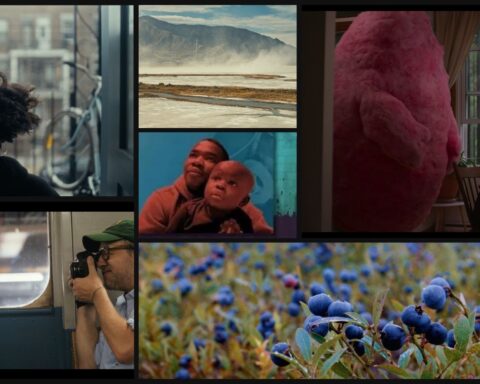



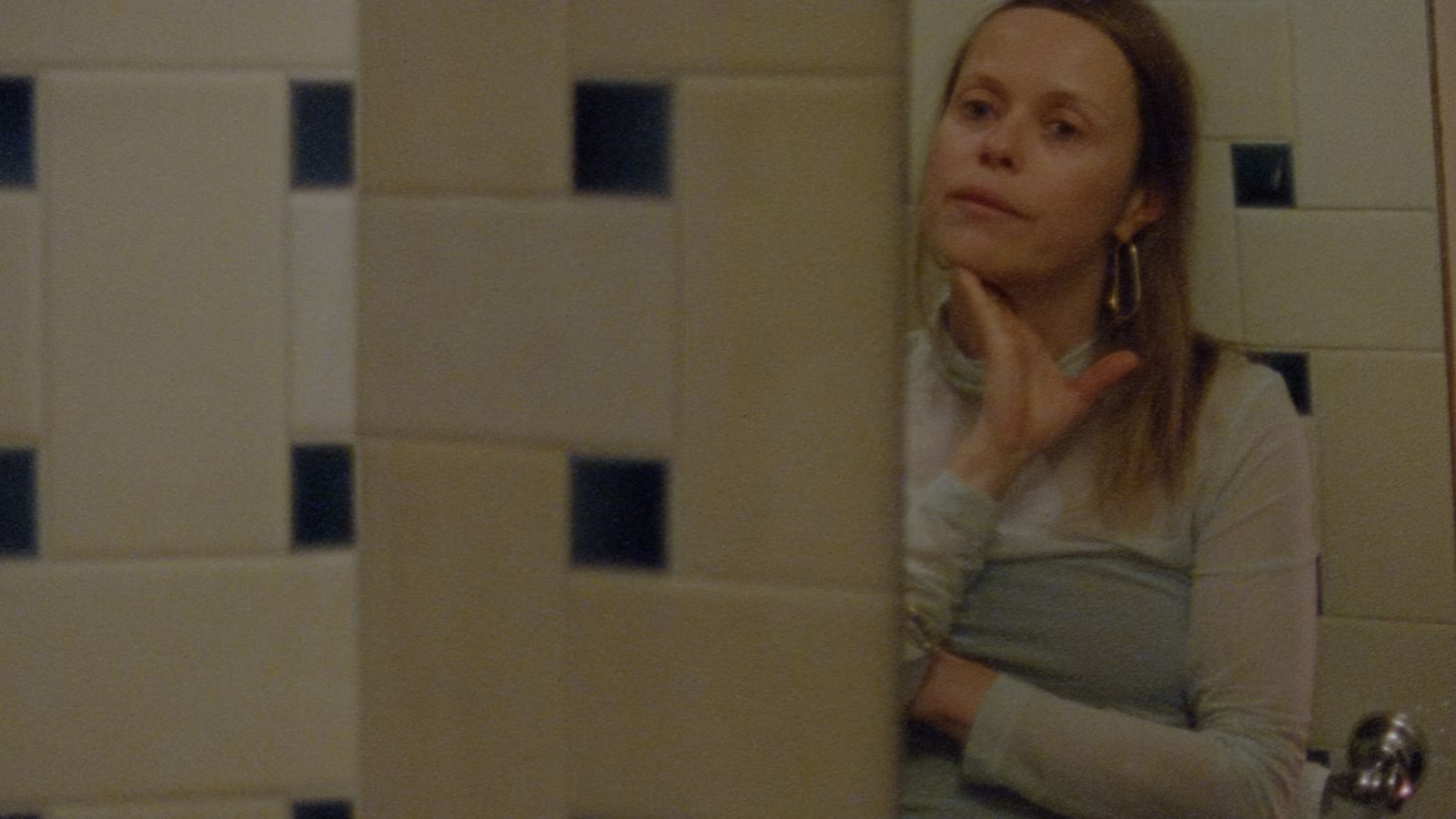

We’re underground, in the rumbling bowels of Paris, France. A train emerges from the distance, hurtling towards us, like in the early Lumière brothers’ film, before it swerves. The glint of tracks; the soft glow of lights; an apparition of faces. On board, a woman looks out a scratched window, waiting and watching, perched—like an eagle, an owl—on the precipice of creation. Then it’s time for her to ascend to the surface; to start her quest.
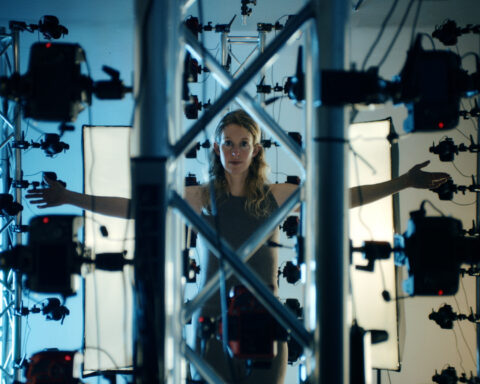
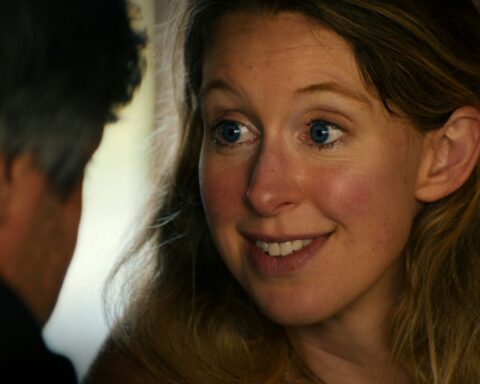
So begins At Night, Beatrice Gibson’s debut feature, an exhaustively layered and sensorially intoxicating work about several women drifting through Paris over a single, sensuous night. Gibson, in a meta-fictional turn, plays Bea, a filmmaker uncertain about the movie she’s making as fragments unassumingly enter the fray: wide-ranging conversations about love, motherhood, and sex, engrossing poems on the sublime in the mundane details of one’s day, and performances of dark desires and surreal dreams. “This is a story of dispossession,” Didi (Diocouda Diaoune), a central character and Gibson’s frequent collaborator, concludes of her life.
Shot by Ben Rivers on 16mm, edited by Liyo Gong, and with an original score by Elvin Brandhi, Gibson has woven a simmering film dissolving those arbitrary distinctions between fact and fiction, forging new modes, textures, and sensations as the reflective characters—shaped by works of Kathy Acker, Alice Notley, and June Jordan—grapple for the language to articulate their intimate and politicized conditions; to forge a collective whose paths crash, intersect, or graze, assembling itself before our eyes.
The result is a moody film less interested in resolution than in remaining capacious: to confront and sit with the discomfort of one’s privilege, and to use oneself as a means to write “through” rather than “of.” One of Gibson’s intentions, she says, was “to make a film in the shape of a question,” and it’s an apt description for a film that continually engenders, asking what a film can contain and what it can make room for still. At Night is many things at once: the wavelength of a city, the portrait of an artist wrestling with her vision, and a work of feminist and queer inquiry. In its covert ambitions and its provocative charm, it is unlike anything I saw at TIFF.
After winning the Emerging Director Award at the Locarno Film Festival, and following At Night’s North American premiere in the Wavelengths section of TIFF, POV connected with Beatrice Gibson over email to learn more about her collaborative and innovative process.
POV: Nirris Nagendrarajah
BG: Beatrice Gibson
This interview has been edited for brevity and clarity.
POV: At Night begins with an epigraph from the late American poet Alice Notley’s 1980 lecture Doctor Williams’ Heiresses, and her voice later appears in the film reading from The Descent of Alette. You also worked with her on Deux sœurs qui ne sont pas sœurs. When did you first encounter Notley’s work, and what did it open up for you? How did you come to know her, and what were your conversations about At Night?
BG: Doctor Williams’ Heiresses was an essay that my friend Will Holder introduced me to. He printed and published it in his incredible series F.R. David. When I read it, it blew my mind—most things I read by Alice have that effect on me. Doctor William’s Heiresses is a semi-satirical meditation on lineage and inheritance. In typical Alice fashion, it’s a provocation. She inserts herself within the largely male Avant Garde poetic tradition that came before her—the New York School—and asks all sorts of provocative questions about what it means to inherit a male history.
I met Alice in 2017, when I was researching and developing Deux sœurs. She was introduced to me by two other poets: CAConrad and Eileen Myles. Notley mattered to me enormously, at the time, because she was one of the first New York school poets to talk about pregnancy, babies, domesticity, and exhaustion. She was using the strange psychological intensity of being a mother as material for making work. I was a new mother, and I’d been working on a series of films exploring motherhood and lineage.
My 2018 film I Hope I’m Loud When I’m Dead (which takes its name from one of CAConrad’s poems) is specifically about trying to gather a selection of female voices and references for my newborn daughter. The quote at the beginning of At Night is about the work of “including, tracing and including.” Alice knew that I was working on a new feature and knew that The Descent of Alette was one of its key structural influences. She read the script a few times as we were developing it, and she was so encouraging. She was always encouraging.
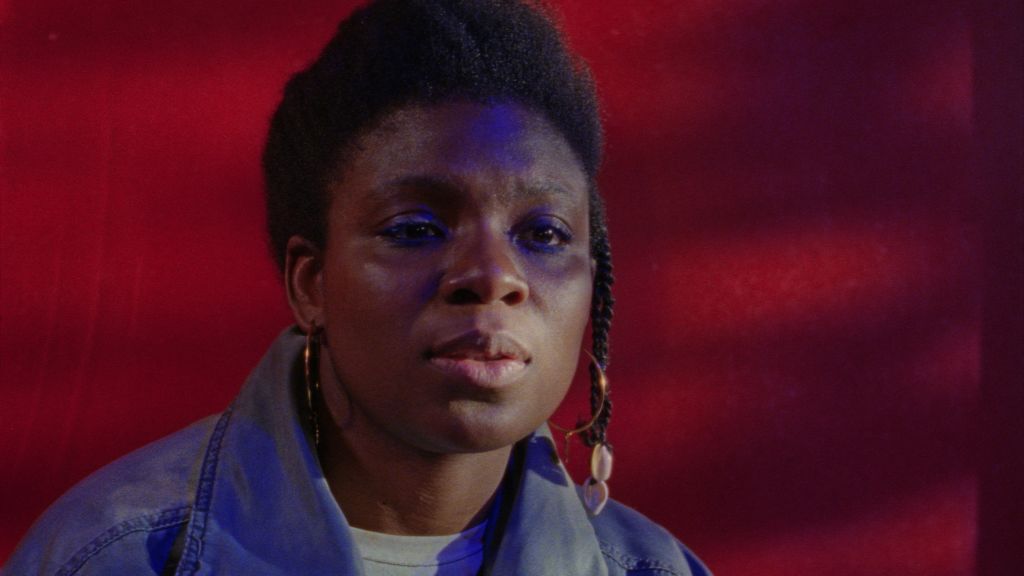
POV: Engaging with literature and other artists is not new to your work, in fact “including” seems almost inextricable from your practice. You’ve worked with—or through—William Gaddis, Gertrude Stein, and Barbara Loden, among others. How do these voices enter into what you set out to do? To begin with, what were you setting out to do with At Night?
BG: I have always made films in what I can only describe as horizontal and vertical conditions, or rather with a horizontal-vertical ambition—which is to say that I like to make work in a crowd!
There is a really beautiful passage by Ursula K. Le Guin in an essay called “The Fisherman‘s Daughter.” She describes the conditions of production for a series of female authors and the contexts in which they write. She contrasts descriptions by these women of where and how they write, of the conditions they wrote in, with those penned by their male counterparts.
One male author she cites, for example, describes “somebody” bringing dinner to the door of their studio and leaving it outside—that somebody, of course, being their (long suffering) wife! The female descriptions, by contrast, are often crowded, populated, chaotic, and collective. There is a beautiful description in which one writer talks about writing at the kitchen table, and of the voices of her children down the hallway and the voices of her characters co-mingling in a cacophonous, inseparable and enlivening frenzy. This is how it really is! Or, at least, this has been my experience of what it means to make work. Domestic. Chaotic.
My films are always to some degree portraits, fictional portraits of their own process and the process is collective and the intention is plurality. It’s no different with At Night, for which I wanted to bring together an intersectional group of women to talk to one another.
I threw in some questions. Simple questions really, or rather questions about simple, core things: money, sex, work, motherhood. The cast started to develop material based on the initial questions. Then development producer Denna Cartamkhoob and I started placing that material in dialogue [with the other responses]. This logic, this communal manifestation in the process, not just by bringing together a living community of friends and colleagues–of non-professionals to be in the film–extends upwards into an absent voice.
This is what I mean by vertical, I suppose: the voices, the influences that accompany us when we make work. This is where the citational aspect of my process comes in. It’s a way to extend the constellation of female voices in the work.
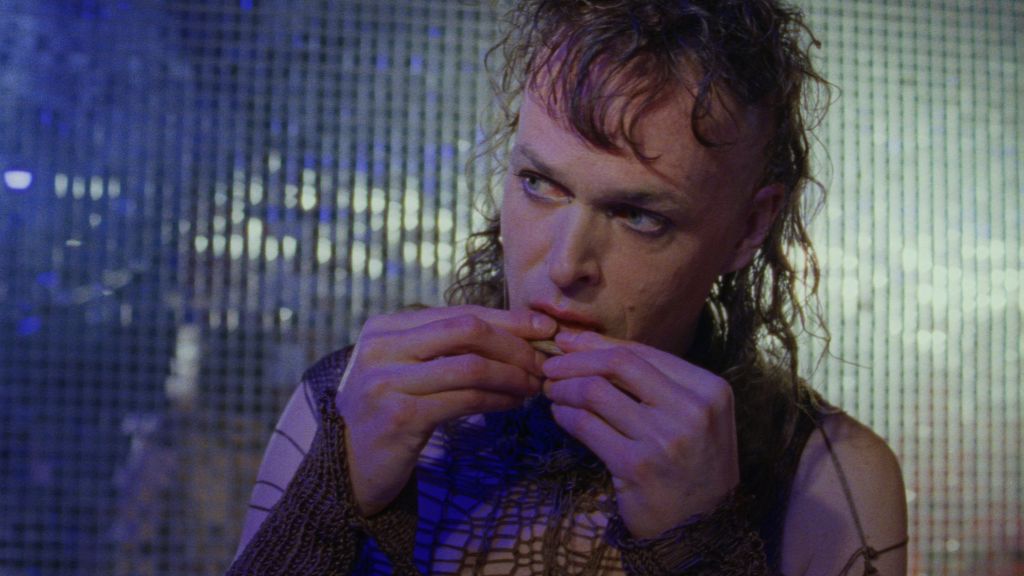
POV: At what point in the process did you decide that you would appear as a character in the film whose subjectivity—and privilege—would itself be interrogated? Didi confronts Bea about the asymmetry between them: “Yours are so far from mine.” Bea sighs, but doesn’t deny or deflect. How much of that encounter is rooted in fact, and how important was it to you that this discomfort remains unresolved? What does fiction allow you to do in depicting that conflict and discomfort that autobiography doesn’t?
BG: I think I’m completely uninterested in the binary between documentary and fiction or autobiography and autofiction. I really, really couldn’t give a damn. I like the poetic self for this reason: a self that liquifies the division between the two. Alice’s self, for example, the poetic I—who entirely collapses the divisions between autobiography, fiction, character and dream. I have used the self as material in my own work for a while now, inspired by Alice as well as other queer feminist poets like CAConrad and Myles.
But to answer your question, I actually wasn’t supposed to be in this film, not originally, no. However, in response to some of the tensions and asymmetries that arose within that intersectional process—in some ways quite quotidian tensions—it seemed that the most interesting thing to do was precisely to stay with the trouble, to sit with the discomfort. I decided to explore my own positionality and write a version of myself into the film.
The scene in the shop was written together by Diocouda and I with help of the amazing poet Sophie Robinson. It’s a highly crafted scene. We wrote it over the weekend and shot it the Monday after. I have described the film as “autofiction with an emphasis on fiction” because it allows me to move the conversation beyond disclosure and confession toward the work itself: its formal qualities, the bigger political questions it asks. The characters in the film all wrote their own material and we are all playing carefully constructed versions of ourselves. The characters are also all constructed in relation to one another, with the ecology of the film as whole in mind.
I like how the writer Annie Ernaux talks about all this. She talks about writing through the self, not about the self. Her “I” explores experiences that are communal, experiences that many of us have knocked up against. She calls this the transpersonal “I.” The cast of At Night—Diocouda and I—used autobiographical material to explore issues and themes that expand beyond our individual selves into a collective, political and social experience. This, to my mind, this is why the film strikes a chord. What’s true and what’s staged, what’s real and what’s false, is not that interesting to me. Your question about resolution—or lack of it—is key though.
The asymmetries and tensions that came up for us all during the process were not, and are not, resolvable. It was fundamental to editor Liyo Gong and I that we stay with this lack of resolution, this discomfort, to make a film in the shape of a question. We worked for months on keeping the film open and unresolved. The narrative is so much about closure, containment, comprehension and sense-making, but the world we live in makes no sense. Maybe this goes back to Alice’ s poetic “I”: the “I” as a questioning investigative device. The “I” as a way to ask (difficult) questions, of the world around us, and of ourselves.
POV: There are psychologists and acting coaches credited in the film, which made me curious about the relationship between performance and lived experience. What role did these practitioners play in developing the characters and conversations? More broadly, how did you negotiate the line between directing something and allowing something to happen?
BG: The on-set psychologists are a new direction in what is essentially “Human Resources.” They weren’t involved creatively in the film at all. They were offered as a resource for the film’s participants, both cast and crew, by the BBC, should they have needed them. They offered training for the crew in relation to varying neurodiversities such as ADHD, autism, and how to offer support in a workplace context. We also received training for disorders and or symptoms such as panic attacks and disassociation. It was very helpful! And the acting coach Toby Clarke was a brilliant, lovely person and helped us prepare as non-professionals for our roles with varying exercises and techniques.
I don’t have too much to say about performance versus lived experience. I think they are completely entangled. The way that I direct more broadly, is very open. I’m interested in setting up conditions so that things can happen; setting up situations for the characters to exist and relate in, with enough openness for those encounters to exceed what we’ve collectively imagined for them. I intervene if something is not working, or if we have missed something we have agreed on, a beat, but mostly I’m trying to create the conditions for people to just be. It’s relatively observational, even if the setting is constructed.
POV: The film is deeply interested in repetition and difference. The opening train image returns around the film’s midpoint, but with another train entering the frame and extending the life of the first image. In the roundtable sequence, you frequently cut away from the person speaking to the people listening, so that the face of thought itself becomes the object of attention. What ideas and principles were you and Gong working with “in the mix,” as it were, to create this sense of displacement and thought between images? And at what point did the music enter that process?
BG: Liyo and I worked extremely hard on keeping the film as open as possible, and in setting up an initial structure that would allow everyone and everything to flow. The repetition has to do with wanting the film to have an oneiric quality, to allow it to move between character, document, dream, and fantasy. The subway is the shot that repeats and the subway, following Alice, acts as a kind of portal in the film. A portal downward away from logic and fact, towards feeling, interiority, the self, the unconscious and the language of dreams.
The characters all cross each other’s paths–sometimes knowingly, sometimes not. One person enters the subway and another one exits. We were trying to find a structure to accommodate all the different grammars in the film, one that wasn’t rooted in cause and effect. The bar scene is a really beautiful scene, one of my favourites. The camera is very focused on the listener, as you say, and that has the effect of putting you—the viewer—also in the position of listener and setting up listening as a primary register in the film.
The music, of course, cradles or frames all this. We worked with musical ideas from Elvin [Brandhi, the pseudonym of Freya Edmondes] very early in the edit. Elvin’s score is a beautiful non-binary parallel to the film’s collapsing of fiction and fact. At certain points you can’t really tell what’s sound design and what’s music. The division doesn’t hold. I love that.
There was a lot of back and forth between Liyo, Elvin, and I, with [Elvin] supplying music and field recordings, sometimes distinct, sometimes enmeshed, and us trying them out in the edit, mixing them with our own wild tracks and shoot sounds. Once we had settled on a grammar and a direction, [Elvin] and I later worked very closely with sound designer Andy Neil to amplify things. It took months.
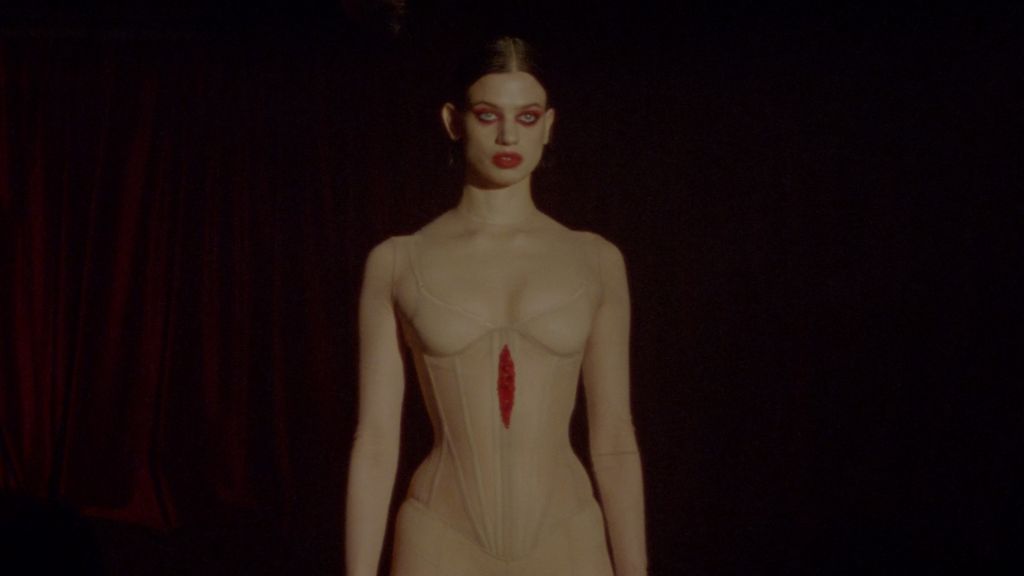
POV: One of the remarkable achievements of At Night is that it commits to the night as a psychic place. Why the night? And what were some of the challenges, discoveries, and blisses that you, Ben Rivers, and Nadia Moussa encountered in trying to photograph this realm?
BG: The night figuring as a psychic space in the film has a lot to do with Alice, again, and the central gesture or tendency of hers that I was talking about before. The idea that a gender-flipped epic would not only replace male protagonists with female ones, but would also flip the logic of male culture. It would involve the opposite of going up into rationality, science and the heavens and instead propose doing down: into darkness, the unconscious, into the interiority of self, and the language of dreams.
Her idea was that the depths were a place where you could truly find knowledge—beginning with self-knowledge, I suppose! She always said: “We should look inside for the answers, not out!” So the night as a psychic space, and the metro as a portal to that psychic space, those are ideas and themes gleaned from The Descent of Alette, and Alice.
The night is undoubtedly a space of emotional intensity, an anxiety-ridden space, but it’s also an emancipatory space, a space for dancing, a space we are afraid of. It’s a space of heightened emotionality. In At Night, I would say it also figures as a transformative space, a space of learning, of coming to self-knowledge. A lot of the night shots were shot independently by Ben, Nadia and I, just the three of us wandering around unofficially, with just a Bolex. It was a much easier part of the shoot! We had a lot of fun.
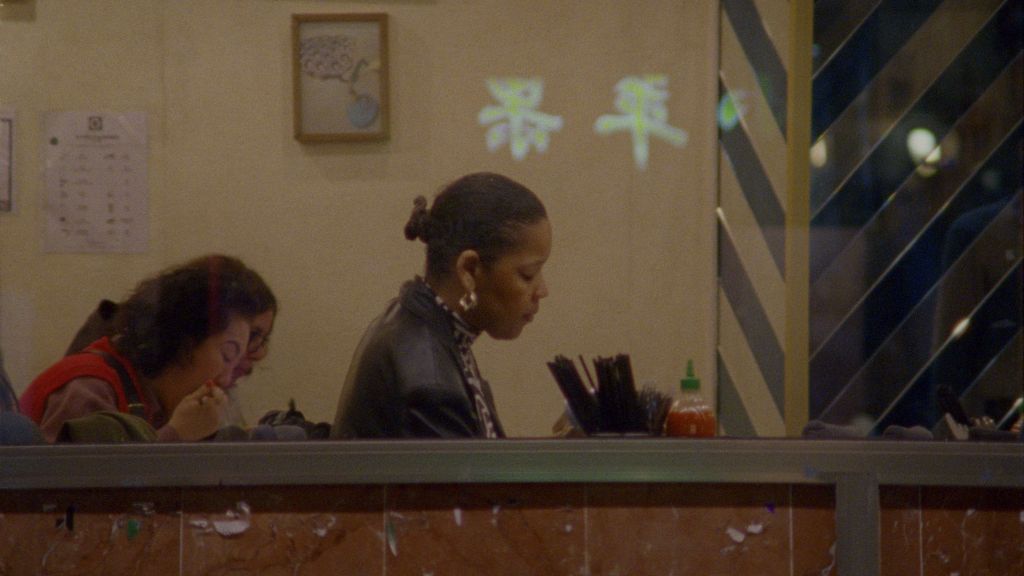
The idea was to capture a little of the different kinds of labour that take place at night, aside from the emotional. I wanted to show the loneliness of city life, in a late capitalist Northern European context, how alienating it can feel in individualistic cultures orientated so heavily around work: workers shutting up shop, people doing their laundry, people eating alone, night workers, and the city shutting down. I thought it would be interesting to show the parallel labours that take place at night.
POV: At what point did you realize that experimental modes weren’t simply a format you were working within, but a way of thinking that suited your sensibility? Your character’s partner offers a philosophy of artistic process: “Trust that it’s going to come out in the wash. Heading in the direction it needs to.” The film dramatizes that uncertainty: Bea is making a film without quite knowing what it is, and then chance, desire and coincidence suddenly sets it all into action. How much does your own process depend on that kind of trust? After making films for so many years, how do you continue working through periods when you don’t know whether something is working?
BG: Yes, it’s what he says, the experimental mode or process, as you put it, is exactly what is dramatized in the film. The filmmaker character—my character—is in a way a MacGuffin to set up the film’s searching, questioning form. In some ways, it’s a logic or trajectory reflected by all the characters. They are all over 40, at a mid-point in their lives, experiencing what you might call a mid-life revelation, and they are questioning what they want, who and how they want to be in their lives.
The great thing about the physical journey as a cinematic or literary structure, the reason it’s so rich, is, because, of course, it’s a metaphor from a psychoanalytic or emotional perspective. We’re all on journeys all the time. Similarly, the experimental processes I have developed within my filmmaking practice reflects ways of thinking and being that of course are applicable to life.
From an emotional point of view, which, to me, is indistinguishable from a political point of view, when things aren’t working, staying with the trouble and looking at what’s difficult—this is how we grow the most as human beings, in relation to ourselves and to others.
I guess I necessarily apply the same logic when I’m making films. If something is not working, it’s worth looking at it. The gold is often where the problems are and running away from them doesn’t really serve anyone. I’m not saying I actively seek painful or difficult things in the context of work or life—but when they do happen, and when we engage in them instead of turning away, they can be our greatest teachers. Part of growing up, as an artist and as a person, for me, is learning to run away less.