



In the past five years, artificial intelligence (AI) has begun reshaping society at a breakneck pace. AI can plan your vacation, file your taxes, and read your children custom-tailored bedtime stories. While it’s easy to marvel at how the technology has evolved in such a short period, all these benefits come at a cost.
Director Valerie Veatch’s latest documentary, Ghost in the Machine, takes viewers under the hood to understand how these systems operate and the motivations behind the tech overlords invested in their success. Veatch debunks common myths surrounding AI while holding its corporate backers to account. Ghost in the Machine calls AI’s viability and morality into question by revealing the toxic source code powering an idealized vision of tomorrow.
POV: Victor Stiff
VV: Valerie Veatch
This interview has been edited for brevity and clarity.
POV: How did this subject land on your radar, and when did you realize you had to chronicle it through film?
VV: This is my third feature film dealing with the intersection of new technologies as they’re becoming normalized into society, so my mind is always contemplating that. About a year and a half ago, one of my friends signed me up for the secret OpenAI early artist program for something called Sora. I wasn’t actively making films, and I was just like, whatever, I’ll look at this.
You could type in something, and wow, an image would appear. But immediately using this technology, the dark clouds of the reality started to form. Immediately, the hypersexualized depictions of women unprompted out of context. Obvious unprompted racial stereotypes would appear. It was impossible to overlook using it even once.
Then I went out to this OpenAI slop cinema event, and I came back to the U.K. and was so upset by things that I couldn’t verbalize, things I hadn’t researched yet. The whole vibe gave me the ick. I started reading white papers about how datasets and neural networks work. I would find interesting white papers and Google the authors and have a Zoom call, and it wasn’t even like this was going to be a film, but that ended up turning into an actual film.
It’s really important that we tell that story and that we then, with that information, figure out how we act as a society around this stuff because a lot of the rhetoric and hype around AI is just classic big tech — we’re building this super-intelligence, which we learn in the film is not a thing. This hyperbole that disguises what are ultimately very classic authoritarian power manoeuvers. By rearticulating the story, by examining its history, we can demystify a lot of it and challenge a lot of these really hyped up narratives that ultimately are entrapping us.

POV: Ghost in the Machine is really an origin story, and focuses on AI’s inception and the systems it’s built on. Can you speak about AI’s history and the principles it’s rooted in, specifically eugenics, and how that shaped the story you told?
VV: I didn’t set out to make a film about eugenics. I don’t even think I understood specifically statistical algorithms to even make this connection. I wasn’t aware of any of that narrative arc. Dan McQuillan, who’s in the film, wrote a book that’s really good called Resisting AI, funny enough. He was one of the first people I spoke with, and he mentioned the connection between eugenics and AI.
I went away and looked at it, and there are so many layers to it, and it all does come down to this worldview that breaks things down into pieces and creates a hierarchy out of them. That’s Victorian-era science, that’s enlightenment-era thinking. All of it coincides with the rise of capitalism, rise of empire and imperialism that we now live under. There’s a lot of different ways that it’s manifested in this current moment.
By looking at the historical context around technology, we can better understand the context of what it’s really doing right now and how it can really behave. So the connections to eugenics are fascinating.
If the film does one thing, it’s pinpointing the moment in which we thought machines could think and how deeply connected that is to this hierarchical way of externalizing and measuring traits, and ranking and intelligence mixed amongst that. And then suddenly, because we have this checklist for intelligence, we can retrofit a computer to check off that checklist and then, “Oh my God, we’re building God,” and everybody better give up their water and their land and their agency and their relationships and their reality.
And what? Excuse me? It’s by going back into history—this is a short-answer to your question—that we can demystify a lot of the hype and therefore take back agency.
POV: We’re at a point where any systems put in place to address institutional racial and gender power imbalances over the years are now being deemed harmful to society. It’s almost ignoring that racism ever existed, at the same time AIs are scraping humanity’s behaviour and incorporating our traits. How’s AI going to evolve if there are no guardrails for how we should treat each other? It’s like a toddler picking up on its parents fighting.
VV: You’re exactly right in locating the phenomena and the whole point of the story. When it comes to how we design algorithms to process data, that needs to come from a correct understanding of what our society is for and what kinds of things we want to accomplish. It algorithmically intensifies whatever is going on around these systems. And one thing I’m really working on is being very careful not to anthropomorphize the computing and rather to locate that often this computing is exactly like you say, a reflection of the society around it.
The narratives that are told back to us about this computing is that it’s fixing a problem, but it’s just papering over the cracks of a broken system. Fixing that system first, fixing how we understand mutual aid, centring care—clearly there are so many things that are untenable about the way in America that we have our economy set up. We need to reorganize society before we continue to unleash computing systems that algorithmically intensify things, and that’s something that Lucy Suchman writes about.
The computing is just a layer to the story. It’s also obviously a driver to the story, but it’s really about how we’re deciding we want to be governed and how we’re deciding we want to operate as a society. And right now, I feel a lot of agency is being absorbed by this narrative of super intelligence, which is why I made this film.
POV: Mass media informs so many of our opinions. How have Star Trek and The Terminator informed public perception of how AI functions? What’s the most misleading concept, and what are some films that come close to depicting how you envision the future?
VV: There’s a film called 2073 that came out a few years ago, directed by Asif Kapadia. That is a very interesting depiction of the future that unfortunately makes more sense than it showed.
POV: How so?
VV: Just in the dystopic endgame of a lot of these surveillance and technology systems in the hands of authoritarian states, which is very valid. That’s a reality. But it’s too discouraging for people to focus on that, and I try not to hyper-focus on that in my film.
Adam Becker, who’s in our film, wrote this great book called More Everything Forever. And he touches on it a little bit in a way that’s not cheesy, how science fiction influences a lot of these guys. And in the film, there are two science fiction authors who are just talking in the interview about artificial intelligence. It’s Isaac Asimov and Arthur C. Clarke.
POV: Two legends.
VV: Two legends, but also two men who deeply believed in the misogyny of their moment, that what they were doing was building a more perfect brain and more perfect human and more perfect entity. So the whole tech industry is saturated, and the whole sci-fi framing of the future has been white. The framing of the future as being non-physical, that our bodies, that our humanity, that our earthliness is somehow to be tamed and to be overcome in mortality and outer space, and the future is all post-body.
All of these are sci-fi ideas, [OpenAI CEO] Sam Altman funds stuff like all of this, and all of their obsession with it is rooted in this rejection of the body. You look at Clarke and Asimov, their worldview is their fiction and then it becomes our reality, and it’s good to observe these and define them and to articulate this.
POV: There’s no way you can cram everything about this expansive subject into a two-hour film. This could easily be a mini-series. Are you going to continue telling this story through film?
VV: I think I’m much more of an activist than a filmmaker at this point in my life. And I will continue this mission, maybe I’ll make a kid’s version of this because it’s very important to me that children understand the lives of superintelligences. I doubt I’ll stop. I love making films.
POV: How did you go about incorporating AI into your film?
VV: Well, [I] took more of it out now.
POV: From your Sundance premiere?
VV: I hate the look of it so much, and it makes me ick so hard that I loved putting it in the film when we’re talking about the singularity and when we’re talking about things that were gross.
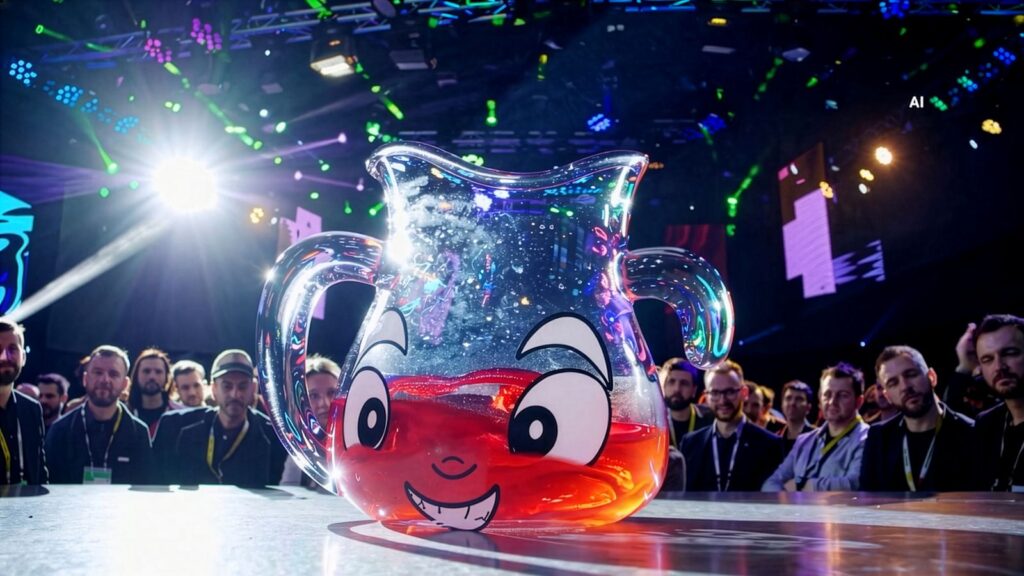
I was being a bit pretentious, like in the lens of feminist filmmaking — internalizing the aesthetic of the oppressor and re-purposing it in critique. That needs more deliberate framing. There are a few moments where I did keep in the Kool-Aid and stuff like that. It’s, to me, a clearer usage of it. And then just licensed a bunch of really stylish B-roll for the others.
POV: If you could choose to show this film to any one person in the world who could make an impact after seeing it, who would you show it to?
VV: One person, I mean, I think the people who could do something, wouldn’t see it. They would watch it, and they would be like, “Yeah, we don’t want woke AI.”
POV: That’s the time we’re living in.
VV: That’s the unfortunate thing. Power is in the wrong hands.
POV: What is your film telling people that they’re not going to get anywhere else?
VV: A reality-based framing of what artificial intelligence is. And the release from having to anthropomorphize it and the permission not to use it and the knowledge that by not using it, you are not going to fall behind in your career, and you know you’re not going to be left behind, and in fact, you will have more personal power.
POV: And all the people who see your film and feel incensed by digital colonialism and technofascism, what’s the next step for them? How can they continue the fight?
VV: Taking it local, to their immediate relationships and communities. For a lot of people, that means identifying where there’s local resistance against data centres, and doing the cringe: going and making community, in any way you can. It doesn’t have to be around anything political — like community gardens and pet walking groups, forming actual relationships. Being together is the most radical thing we can do right now, in real life.
Understand our real position: where does our water come from? Where does our power come from? When we’re on our phones and scrolling, we lose our collective agency. Finding ways to create that sense of community is the first layer. And that leads to participatory democracy.
Culture is our medium as storytellers, so that’s where we can create the change that we need by sharing these stories, creating community around them and that creates culture and then our natural behaviours with technology will change. Whether or not they are regulated to change their products or whether or not they shut up about super intelligence doesn’t matter as long as we can create understanding amongst ourselves about what this is.
Ghost in the Machine screens at Hot Docs 2026.
Get all of POV’s coverage from the festival here.