



Everest: The Other Side
(USA, 115 min.)
Dir. Elizabeth Chai Vasarhelyi, Jimmy Chin
Prod. Elizabeth Chai Vasarhelyi, Jimmy Chin, Shannon Dill, Anna Barnes, Bob Eisenhardt, Janet Yang
Programme: Special Presentations (Canadian premiere)
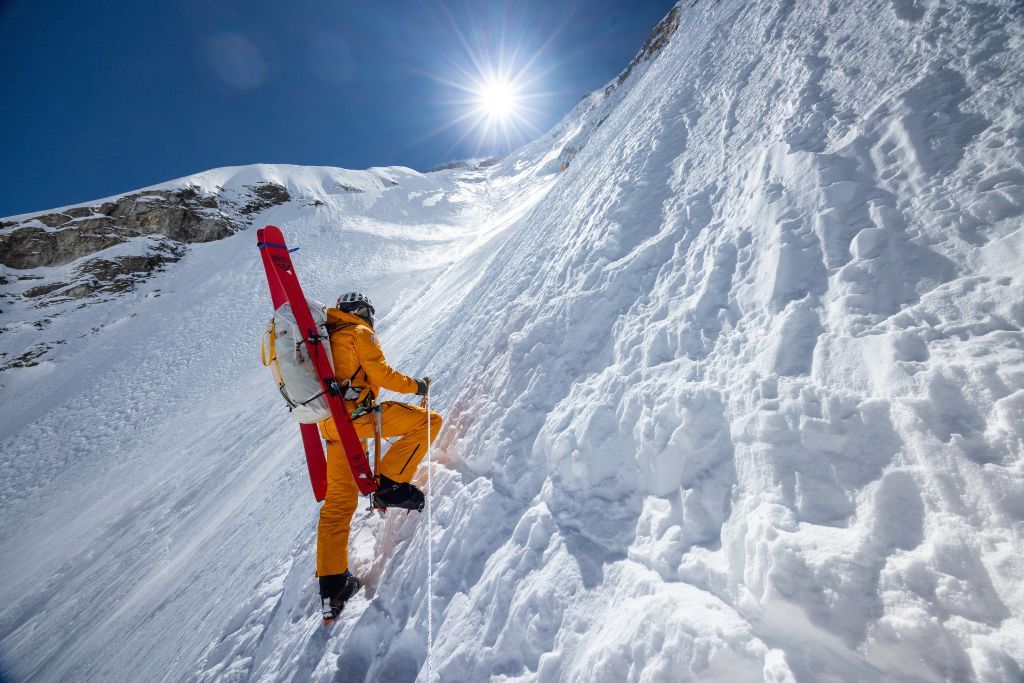
Should people risk their lives in the service of a colleague’s goals? That question resides at the heart of Jimmy Chin and Elizabeth Chai Vasarhelyi’s exquisitely shot, if thematically thorny, documentary Everest: The Other Side. The film offers another ambitious test of human endeavour in the seemingly limitless field of Everest docs. It’s a solid mountain movie, but one precariously on a moral precipice. To their credit, the filmmakers recognize the complexity of their delicate situation and make it part of the documentary’s design as they chronicle the efforts of their long-time friend Jim Morrison (not the singer) as he strives to make history as the first person to ascend the north face of Mount Everest and then ski down it. It’s a near-impossible feat, since only five people made the climb and nobody–literally nobody–has successfully skied down the steep and extremely dangerous terrain.
Those circumstances make Everest: The Other Side a breathtaking adventure. It’s a complicated one, too, as a tragic turn of events underscores the personal stakes of the mission, but also illustrate the tough ask entailed in recruiting others to join what’s essentially a suicide mission. (This review may read a little vague to avoid spoilers, as I went into the film cold and had my heart in my throat.)
Ascending and skiing the north face poses an extremely difficult challenge. Nearly all climbers at Everest ascend the south side from Nepal, which offers a comparatively easier incline and path than the route up the north side via China. Moreover, the ski down requires key conditions. Go when it’s colder, and the route is too icy. Wait for a thaw and melting snow and avalanches yield a death sentence. The window for this feat is small and unforgiving.
Morrison and his partner Hilaree Nelson, both accomplished mountaineers, vow to make the history run together. They train on smaller mountains and recruit Hilaree’s young sons from her first marriage to help them along the way. Mountain air runs in their blood. These strong- willed alpinists are determined to do the impossible together. Their passion rings palpably clear, as does their efforts to make the expedition in an informed manner, as seen when they interview the first mountaineer to make the climb and for whom the treacherously steep Hornbein Couloir is named. That narrow vertical path offers the ultimate death drop.
Chin and Vasarhelyi are both accomplished adventurers in their own rights with the former having climbed Everest himself in 2004. They know the daredevil stakes of this mission. So, when, as Vasarhelyi states in the film, literally the worst possible outcome for their story happens, they face an impossible call. They can end the project and disappoint a friend, or risk everything after losing so many friends to the unforgiving mountains. A bone-chilling shot of the snow giving away under a friend’s feet during a fatal accident on a mountain makes the stakes as clear as they can get. It’s like seeing the tape from Grizzly Man.
The filmmakers choose to continue, but the weight of completing the expedition carries throughout the film. Everest: The Other Side captures the risks that event takes in service of a friend’s quest. The crew’s team of Sherpas, for one, face enormous risks. They head out in advance of to set the path and ground the supports and ropes to ease the ascent. The mission requires the climbers to traverse thousands of feet of unforgiving terrain at high altitudes with the base camps to divide the journey. White-knuckle moments ensue as point-of-view footage lets viewers experience the snow that comes rumbling by as Everest’s terrain changes in the window between the end of monsoon season and the arrival of the Jetstream.
There’s no shortage of mountain docs or tales from Everest, but Vasarhelyi and Chin get some truly awesome footage from the side of the mountain that audiences rarely see. Shooting on for IMAX on the world’s tallest peak ensures that the views from the mountain are breathtakingly awe-inspiring, but the eye for scale perfectly captures the sheer difficulty of the task ahead. It’s a vertiginous cinematic experience, much like Free Solo gives a sense of what it feels like to hang in the balance between life and death with bring but the air separating the two.
Chin also plays a key role in front of the camera this time as a member of the expedition. While aspects of the adventure may make some audiences uncomfortable, the filmmaker’s presence offers a rare entry point for the participant’s own drive to fulfill a death-defying act. Everest: The Other Side feels like a film that only Chin and Vasarhelyi could have made. The filmmakers and adventurers offer clear doubles for Morrison and Nelson. They understand the physical toll of their quest as well as the risks entailed, but also the bigger questions entailed when parents embark on such high stakes adventures. This study of grief hits hard because, tricky as it is, it comes from a personal place.
But documentaries don’t get shots like Everest does without people who understand and appreciate the adrenaline-high of the climb, and have the rare artistic and technical know-how for both the climb and the filmmaking to ensure that the mountaineering team and the documentary team do the job safely. Thankfully their IMAX scope means none of us ever has to make the climb in real life when the movies will do.