



Shoot the People
(United Kingdom, 90 min.)
Dir. Andy Mundy-Castle
Prod. Wyn Baptiste
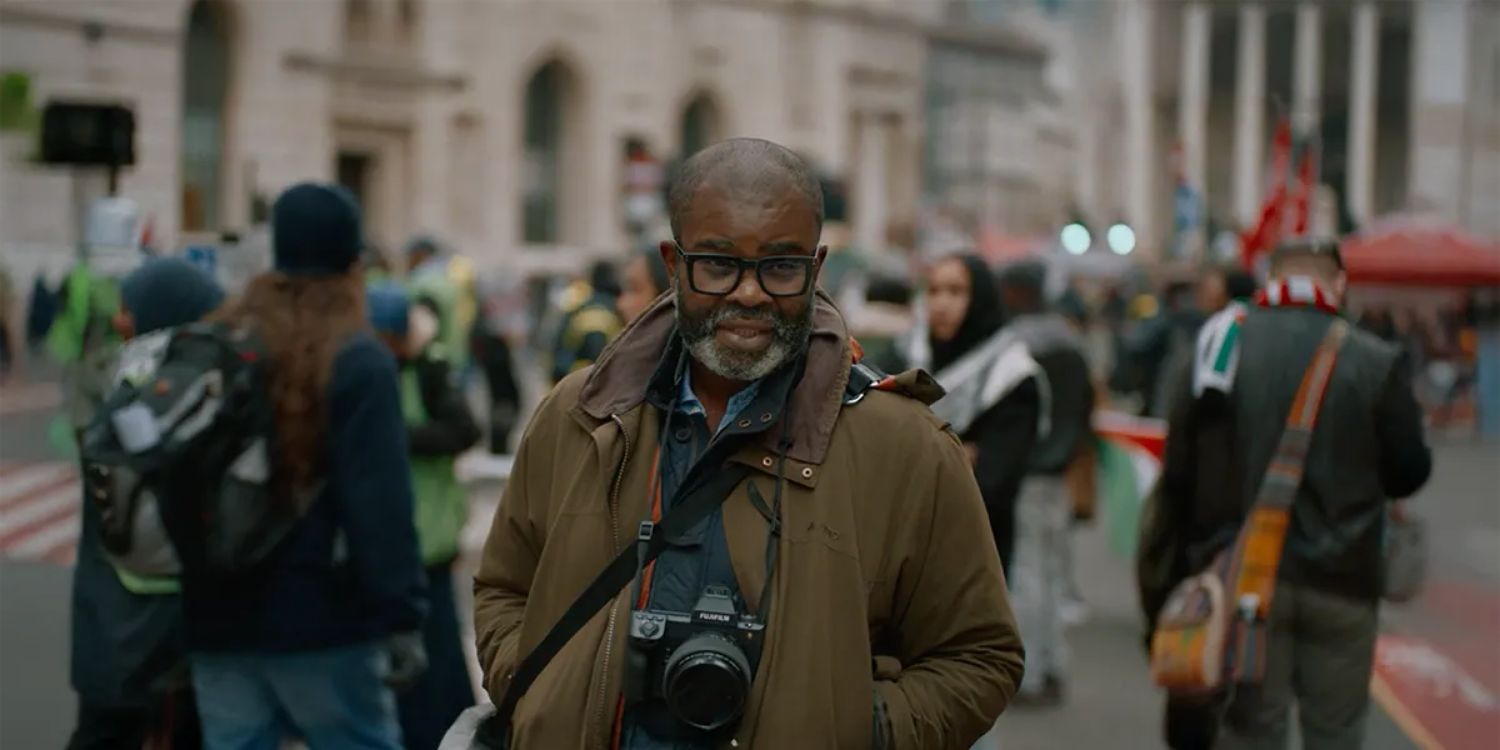
Shoot the People is a lot of things, but it’s primarily a disappointing documentary on Misan Harriman. There is little in this film about the photographer that cannot be gathered from his Wikipedia page. Much of this reluctance to offer any credible insight into Harriman stems from the doc’s inability to commit to a singular or even dual narrative. At once it attempts to be a doc about Harriman, about the importance of protest culture, an indicator of the burgeoning socio-political and ethnic divides in the world, while also managing to showcase Harimann’s significance through interviews with Martin Luther King III, David Meyer, and Ilhan Omar, and by giving the audience a behind-the-scenes look at Harriman prepping for his grand night at the 2024 Oscars where he was nominated for directing a dramatic short. The film’s desire to contend with such an assortment of themes simultaneously indicates a lack of interest in Harriman and presents a sanitized, one-dimensional version of his activist self. This disconnect between Harriman’s story and the work that he ostensibly stands for is also indicative of a trend that favours the novelty of celebrity biography over the urgent world issues that surround the subjects themselves.
This surface level engagement with its subject matter is clear from the extended introduction itself, where a montage of Harriman’s photographs and independent news clips plays out over a series of politically charged audio bites. The montage emotionally primes viewers in an over-simplified reduction of its central subject. It merely reminds folks that “Protests are important, especially today.”. Even when concerned with this idea of the protest, the film does not engage with the reality of the counter-protest, or protests by people with whom we may disagree politically. We are offered a sea of Palestinian flags at one demonstration and Israeli flags at another, but we do not hear enough from either side to coherently put the conflicting parties in conversation with one another beyond their understood opposition.
The film limits its discussion to global movements that have gained traction within the last decade to conveniently situate itself on the political paradigm. Protests in this doc appear to exist as relational touchpoints to craft solidarity with the audience instead of providing an attempt to submerge the audience into protest culture, warts and all. This restricted portrayal of protest is quite contradictory considering Harriman admits in the opening ten minutes that, “10% of my time (at the protests) is taking photographs, the rest is being in it.” However, the only time we see Harriman at any sort of public demonstration, be it in Atlanta, Los Angeles, or South Africa, his urge to photograph or document receives emphasis over his desire to participate.
In fact, on his way to the Oscars’ red carpet, when his car passes by protesters advocating for a free Palestine, we hear Harriman ask his driver to slow down as he records the demonstrators on his phone. That is the extent of his engagement. While he is at the Oscars, we hear a news reporter commenting on how the gift bags being handed out that year are worth over $170,000. The visuals then cut from the red carpet to Israeli airstrikes and protests for a free Palestine. It is clear that the film wants to put these two events in conversation, urging the viewer to contend with the reality of millions of dollars of party favours being offered at the same time that Israel is reducing a civilization to dust. However, in this scenario, what is the viewer supposed to infer about the film’s protagonist when he chooses to attend the party instead of the protest?
This moment is only exaggerated by Harriman the next day when he admits, “It took everything in me to not take my big camera and join the protesters from the red carpet and at least shoot them, but I think I would have been arrested and maybe not allowed into the Oscars. But that itch was there.” This statement reads as an empty compromise by Harriman, who earlier in the film had spoken of late South African figure Peter Magubane as someone after whom he models his photography and activism. The same Peter Magubane who was arrested and sentenced to solitary confinement for photographing a demonstration outside Winnie Mandela’s jail cell in 1969. The same Peter Magubane who was arrested several times after that, and yet remained unafraid to challenge the oppressive regime, continuing to photograph political situations he thought the world must see. Harriman’s admission that he did not photograph the protesters, let alone join them, because he would not have been “allowed into the Oscars,” is an utterly tone-deaf statement in this situation, from the man who is the central figure in this alleged documentary about protests.
This complicated scene illustrates how the film consistently positions Harriman as above the people he captures. In an interview bite where Harriman is contending with his own privilege, we hear him say, “I could be jumping from one film and fashion party to the other. I have plenty of, I guess, celebrity friends that I could be hanging around with and just turn my head away from the pain and inequality of the world.” It is both a contradictory statement considering his attendance at the Oscars (arguably the biggest film and fashion party) and an outright confusing one. Does Harriman expect us to sympathize with him for giving up an extravagant lifestyle to document protests? Or does that make him better than the very celebrities he has photographed for a variety of magazines and media houses?
Where Shoot the People turns its own gaze tells a story of its own. The film’s greatest bits arise during the rapturous addresses delivered by people at these protests and in side-interviews with protesters and activists. Most of these interviews are conducted by the filmmakers and not by Harriman. Had the film been about any of those protesters or protests in its entirety, it would have undeniably been far more interesting than the self-aggrandizing portrait of Misan Harriman that we are offered.