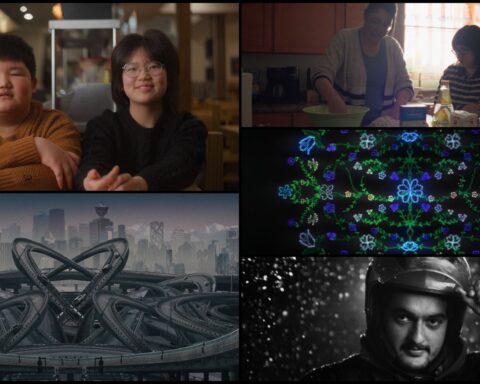




People often place animation and documentary on opposite ends of the cinematic spectrum. This receptive dissonance is understandable, to an extent. It is true that documentaries do capture unobstructed reality, and animation is often employed to construct other-worldly visuals that interrupt our very understanding of reality. However, throughout history, some filmmakers have blended these two genres quite effectively to narrate stories that are equally as moving as they are imaginative. Throughout the history of innovation at the National Film Board of Canada, several animated documentaries have brought the genres together in ways that are sure to expand your perspective. Here are ten films available to watch on the NFB website right now, that fit this bill.
Fiddle-de-dee (1947)
Aptly described as a “painting on film,” Fiddle-de-dee is Norman McLaren’s experimental work that translates music into a collection of indescribable images. Choreographed to the tune of “Mocking Bird” as played by a fiddler, McLaren’s images twist, turn, dance, shape-shift, and transform to visualize the rhythm being produced by the fiddle. A musical kaleidoscope of sorts, the rapidly changing scenery leaves the meaning up to interpretation as it loses itself to the beat of the song.
Fiddle-de-dee, Norman McLaren, provided by the National Film Board of Canada
Cosmic Zoom (1968)
The film opens with the image of a massive factory standing next to a river. The camera tilts down revealing a small rowboat being paddled by a boy, as his dog stands guard on the opposite end. The camera freezes on this unassuming image as the scene shifts from live action to animation and we zoom out to the sky, the stars, and everything beyond. Mimicking a boomerang’s rebound, the film pauses and begins to zoom back in past the cosmic visuals and towards the boy, going past him to the mosquito on his arm and in to cellular level compositions, in one uninterrupted camera movement.
Cosmic Zoom, Robert Verrall, provided by the National Film Board of Canada
Mirrors of Time (1990)
Employing animation to capture the expansive and ever-present history of time itself, the film does so quite effectively. It features a variety of 2D animation styles, some of which are reminiscent of Popeye and Asterix comics while others are designed with a chiaroscuro-style lighting to evoke a more mature composition. The entertaining animations are used to construct micro-narratives across a series of set-pieces that explore calendars, seasons, the solar system, and constellations.
Mirrors of Time , Jean-Jacques Leduc, provided by the National Film Board of Canada
Minoru: Memory of Exile (1992)
The eponymous Minoru is a nine-year-old Canadian of Japanese descent, who was deported from his country following the bombing of Pearl Harbor in 1941. The film, directed by Minoru’s son Michael, employs animation to reconstruct the fragmented and underdiscussed history of thousands of Japanese Canadians including Minoru, who were forced into internment camps and ultimately out of the country as they were considered ‘enemies of the state.. Minoru artfully blends animation with archival footage brought together with a revelatory voiceover from Minoru himself creating an animated documentary that brings to light a severely underrepresented story in an exceptionally moving manner.
Minoru: Memory of Exile, Michael Fukushima, provided by the National Film Board of Canada
Ryan (2004)
An Academy Award winning animated short about the legendary Oscar nominee, Ryan Larkin. The film is an achievement in animation and storytelling, framing Larkin’s struggles with addiction as the central metaphor in both the visuals and the narrative. Ryan is an excellent example of how animation can be employed to capture real stories in an authentic manner without downplaying their seriousness.
Ryan, Chris Landreth, provided by the National Film Board of Canada
Lipsett Diaries (2010)
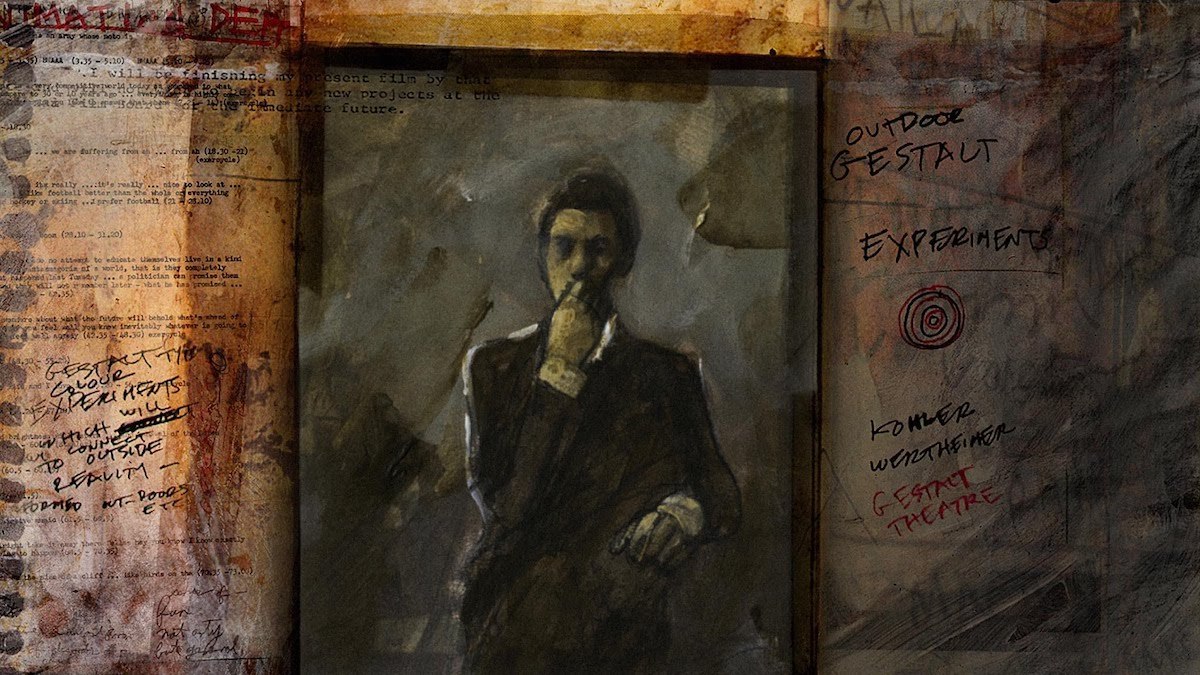
Another doc about a Canadian filmmaking maestro, Lipsett Diaries captures Arthur Lipsett’s struggles with depression, externalizing his internal turmoil. The film restructures sounds and images from Lipsett’s own work across a series of dream-like portraits that evoke the madness that the film seeks to picturize. Like Ryan and Minoru, Lipsett Diaries is a film that visualizes the potential of animation as a medium to relay more complicated stories.
Lipsett Diaries, Theodore Ushev, provided by the National Film Board of Canada
Paula (2011)
In a style that evokes monochrome watercolour paintings, Paula captures a working-class neighbourhood where families cross paths with prostitutes. Featuring no dialogues or voiceover, the dreamy animation style is complemented by the vivid soundscape that ebbs and flows, guiding the viewer through the emotionally and physically charged narrative of the film.
Paula, Dominic-Étienne Simard, provided by the National Film Board of Canada
Wall (2017)
The only feature film on this list, Wall boasts a peculiar animation style that portrays how animation can impact a viewer’s reception of the story over time. The experimental 3D motion capture form resembles a video game, which is further complicated by the monochrome tone of the film. However, as narrator David Hare takes us across the wall separating Israel and Palestine, the film’s odd form becomes arresting and its colourless images fitting for the harrowing reality it captures. At times it does feel like watching a film about David Hare’s thoughts on Israel-Palestine rather than one about the illegal Israeli occupation of Palestine, but it does sustain intelligent and well-informed commentary throughout that sympathizes with Palestinians.
WALL, Cam Christiansen, provided by the National Film Board of Canada
Three Thousand (2017)
Three Thousand features a compilation of archival footage in the form of newsreels and films discussing Inuit culture, stories, and people, reframing these depictions of the community with director Asinnajaq’s own vision for their people’s future. The structuring of the archival footage explores the history of Inuit representation in Canada, especially the propagandistic and performative nature of early docs featuring them. The animated sequence that concludes the film interrupts this problematic history with a truly spectacular, luminescent scene that artfully visualizes the filmmaker’s aspirations for the future of her people.
Three Thousand, Asinnajaq, provided by the National Film Board of Canada
Amma (2024)
Filmmaker Akash Jones uses stop-motion animation to immortalize his mother’s ‘micro-lessons’ that continue to guide his life long after he has moved out. The whimsical format of his mother’s multiple reminders alongside a smart use of colour, texture and set design bring Jones’ characters and story to life.
Amma, Akash Jones, provided by the National Film Board of Canada