

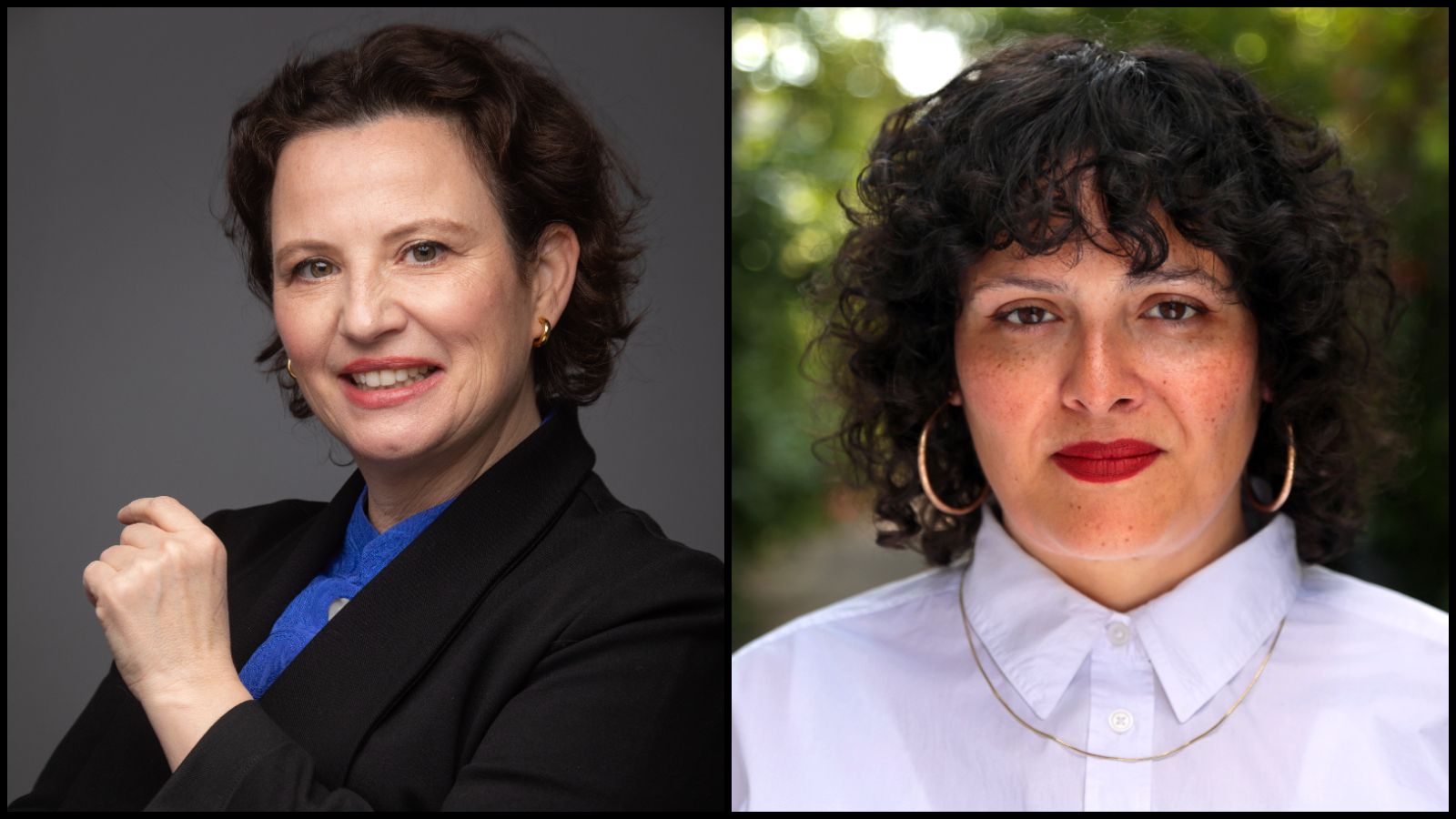

Hot Docs reaches another milestone in its redevelopment today with the announcement of a new executive structure and appointment. Diana Sanchez will move up to the president position with Mara Gourd-Mercado joining the organization as its executive director. Gourd-Mercado, currently head of industry and training at Copenhagen’s CPH:DOX, will join Hot Docs in October after relocating to Toronto.
The restructuring comes after nearly a year-and-a-half on the job for Sanchez, whose time as executive director has included a period of renewal for the festival including rises in festival attendance (up 3% this year) and ticket sales (up 14% for single tickets), the sale and lease back of Hot Docs Ted Rogers Cinema, and a new board of directors (with Julie Bristow announced today as chair and Aaron Zeghers as vice-chair.) This year’s industry side of Hot Docs drew 954 delegates from 47 countries.
Sanchez, speaking with POV in a joint interview with Gourd-Mercado, admits that the first year was a challenge, but that this new appointment reflects the results of the community rallying around Hot Docs. “Everyone wanted Hot Docs to continue to thrive, to succeed,” says Sanchez. “The donors came in, the sponsors, the audiences.” The latter number is especially encouraging after Hot Docs ’26 drew over 40,000 attendees with 35% of screenings going rush, and the Docs for Schools program cultivating a new generation of documentary fans.
“If you go to the cinema now, you’ll see a real response from the audiences as well,” adds Sanchez. “We adjusted our programs and our festival. We were trying to shrink, in a way, to go for high impact and an intimate experience for our stakeholders.”
Those changes included a reimagined Forum, which shifted to the cinema and did away with the pageantry of previous iterations that put pitching teams in the hot seat. The festival footprint also decreased with fewer venues to keep events intimate, but also work on a manageable scale.
Sanchez says that bringing Gourd-Mercado aboard allows Hot Docs to continue those developments while re-growing the organization. “This is going to help our fundraising. That’s our big challenge,” says Sanchez. “This is creating new programs, opportunities for international stakeholders and really creating a Hot Docs that can thrive and meet the needs of the community.”
The new structuring means that Sanchez will focus on the long-term organizational strategies and government/stakeholder relationships, while Gourd-Mercado on will be responsible for daily operations and fiscal management of Hot Docs.
While Hot Docs’ last dual leadership structure began a rocky period of turnaround with former co-president and executive director Heather Conway beginning the role in November 2021, sharing the president role with long-time head Chris McDonald, but then stepping down before the next festival even began in April 2022, Sanchez says the restructuring decision made with the board should inspire confidence. She says that she and Gourd-Mercado have complementary skills, but clearly defined roles.
“We’ve talked about this deeply because it is important. Mara is fully focused on the day-to-day operations: laser-focused on the festival and industry. I’m looking at a lot of our multi-year agreements, ensuring that Hot Docs can thrive and continue,” says Sanchez. “We’ve had those deep conversations and are learning from the past and looked at our roles to ensure that they’re well-defined so that we can have a really communicative, collaborative approach within those lines.”
Gourd-Mercado adds that she comes to the role looking to focus on management, operations, workflows, and HR. “I love bringing out the best in a team. How do we make it work with the means that we have and the team that we have?” she asks. “I’ve never been an artistic director. I’m not a programmer. That’s not my job. It has never been. When Diana came to me, those things were really clear.”
For Gourd-Mercado, who previously served as executive director of Montreal’s RIDM and held the same position at the Quebec division of the Academy of Canadian Cinema & Television, coming aboard Hot Docs in a time of change is a welcome challenge. And she knows the festival well having attended many times in her various capacities.
“For me to have the opportunity to be part of Hot Docs and also to bring back everything that I’ve developed as skills, whether that be in Canada, or now in Europe, and bring that back to the documentary community in Canada, I think that’s super exciting,” adds Gourd-Mercado. “I’m a builder, I’m someone that loves to take something and make it thrive and reimagine and rethink. How can we really build a space that serves the doc community and the doc industry, but also the doc lovers?”
After her time at CPH:DOX, Gourd-Mercado notes that Canada and Denmark have similar ecosystems when it comes to documentary funding, but the difference offers room for innovation. Europe has the benefit of proximity with borders and productions becoming porous.
“People get inspired and cross-pollinate in a very fast way. I also think that out of necessity, most European countries, except the big ones, need to co-produce,” says Gourd-Mercado. “It’s also because there is this communion of ideas through the European Union. In Canada, we have that desire to go out there and to co-produce and to tell stories that will have an impact not only in Canada, but outside of it. And I think that some producers do it really well, but I think that we can do better in that field.”
Gourd-Mercado brings this perspective into the role as she’ll be tasked with fundraising and industry programming, which includes the Hot Docs Forum. The pitch sessions paused in 2025 but returned in 2026 as the marquee event of the Industry side. This year’s Hot Docs Forum awarded over $48,000 in prizes with the top two awards going to Canadian teams. Other key industry sides include the Deal Maker sessions and networking events that connect filmmakers and producers with funders, broadcasters, and distributors.
Moreover, with the leadership news coming just a week ahead of TIFF and the launch of TIFF: The Market, Sanchez and Gourd-Mercado aren’t phased by rebuilding alongside the behemoth. They see it as a positive. “The more vibrant our ecosystem is, the film festival ecosystem, the market ecosystem, the better it is for everyone,” says Sanchez, who previously served as a TIFF programmer and senior director of film before coming to Hot Docs. “And then there’s more opportunities to partner, to meet people throughout the year.”
Among the partnerships and strategies for Hot Docs’ leadership is a focus on strengthening ties with Francophone audiences, perhaps looking to tap into that porousness that Gourd-Mercado observes in the European system. (The 2021 Census pegged about 10% of Toronto residents as reporting fluency in French.) Sanchez says the focus is part of expanding Hot Docs’ reach as it looks to audiences and partners.
“We are the biggest Canadian and international documentary festival. We should be a meeting place for all Canadian documentary filmmakers,” she says. “We want to have these conversations. This is our identity and documentary is such an intrinsically Canadian genre. If we’re going to be the biggest documentary festival in Canada, we have to extend that welcome across the country.”
Sanchez admits that the distinction between being the “biggest” festival and the “best” is hard to qualify, but they’re factors she has to consider and not necessarily exclusive. “If we’re having a critical mass of filmmakers here, of course we’re looking for rigorous filmmakers, rigorous films,” she says. “We do want to have the films here that will attract audiences. When we have such a huge amount of the community here, we want the whole community to want to come to Hot Docs.”
Hot Docs’ president also notes that the political climate in the U.S. place the festival in an opportune position. “A lot of filmmakers right now would prefer to travel to Canada than the U.S. So it’s an ideal meeting spot for the industry in North America,” says Sanchez.
Gourd-Mercado adds that the “biggest” versus “best” question holds weight on the industry side of Hot Docs. “What needs to be built and what’s already there from the last edition is a space that has impact, having the right people in the room who will bring the money, who will bring the connections, and the creative partnerships,” she says. “When you look at a festival and an industry space through the lens of [being] the most impactful, then you grow responsibly and you do it in a sustainable manner because you’re always answering the needs of the community.”
Hot Docs’ announcement today also notes some restructuring of the cinema operations. Some positions have been “consolidated or eliminated” after taking stock of the theatre’s reduced operations, following the lease-back plan that was part of the sale. “I’ve been looking at our structure and at the organization, and a lot of it was built for programs we no longer deliver from programs that we did in past iterations of Hot Docs,” explains Sanchez. “This speaks to the programs that we’re actually delivering today and that we’re planning on delivering in the future.”
When asked if the cinema will ever return to full theatrical runs, Sanchez says that’s something the theatre committee will assess, but plans remain for screenings running Friday to Sunday.
As for looking to the future of Hot Docs, both Sanchez and Gourd-Mercado are optimistic about the role of festivals in the documentary space. “Festivals are a place where makers get to gather and meet each other and discuss and expand upon, the language of cinema, the language of documentary, make new creative partnerships,” says Gourd-Mercado. “For audiences, festivals are a space to actually meet and disagree together, discuss together, and to get out of our echo chambers and our bubbles. Watch this documentary and then let’s chat about it.”