



Better Go Mad in the Wild
(Czechia/Slovakia, 83 min.)
Dir. Miro Remo
Prod. Miro Remo, Tomáš Hrubý
Programme: World Showcase (Canadian premiere)
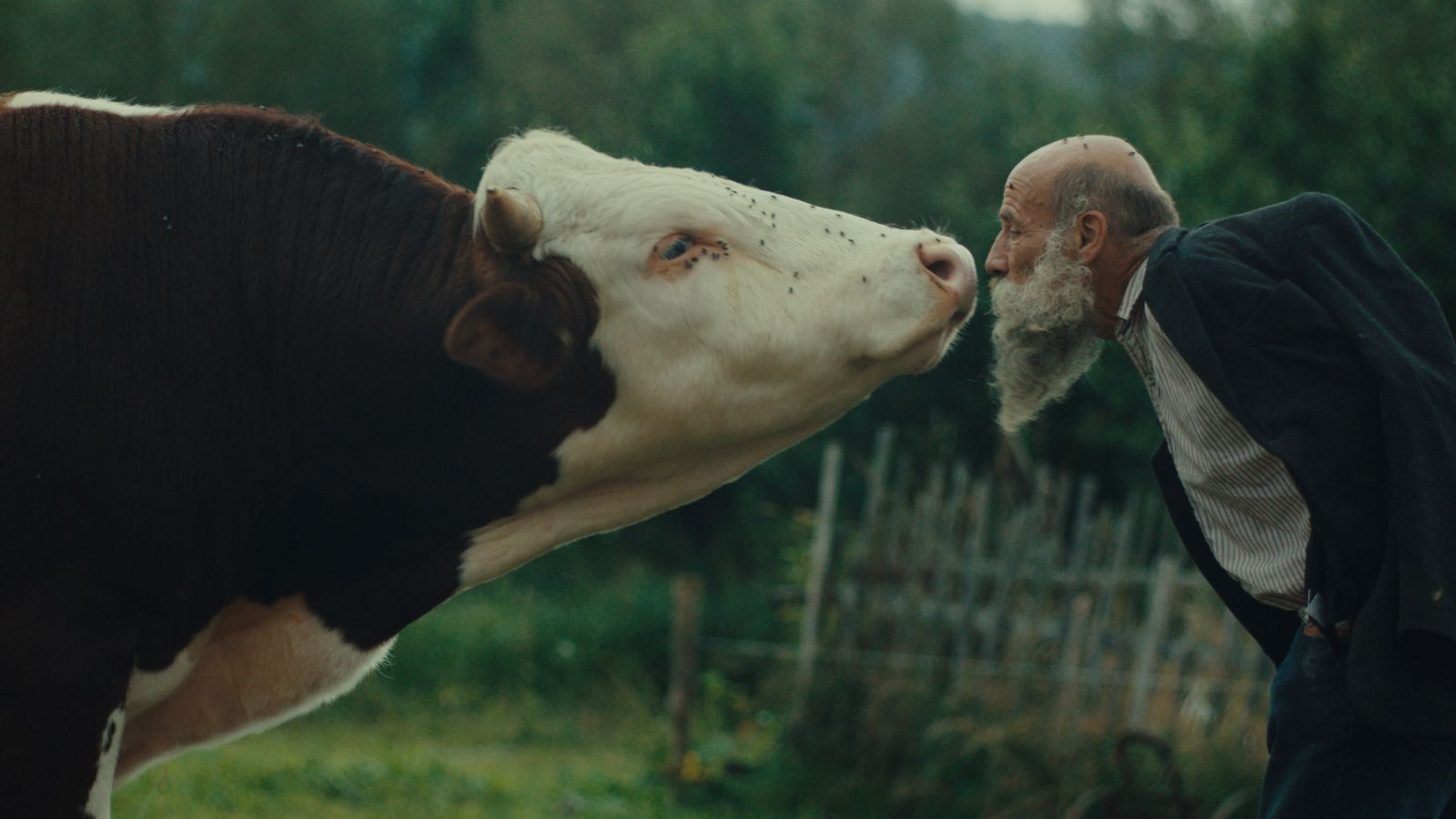
It’s not every day you see a cow suckle on the beard of an irascible bald man, flies dotted upon both their heads like dancing raisins on a stale pastry. This is but one ingredient that ensures Miro Remo’s latest film isn’t some run-of-the-mill work of non-fiction. A surreal yet sweet portrait of twins Franta and Ondra Klisik as they make their way haplessly as farmers in the rolling landscape of the Šumava mountains, Better Go Mad in the Wild plays as part fever dream, part paean to rural life, all while focussing deeply on these brothers and their menagerie of animal companions and myriad mishaps.
Based in part on Aleš Palán’s book that gives the film its title, Remo infuses the documentary with both whimsy and melancholy. The brothers live in somewhat wretched circumstances, bathing in open puddles, wearing ratty clothing, and binge-drinking to the point of physical altercation while their grey beards have a faint stain of nicotine from years of chain smoking. While the siblings are easy for one to distinguish (one brother lost a limb in an accident years ago), their fraternal scuffling, arm wrestling events, and general irascibility belies their age and feels far more like the precocious posturing of adolescents.
And yet, occasional poetry emerges from their ramblings, as well as artistry in their scratched-on-walls illustrations. This collision between the seemingly ridiculous and subtly profound will intoxicate audiences looking for something unique, while others may justifiably tire quickly of the maudlin nature of the twins’ dynamic.
Occasionally, the real world manages to interfere with the otherwise bucolic existence, and to see slightly more modern settings provides a bit of whiplash at times. Despite certain conveniences like a Nokia 3310 laying on the kitchen table, itself a technological throwback to a time when things were built to be indestructible, the lives of the brothers, surrounded by dogs, cats, cows, and chickens, feels practically medieval. The arrival of a round mirror feels like both a cinematic crutch and an almost magical addition to their living space, akin to some alien advanced technology literally bringing the light into their otherwise sordid living abode.
We see walls literally broken down between the two brothers, but also moments where their drunken brawls border on the fratricidal. The loping bovines that provide chorus-like commentary are goofy, but there’s nothing funny about the near fatal encounter with a rampaging bull. The collision between these elements – the bull dragging logs via a large chain to bring firewood to their home, only later to have such modernist moments as a helicopter landing to extract one of the brothers for a medical emergency, shows how they live both inside and outside a society that they’ve seemingly wished to excise themselves from save for the most specific of needs.
That sense of hermit-like removal is belied when we see their recognition for their role in helping foster revolution during Czechia’s battle for independence from Soviet control. The brief moment of the two in well tailored suits is perhaps startling in contrast to their quotidian garb, but it illustrates how there is more behind their hijinks than appears on screen.
This is not to say we get deep into what makes Franta and Ondra tick, save for brief moments when we hear about romances that faltered, or the desire at one point to divide up the home to provide a modicum of privacy. In fact, the first credit that rolls speaks to an unexplored narrative thread that invites questions about what transpired after the filming wrapped, making the final chapter of the Klisik’s story begging to be further explored. And yet, despite the more explicit exploration that would be employed in a more straightforward film, it’s probably for the best that in such a decidedly offbeat project that even these elements are touched upon obliquely.
Handsomely shot by Dušan Husár and Remo in tandem, the result is a quirky, dream-like portrait that somehow manages to be engaging even as it often descends into obnoxiousness. Much of this has to do with the implausible charisma of the boys, their battles and musings managing to be more captivating than off-putting. There is a general madness that is evoked by the title, but it’s not simply a matter of creating chaos and revelling in incoherence. Instead, we are treated to an avuncular, angular portrait of these two brothers, seemingly living out of time, but very much mirroring each other as both their best and their worst.
Can it be read that the title, Better Go Mad in the Wild, suggests that it’s superior to go over the edge than to have never have gone mad at all? Or is it more straightforward than that? If one is to succumb to madness, do so away from prying eyes? Either way, we get a glimpse of the particular gradations of sanity that Franta and Ondra traverse, and the result is as laudable as it is a work of sheer lunacy.