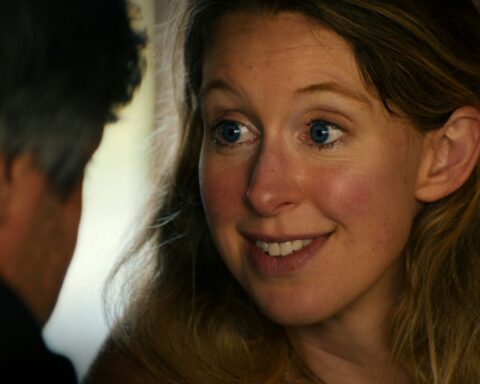




“I’m trying to pick my words carefully so that I don’t get in trouble,” Carol Nguyễn says a few times during an hour-long conversation.
The Montreal-based filmmaker is in Toronto chatting with POV over coffee during a casting break from her upcoming drama. Choosing words cautiously is an occupational hazard for Nguyễn, but she navigates the task with ease. Her films, including the feature directorial debut Still Night, Burning House, share her family’s stories with disarmingly intimate ruminations upon loss. She nimbly traverses personal and artistic spheres as loved ones articulate their emotions on camera, often sharing feelings for the first time. “We have to compromise and it’s a lot of giving up control and letting life write itself,” Nguyễn says of the process.

A co-production between NFB, Metafilms, and Portage Films, Still Night, Burning House has its world premiere at the 2026 Toronto International Film Festival. With additional berths at major festivals to be announced, it’s sure to be among the Canadian highlights this year. More significantly, though, it offers a window into the shared pain of Nguyễn’s family as her father, Ngọc, opens up about his brother, Thach. Ngọc tells his daughter how her uncle died by suicide when she was just a child. The film explores how stories about “accidental falls” were part of Nguyễn’s childhood, but the little white lies reveal a larger narrative about the power of silence when mental health precipitates collective trauma.
Still Night, Burning House shows once again that Nguyễn may be Canada’s most notable wunderkind since Xavier Dolan. In 2017, her films on the youth circuit made her an ambassador for TIFF’s Share Her Journey campaign supporting female filmmakers. By the age of 19, she was already in TIFF’s official selection with her 2019 short doc No Crying at the Dinner Table. The success of that film included a win at SXSW and a spot in Canada’s Top Ten. It also brought Nguyễn to Amsterdam’s prestigious documentary festival IDFA where she provided introductory remarks at the opening ceremony as the youngest filmmaker in competition. In 2022, following a TIFF win for her short Nanitic, Nguyễn scored the Toronto Film Critics Association’s Stella Artois Jay Scott Prize for an Emerging Artist.
“I think it gave me a lot of confidence going into things,” Nguyễn says on her early success. “But because I was so young and naïve, I didn’t really register these successes as important milestones.”
Still Night, Burning House delivers on the promise of her short work as Nguyễn returns to a story that appears briefly in No Crying at the Dinner Table. The short sees Nguyễn’s father, mother, and sister share a collective ugly cry while listening to recordings of their interviews with Carol. As they hear the audio, the family absorbs the collective sense of absence that surrounds them. These powerful conversations include Ngọc’s aforementioned revelation. He tells Carol about the night Thach died, and expresses sorrow for having left him alone earlier in the evening once he came down from a psychotic episode in which he vividly imagined his home engulfed by flames.
“When I was about 10 years old, my cousins Jennifer and Jenny came to my house because that situation was going on. I remember being very confused about what was happening. And even after he died, Jennifer was like, ‘I don’t know what happened. I don’t know if he was on drugs or why he was seeing things and saying the apartment was on fire,’” explains Nguyễn. For considerations of time, Nguyễn says she couldn’t fit the full story in No Crying at the Dinner Table, nor were specifics relevant to that film.
“It was the biggest mystery of my dad’s side of the family for the longest time. Seeing that he was willing to talk about it was something that I wanted to explore deeper,” she notes when asked about the feature’s narrative focus on Ngọc and the pain he can’t shake. “Mourning never finishes. You carry grief with you for the rest of your life. It just takes different forms.”
Nguyễn says that as her father was ready to verbalise his feelings and be honest for her project, she felt obligated to draw her cousins and aunt into the film so they could learn more about Thach. Moreover, as Nguyễn gets Thach’s medical records to find the diagnosis, the film observes Thach’s wife Phán and their daughters, Jennifer and Jenny, as they process this information with her and learn about Thach’s history with schizophrenia. Memories crystallize thanks to the clarity afforded by a single word. Tears abound.
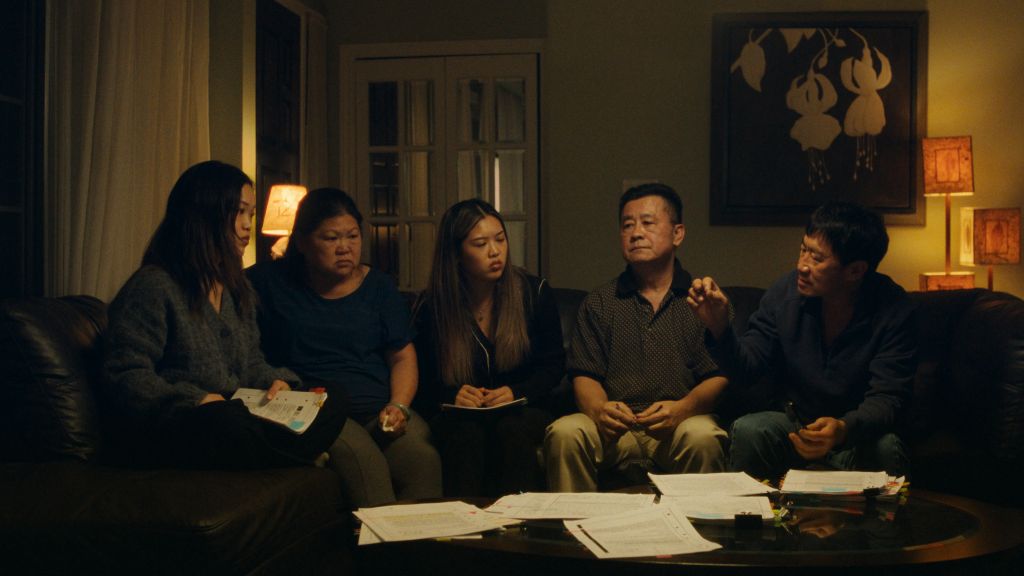
“It allowed them to close a bit of that grief that they’ve been holding on for a while,” observes Nguyễn. “It’s a very taboo subject, mental health, in the Vietnamese community. A lot of people are very superstitious.” Still Night, Burning House considers what it means to have conversations when cultural moors encourage others to simply categorize mental health as “sickness” or avoid the topic altogether.
Still Night, Burning House features a mantra that circulates within Nguyễn’s family: “We don’t talk about this.” Things unsaid hung over No Crying at the Dinner Table as well. However, a family so attuned to privacy and silence becomes admirably open when the camera rolls. Nguyễn stresses that the camera serves as a useful catalyst for people to relieve themselves of secrets, even if opening up before a crew of strangers requires patience. She says it’s a process to get family members in the same space emotionally to have these discussions on an equal level.
“It helps people gain access to conversations and spaces that they’ve always wanted to have with certain people, but don’t know how, or [can’t] because of our language barrier. So to have an uncommon element, which is the film, or me, come in to bridge that gap makes cinema a tool for communication and for overcoming those barriers,” reflects Nguyễn.
“The understanding that we are here together for a particular reason allows people to take their defence mechanisms down,” she says, gesturing with both hands to the coffee table between us as a collective site, like the gathering place of her short film. “You’re intentionally creating space for that. You’re intentionally blocking out time to say, ‘We’re going to talk about this one thing.’”
Using film to inspire tough love lets one wonder how Nguyễn gained such strong emotional intelligence in a tight-lipped family. “That’s a question for my therapist,” she admits with a laugh. However, Still Night, Burning House proves palpably cathartic as Nguyễn’s family embraces the opportunity the doc presents.
“From a very young age up until now, I feel like I have been the emotional rock in my family,” says Nguyễn after pausing to find the right words. “I grew up around a lot of chaos and oftentimes I found that I was the person to keep the peace at the expense of my own emotions and my experiences. I grew up around a lot of grief, a lot of mental health issues.” The filmmaker cites numerous losses that made her learn to process heartache while quite young—grandparents both maternal and paternal, her uncle by suicide, and a beloved dog in an accident—while other events in the family tree generated intermittent chaos.
“My survival instinct was, for some reason, to choose to find myself responsible for a lot of those emotions,” Nguyễn continues. “In my documentary work, I’m very good at parsing through and helping people hold those big emotions. But something I’m trying to understand now is what I want and how I want to include that in my films so that I’m not always working with heavy subjects. I’m able to get into spaces that might be harder for the average person, but it is a lot of emotional labour.”
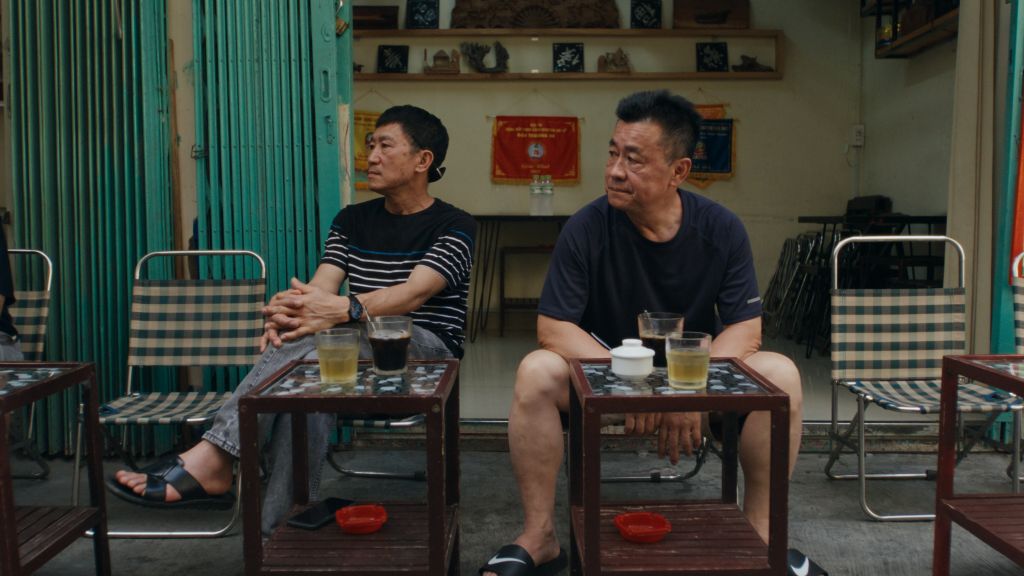
This skillset comes in handy as the Nguyễn family returns to Vietnam with plans to lay Thach’s spirit to rest. Ngọc and his younger brother bring Carol and company to see the former family home in Ho Chi Minh City. It’s now a bubble tea shop.
However, an elderly friend of their parents still remembers the boys. He particularly asks about Thach, who clearly made an impression on him. The memory forces the family to confront distances both emotional and geographic as they’ve been away from Vietnam for so many years. (Nguyễn notes that she visited Vietnam prior to this shoot.)
“I think it was healing for him to understand that transformation,” says Nguyễn of seeing her father return. “A lot of refugees who have traumatic experiences may not want to return home. And that was my parents for the longest time.”
The documentary tells how the trauma of leaving Vietnam shapes the beginning of the story. Ngọc came to Canada among the boat people escaping Vietnam, while Thach first displayed symptoms of schizophrenia in a refugee camp. (Thao, Nguyễn’s mother, briefly alludes to an escape that was comparatively more comfortable.) Nguyễn, however, doesn’t dwell on history. The past remains behind her. “In the media, we see a lot of Vietnam stories about the war, the immigrant story,” she says. “Then it becomes a part of that canon. I wanted to portray Vietnamese people, immigrants, and the country in a different light.” Ngọc finds closure by going home and engaging in grieving rituals to properly mourn his brother while also breathing deeply the air of a land he knew long ago. He enjoys tea at cafés, listens to birds, and shops in the market for ingredients to fuel the next cinematic therapy session at the dinner table.
“Certain diasporic communities may live in a past where they’re not able to heal with trauma versus those who grew up locally in Vietnam who were forced to see the country and the politics change throughout time,” observes Nguyễn. “They’re able to find some collective healing. But for those who have separated, their understanding of Vietnam is their memory of a war-torn past. It’s hard to find reconciliation. To go back and see the thriving economy and the people was a healing experience.”
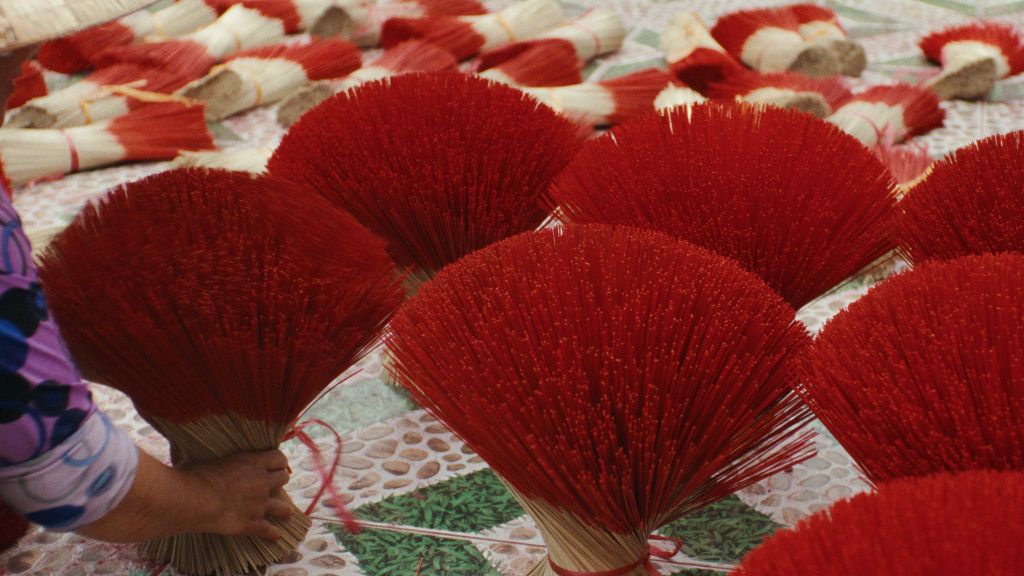
Moreover, the journey contrasts the family’s articulation of grief. In Canada, Nguyễn’s family and her cousins’ family mourn inwardly. In Vietnam, however, they find themselves in a literal economy of sorrow. Nguyễn’s aunt and cousins visit a market stall that sells Joss paper supplies, like guitars, fake money, and decorative clothing that families burn to provide loved ones with currency in the afterlife. Evocative shots capture the assembly line production of incense sticks as workers size and portion the batons into parcels, dip the pieces in red dye, and then fan them out to dry with bouncy pageantry.
Nguyễn’s camera captures other families laying bodies to rest in the cemetery. Altars hold Joss paper and incense sticks, emblems of Chinese influence. People cry while an elder rhythmically taps a gong. A cigarette remains fixed between his fingers as he raps the mallet to the plate, bidding the spirits safe passage to the afterlife. The growing ashes dangle patiently and reflect the quotidian nature of these death rituals.
The film pauses in key moments to provide collective breaths as Ngọc regains his bearings. In one interlude, Ngọc wanders the street at night while the palm trees sway in the warm summer air. The shot allows audiences to marinate in the pensive silence as his journey comes full circle. The breeze relieves some long-held weight from his shoulders.
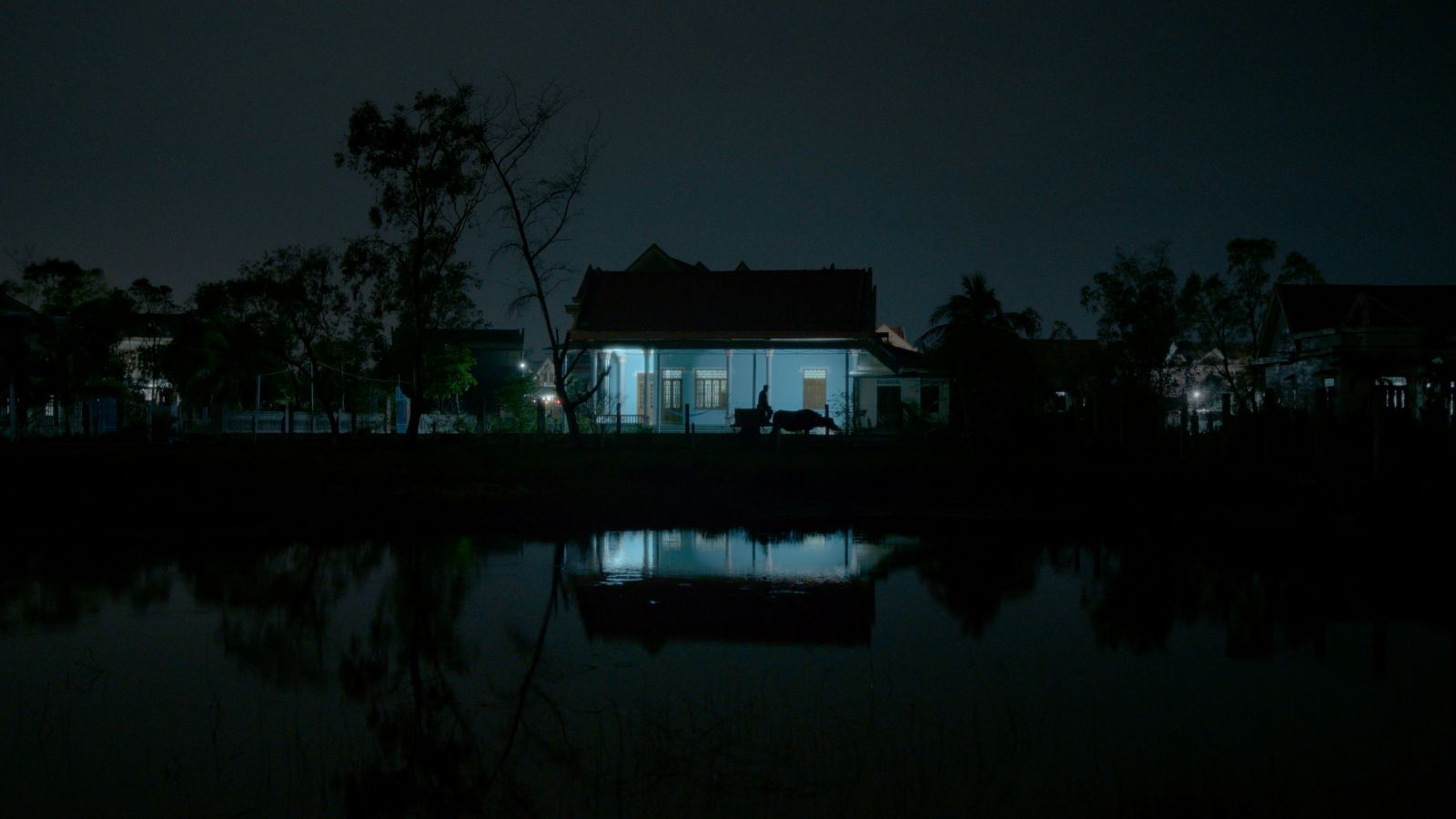
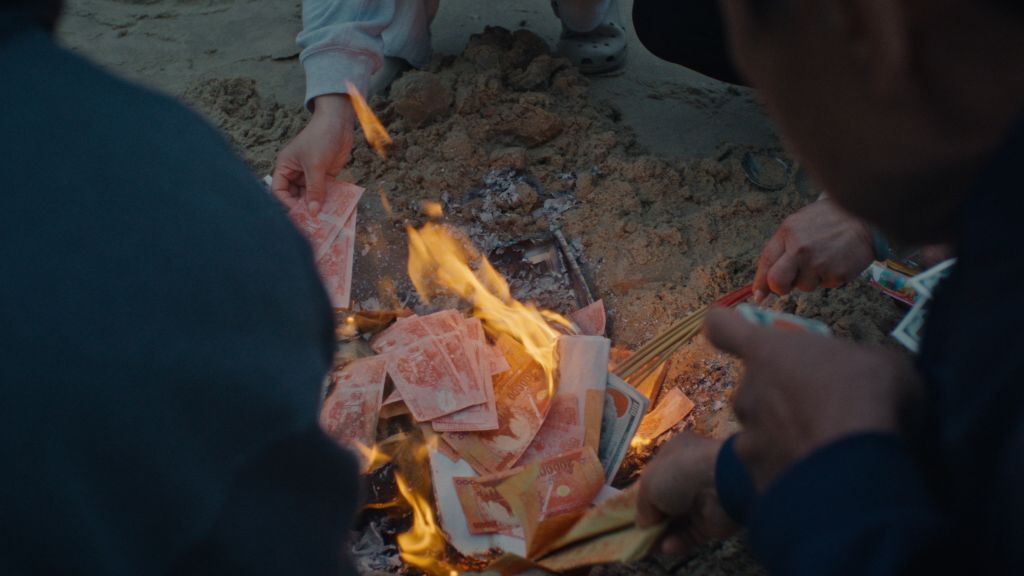
Later, in one of the documentary’s most strikingly cinematic moments, handheld camerawork captures a parade of oxen as they trot to the beach. The cloppity-clop of their hooves and the jangling bells create an appropriately eerie processional. The long interlude with the oxen leads to the burning ritual at the beach.
“It really was the country, the rituals, writing itself,” says Nguyễn on filming the oxen. “When we went to visit one of the cemeteries during a development shoot, we saw a line of oxen walking to the beach.”
She recalls taking in the sight with her director of photography at blue hour: “Are we in the after world?” she remembers asking him. “It was so magical. We didn’t know why they were walking to the beach. We clocked that image. I kept having that visual in my head, and I thought, ‘What if these carts and these oxen were walking to the border of the afterlife, like a school bus for souls and ghosts?’”
Nguyễn says the commuting oxen provided the right metaphor to expand the intimate family story. “It was always my intention to create a segment of the film with a love letter to my dad where I can show him that there is an afterlife, that things maybe are okay,” she notes. (Ngọc expresses ambivalence to the afterlife in the film.) “That visual kept repeating in my head, and I wrote that storyline based on that and on a narrative from Vietnamese culture that says when you die, it takes a certain amount of days before the soul leaves and goes to the afterlife or enters reincarnation.”
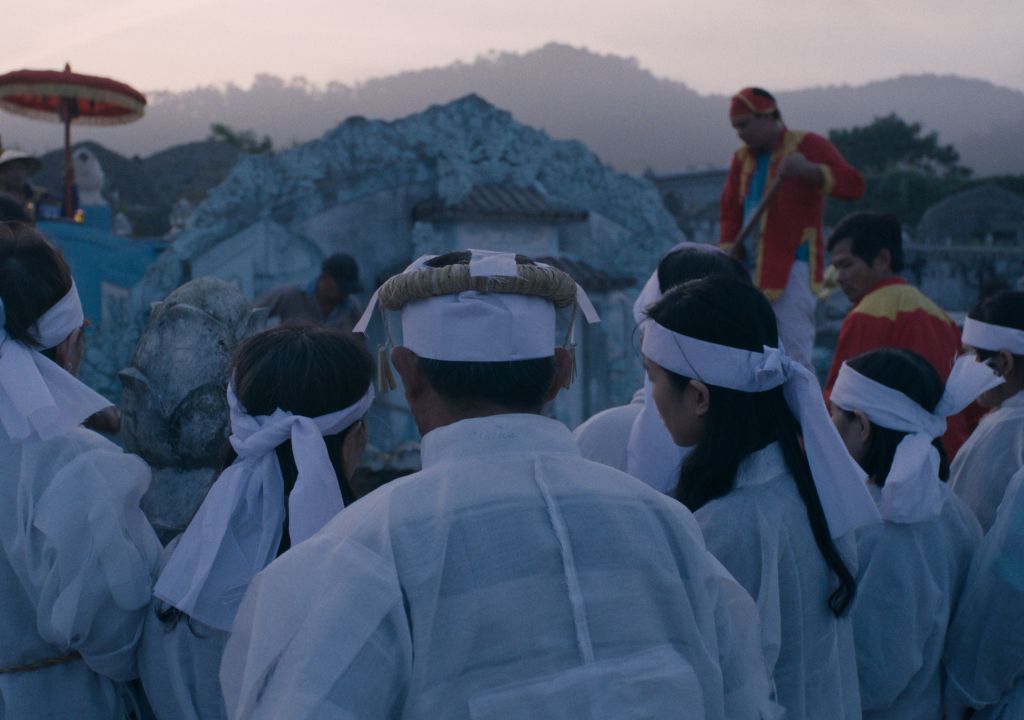
Nguyễn says that these temples and cemeteries obviously exist for Vietnamese Canadian communities, but she was surprised to encounter such a system for public mourning. “It created a lot of comfort because there’s so much grief in Vietnamese history. We’ve been colonised by China, by the States, by France. There have been so many wars and death that grief is inherently a part of our DNA,” says Nguyễn.
However, engaging with them creatively allows her to address her interest in pursuing the secrets of her paternal family. “Vietnamese culture doesn’t talk about things in general, so these death rituals help us create meaning and our own responses to things that we don’t talk about,” she notes. “They act as a conduit for that disconnection. But they also allow us to find meaning amid uncertainty. That was a big question that I had for my film: How do you create meaning for an event when you cannot understand why [Thach] had a psychotic visualisation of the apartment being on fire the day he died?”
Fire becomes a powerful motif throughout the film with the final flames expiating a collective burden. The Joss paper ritual gives the family ownership over things they lost in the “fire.”
“We heal through storytelling,” observes Nguyễn. “That was my way of being able to address my dad’s story. To be like, ‘I see you, I hear you. I want to make a story where you see grief and you see that there is an afterlife.’ Being in Vietnam and seeing that industry allowed me to understand that we’re missing the collective ability to breathe together.”
Working with family members obviously involves high stakes when it comes to representing their stories. Nguyễn embraces the responsibility, though, often waiting to show participants cuts once the film’s more polished to inspire more confidence in their portrayal. It’s important because these stories are hers too.
“Oftentimes we don’t know how important our stories are if we think they are mundane,” observes Nguyễn. “Even with my past films, if the subject’s not someone of prominence or doesn’t have an extraordinary once-in-a-lifetime story, we might think that what we’ve lived through isn’t interesting or what we have to say isn’t important. Because we are often dismissive of ourselves, we don’t push our own potential as much as we can. It’s a lot of reminding them that this is important: Your story matters. Don’t be shy with your own feelings and sharing that vulnerability with others.”
This philosophy illustrates how one family story can be intimately epic with universal resonance.