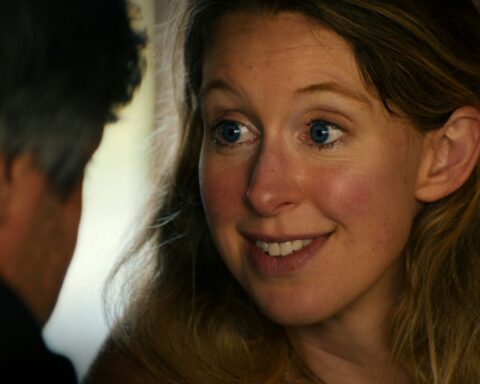




“I met her work before I met her, and it had this vibrational power,” The Hummingbird Pains Fragrant Songs director Matteo Norzi says of artist Sara Flores. The documentary, directed with Èlia Gasull Balada, immerses audiences in the magnetic aura of Flores’ work. With a premiere at the Toronto International Film Festival this week, it’s sure to expand the fan-base of the 76-year-old artist who hails from the Shipibo-Conibo People who reside alongside Peru’s Ucayali River.
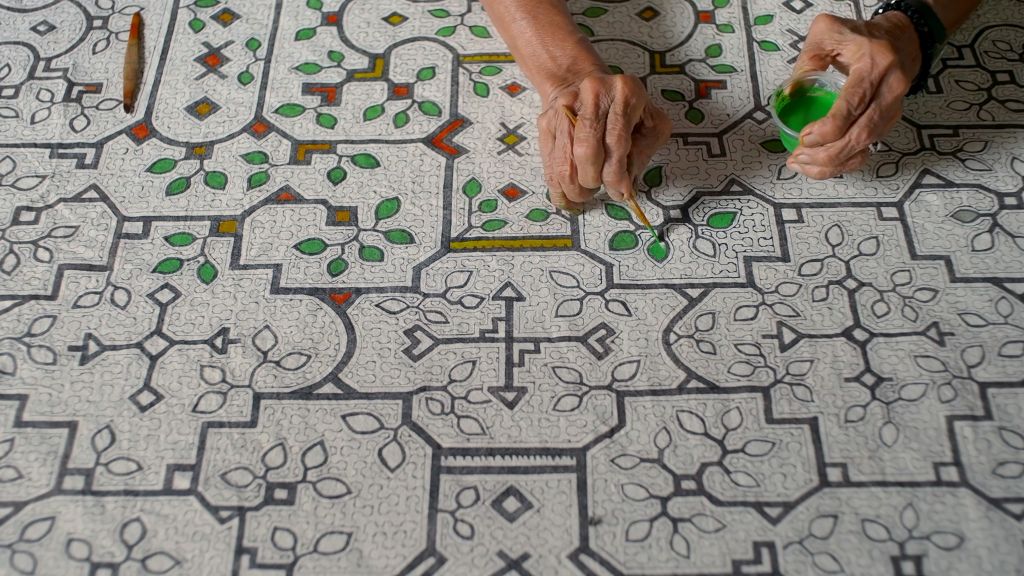
Norzi says he was immediately struck by the power of Flores’ art, which harnesses the traditional method of Kené. The elaborate geometric patterns create mind-opening visual fields, rich with colours, winding lines, and negative spaces in which onlookers can easily lose themselves. “Her work distinguish itself for its inventiveness,” observes Norzi. “It’s a mistake to consider Kené a tradition because it’s a forward-looking practice that finds its core interest in always designing a new pattern.” As co-founder and executive director of New York’s Shipibo-Conibo Center, an organization that furthers the work of Indigenous artists like Flores, Norzi says he couldn’t help but feel the need to explore the Kené story. “I fell into the rabbit hole of these patterns until one day I end up knocking at her door,” he says.
The Hummingbird Paints Fragrant Songs shares the name of a 2020 exhibition of Flores’ work, but the documentary hardly follows the typical mounting-of-a-show model. Instead, it plunges audience into the technique and philosophy of Flores’ artistry. The film follows her in the years after that show, which wrapped just before COVID shut down the world. It’s fortuitous timing, too, as the directors are right there with Flores’ as her stock rises on the international art scene, culminating with an invitation to design a Dior handbag with Kené patterns.
For Gasull, who makes her directorial debut after editing films including Norzi’s Amazon-set Icaros: A Vision (2016), about songs performed by the Shipibo during ayahuasca ceremonies, Hummingbird was a chance to further techniques and relationships she developed while pursuing an art project with the community in the Amazon. That ongoing multimedia project, she notes, was a tribute to Shipibo women who “were forcefully sterilized during the Fujimori dictatorship.”
Gasull explains that the project engaged Shipibo women with Kené drawings and patterns, which were painted into their bodies before they posed for photographs. “We did a lot of work in co-creation and collaboration, drawing Kené on paper to express their traumas,” she says. “It was a series of photographs that explained the story between healthy, fertile women through the trauma of sterilization and what came after as a survivor.”
The project, coupled with Norzi’s own work, means that the filmmakers already had substantial groundwork in place or understanding the Shipibo community and working collaboratively to express their art and culture through another medium. “The access that we’ve had, it would have been impossible if we had landed there having found this interesting story and try to figure it out because it has so many implications,” Gasull notes of their three-year shoot. “And there were so many commitments that we did early on without even knowing that we were going to make a film there again.” The Hummingbird Paints Fragrant Songs furthers this practice as an antidote to extractive filmmaking we’ve seen too often in Indigenous communities. From the outset, Flores’ creative process serves as a guiding light.
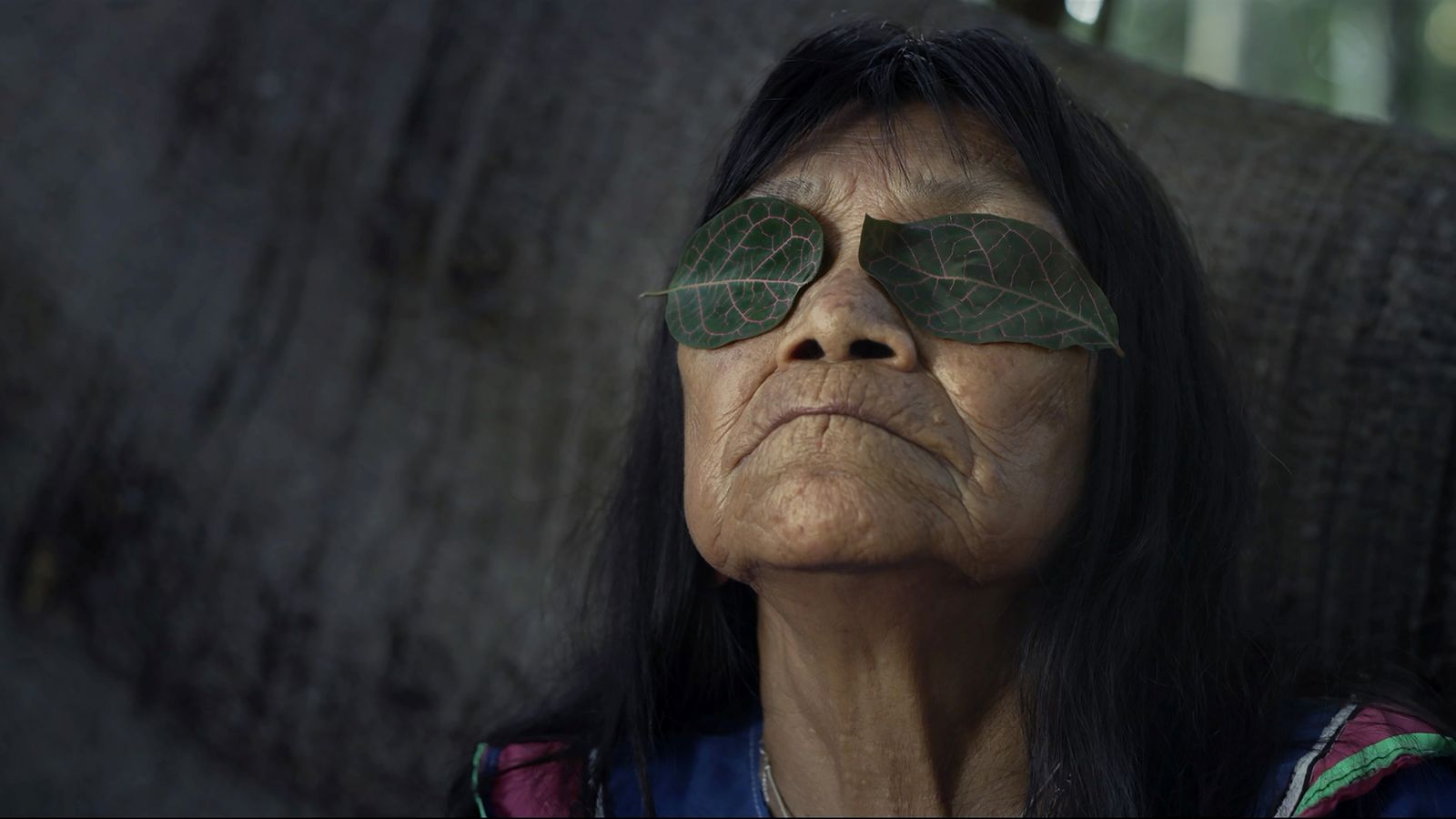
The film begins by observing Flores in her element amid a moment of inspiration. She roams through the Amazon and settles against a tree. She places a leaf atop each of her eyes. Leaning back, she soaks up the sounds of the Amazon, viewing patterns of light created as the sun hits her eyelids.
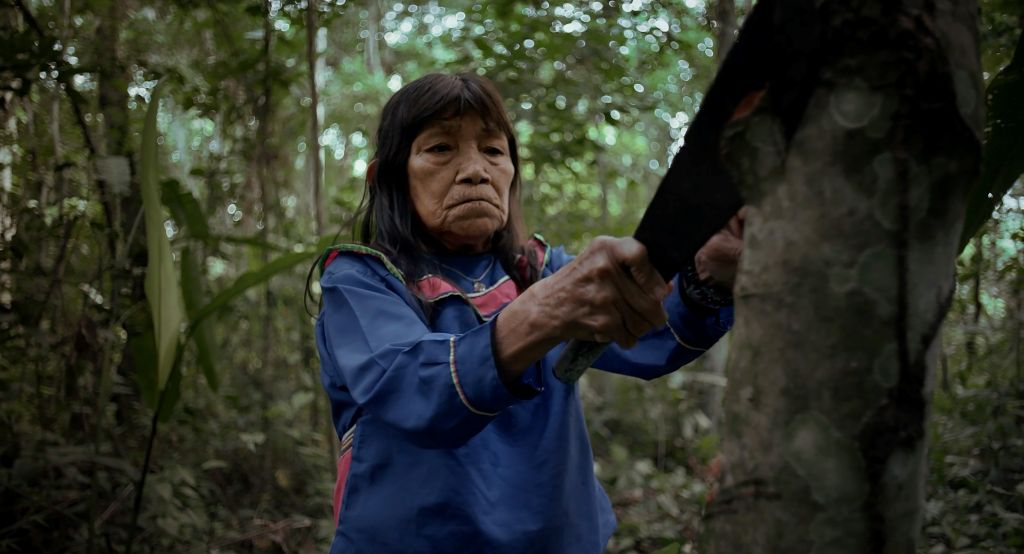
Norzi says this approach came naturally following their first interview with Flores. “Sara tried, in every possible question, to talk about materials, to talk about environment, to talk about what means to be Indigenous as an expression of the land,” he notes. “By following this idea of going out and about in the forest with her to seek the materials, we realized, because she told us that those materials are harder and harder to find, she needs now to go farther into the forest in the places of her childhood to find these plants.”
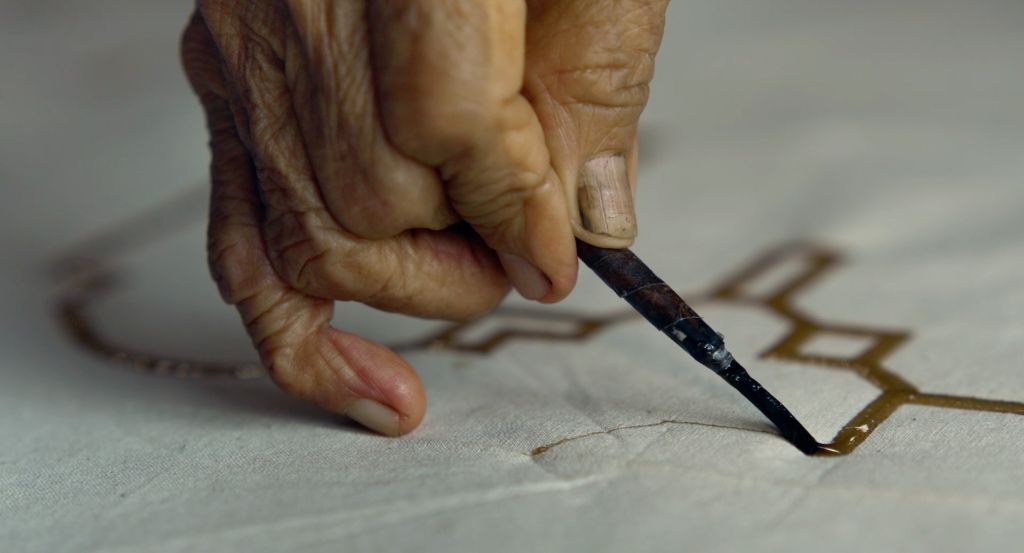
On one hand, the film’s vérité jaunts with Flores show how she draws upon the land that raised her. She makes dyes and tinctures, which have medicinal purposes in addition to their striking colours. On the other, The Hummingbird Paints Fragrant Songs subtly reveals itself a stirring environmental fable. As Flores’ treks deeper into the forest, noting the growing scarcity of resources, the buzz of chainsaws violently interrupts the soundtrack. She keeps creating her art, putting the land itself on display for the world to see.
“We realized that even picking up plants is a form of territorial resistance,” observes Norzi.
Gasull adds that the environmental element of the film builds upon her observations of deforestation that she encountered during previous work with the Shipibo community where she photographed evidence of deforestation by Mennonites.
“It became a way to collaborate in a sense that informed Sara’s exposure and the message that she wanted to keep putting out in the world,” the filmmaker says about the environmental elements. “During the trajectory of the film, Sara became way more famous than we would have never imagined in September 2023, when we started making this movie. She became viral in Peru. There was overwhelming press. We’ve been shooting with her in museums in Lima and people have waited half an hour to take a picture with her.”
With Flores’ celebrity rising, she uses her role as a matriarch in the community to speak to issues the Shipibo face. The film observes the community rallying for environmental causes, reflecting larger fights amid aggressive resource extraction in the Amazon by outside/settler forces. “Because of the making of the movie and the need to visualize her struggle with the land, we’ve gone to places that could show that,” adds Gasull. “She has seen it in a scale because a lot of the struggle that she encounters is in her own community.”
The filmmakers admit that Flores’ rising celebrity didn’t have too much of an effect upon her relationship with the camera. She isn’t too self-conscious, nor are her five adult daughters, but the many grandchildren that run around her home and neighbourhood certainly like being around the cameras as kids of the TikTok era. Flores, moreover, offers the strong silent type of character. She’s a woman of few words. She generally prefers to express herself through her art.
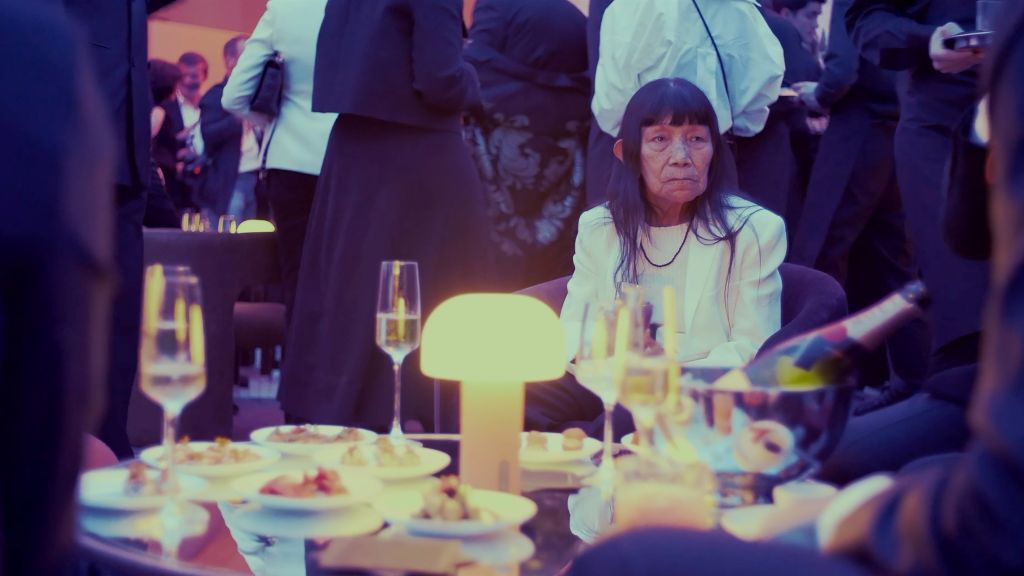
Hummingbird finds an amusing visual stroke when Flores achieves a new level of fame through her Dior collaboration. It’s a huge honour as she creates the ninth version of their iconic Lady Dior bag. She lends the intricate lines of Kené to haute couture. The film observes this tiny woman sipping champagne and sitting around A-list actresses and models at a metropolitan party. (The film follows Flores as her travels take her to urban centres like New York and Paris.) Flores soaks it all in, albeit with a fish-out-of-water dynamic. After the flashbulbs pop, she’s back home rinsing out her buckets.
With Flores being relatively content to let her voice appear mostly through her art, The Hummingbird Paints Fragrant Songs finds an appropriately artistic lens to represent both the her and her work. “We realized that Sara’s practice is very meditative and it needs a certain pace and attention to respect her creative process. We also decided to take this approach of the zenitel [overhead] shots so we could see without having to explain too much how she creates the designs without any rulers and feels the fabric from the centre to the edges perfectly aligned and develops the design in a way that’s mind-blowing,” explains Gasull.
At times, interludes in The Hummingbird Paints Fragrant Songs evokes the spirit of Frederick Wiseman’s National Gallery as it pensively lingers upon the art, recreating the act of being present in a gallery soaking in the artwork. “That was the formal approach for her art, always knowing that the vibrational power of her art was so strong that, as filmmakers, we didn’t need to impose a gaze on it. It was [about] finding the simplest, most subtle way to capture it, to respect her own vision,” adds Gasull.
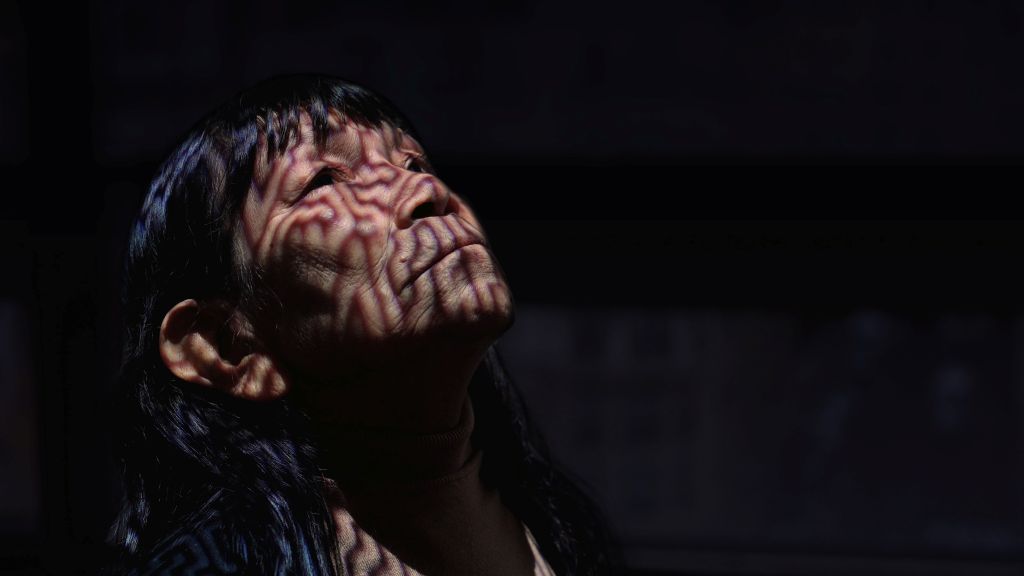
Norzi says that finding the right design to the film came from understanding how Flores’ art can be understood in three categories. First come the aesthetic qualities. “It’s beautiful; it’s the energy of life growing. It’s the secret code of nature. We convey that in the opening scene in which she puts the leaves in her eyes and then there are all these patterns,” explains Norzi. “Then it’s a question of synesthesia. This was very informative because it is also the world of ayahuasca. Plant medicine brings you to a place in which there is a crossover of the senses.”
The film’s vibrant lighting and free-flowing cinematography finds a complement in the intricate sound design that leads the images. “It’s almost if the agency of sound would have power on the cut of the images,” says Norzi. The film evokes the vibrational power that they identify so strongly with Flores as she imagines the ikaros, or plant songs, while seeing the forest through this lens.
“Finally, the work is a visual manifesto for Indigenous ethics,” says Norzi. “We try to be lyrical and, at the same time, to be militant and convey a message that is bonded to the struggle for self-determination of the Shipibo people and the right of cultural and territorial sovereignty. It has an activist soul, the film. We adopted Sara’s low voice and elegant manners to bring the audience through this journey, which is also a shamanic journey, and try to have them transform on the other side of the experience.”
The directors say that their collaboration with Flores hopes to carry through the film’s impact campaign as they bring her art and the concerns of the Shipibo community to audiences. “Sara wishes this film to be her spirit, her afterlife. She entered this collaboration accepting it when she realized that her energy would propagate into the future even beyond her physical death,” says Norzi. “For her, it’s a very much of a spiritual expression and afterlife.”
True to Flores’ spirit, The Hummingbird Paints Fragrant Songs offers an artfully poetic assertion of Indigenous rights and sovereignty, but also of environmental concern and responsibility.
Gasull adds that the film itself honours Flores’ and her community through its activist spirt, just as she paints the Earth into her art while outsiders pillage the territory.
“This film is also an act of resistance because everything goes against you, in a way, in the industry crisis that we are navigating. But you still do it because you believe it’s going to have an impact that’s worth a lifetime,” she says. The filmmakers also hope that Flores’ contemplative, unhurried pace reminds audiences to put down the phone and surrender to the sights and sounds of nature.
“It is also an act of resistance against the infinite scroll that a lot of us are caught on,” says Gasull. “We made a film that asks you to stop and deaccelerate for a second and pay attention. The third part of this act of resistance is to be able to prompt conversations in a room that talk about the numbness that we are all exposed to. We need to react.”