


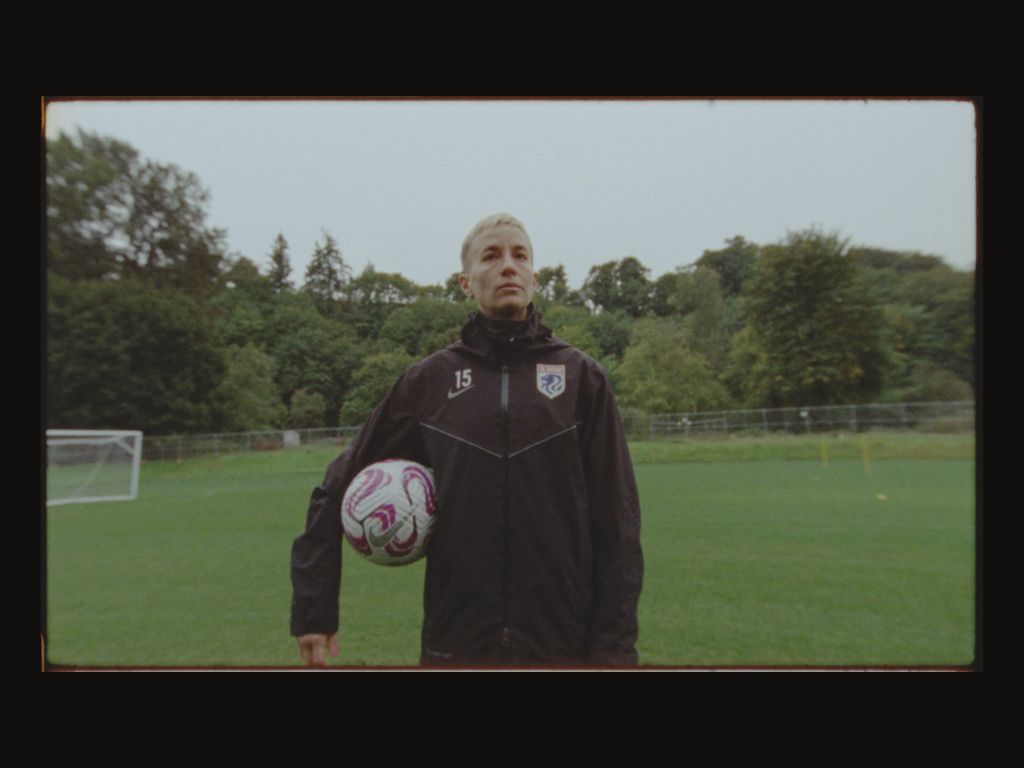

Rebeca Huntt admits she wasn’t a sports fan. But making a film about American soccer superstar Megan Rapinoe changed all that.
“She’s a really important part of my generation, a once in a generation athlete, a no-bullshit player, a brave woman who stuck to her guns,” Huntt says on the phone from New York City. “And I need more of those: hardworking, disciplined, glamorous. I’ve always respected athletes but didn’t really watch sports unless someone invited me to see a game live. And now I’ve become much more of a sports fan.”
It’s easy to see why a creative encounter with Rapinoe would have that impact. Rapinoe raised the profile of women’s soccer—check that, soccer, period, in America to spectacular heights, leading the U.S. team to Olympic gold and two World Cup championships, breaking scoring records along the way. She was also open about her queerness, a rarity in 2011. But it may be that her courageous political stances are what set her apart from other high-profile athletes, taking stands for pro-choice and equal pay for female soccer players and, most famously, taking a knee during the American national anthem. Huntt’s documentary takes us through all those controversies in the context of a full-on portrait that tracks Rapinoe’s early childhood through to the last of her playing days.
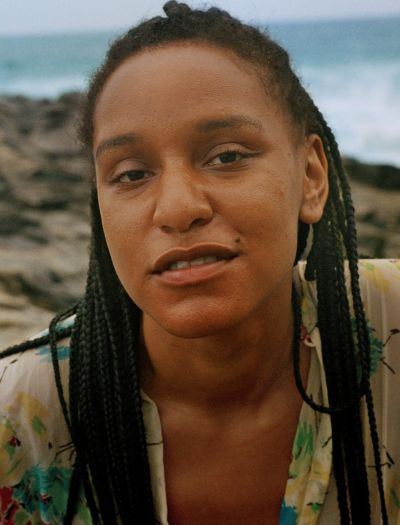
Huntt’s latest work is nothing like her compelling debut Beba, which played at TIFF in 2021. Beba is a profoundly personal film, an autobiography basically, about Huntt’s family and her upbringing and her often problematic relationships with family members. It’s raw, aching with its own vulnerability, and often experimental in form. Rapinoe gives the athlete’s life trajectory a linear arc and trades Huntt’s own vulnerability for intimacy with her subject.
“To make Beba, the most access I had was to myself,” she explains. “With this one, I was ready to step into someone else’s world.”
Fortunately, Rapinoe was ready to let her in. She talks about the good, like her joy of the sport and her coming out (I can’t decide whether her pink prom dress she wore in her pre-lesbian phase is funny or sad); the bad, like her beloved brother’s struggle with drug addiction; and the ugly, the vicious hostility she received because of her political opinions.
“Megan was extremely open. She was down for it from the start,” Huntt remembers. “We’d be talking and I’d say to her, ‘Time to go into the portal,’ and she’d say, ‘I’m ready and I’m excited to see where you’re going to take me.’ But athletes are very skilled with media. They’re doing interviews all the time and I had to find a way to take her to places she’d never been before.”
She’s successful, creating a film about a bona fide celebrity that’s intimate and reveals her as unique and wholly authentic. Authentic, in that she’s startlingly candid, and unique, in that there probably never has been a natural female soccer talent like hers. Footage of her as a young kid shows her demonstrating intricate footwork and shooting skills way beyond her years. It was clear that she was going to be a star. It’s akin to a child teaching herself how to play the violin and getting into Julliard as a teenager. Except that child would have practiced, whereas Rapinoe, though she was on the pitch almost daily, never really trained. It was Rapinoe’s wife-to-be, hoops star Sue Bird, who told her that she was great but could be magnificent if she embraced a training routine. And she was right. Rapinoe hit the gym after recovering from a knee injury and came back greater than ever.
Not that Rapinoe had it easy. In the film, Rapinoe describes the intense pressure of being a star. “God sprinkles something onto our athletes. To have this God-given talent and then keep playing at the highest level is very difficult,” observes Huntt. “They’re very skilled at handling media and they’ll drop a few posts on Instagram when they’re out and about, so we think they live these luxe lives.” But, she says, the battle to stay the best is a lonely one.
And so is the battle to stick your fundamental values. To make a statement against anti-Black racism in America, Colin Kaepernick led the movement in the National Football League to kneel during when America’s national anthem played before games. Rapinoe followed suit, kneeling during the national anthem in Seattle, where she played professionally, to express her solidarity with Kaepernick and Black Lives Matter in protest of police violence against Black Americans. As the film documents, the reaction was ferocious. Critics wanted her off the team. Fox news commentators were apoplectic. There were death threats.
In the face of it, Megan was unrepentant, although distressed that she was the only white athlete to support Kaepernick. At home games in Seattle, she was mercilessly booed. But she seemed eerily unaffected, something that astonished her teammates. She says she managed the pressure via the classic strategy (usually involuntarily, but not in her case) of disassociation, which is a recurring theme on the doc.
“Well, when you’re playing at that level, how can you not disassociate,” declares Huntt.
Rapinoe in the film takes it one step further, saying her ability to disconnect in the moment fueled her drive to win. “Disassociation,” she says, “made me a killer.”
Huntt traces Megan’s campaign for equal pay for women in soccer in a section of the film in which Rapinoe is at her most eloquent. As the women’s team was chalking up their World Cup victories, they were making one quarter of the money the men’s team was earning. The men had better money, better facilities and better travel arrangements though they’d won exactly zero World Cups. She led an intense campaign for equal pay for female players and in 2016, 28 players filed a discrimination complaint against the United States Soccer Federation. In 2019, when America won the World Cup, fans in the stands responded by angrily shouting,” Equal pay, equal pay.”
In the film, Rapinoe states the case clearly. “I’m working hard, I’m winning, I’m one of the best and one plus one is not equalling two… I’m doing this to create a paradigm shift, not just for women soccer players but for other women athletes and for women in general.”
“She’s the real deal,” says Huntt. “It’s corny but it’s the truth. She walks the talk. She is that person and in the most minute detail and she stands up for what she believes. She wasn’t making millions, but she had a lot to lose. It’s kind of remarkable.”
In a court filing, lawyers for the U.S. team stated baldly why they opposed the women’s claim, citing biological differences. Men, they stated, “have more responsibility and play at a higher level based on skill and strength.” It was a startling admission of basic discrimination.
Rapinoe knew that relying on the assertion that women are just not as good or important as men was a ludicrous, losing argument. Reflecting on the filing, she recalled her amazement, pretending to address U.S. Soccer directly. “You just took that biggest fucking L [loss] and gave it to yourself. I always knew that you felt that way about us and now you said the quiet part out loud.”
When I ask Huntt whether she appreciated the gold Rapinoe gave her in that moment, the director was at her fiercest. “The golden part of it was that they fuckin’ won,” to the tune of a $20 million dollar settlement, making the American women the highest paid female soccer players in the world. “But they shouldn’t have had to play the fucking Hunger Games to make it happen.”
Even counting the brutal backlash to her political activism, facing the end of her career may have been Rapinoe’s most vulnerable time. Only after she retired from playing did she actively undertake the self-reflection that helped her reject disassociation as a survival tacit and embrace each moment with eyes open.
“(In retiring,) she was going through a kind of death,” says Huntt. “Athletes are our rock stars, our gods. She had to figure out how to be useful in the world. These are times that are going to be messy. It was a moment in which someone who embodies greatness was expanding into a reality where that greatness would no longer define them.”
It’s clear that Huntt’s affinity with her subject was a major asset in the making of the film, helping her develop that trust director requires to get the most out of an interview. The more she shot, the more she learned and the more she could empathize with Rapinoe.
“I do relate to the importance of being authentic, and of showing up as you are,” she explains. “Especially for women or any sort of marginalized person, that does put you at risk and makes you more vulnerable; however, showing up authentically is where the real power is. And by power I mean the actual opportunity to take responsibility for myself and live life fully.
“I’m not a lesbian, so I can’t relate specifically to coming out, but I relate deeply to fighting to live your truth.”