


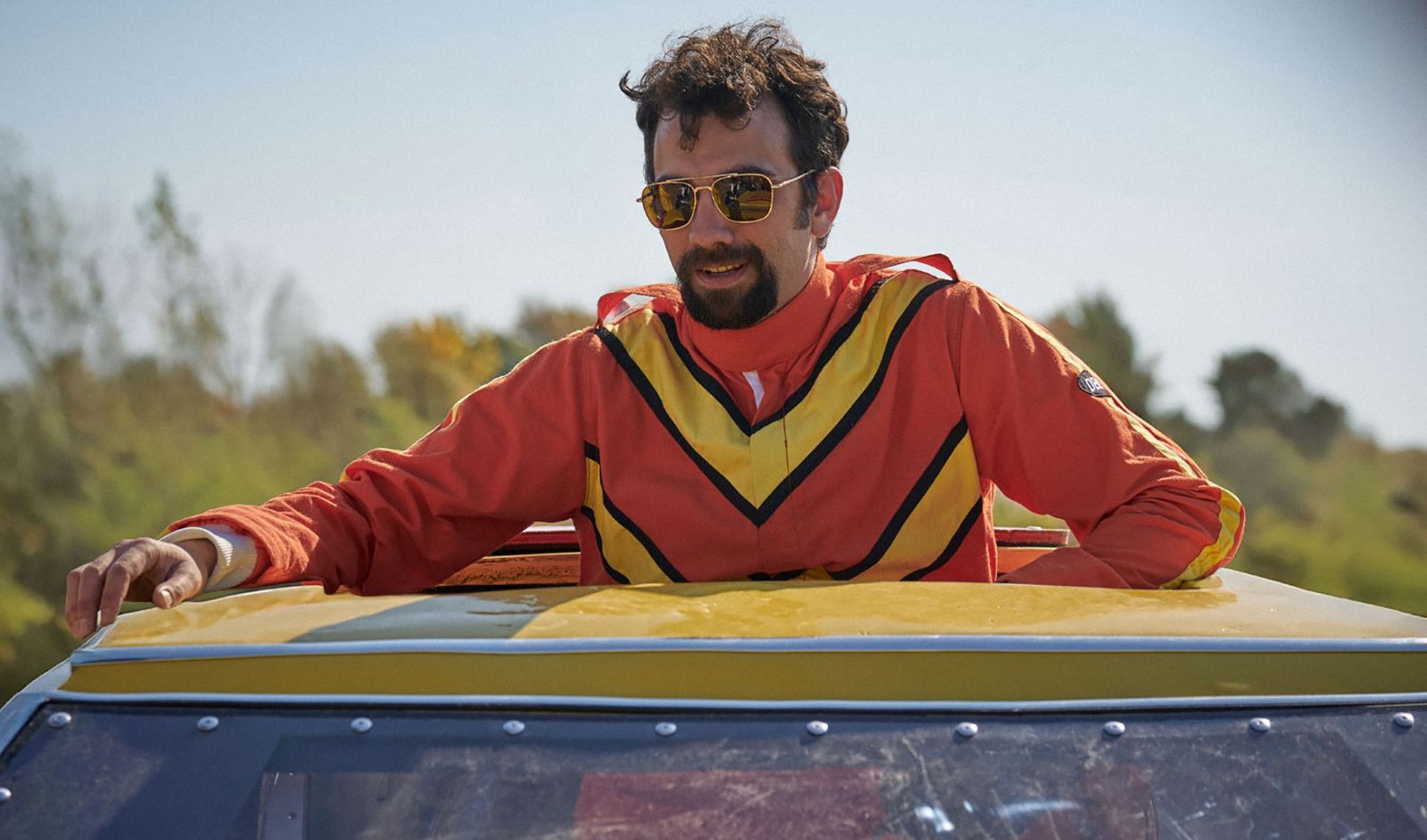

Ever since his feature directorial debut with the rock mockumentary Fubar back in 2002, Canadian director Michael Dowse has merged the techniques of non-fiction filmmaking within his narrative works. His latest film, The Stunt Driver, is his most hybridized vision yet. It explicitly merges the broad storyline and even restored elements from Robert Fortier’s cult classic NFB doc The Devil at Your Heels, the 1981 portrait of the “Mad Canadian” Ken Carter as he attempted a rocket car jump across the St. Lawrence River. (The Carter story itself was reimagined in the 2016 documentary musical Aim for the Roses.)
Dowse reunites with his Goon collaborator Jay Baruchel in this sympathetic yet unabashedly zany version of Carter’s story. With Joe Cobden playing Fortier and other characters more broadly fictionalized, this meta film-within-film retelling of the tale is a reflection not only upon the story of the stunt but also the films that tried to document it. As fictionalized elements merge with truthful parts that feel almost too strange to believe, The Stunt Driver derives much of its impact from its truth-is-stranger-than-fiction play, showcasing Dowse’s skill at knitting fact and fable into an effective whole.
POV spoke to Dowse prior to the film’s premiere at this year’s Toronto International Film Festival.
POV: Jason Gorber
MD: Michael Dowse
The following has been edited for brevity and clarity.
POV: When did you first learn about Ken Carter’s story?
MD: About 12 or 13 years ago, a friend of mine said I should watch this doc on the NFB site. I had never heard of Ken Carter, and his story was totally new to me. I watched the doc and completely fell in love with the character and the story, and I just thought this would make a great [scripted] feature.
We had a bit of development money, so we tried to get the rights from the NFB to the doc, and that took a while. A lot of people had tried to make a version of this film over the years. While the NFB had the rights, they were tied up with another producer. We decided to reach out to Robert Fortier directly. He was rightly a little wary as he’d spent some time helping out a bunch of other people who had never succeeded at making actually making the film.
About five or six years ago, the rights became available, and the NFB allowed us to acquire them. In the meantime, I had written a script on spec. We started the long process of casting and raising money for it. This film is definitely a labour of love, and I just really fell in love with Ken as a character. I think there’s a piece of Ken Carter in all of us for sure, that quixotic instinct to do something crazy or make your mark as a person. I love that he was a walking contradiction. He’s a stunt driver, but he doesn’t have a license; he’s jumping a river, but he doesn’t know how to swim. He just felt like a character that a lot of people can relate to. I certainly related to him!
POV: In addition to Fortier’s film that tells Carter’s story there’s Aim for the Roses. Did you also have a similar relationship with that project?
MD: Not really. It’s a totally different take, much more of a musical for sure. I tried to avoid any script that came in. A lot of people had scripts on this thing, so I would just send them right back to my agent. So while Aim for the Roses wasn’t a huge influence at all, we did meet a lot of the same people they had collaborated with.
POV: You’re no stranger to bridging the gap between fiction and non-fiction, but this is your most explicit tie-in with documentary in your filmography. Was the direct relationship to the NFB film always in the cards?
MD: For this film, there was a certain amount of necessity where we had to lean on Fortier’s footage. There’s no way we could insure or have the money to send a car off a ramp or do all of those stunts. It would have taken another six weeks of filming and at least another four or five million dollars to that pull off.
As I developed the script, and started to play around with the elements, I thought there was an interesting relationship to capture with Ken Carter and the 16mm cameras themselves, along with Bob Fortier. I thought of it like the Paul Anka doc, Lonely Boy. At the time, Ken was very much aware of the camera, as anybody would be. I was interested in was trying to get behind that and then also mix with the various media. The documentary cameras in themselves give a window into Ken’s showmanship, but as the movie goes on, we introduce a 35mm documentary crew, and that provides a whole other aspect ratio.
What was exciting to me as a filmmaker was this idea of reverse engineering a dramatic film out of documentary footage, which I don’t think has been done that much. Stories We Tell would be something that kind of dabbles in that, for sure. That was the interesting part, to take a 2.39:1 anamorphic, beautifully shot image and make that the truth of our story, and then be able to duck and weave around Fortier’s footage to fill in the blanks and to give it the scale and the period.
Those period things that you absolutely need and are, to be frank, incredibly expensive to create. With the first schedule laid out, we were doing all of the stunts. We gave the script to an Assistant Director and they were like, “This is what it’s going to cost to do it,” and we’re like, “Well, there’s no way in hell we’re gonna do it like that!” So we had to be creative in terms of how can we shoot this. So it really grew organically, and what I loved is how everything just cuts together. You can jump between 16mm and 35mm. What I tried to do is that when Ken’s not aware that the camera’s on him, we mix in the wider aspect. When you pop in behind the 2.39, you feel like you have a special access, which is kind of what documentary filmmaking is all about. So it’s all about playing around.
POV: You’ve obviously watched that documentary a gazillion times in order to select those elements to incorporate. Which pieces did you always know were going to be included, and what did you know you didn’t need to adhere so directly to the truth in order to get a dramatic truth?
MD: For some people, you just couldn’t clear them, like Kenny Powers. That’s a hornet’s nest of clearances for a number of reasons. So when we couldn’t clear the name, we changed Kenny Powers to Danny Lafortune. We also cast Marc Beaupre, one of Quebec’s greatest actors, and to be able to work with him was a big thing for me.
Right from the top we put a big disclaimer, because it’s a story that has to work in a 90-120 minutes, so you have to combine characters. There was more than one impresario/producer of the jump in the documentary, and it was going to be very hard to clear those guys, so we combined that into one character and fictionalized it. There’s a lot of things you have to streamline.
There were lot of attempts for the actual jump, and my first draft definitely stuck very true to the documentary. As you read that out and you realize there’s a lot of repetition of beats – of the car blowing up, of testing Captain America car versus testing the actual yellow card vis a vis testing one in between in Florida. In our film we can’t do three tests of the car because it becomes redundant and still have a flow to the story, so you have to be quite picky.
In terms of what we selected from the doc, it was an ability to utilize the best scenes that we could never recreate, like the car going off the ramp, the helicopter stuff, and the water. We do partially recreate it, but it’s a smaller version. Narratively, you have to fill in some of those spaces in terms of the relationship with Gloria and Ken.
There was also the relationship with Bob and Ken, which isn’t really documented in the doc, but it’s a huge part of the process of making of Devil at Your Heels. It’s as much about Bob Fortier as it is about Ken Carter. And he’s got to finish a film, so they’re a little bit at odds, especially at the end, when things don’t go as planned.
POV: It is wild to watch the scene when the door closes, in the doc, after having seen your fictionalized version of this conversation that we didn’t see. Now, it’s impossible to see that scene through anything other than the perspective your film provides.
MD: For sure, we were extrapolating all of that stuff in the motel. That’s all based off of what we could take out of Ken’s interview with Bob Fortier that’s in the documentary when he talks about what happened.
I’d love to do something like this again with Burden of Dreams or something like that, where you get the clearance to use the doc footage, and then you reverse engineer a dramatic story out of it.
POV: The making-of a making-of doc?
MD: Yeah!
POV: I love when things that are lies tell deeper truths, and where truths are so surreal as to appear made up. You have deeply navigated that from your earliest films to now. What draws you specifically to navigating this balance?
MD: Man Bites Dog was a huge influence on me. But there’s a big difference between Man Bites Dog and Spınal Tap, right? That’s a $50,000, $100,000 film that’s attainable as a young man when you’re making films. From a comedy standpoint, you let people improvise and embrace everything about a documentary. It injects the movie with energy. That’s what I like to bring from the doc style into narrative. But with this one, I’m kind of flipping it on its head in a way of trying to take a more traditional, dolly-locked camera, 2.39:1 aspect film ratio and ram it into the middle of a documentary and see what truths can come out of that.
I’ve always been a big fan of mockumentaries. I grew up watching them and those were my favourite movies. When we went to make Fubar, it came out of trying to make a film the “proper way,” like by reading [Rick Schmidt’s] Feature Filmmaking at Used Car Prices and all of those books that were around in the early 2000s and the late ’90s, and then realizing that all of that shit doesn’t matter at all. So films like Man Bites Dog, …And God Spoke and stuff like that were big influences on me.
Back then it was right in the middle of the Dogme style too, in terms of the rules of not using lights and all of those other rules. That was a massive influence on figuring out what I could actually and practically make. I think I’ve tried to keep that going. You see a little bit of that in It’s All Gone Pete Tong, but that’s a bit more of like a fake bio piece with a bit of documentary elements added.
POV: You brought in the likes of Ed Helms, a writer comfortable with improv, and you once again connect with Baruchel, also writer, etc. Does having space for improvisation provide an even closer sense of non-fiction style?
MD: 100%. These are the kind of actors I want, ones that improvise. What I try to do is nail the script and then let them run. With Jay, you’ve gotta let him run. He’s awesome, and he adds so much. You want those thoroughbreds who can live in that world. It just gives the film energy.
POV: A documentary energy?
MD: A documentary energy for sure. Exactly.