


2.6 Second: Death in the Outback
(Australia, 118 min.)
Dir./Prod. Darren Dale
Programme: Primetime (World premiere)
Kumanjayi Walker, an Indigenous man, is murdered by the overzealous police officer Zachary Rolfe in this compelling documentary series set in the Yuendumu community of the Australia’s outback. Four episodes (POV received access to the first two) track the lead-up to and ensuing consequences of this heartbreaking collision of Kumanjayi’s personal struggles with trauma and cognitive difficulties and Rolfe’s toxic masculinity. Director Darren Dale makes clear that racism and the aggressive culture of the military, where Rolfe first trained, play key roles in these events
Using police body-worn camera footage, surveillance archive, emergency calls, and interviews with people close to both Rolfe and Kumanjayi, the doc delivers a granular, play-by-play account of the murder and its aftermath. Along the way, we discover the complexities of policing in Central Australia and the lives of poverty and systemic inequity among Indigenous peoples.
Kumanjayi, whose developmental challenges were not identified for years, had contact with police, with scores of arrests at an early age. We follow him just before he escapes from a residential rehabilitation program in order to attend his grandfather’s funeral. But he can’t make his way back and an arrest warrant is issued.
A first attempt to take him into custody is aborted when a terrified Kumanjayi starts wielding an axe, forcing the two officers to flee. This is where Rolfe comes in. Known to be a risk taker, he relishes the physicality of police work, the intense workload – he attended 3,000 cases in three years – and loves the adrenalin hit of a dangerous situation.
When Rolfe, working out of Alice Springs, a town 300 kilometres from Yuendumu, sees the video of the botched arrest, he mocks the two officers who left the scene as soft. He decides he is going to get his man, and sets up a major operation to do it. The fact that he’s an outsider invading a community he doesn’t understand doesn’t cross his mind.
2.6 Seconds recalls The Perfect Neighbor, which used police body-camera images to tell the story of how a white women (plainly unhinged, although nobody tries to help her) shoots her Black neighbor, the mother of a boy who often trespasses with friends on her lawn. But 2.6 Seconds is much more detailed, showing exactly how the police were deployed, where they were stationed – at least five of them – and how Rolfe, determined to validate his reputation for successful hunts, violated laws and basic standard procedure.
To get into the house where Kumanjayi is hiding out, he jumps over the fence (illegal), goes into the house without permission (illegal), makes sure his team has their guns out of their holsters (not standard procedure), finds Kumanjayi, and confronts him.
As social worker Kerri-Anne Chilvers tells it, Kumanjayi panicked, terrified of going back into custody, and fought back. With the many officers on the scene, he tries to flee, and while never putting the police in danger, he gets shot by the trigger-happy Rolfe. Three times. In 2.6 seconds. The first episode ends there.
Kumanjayi is dragged over the ground to a patrol car – the police thought touching him would endanger them, but the decision only worsened the damage inflicted upon his body – and took him to the police station where they claimed they would attend to his wounds. It’s clear from body-camera footage that they don’t know what they’re doing. This disregard for Kumanjayi’s life is the essence of the second episode.
The racist fears of even touching Kumanjayi play a key role in the young man’s fate. And while Kumanjayi is expiring at the police station, the officers refuse to give him mouth to mouth respiration, fearing for their own safety, when the equipment to properly protect police while administering mouth to mouth is readily available in the station.
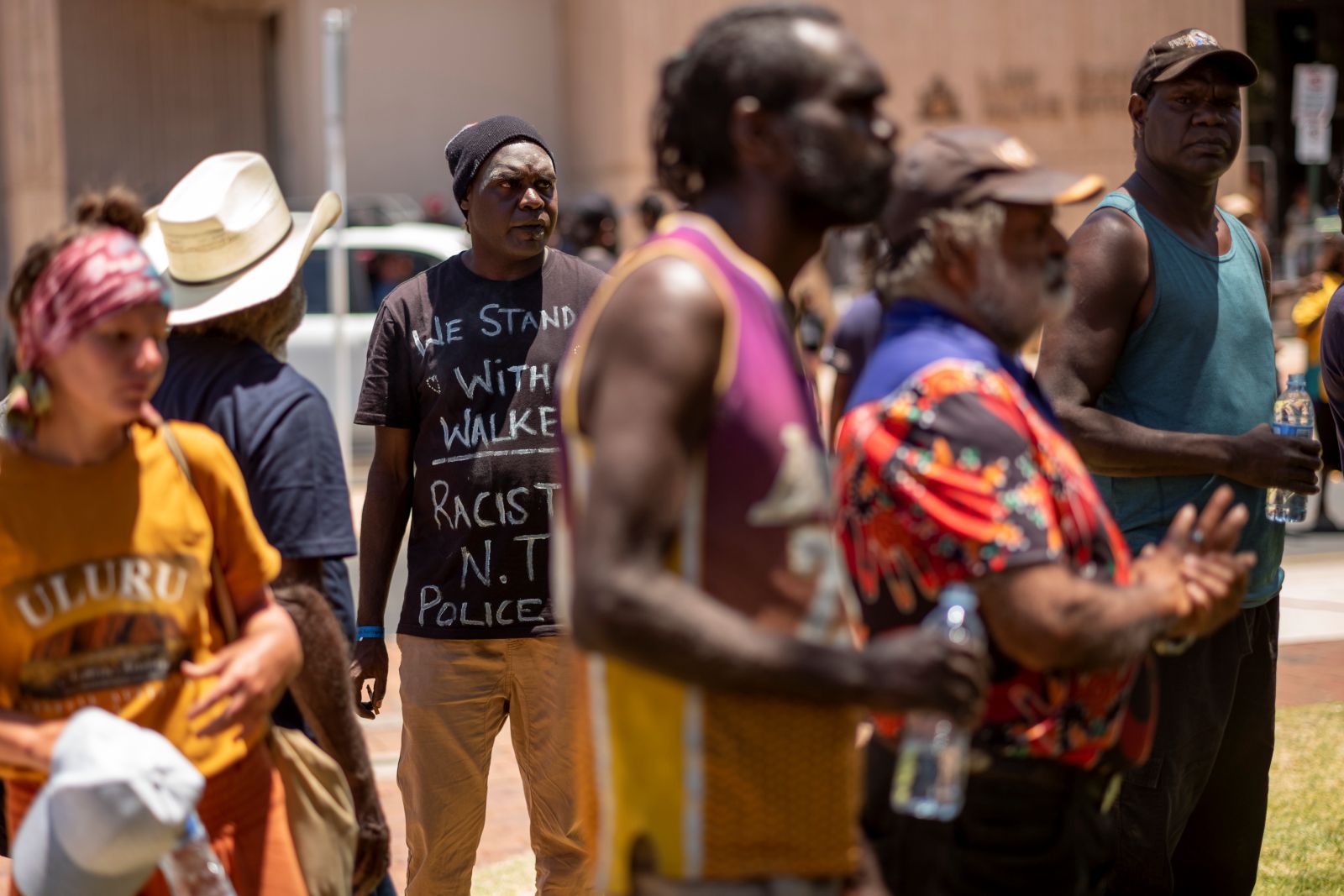
When words gets out that Kumanjayi has been shot, the community descends on the station. But the police lock the family out as Kumanjayi is dying, denying the victim the basic dignity of having loved ones around him as he weakens. This section of the episode is especially tense, as the crowd gets more enraged. The police inside the cop shop start to panic. Outside, the people have no idea whether Kumanjayi is dead or alive.
They find hope when an ambulance finally arrives, followed by a convoy of police cars. But the ambulance isn’t meant to take Kumanjayi to the Alice Springs hospital, as the local clinic was purposely evacuated by police before the raid. It’s meant to bring police reinforcements to deal with what they’re sure is going to be an angry riot. And it’s not Kumanjayi that they take to hospital, but rather Rolfe, who has a shoulder wound.
The episode ends as community resistance looks like it will burgeon into a full-fledged anti-police movement.
This is deft documentary filmmaking and must-watch television. The body-camera footage is devastating and the testimony from the town people and local police revealing. The social worker Chilvers is one of many eloquent interviewees who shed light on Kumanjayi’s plight. Lawyer Andrew Boe gives much-needed context to the police manoeuvres and their dubious legality. Another compelling character is Derek Williams, an Indigenous police officer caught between his professional duty and his commitment to his own community.
Other interviews with family and friends of Kumanjayi paint a vivid portrait of a young man who never had a chance, abandoned by the broken health and justice systems. And encounters with Rolfe’s associates reveal a near narcissist hellbent on wielding his weapons to demonstrate his power.
Viewing the first two entries in this four-part series makes me impatient to see the next two episodes.