



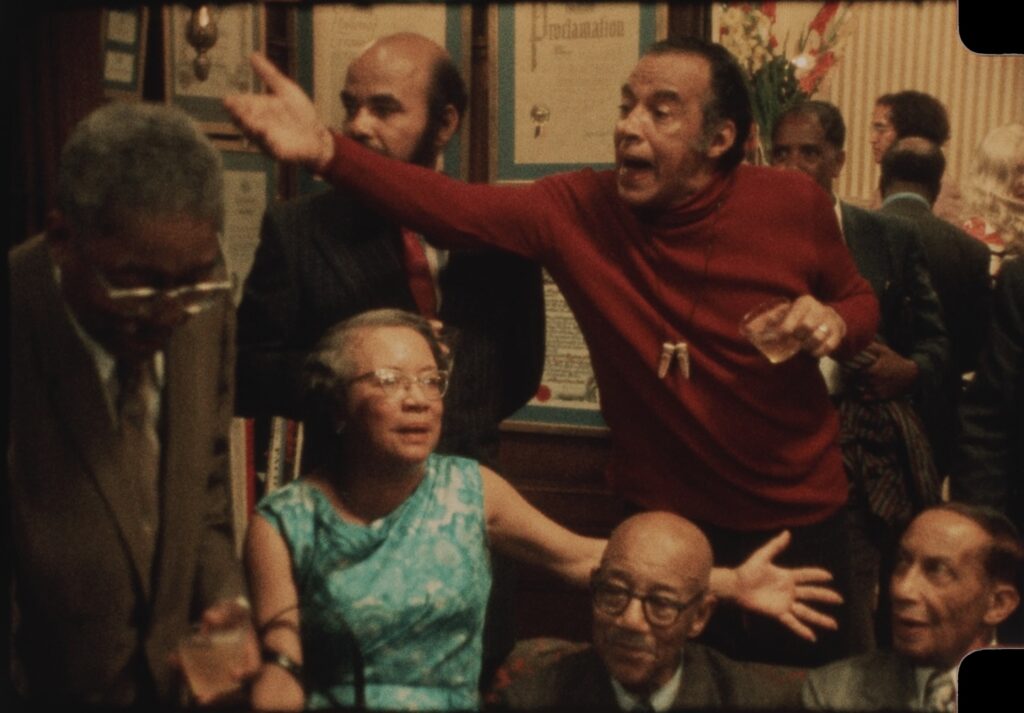
For almost half a century, cinematic gold sat in cans waiting for the right time to be unearthed. In August of 1972, the celebrated filmmaker William Greaves, renowned for such groundbreaking works as 1968’s Symbiopsychotaxiplasm: Take One, invited a group of artists, musicians and intellectuals to the home of Duke Ellington for the purpose of reminiscing. Over drinks, witnesses to what has been dubbed the Harlem Renaissance from the 1920s and ’30s regaled with tales of legendary figures and spoke of how events of decades past continued to shape their present.
The result is Once Upon a Time in Harlem, an electrifying look at the culture and artistry that helped elevate a people and gave rise to an entire generation of political thinkers, poets, avant-garde artists and more, amplifying their own voices in a nation that had sought to silence and crush the spirits of those of African descent. The remembrances of this Renaissance are priceless historically, but much of the power of the film comes from the engaging way that Greaves prompts his party guests to dive deeper into their memories, going beyond mere platitudes to provide an unvarnished living history of this remarkable era.
Greaves himself was a kind of Renaissance man. Born in Harlem in 1926 in the midst of the era that he would grow up to help document in his posthumously released film, he began as a dancer and performer, eventually leading to work at the American Negro Theatre. In the late 1940s, he would join the iconic Actors Studio, but despite his world-class training found himself stultified in minor roles.
He soon packed up and moved to Canada, where he immersed himself in the production side of film, eventually becoming our nation’s first Black filmmaker. It was in Montreal that he met his future wife and collaborator Louise Archambault, a powerful figure herself who played a major role years later in keeping the dream alive of bringing this remarkable footage to audiences.
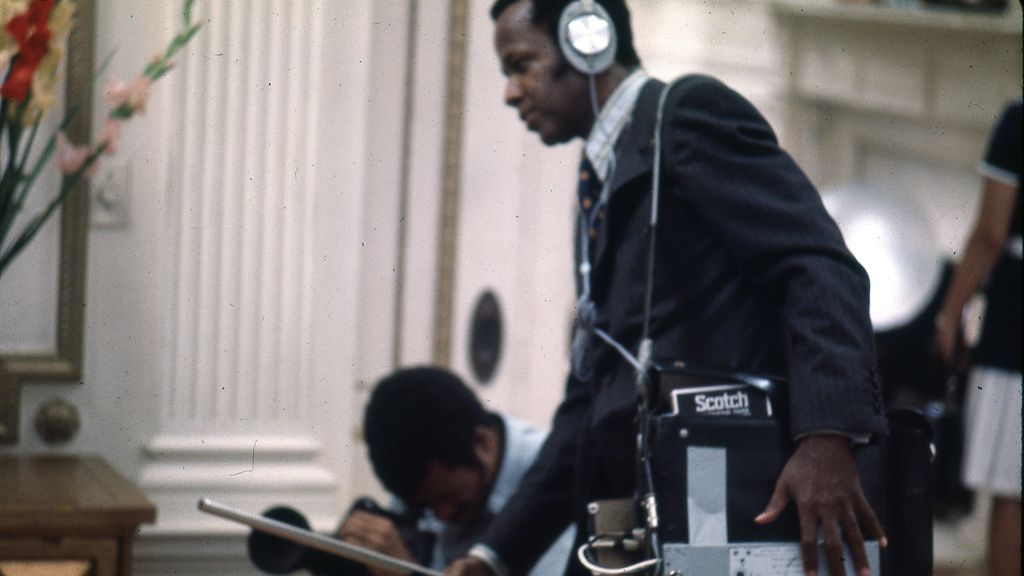
One of the camera operators that hot summer day back in 1972 was David Greaves, William’s son. All of these years later he is credited as co-director of the resulting feature-length documentary along with his late father. Joined by David’s daughter Liani who serves as one of the film’s producers, the two along with a dedicated team of collaborators have helped to bring William Greaves’s vision to life.
The restored footage looks brilliant, but it’s the compelling and intelligent conversations, as electric now as it must have felt then, that make this time capsule feel particularly miraculous. The result is nothing short of astonishing, with the deep sense that the belated time for release was meant to be, with equal distance between the Renaissance, the remembrances, and the release of this profound work.
POV spoke to David and Liani Greaves following the film’s premiere at the 2026 Sundance Film Festival. It has its Canadian premiere at the Toronto International Film Festival in September.
POV: Jason Gorber
DG: David Greaves
LG: Liani Greaves
The following has been edited for clarity and brevity.
POV: For those of us in Canada, we take pride in your dad’s work that was crafted up here. What, if any, is your connection to your dad’s stories told in our country?
DG: My dad used to tell great stories of when he started at the NFB. I don’t know if he volunteered, or if he was sort of cleaning the editing room, but he started there as an assistant. He then became a senior editor, and then a director of projects. It was a classic “work your way from the ground up” situation. As a child, I visited him in the editing room once or twice in Canada, working on that upright green Movieola. I was born and raised in Brooklyn. Actually, I didn’t meet my father until I was twelve, so I was not involved in those really early years.
POV: In the film, we’re hearing what Harlem was like in the 1920s. I want to hear what Harlem was like in 1972. What do you remember about your time there shooting the film?
DG: In 1972 we were so intent on what it is that we were doing in terms of filmmaking that I cannot say that I was really involved in any community activity. We were just focused on the work. In fact, I cannot even remember being at the event! I can remember other shoots that I was on, but for this particular production I can’t remember much of anything that I did there. And yet, I see myself in some of the shots, you know?
POV: Liani, could you please talk about when you found out about the footage and how you became involved in this production?
LG: I knew that my grandpa had this amazing footage of these people from the Harlem Renaissance, but I did not have very much of an understanding or reverence for it. What excited me most about being able to be a part of this after seeing the footage is what the experience would be for others. We see this as a co-creation between generations. There’s that first generation who are the subjects, and then my grandfather, who was looking up to them, and then my father who was there and who’s directing this new film, and then me as the producer on it. The result is very much this co-creation across time. But what gets me very excited is about what happens when we add this other, the viewer, to the continuum of this creation, and then what happens for them. It’s sort of like the Symbiopsychotaxiplasm of it all, you know?
POV: What for you were the elements that shine more in 2026 than they may have in 1972?
DG: There are some underappreciated historical facts, like Theodore Roosevelt being booed and hissed in Harlem. Or the stories about Jimmy Walker, who had such a horrible reputation, but he was the one that in a moment of moral clarity put out his hand and shook Bojangles’ hand. Or there’s talk about J. T. Gibson, who loaned Irvin Miller $5000 in the 1920s, one Black man loaning another Black man $5000 dollars. There’s Casper Holstein, the gangster who was also a philanthropist who sent twenty or thirty people through college. These are things that are important for people to know.
I love it when Irvin Miller speaks about his road show, and how they travelled through Pennsylvania and Indiana. In one of the outtakes, he does a description of The Chocolate Dandies. I thought, boy, if Tyler Perry hears this, he’s going to snatch that because it’s just fabulous! We wanted to give an idea of how important things were at that time. There’s talk of Countee Cullen as a high school boy writing a poem that had a city-wide impact. I’m thinking, what kind of poem has a city-wide impact today in New York?
POV: Something from Jay-Z?
LG: [Laughs.] Yeah.

POV: Can you talk about your own journey of diving in and learning about stuff from the film that you were making?
LG: One of the things that impresses me about my dad in these stories is that he was able to bring in historical moments from a journalistic perspective. He’s able to share this vital information while also remaining focused on how we tell the story so that these folks have their say in a way that doesn’t feel didactic.
One thing that’s wonderful about this film is that you want to dig down on every tale told. There’s talk of The Negro Hokum by George Schuyler, the letter and response to that from Langston Hughes. The participants name drop people and books constantly. It expands your curiosity and [desire] to learn more. I’ve been reading a lot that came directly out of these conversations. It’s opened up a whole new world for me.
POV: We often put historical figures up on pedestals and forget how they are human beings. How much of a challenge was it to allow for the contradictions in remembrance between these legendary people?
DG: The party sequence is of course very important, but I thought the individual interviews were critical. It’s there that they got to be even more introspective. It’s funny, I can remember some of the interviews that took place in an apartment up on Central Park West—It was like 444 Central Park West or something like that. It was an important address for some reason. I think we had a negative cutter there as well who had a very unique apartment, and it was like a two-story apartment. You went upstairs to the balcony. It also had roaches! [laughs]
So, I remember shooting some of the interviews and the subjects were just very relaxed. The Richard B. Moore interview went on and on. At one point, my father says, ‘You’re costing me a lot of money Mr. Moore!’ Every time he changed a film magazine it cost my dad money. I love what came out from Regina Andrews when she talks about going on this food tour with the boys, you know? You can just imagine this young woman with Aaron Douglas, Countee Cullen and Langston Hughes. It’s a heck of a group of boys to go Chinese restaurant hopping with.
LG: It would be interesting to pose that question to grandpa. For example, he acted with Leigh Whipper in a film when he was much younger. It makes for a sort of “meet your heroes” moment. I wish that we could interview him now because I’d be curious what he would think having had that interaction with all of those folks.
POV: So, why did this film sit in the can for 50 years?
DG: Originally the film began as a project that was going to be both live action and stills. After things were synchronized, and while we were in the editing room, he was trying to meld those two things together. And he couldn’t get it to work. Many years later I told my stepmother that Dad couldn’t finish the film because he’s a part of it. He had to be in it himself, and he could not see that. Also, we were paid to do the short film that came out of the footage, From These Roots (1974). It won over 20 film festival awards, and that was where the production money went. We didn’t have money to do another film! So, it just had to sit there while we worked on other things.
Much later, he and his wife Louise were shooting a lot of other live action current, contemporary stuff up in Harlem. I think they sort of lost the direction of where they were going with it. But Louise was actually a tiger. She was the one who kept the footage alive, stored it, championed it, and just remained very protective of it so it didn’t leak out. She got the Ford Foundation to give us the money to restore it and that started it all off.
LG: If you want to know the philosophical side, I think my grandfather would say that, cosmically, this film had to happen now. Now is the time that the collective needs it. It was a time for me, and it was a time for my father. As my dad said, my grandfather could not see what we see. The time is now and it’s meant for us in this moment.
POV: There’s a lot more pressure to not mess this up.
LG: I feel I’m more open to the realities of what my grandfather thought about his filmmaking. My grandfather was a yogi, and one of his favourite philosophers was somebody named Sri Aurobindo. One of his guiding texts that he would read all the time, and he read it constantly, was called “The National Value of Art.” I always recommend it to filmmakers and to artists and to people that are creating culture in the world.
The poem that we use at the end is one that my grandfather wrote about creative expression. Ending the film on that note was important to me because I wanted people to get that this is not just history. The Renaissance was a recipe for the awakening happening, figuring out how we can create this kind of environment of intergenerational collaboration and communication. As Romare Bearden says in the film, art comes out of a community and audaciousness. These are the messages that are most important for me.
POV: David, to that point, you were working in your father’s footsteps. He’s credited as a co-director on it, and yet in deep and fundamental ways, this is not the film he would have made.
DG: One of the things that I learned new about my father was his deep emotional work in Eastern philosophy. I went through his books for the first time, and had his interns go through his library. He always used to say, “Pain will always be with you; the question is who is going to impose it? Is it going to be yourself or someone else? But don’t try to escape the pain, because that’s where the joy is.” He was very complicated in that sense. I learned all of that about him in the making of this film.
LG: This was such a collective collaboration. My dad has this very journalistic perspective that is incredibly valuable. I’m thinking a lot about my grandfather’s overarching philosophy. Anne de Mare, who is also a producer, was in the editing room with my dad. We created with each other. There was a lot of returning to the writings, returning to the ideas around conflict as dad was mentioning, about pain. We noticed moments of conflict, whether it was in the film, or within each of us. So, I think it very much is that collaboration that we all brought to it.
POV: You don’t often receive standing ovations in your journalism like when your film premiered, do you?
DG: No, you don’t get that every day. That was really amazing, and the reaction to it has really just been wonderful. There’s no other way to describe it.
LG: For me personally, it’s a gift. My grandmother wanted to make this film, but she died trying to make it. It wasn’t just because of my grandfather; it was because she believed that this footage could be useful for the collective. For us, it’s a gift to be able to finally share it. And William Greaves is a whole other layer of it, but to be able to share these people with everyone, it feels really important and an honour.
DG: You know, when you finish a film and people like it, they say, “Hey, congratulations, it’s wonderful”? We keep hearing “Thank you.” We keep hearing the words “Thank you, thank you for this.” As Liani says, it’s a gift, and I think that sentiment reflects what it is that my father wanted. He wanted folks to look at this and say, “Thank you for showing us what it was like back then, thank you for showing that these kinds of folks existed, that this kind of thinking existed.”
POV: What else can I say but thank you?