

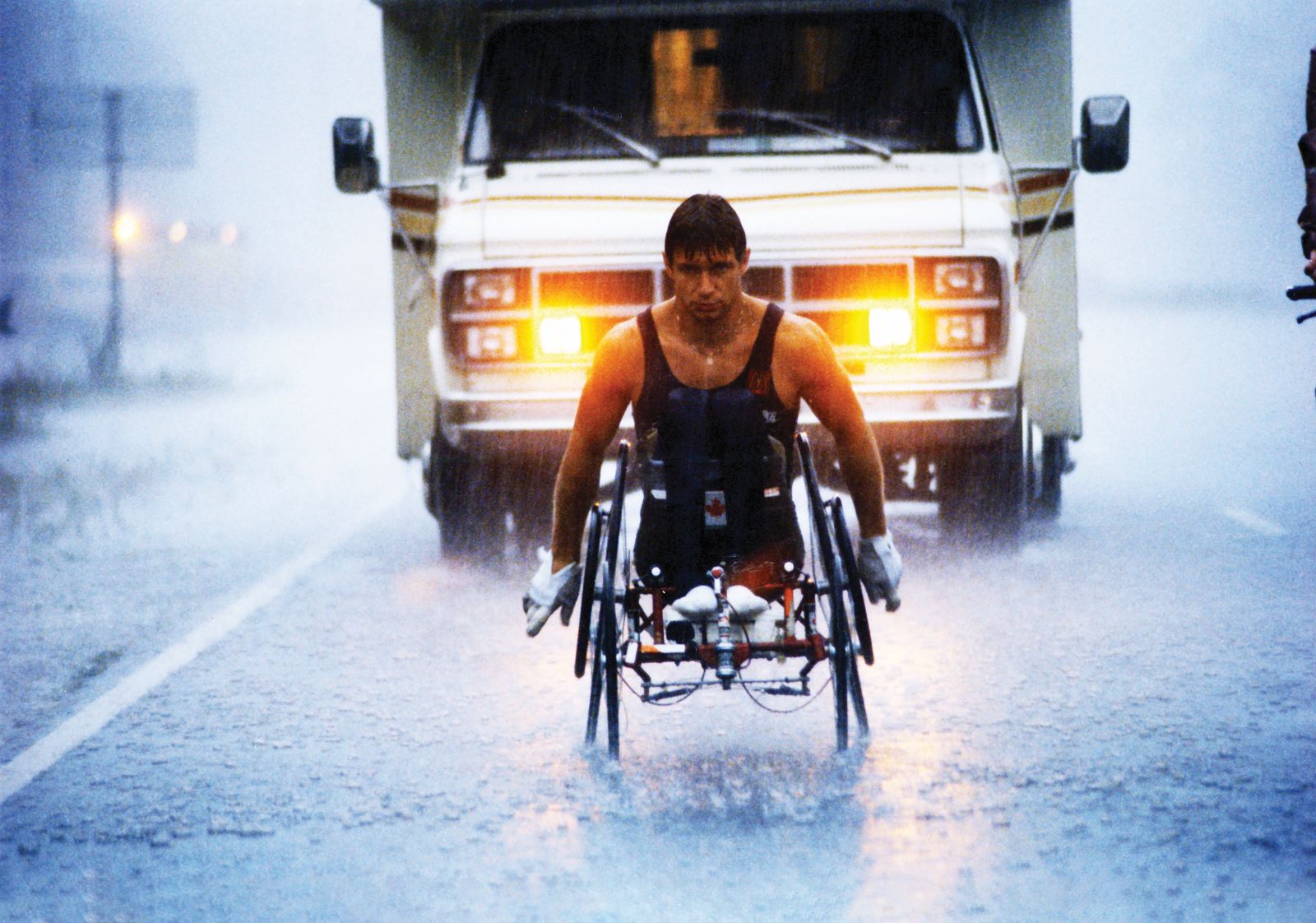

In March, 1985, five years after his fellow British Columbian Terry Fox made his own journey to raise funds for cancer research, athlete and activist Rick Hansen set out on a journey that was global in scope. His Marathon of Hope-style trek would take him through 34 countries and more than 40,000km, from the top of mountains to ocean-side paths, all while traversing such terrain via wheelchair. Along with his teammates on this tour, including physiotherapist-turned fiancée Amanda Reid, Hansen spent over two years circumnavigating the globe raising awareness and funds for spinal cord injury research.
Some four decades after his wheeling odyssey, Hansen and his colleagues are able to fully share their tale. Man in Motion: The Rick Hansen Story is helmed by Adrian Buitenhuis who has made a career out of crafting biographical documentaries on the likes of Anne Murray, Heath Ledger, Burt Reynolds and more. Along with his producer partners Derik Murray and Ryan Reynolds, and an editing crew consisting of Graham Kew, Sandro Desaulniers, Freya Maude, the film uses archival materials long buried to provide a more fulsome portrait of what this experience was like from those on the inside.
Set to play as a Gala presentation at this year’s Toronto International Film Festival, we spoke to Buitenhuis about the challenges of making a film about a childhood hero, wrangling all that archival material, and what it felt like personally to learn about certain unseen footage uncovered in the vaults of a superstar producer with a deep connection to Hansen’s fame.
POV: Jason Gorber
AB: Adrian Buitenhuis
The following had been edited for clarity and brevity
POV: When did you first hear of Rick Hansen?
AB: I grew up in Vancouver, and Expo ’86 and Rick are my first memories. He was someone who was talked about in school. The producer Derik Murray had a vision for this project before I came on board, but I knew there was a deeper story to tell. It was an international story about a Canadian hero that hasn’t been told in the depth of a proper documentary, so I argued this is a film I really want to be a part of.
POV: You have done a number of documentaries that are essentially biographical works, often about people who have passed. Can talk about the differences as a filmmaker between doing something in direct conversation with a subject, versus using strictly archival material to tell their story?
AB: It’s a different beast. When I’m preparing to make a film about someone who’s no longer with us, my biggest research is finding who the closest people are to them, like friends and family, but also the core people who were around them to help tell the story. Like with Heath Ledger, finding a lot of personal archive that helps, that’s unedited, and that allows a window into their lives.
In the opposite case, it is very different because obviously you have the person to talk to who is alive. But I make sure with any of my films, whether dealing with the estate, or with friends, or with the person, it has to be truthful, it’s going to be warts and all. I’m never going to make something that isn’t a completely human story. Everyone has their faults. Everyone has their moments where they’re not at their best. That’s what makes for a good film because it’s about being able to tell the whole human story.
I’m just very direct with the people I’m interviewing. With Rick, I let him know that I really wanted to dig in, and wasn’t going to make a puff piece.
At the same time, I’m not looking to make some sort of scandalous movie. There’s going to be things that I won’t put in the film because I don’t think they help the story. I want to tell about the challenges in people’s lives, but I think there’s a problem with media where they’re always going to try and dig and find the worst possible thing about someone, and make that the headline or whatever.
POV: Is that a conversation right at the beginning, or is that a conversation you have throughout the project?
AB: It’s a preliminary conversation with the subjects, explaining that we’re going to really dig in here, and we’re going to tell the story as it happened. I don’t think there was ever a point where we really pulled back, but you want to have a balance. It’s a tough go for Rick and the team for 90% of the movie. It is a huge struggle. Derik and I screened the film at an assembly point for Rick and Amanda, and they were obviously emotional watching the film. A lot of this stuff they hadn’t really heard or seen before either. And Rick said, “This is the first time I’ve ever felt someone has really captured the struggle.”
POV: And not just the physical struggle. The financial struggle, the logistical struggle, the emotional struggle…
AB: The lifetime struggle too. We talk about his childhood, we talk about trust issues, we talk about his struggles with relationships, and how that played out with Amanda. And we talk about the love story, to be so open about how they struggled on the tour. All of that was a lot of trust in us. Even his people were surprised that Rick wanted to be so open. It’s also the right time to make this film. Rick is at a point in his life where he’s ready and the stars aligned. Of course, it’s the 40th anniversary, so there’s a big campaign behind that and breaking barriers and a big push from the foundation, so the timing is great for everyone involved. I don’t think there was anything in his audio archive that I left out. We really leaned into the struggle.
POV: Let’s talk about those archives, specifically the audio recordings. Those were recorded essentially as diaries as they’re presented, but who has been listening to these – where have those been? At what point in time in this project did you find out this even existed?
AB: I was reading the preface to the book that came out of the tour and there was a mention of audiotapes that Rick had recorded. So Derik and I had a meeting with Rick and Amanda as we were getting into pre-production, and in the conversation I told Rick I read that there’s some audio tapes. And he kind of took a beat, and said, “Yeah, I have those stored away.” No one other than Jim Taylor, with whom he wrote the book, had ever heard them before. They had been sitting in Rick’s personal storage at his house in a box for almost 40 years. I had to go physically pick them up, and we had to be really careful with them. Deeper into that meeting, Amanda said, “You know what, I also recorded a diary.” She has never listened to it. No one had ever listened to it. She basically was recording them as a diary, as it was her way of having someone to talk to about what she was feeling. Through some deliberation and time, she finally gave us the tapes.
POV: So she hadn’t listened to them, Rick hadn’t listened to them, nobody had listened to them, basically.
AB: I don’t think Rick had ever listened to his tapes, either.
POV: Was there a film crew following him? Were there other films you were drawing from, or was that simply broadcast footage?
AB: The biggest source would have been Fred Cawsey, who was working with the CBC. He pitched the CBC about paying him to go on tour, and they said no. They didn’t believe this guy Rick’s going to make it. So Fred funded himself and would do pieces for the CBC. He had a team and they were popping in and out, they weren’t with them all the time. A lot of those tape hardcopies are with the Museum of History in Ottawa, but the Hansen Foundation had a digital copy of them. Along the way, we’d find photographs and track people down, crew members would have photographs here and there. We used some various news sources, some in Europe. We got some footage from the Vatican.
POV: The big difference is the fact that you find this 35mm footage that has the name David Foster on it. That’s the same music producer, co-writer of the theme song David Foster?
AB: Same David Foster. Derik, founder of Network, which was the company that made this film, was with David in Los Angeles. We were talking to him about the song because that’s a big part of it, as obviously the song was inspired by Rick. David let him know that on the final day they shot some 35mm film, and that he had it in his storage somewhere.
POV: Hold on, I want to know as a filmmaker, as somebody who’s been working on this documentary for, I assume, months, if not years—you find out that multiple-Grammy-award-winning, unlimited-funds “My Heart Will Go On: producer David Foster randomly has 35mm footage that fills in a missing piece. What does that feel like emotionally as a filmmaker?
AB: As a filmmaker when I heard that, I was like, wow. I don’t know if there’s better documentary capture of Vancouver from that period. It’s so rich. It’s the same stock as Raiders of the Last Ark, I think. And it’s like wow, and we scanned that locally in Vancouver.
POV: You even shot the telecine scan digitizing that print.
AB: That is the moment when this becomes digital and something everyone’s going to see. I wanted to capture that.
POV: Including Rick.
AB: Including Rick. And that’s what we did. When we interviewed him we use an eye-direct, where my face was projected onto the lens,
POV:You can call it “The Errol Morris Thing.” [Interrotron]
AB: We didn’t tell Rick through the whole interview, and then we projected the footage and played the Bill Callahan song for him to see for the first time. It’s a cool moment in the movie. I can’t imagine what it would have been like to be him, the emotions of going through that, and the amount of people who were there, but to be able to see it turned back on you for the first time 40 years later. It was a special moment.
With all of these people coming back together in this film, so many years later, it does feel like a full circle moment for all of these materials. All of this archive from a monumental event has been sitting, sleeping, just waiting for something to happen. As a documentary filmmaker, this was a huge dream to be able to have all of the access and the archives. It was a huge amount of work for my editors, to go through the transcriptions and to listen to the tapes. It was a lot of work for a very small team.
POV: Could you talk about how your relationship changed to someone who was a hero, and did you always have final cut?
AB: The relationship between Rick and myself grew a lot over the process. Rick has built this foundation and has a certain image out in the world that he’s allowing someone else to take on, to take on his narrative and relinquish control. I feel like that’s something that maybe he wouldn’t have done 10 years ago or 15 years ago with the same liberty. It also goes to the fact that Dave Doroghy and Derik Murray are people that he’s known for a long time and he has trust in them as well. The first time I really met Rick, we went sturgeon fishing. He does conservation work along the Fraser River and we went fishing for 12 hours in the winter and got to know each other.
POV: Without a camera, I’m assuming.
AB: Yeah, without a camera. We spent a lot of time in conversation before we got into filming. There was a lot of trust to allow someone in and give them that archive. Rick trusted us with the final cut. As I said, he watched an assembly rough cut, saw what we were doing, and said, “I want you to go and finish making the film how you want to make it, and I’ll see it when it’s done.”
POV: And what did that feel like?
AB: It felt pretty amazing. I think Derik and I were in the room with them, and then, to be, obviously they were very emotional, but to have that level of trust as a filmmaker is all you can ask for. But I also feel a great responsibility to get it right and to find the balance between the struggle and the hero, but I think ultimately a hero is someone who is not perfect.
POV: There’s a big Christopher Nolan movie about that right now.
AB: The imperfection and the struggle and human nature of the film, the humanity and the authenticity are what makes the film interesting. I don’t think I would ever go into a project that didn’t allow for that.
POV: Let’s talk specifically about your choices of delaying certain facts in order for them to not necessarily trump other information that’s being provided, such as the nature of his accident.
AB: That was important, to not make the film simply about the accident.
POV: An origin story.
AB: The origin story is important, obviously, and the people who don’t Rick’s story wouldn’t know it. But that’s not Rick’s story. Rick’s story is what he made of that moment, so we started from that, and put the incident deeper in the film. It’s important, [as is] the trauma and his desire to do everything to reach a goal at all costs, which is the crux of the film. That hinges on going back to that moment. The origin story tells you why he is the person he is now, and it’s important to reveal that the middle of act two.
Some people have asked why that isn’t at the beginning, but that’s not what the real story is. Also, for him, it was so important for this film to be as much about Team in Motion as much as it is Man in Motion. He was clear that he wanted his team to speak openly about how it was for them. Because this is the first time that the team has also been able to really share their stories.
POV: What does it mean to you to play Toronto? As a Gala, no less?
AB: A Gala, no less! I’ve been so deep in the process that I would honestly say one week out it hasn’t really hit because I’m so in it, we’ve been making this film up until very recently. It’s done, finally, but there are still things that I want to fix, but it’s too late for this cut.
I’ve never had a film at TIFF, so as a Canadian filmmaker, even as a global filmmaker, to open and play Roy Thomson Hall is a big deal, and I’m excited. I think it’s perfect for this movie. We’re going to play VIFF also, which is great, but Toronto’s a big one.