


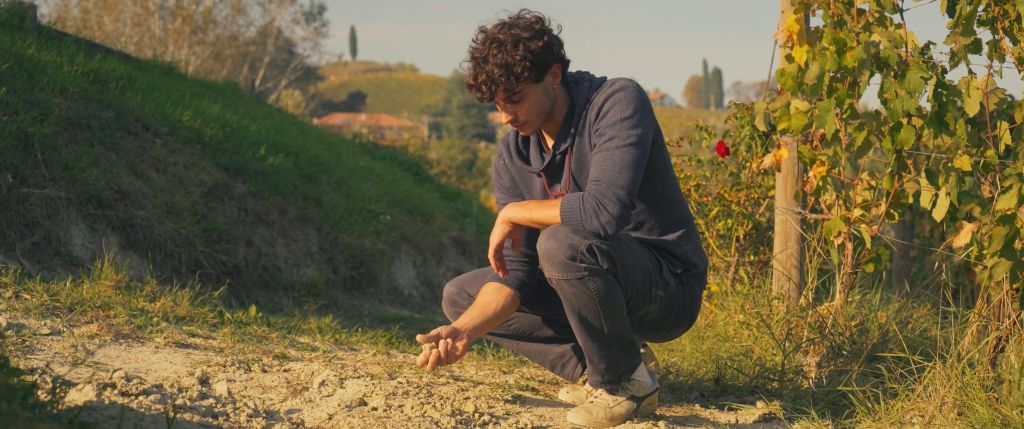
“Slowly, slowly,” seems to be the mantra for filmmaker Emanuele Gerosa and his approach to Low Lies the Land. The beautiful documentary has its world premiere in the TIFF Docs slate of the Toronto International Film Festival this week, and it invites a deep appreciation for the wines of Piemonte, Italy and, especially, the people who endeavour to see the region’s grapes through the harvest. This gorgeously shot and languidly paced film immerses audiences in the cadence of bucolic life as Gerosa observes several families working the land after two consecutive years of drought.
The parched land adds to the arresting, almost painterly compositions as Low Lies the Land gradually reveals itself as an environmental fable. Many of these families find themselves at a crossroads if water shortages mean that it’s no longer sustainable to keep producing wine. As a predatory broker lurks through the vineyards like a coyote prowling for easy kills, he presents generous offers to the families on behalf of a foreign investor. For these families, though, the prospect of selling brings serious existential questions as the land and the practices have been passed down through generations. The Piemonte wines, among the most renowned in the world for anyone who likes a nice and hearty dry red, boast a complexity of flavour thanks to the methodical care that these vintners bring to each harvest.
Ahead of the TIFF premiere of Low Lies the Land, POV spoke with Gerosa about capturing the dynamics of labour and the power of the landscape—slowly, slowly—for a film that, like a good wine, evolves over time.
POV: Pat Mullen
ED: Emanuele Gerosa
This interview has been edited for brevity and clarity.
POV: What about Piemonte makes it unique among Italy’s wine regions?
EG: Italy is a big wine producer. In many regions in Italy, wine is produced massively. It’s not a minor business in the Italian economy. But I would say that the wine of Piemonte, along with the wine from Tuscany, is one of the most famous around the world and one of the most renowned, probably because they have a long tradition, not only in producing wine, but also in commercializing and selling wine. Even before Italy was a country, a little more than 150 years ago, the prime minister of the kingdom of the north of Italy that was precisely in Piemonte was a wine producer himself. We cannot call it an industry back then, but he was pushing the production of wine of that area.
Besides wine, Piemonte is, for me at least, is a very peculiar area in Italy because it belongs to the north of Italy and the north of Italy usually is the economical driving force of the country. But there’s still a very strong and present agricultural economy. Most of it is based on wine.
POV: And with that rich history, was there an event or incident that really drew your interest to looking at the region for a documentary?
EG: I come from a nearby region called Trentino. It’s at the beginning of the Alps, but in the northeast part of Italy, while Piemonte is in the northwest part. I’m not specifically from that area [the west], but where I come from is a bit more mountain-ish, but it’s very similar in terms of occupation of the people and in terms of the wine production, of wine growing. I came to [Piemonte] by chance because [executive producer Laura DeVere], who recently bought a property in the valley where the film take place, invited me to come and check out the stories of the people. She told me she thought that it would be very interesting research for a documentary film because she found the stories of the people very poignant, very attractive and very peculiar.
I started to meet some people and was researching a bit. Immediately, I was attracted to the attachment: how they were rooted in their land, viscerally in their DNA. They were really attached to their land and what they were doing, growing the wine, and so on with a spiritual connection, something like they have inherited this way of living over many generations. They cannot imagine a different life from the one they’re living. I immediately felt how much passion there was there, but I couldn’t find the conflict that obviously you need in order to tell a story. I would say that I spent there one year and a half researching, going back and forth.
POV: What new things began to emerge over those visits?
EG: Slowly, I started to understand and while I was getting to know the people better while they were letting me in a little bit more in their lives, I got to understand how climate change, especially in the last few decades, is abruptly changing the weather. Now there is a drought that is growing and growing and growing and every year it is more difficult to keep on working the land. Slowly, slowly, I saw that most of the people I used to meet were older people—not below 50—and then I understood that the young people basically flee the area.
For the young generations of these families, the attachment to the land to bring forward the work of their ancestors, their parents and then to inherit this kind of businesses…it’s not just a gift as we could easily imagine. It is also a burden because it means, to a certain extent, not to have a choice in what you do with your life. It’s also heavy work.
POV: So the story basically revealed itself over time?
EG: Then I understood we can follow the stories and I identified the families who I would’ve liked to be the protagonist of the film. And then I said, “Let’s follow and let’s see.” After a while, this third dynamic appeared: these international funds would arrive and try to speculate over the land. They have no connection at all with the territory. They are totally depersonalized. We don’t even know who they are. I saw quite clearly that it was important to intertwine these dynamics and to how this apparently perfect old bucolic life that basically is part of our European identity also is threated by several angles.
POV: The broker adds such a strong narrative dynamic to the film. When his interest in buying the wineries for the foreign investor came in, did that have any effect on the relationships that you had built with the families over that previous year? Or did that change which families became more central to the film?
EG: Let’s say it’s the opposite way. The broker came into the film quite late. We had filmed for between three and four years. There are a lot of wineries in the area, so his job, besides being nasty, is also to be very punctual. He’s going not to every winery, but he visits a lot of people. I got to know him and then I thought for sure that he was going to visit our protagonists because they are three important wineries, but also three types of families.
I said, “Look, I’m not lying to you: You are going to be the villain.” Because that’s what it is. You want to play a double game and have to hide something, but then him a film and have him understand that I lied to him. He said, “That’s perfect for me. It’s my job.” I also spoke with the protagonists and they said, “Look, this person is going to visit you and I would like to film this dynamic.” At that point, we had built such a good trust. They were totally fine with that. That would’ve been impossible in the very beginning when I was still trying to get their trust and to know them.
POV: The broker tells the investor’s lawyer that the families in the region are very traditional. Was that a dynamic that you had to work with as well?
EG: Absolutely. For the first year, when we filmed, we never entered the houses. Never, never. We could film a lot of things: in the field, in the winery, in the cellar, outside, but we never entered the house. But slowly, slowly, they understood. Also, I think that slowly, slowly they thought, “Who are these stubborn people that keep on filming? Probably we must believe them.” We worked with a mini crew because it was just me and the director of photography and, for me, that was really important. It would’ve been more difficult, if not impossible, to achieve the naturalism. And so slowly, slowly, slowly, they accepted us in the house, and we start speaking more.
POV: I guess doing this slowly, slowly, you drank a lot of wine?
EG: Yes! For example, during the documentary’s production, the people were working, so we were a hell of a pain in the ass for them. We were really making them lose time, but they were convinced by the bigger purpose of making a film. Many times we also had to postpone the shooting, maybe losing one day, maybe thinking that we were filming in the morning, but then adapt to midday or in the afternoon, and then the light was completely different. One evening, we were going to film a scene with Dino, and we had been preparing the light all the afternoon for the evening, and around seven o’clock, Dino said, “Let’s drink a glass of wine before starting filming.” We drank one glass and then two. And then at one point he said, “It has been a very long day, so why don’t we spend the evening drinking and chatting and we film another day?” I said, of course. You build the relationships.
POV: Low Lies the Land is such a beautiful portrait of the region, but also for the way you and cinematographer Alvise Tedesco capture the grapes and the vines. What was your inspiration for capturing the labour, the work, and the landscape?
EG: In the very beginning, there was a moment of observing the landscapes, but also the labor, of how the work. I know how the work is done because, when I was a student, I had seasonal jobs harvesting the grapes. But it was important to see how we could follow the pace of the work. We came to the idea that it was very important to respect the slow pace of their life. In the countryside, the life—the work, the passing of time—is very slow, even though is relentless.
It was important to choose a location and keep the camera steady and try to create something like a painting with a frame where the characters could get in, get out. And with the DP, we decided immediately to use the CinemaScope format because you have a lot of space on the side, so you need to fill this space. CinemaScope could give us such grandeur to the background of the hills, the vineyards, the soil, because many times in the shot you see this dry soil and it’s very present, sometimes even more than the sky. For me, it was a key element because we started thinking about CinemaScope as an aesthetic choice, but we immediately understood that this format could give personality and transform the land, the hills into a character, that stayed behind all the other stories, but to which all the stories of the protagonists are related.
POV: In the body of wine documentaries, sometimes we’ll have a movie like Mondovino, which looks at the economics of the industry, but not really the wine. And then you’ll have a film like Somm, which is all about the tasting notes, but it’s just people who enjoy wine. It doesn’t really get into the industry. Low Lies the Land is like a blend, if you will, because get an understanding of the wine, but also the larger industry that shapes it. How did you balance narratively these different elements of wine so that we understand not only the dynamics of economics and history, but also an appreciation for the flavors that are being made through the grapes?
EG: The most important thing since the very beginning was not to speak about wine I never wanted to make a film about the process of winemaking because it can be interesting, but it would be simply a winemaking explanation. Making wine from grapes is such a magical process that it brings history with it. It has this added value: in history, they called it the juice of the gods. But I didn’t want to make a film about wine; I wanted to make a film about people. If they would be growing carrots, the story could be amazing as well.
It was a film about the people, about these winemakers who try to preserve their identity, their roots, and a lifestyle where money means nothing compared to the importance of their sense of belonging. That was the most important part: to create a connection so that the audience could feel not just empathy the protagonists and hate toward the broker, but each one of us could identify with the dynamic—the son discussing [future plans] with the father [who is getting too old for manual labour]; with the man alone with his winery and looking for love; with the young guy who has to decide if he is going away and try to build his destiny or to go back home and help the family .
POV: At a certain point, too, you realize you’re watching an environmental film with a unique angle about how people are affected by climate change, which I think makes the last shot quite effective when they’re trimming the vines and you see the water drop from the tree. It gives a nice hopeful ending. When you were filming, did you know that that would be the ending when you saw it?
ED: Absolutely. I have goosebumps just now. Every time I watch the end of the film, I have goosebumps. Each one of us could think something different about the end of the film, and that is what I hope. For me, that ending, is such a great lesson in humbleness. It makes me feel that whatever we do, whatever we think, however we decide to live, however we fight in our life, however we run, nature will be still there and going on.
As I told you, I come from a region that is a very strong wine producer. It’s [an expression] that is not used anymore, but when I was a kid, I remember often the old people–the grandfathers, the grandparents–saying whenever somebody would cry, “Ah, you cry like a wine.” When there is a quote and you take it for granted, you know what it is, but you never really ask yourself what it means.
Then, in the last years of filming, I saw after pruning and right before the spring, just before the buds start growing, they cut the old branches and the vines started crying. They call it the “wipe of the wine.” Then maybe 40 years after that I heard that quote, I understood. Slowly, slowly, slowly, you feel what is at stake. It is so magic, that moment, and each one of us can get inside himself or herself and hopefully starting reflecting about what they have seen.