


Alison Klayman is no stranger to documenting complicated subjects. Her films have ranged from her celebrated Ai Weiwei: Never Sorry, which opened Hot Docs 2012, her doc about the mercurial artist Alanis Morissette, Jagged (2021); a deep dive into the vagaries of a fashion empire with White Hot: The Rise & Fall of Abercrombie & Fitch (2022), as well as a probing look at towering political operative and kingmaker Steve Bannon in The Brink (2019). However, her latest film, a concise yet powerful short, Scenes from the Divide, may prove to be her most personal work yet.
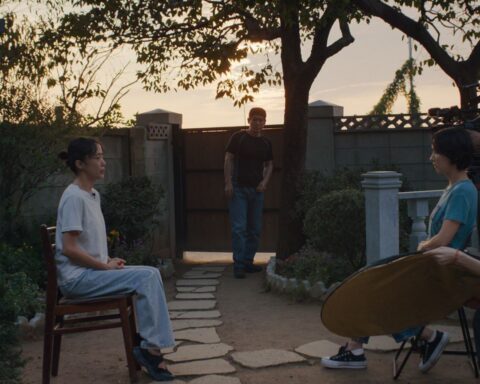
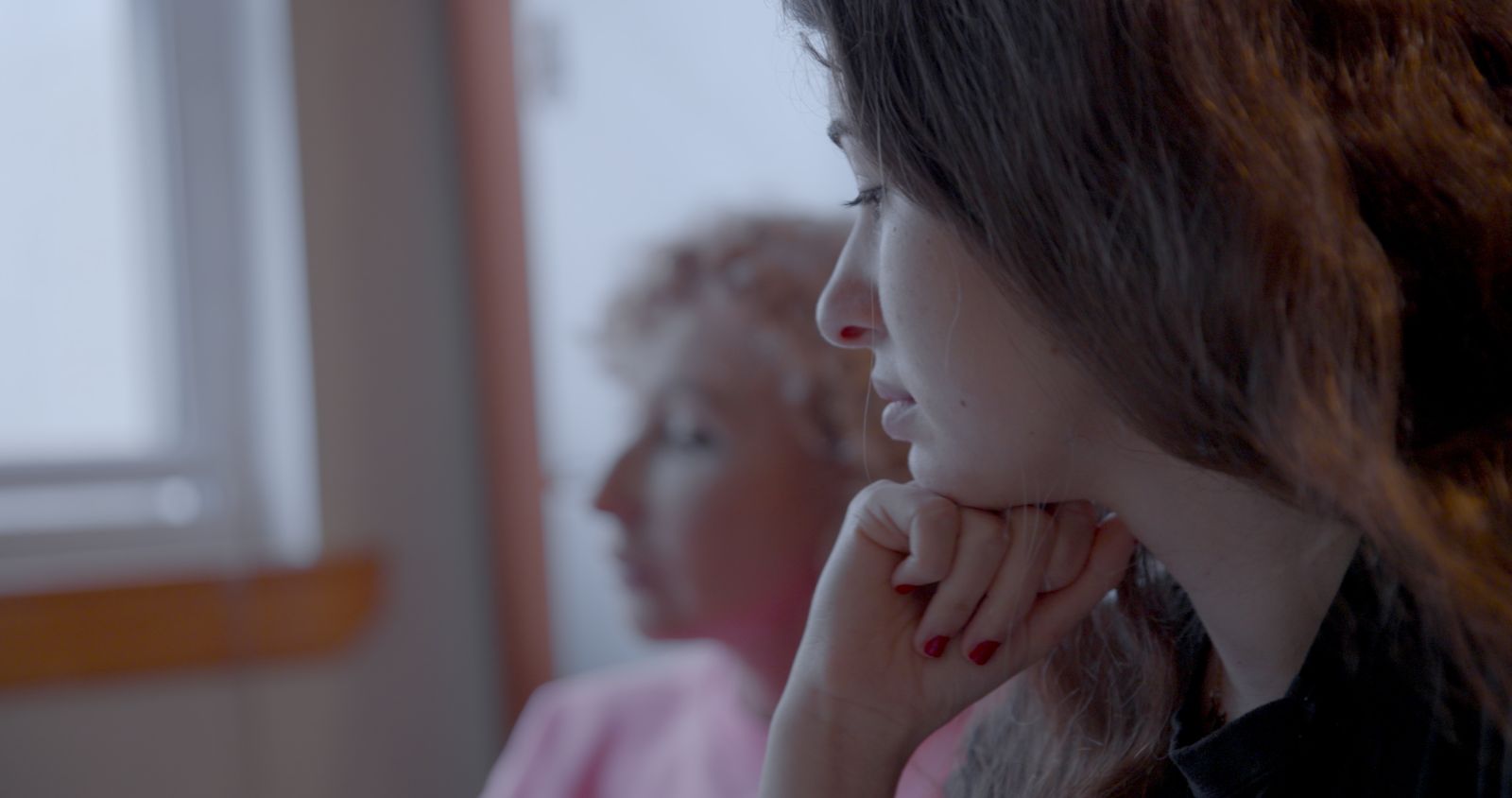
Scenes from the Divide is a timely portrait of a generational and political split, situated during the tumultuous New York mayoral election that garnered international attention. The film is a microcosm for the conversations that Jewish families are having in the metropolis as well as in communities throughout the diaspora, navigating post-October 7th politics and coming to terms with with the rise of anti-Zionism in the wake of Israel’s escalation of violence against Israel following the Hamas attacks of that faithful day, while maintaining a strong sense of their Jewishness, especially among the young, challenging, and decades-long held perceptions of their elders.
The film both documents the divisive nature of these perspectives and offers an invitation for discussion. It gives voice to what often prove to be diametrically opposed perspectives, but doing so both with kindness and nuance. The result is a powerful piece that, in its relatively spare running time, provides a compelling articulation of these disagreements than the usual, histrionic messaging that has dominated the discourse.
POV spoke to Klayman from New York prior to the film’s Hot Docs screening.

POV: Jason Gorber
AK: Alison Klayman
This interview has been edited for brevity and clarity.
POV: The last line of your Wikipedia bio says, “Klayman is Jewish.” What does that mean to you?
AK: “Jewish” is one of the most core, foundational, unquestioned parts of my identity. I went to Jewish day schools from pre-school through 12th grade. That felt like a very meaningful choice that my parents made. My mom especially wanted to give me a Jewish education. She’s an immigrant who came to the U.S. Her parents are Holocaust survivors. I could go on and on but it was a great gift that they gave me. It made me feel very secure in where I come from so that I can go out and be a person in the world, and that was how I always felt. The Israel/Zionism piece is what is providing a lot of people a lot of consternation. I’m part of that world, and that’s what this film is about in some ways.
POV: Do you as a filmmaker ideally need to agree with your principal subjects in order to make a film?
AK: [Laughs.] No. Definitely not. I don’t feel like it changes how I make a film, whether I agree or not, actually. And I say that from, not just as theory, but I have done it. You can make a film about someone you don’t agree with, but that doesn’t mean you’re promoting what they think, either. I spent a lot of time thinking about that when making The Brink That just gets down to the question of what vérité is, really. There are so many choices, and there’s an art and a point of view and sculpting that is done. Everything is contributing to a point of view, even when you make a film that is by approach not didactic and not persuasion-based.
POV: This is a film about nuance, it’s a film about conversation. It’s a film about respecting the fact that by being divided does not necessarily mean that one side is superior to the other. Yet I assume that many people who claim that they’re open minded to opposite perspectives, be they about Mamdani’s mayoral candidacy, Zionism, the advocacy for a liberated Palestine, etc., see this film and simply have their own points of view emphasized and amplified. How do you make space for these paradoxical elements to co-exist without putting your thumb too heavily on the scale?
AK: Propaganda or persuasion is a certain mode that you can make films in. But no matter what, films are going to be in the eye of the beholder. If you do things that touch on political matters, or are political through and through, things where people have strong divides, there’s a heightened challenge about how you make it. In the end, you have to make it for yourself.
For me, it comes down to if you are portraying the person fairly and accurately, yet there’s still a lot of choices that can be made within that. The subject may still not like it, though that hasn’t been the case with this film in terms of any of the participants. The question is, is the film telling the story that you as the filmmaker wanted to tell?
This film was made in some ways as a response to where the rhetoric is, although I don’t think it gives a definitive answer. The discourse is often so reactionary, like road rage. It’s a lot of things happening online, or in encounters with strangers on the street, videos that might go viral, things like that. But there’s another story going on, which is in everybody’s family and personal life, and also within everybody’s soul, in relationship to their core identity. Like the first question you asked me. And that’s what I thought was really interesting and worth making a movie about.
POV: One way to shape your telling is to decide who to focus upon, and how much that leads to the larger questions at hand.
AK: Rabbi Irwin talks about the breaking down of a consensus, and that was in mind with the casting of this film. The American Jewish community, for a really long time, was mostly on a liberal to progressive spectrum. They were members of the Democratic party, they were Zionist, and that was the default consensus. When we talk about this divide right now, it’s very clear that that is shifting. We’re in that moment of transition and inflection point, and what things look like now is not what it looked like 10 years ago. And so then I have to believe that what it’s going to look like in 10 years is also going to be very different from where we are now.
So, this is in some ways more than an interesting exploration and a piece of art, and holding up a mirror to the moment. It’s like having a document of what this moment feels like. If you showed this to someone in a time machine from the past, they would be like, “That’s what’s going on?!” Seen from the future, we’re going to land somewhere. I don’t know where it is, and the feelings of this moment will; it’s worth distilling and having as a record.
POV: Can you talk about the personal and professional experience of navigating those who are certain in their certitude at this incredibly challenging time?
AK: That’s where I’m jumping into this as a filmmaker, doing what I do. This is my first film about the Jewish community, about Judaism, although, again, I was living and breathing and following and thinking about this all the time. But I was late to thinking I should do it as a film.
The timeline starts before October 7th for watching this, regarding the conversation around Israel and the conversation around how Jews were having different opinions. But it all gets really heightened after October 7th, and it really wasn’t until 2025 that I started to feel like maybe I have something, not even something to say, but I have something to do about this. I can contribute something and I want to explore it as a filmmaker.
I’m a lurker on social media, but I still keep things that are also very toxic, like Twitter. I was part of the early Twitter news wave of Ai Weiwei and China. Twitter meant something to me in different phases all along my life. Now my Twitter is sort of like right wing Steve Bannon Turning Point USA Twitter, it’s like WNBA Twitter, it’s Human Rights Twitter, and it’s also Lefty Israel. You can’t not have all things about Israel. That’s everywhere.
There are a lot of people who I grew up [with] who feel very differently than I do. Early on, I intentionally kept everybody in because I want to see what’s happening, what people are thinking and saying. This is all from over 10 years ago, and that was a choice.
As a filmmaker, you know the amazing thing you get to do, for documentary, is to engage someone and ask a follow-up question. You watch the people put the things out and have fights maybe in comments or whatever, but there’s a lot of things that people say that I want to know what they mean by that. That was the framework of approaching people on this film: Asking the follow up questions, asking what they mean, asking to define terms, to see what they are afraid of, or what’s the thing that they think is happening or not happening. The task then was to find people who might be articulate in that way, but who were engaged in this election too. That was part of how to narrow it down.
Then as an editor, I looked at everyone and I was like, “Does this feel like you’re getting some insight that surprises you?” Everyone had to have something that I think a viewer might be, even if it’s just a little bite, not that their whole character taken as a whole is going to surprise anyone. Making this with Jewish Currents, a publication that is very enmeshed in this topic, it’s like they’ve seen everything. But to render someone in 3D in the film, the embodied nature of seeing someone in a film versus in print, I make sure to get at their essence and then also include something that’s maybe a little bit surprising.
POV: The Ai Weiwei social media stuff is fascinating, and I admit I only know about him from your film. I was fascinated by the reaction from those who turned on him when he went back to China.
AK: Yes, that was a real moment.
POV: They felt betrayed by their vision of who he should be, not who he actually is. Similarly, people thought Mamdani would be elected and it would be the death of New York, and people thought Mamdani would be elected and he would surround himself with incredibly pure people with good intent. And we’ve certainly seen on both fronts, they’re both wrong.
AK: Time will tell. A lot of my films, especially this, especially The Brink, I want this to be for history. When you’re also trying to make something that reflects the moment and be very current, it benefits you to also try to release it to try to be part of the conversation. If it was something that was out in a year, because it’s about the election and his candidacy: Is it going to feel like old news once he’s the mayor? That’s why the film is about the Jewish community, their issues all projected on to him. I personally think it’s going well, as someone living in New York, as my country, along with Israel, is putting this completely unnecessary, harmful war in our names. It feels nice to have a mayor who’s pretty focused on people’s day to day life and telling you that government is doing things for you and trying to care about you at a time when it feels like our government doesn’t communicate that to anyone otherwise. Some of the deeper questions are going to be in the eye of the beholder and have not played out yet.
POV: With Ai Weiwei going back to China, as I said, it’s not that people were upset, it’s that people felt it was a sense of betrayal. What’s it like when one of your subjects, somebody you’re very closely directing, makes that decision? How did you feel when he went back to China?
AK: People expressed those things to me, and I didn’t have the same reaction in terms of surprise, and also not betrayal. Every time he comes to New York, we go to a Chinese restaurant. I would bring him bagels when I would visit New York when I lived in China. He’s a very cosmopolitan person, but he’s a Chinese person who cares very much, and he’s deeply rooted in his identity. China’s where he feels most at home. He’s also someone who is engaged with the world, and very lucky and grateful to other countries that have been his home. But he also consistently will give interviews talking about how those other countries were shitty to him, and that’s what he did in China too. I didn’t see what he did as inconsistent with him as a person, but I understand politically that that is a choice that I don’t know if his former self at a certain point would have agreed with.
I’m just saying that say I don’t know. I don’t judge it. I’m not sure. He might have a different opinion. And people are free to have their opinion just like he might judge someone for what they say.
It’s a great question from you because there’s something here that speaks to what these kinds of films can do. Politics are still important, but there’s another register, which is human beings and their life and their relationships. The goal is not to flatten everything. We’re also all people with relationships and real life choices that you have to make on a daily basis. And that’s something that scenes from the film can really get at. It’s not a novel revelation, but it’s a movie that shows it. These are issues that are of this fever pitch, that there’s a political urgency and a divide, but it’s also within the community, it cuts through everyone’s families. That’s part of why this is such a painful moment right now.
POV: Do you see that part of the reason we’ve gotten to this division is purposeful and planned? [In that they are provoking people during a sensitive moment for political gain.] There are those that want there to foster these divides through our social media, etc. In that case, the divide itself is not a bug but a feature. As a filmmaker, how do you even begin to break out of those pressures?
AK: Rosa Lander says in the film that we’re tired of either not having these conversations or not doing it well. That describes the last decade, I would say. That’s why this is the inflection moment. It didn’t come from nowhere and it’s not because of Mamdani. That’s part of the point of the film. It also didn’t start on October 7th, and that is also missing the point, too. All of these things have brought us to this moment where we’re needing to address this stuff out loud and to each other.
I’m not saying that only Jews have the right to have opinions about Israel, but when I talk about this divide, it’s becoming a conflagration because it’s been suppressed and unspoken. It’s been there for a while, and these questions are really existential.
You asked me what being Jewish means to me, and honestly, my ancestors and my duty to my family and the past [are] a big part of what it meant to me, and what was instilled in me. That’s a big part for everybody: There’s the people in the room, there’s the people who came before you. If people think they’re right, what do they mean? Why do they think they’re right? And what is the thing that they mean by what they say?
I don’t have an easy answer. But this moment is one where things are erupting, and it’s because they have been there for so long and just haven’t been addressed. It’s painful, but it’s exciting about this moment. I’m so curious where we’re going to go on the other side. That also means the status quo has not been serving us. Every day in the last couple of years, there have been more and more people within this community are coming to that conclusion. I don’t know what’s on the other side, and I don’t know who does. But it is no longer a fringe or radical idea to suggest that the status quo isn’t working, and that’s why it’s breaking apart now. I don’t know what replaces it, and that can be scary or exciting. I mean, it’s both, I guess.
Scenes from the Divide screens at Hot Docs on May 3.
Get all of POV‘s Hot Docs coverage here.