



As we enter the tail-end of summer, with fall beckoning at our door, it might be hard to admit that the season is ending. However, the summer spirit of adventure will live on. For readers seeking to relax and mellow out for the last month of summer, we have compiled a list of documentaries that will take you across the country without moving an inch! Most of these are short documentaries that can easily be penciled into busy routines to make the most of what is left of summer. If you visit any of the cities or towns that make this list, be sure to share the films with friends to help spread the travel bug!
Our Town Faro (2004) – Faro, Yukon
Going from west to east, first up we have documentary as quaint as the town that it is about. Our Town Faro invites the viewer into the kind of small community that is essential to this country but is far from being recognized. Faro’s story is one of failed futures where in a flicker, it went from being a potential centrepiece of the Canadian mining industry to finding itself at risk of becoming a ghost town. Beyond the surface, where mayor Murray Hampton is determined to save Faro, the film has undertones of critiques on capitalism and ideas of non-industrial development that are interesting to consider from the perspective of a small, under-serviced town that wouldn’t conventionally form a part of anyone’s road trip—unless they brought a few spare cans of gas!
Our Town Faro, Mitch Miyagawa & David Oppenheim, provided by the National Film Board of Canada
Mudflats Living (1972) – Vancouver, British Columbia
An exploration of an artistic community who lived as squatters in the mudflats area of North Vancouver, the film learns from these inhabitants about their peaceful way of life constructed around ideas of love, simplicity, and curiosity. This determined way of communal living is contrasted with the entrepreneurial spirit of the city’s mayor, who wants to turn their residence into a shopping centre. Much like other films on this list, Mudflats Living is about the intersection of development, difference, struggle, and belonging that continues to define life in Canada even today.
Mudflats Living, Robert Fresco & Kris Paterson, provided by the National Film Board of Canada
Stampede (1963) – Calgary, Alberta
What good is a trip through Canada without attending the glorious Calgary Stampede? This film stands out as a document of the rodeo while spotlighting one cowboy, Kenny Parsons, who is reaching for the grand prize at the Stampede after a string of losses elsewhere. The focus on Kenny allows Stampede to play out as an underdog story while documenting the enrapturing performances of the rodeo that draw people from far and wide. The voiceover acclimatizes the unfamiliar viewer as the film blends the dynamic and dangerous nature of the festivities at the Stampede with pockets of information about the event itself.
Stampede, Claude Fournier, provided by the National Film Board of Canada
Flin Flon (1978) – Flin Flon, Manitoba
The story behind the christening of the only town in Canada named after a science fiction hero (from the 1905 novel The Sunless City), Flin Flon is only three minutes long, but is quite endearing, inviting, and informative. Exploring the origins of the town’s name, the film combines archival footage and a brief special effects sequence with shots of the town that take the viewer through the town’s history, it’s industrial pursuits, and the people who have since settled in it. Much like Faro, this is the story of yet another small town that could otherwise be overlooked in a cross-Canada road trip, but the transportive qualities of film allow us to acquaint ourselves with this beautiful place.
Flin Flon, Tina Horne, provided by the National Film Board of Canada
I See Myself in You (2026) – Brampton, Ontario
Shot on 16mm film, this short doc explores the controversial city (and my hometown) of Brampton, Ontario, discussing the very ideas that create the commotion that defines it. Xenophobia, internalized racism, and stereotypes regarding new immigrants are themes that the film addresses through personal accounts narrated by three Bramptonians who arrived in the city at different phases and points in their lives. The film is shot in iconic spots around the city that hold immense value for the residents, especially the three featured in the film, and in doing so, constructs a sensitive portrait that opens up a side of Brampton that mainstream media wilfully sidesteps. [Watch out for the film on the festival circuit.]
Nirvanna the Band the Show the Movie (2025) – Toronto, Ontario
This mockumentary/doc-adjacent comedy arguably the best representation of the electric, indescribable, and overwhelmingly hilarious city of Toronto. Through its visuals, the story, and the subtle and not-so-subtle cultural references, the film is the most intricate document of Toronto and what it means to be a Torontonian. The stories of Matt Johnson and Jay McCarrol and that of Nirvanna the Band itself inevitably heighten the appreciation one holds for the city after watching this film. The offbeat manner in which it was shot, especially across timelines, invites the viewer into two distinct portraits of Toronto. [Watch the film on Crave.]
A Capital Plan (1949) – Ottawa, Ontario
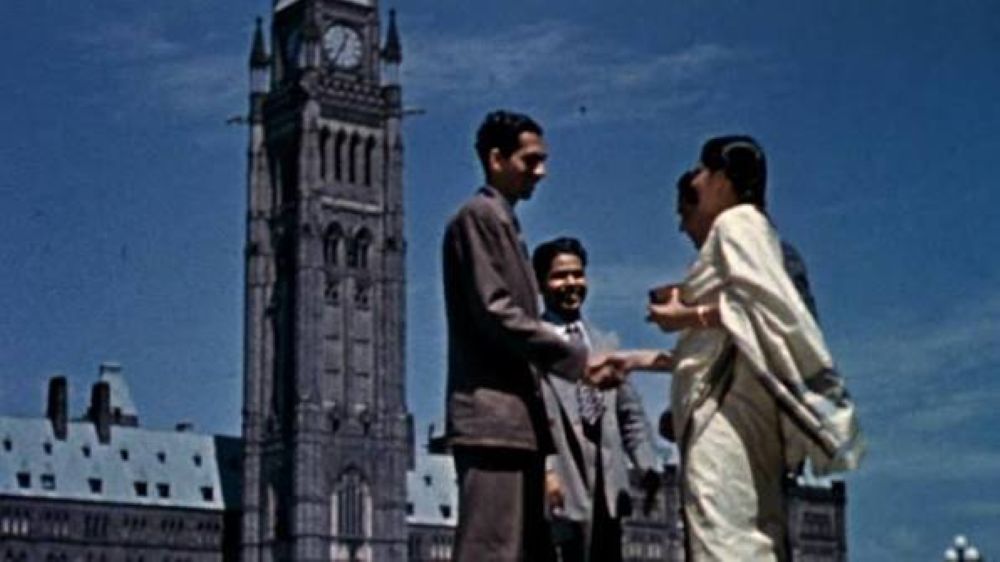
A Capital Plan is a portrait of mid-century Ottawa, focused on urban planner Jacques Gréber’s redevelopment proposal that would reorganize the city to look and feel more like a capital, similar to its American and Australian counterparts. The film acts as a time capsule, showing glimpses of the wildly different pre-development Ottawa, featuring a voiceover that eloquently explains the changes that involved redesigning the transit system, the factory locations, and reconstructing neighbourhoods – features that define the city today. The informative nature of the film does not impact its cinematic quality, as director Bernard Devlin brings together stunning shot compositions and a brief animated sequence that are sure to delight viewers.
A Capital Plan, Bernard Devlin, provided by the National Film Board of Canada
September Five at Saint-Henri (1962) – Montreal, Quebec
A meditative exploration of the lives bubbling inside the Saint-Henri neighbourhood of Montreal. The film’s intent is to document visually, with minor verbal probes, inquiries, or explanations, letting the stories unfold in a manner that essentially transports the viewer to the scene itself. In its construction the film’s occasional meandering and lingering reminds one of the French New Wave, which perhaps is fitting for a film depicting the city of Montreal. The monochrome look complements the film’s mystique, resulting in an enchanting portrait of an equally enchanting city. Be sure to check out the 2011 re-imagining of the film as well.
September Five at Saint-Henri, Hubert Aquin, provided by the National Film Board of Canada
You Are on Indian Land (1969) – Akwesasne
It is a fact that any sort of movement, expansion, or expedition conducted in Canada is being done on land stolen from Indigenous peoples by the colonizers. In that spirit, our road trip would be incomplete without learning of what this land means to the people who are its rightful inhabitants. You Are on Indian Land is a remarkable documentary about the Kanien’kéhaka occupation of Akwesasne territory (bordering U.S. and Canada) after a taxation violation by the Canadian government that threatened the nation’s autonomy. The film brings to light the immense strength and unwavering defiance that was and continues to be necessary to fight against the systematic oppression enabled by the Canadian government.
You Are on Indian Land, Michael Kanentakeron Mitchell, provided by the National Film Board of Canada
Speak It! From the Heart of Black Nova Scotia (1992) – Halifax, Nova Scotia
Our final stop in Halifax, Nova Scotia is about change, and the sheer determination it has taken for minorities to establish themselves as Canadians in their right. Depicting the experiences of a group of Black students in a predominantly white high school in Halifax, the film portrays how despite being ‘welcomed’, minorities in this country have always had to fight and struggle for adequate representation. While programs and groups related to culture, ethnicity, and diversity are commonplace in Canadian schools and universities today, the efforts undertaken by the film’s protagonists to put together a Cultural Awareness Youth Program, emphasize the hardships that people and communities before ours underwent to provide the avenues we take for granted today. It is a reminder that the fight we fight is not only for us, but to honour those who came before us and to ensure a better future for the ones who will come after.
Speak It! From the Heart of Black Nova Scotia, Sylvia Hamilton, provided by the National Film Board of Canada