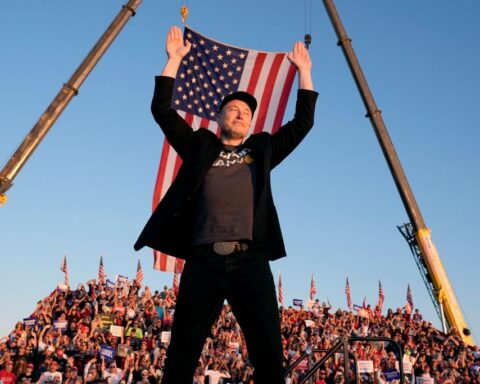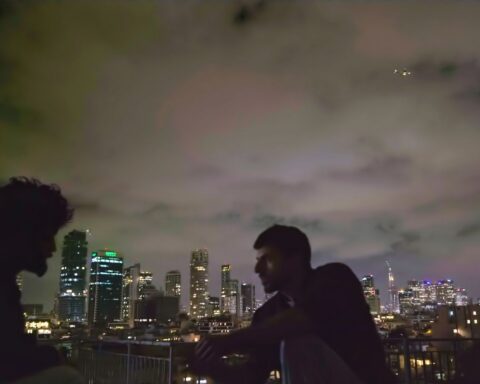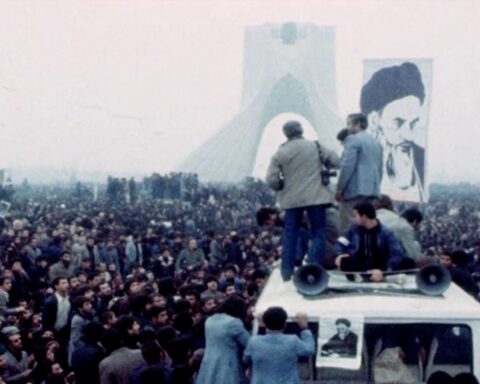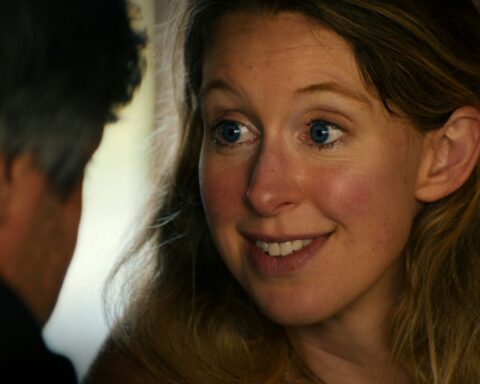



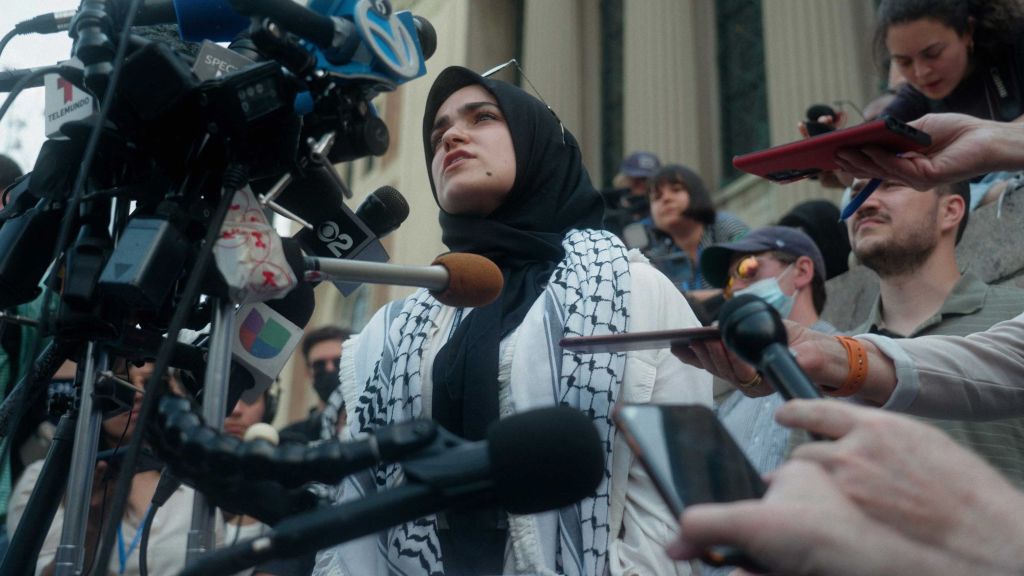

With the Rise of U.S. President Trump and India’s charismatically autocratic leaders take over two of the world’s largest democracies. Watching these brothers- in-arms willfully dismantle the republican machinery of their respective nations, while morbidly comic at times, has made for a grim decade. Making signal contributions to the wealth of media surrounding both politicians are two documentaries that acutely capture the countries’ descents into autocracy, Payal Kapadia’s A Night of Knowing Nothing (2021). and Michael T. Workman and Kei Pritsker’s The Encampments (2025).
The two films are aesthetically different, with Kapadia offering a stylish experimental essay cataloguing several student protests across India, while Workman and Pritsker’s feature offers a more traditional documentary look at the development of the pro-Palestine encampments at Columbia University last year. Both privilege student voices and opinions around protests, educating the audience regarding the urgently unravelling political tensions in both countries through an examination of the frustrations of the youth, a section of society that is often ignored for its lack of “real-world” experience.

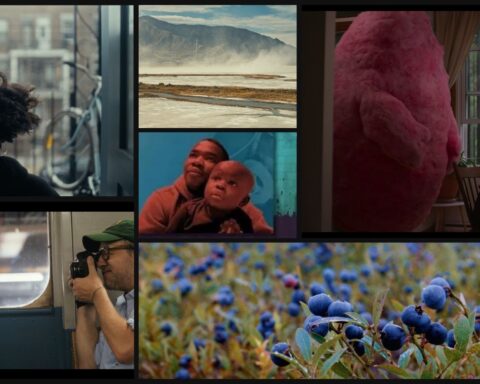
For Kapadia, who takes the autocratic beast head-on, the challenge is to create an anti-establishment film under a regime that has effectively banned criticism. Using sober voiceovers narrating a series of fictional letters between two estranged lovers, Kapadia guides the audience through a few of the most turbulent student protests in contemporary India. Taking off from her alma mater, the Film and Television Institute of India (FTII), she chronicles the outburst against the governmental appointment of former two-bit actor Gajendra Chauhan as Chairman of the esteemed institute. From there, A Night of Knowing Nothing (ANOKN) dips in and out of a series of student protests on themes including caste-based discrimination, unlawful governmental arrests, and subsidized education for qualifying students.
For India, a country where student protests are largely dismissed or outright ignored, ANOKN’s focus on them is novel. The “ideal” student in the country is one who studies in school, then studies more at home, and then goes to tuition classes to study even further; one who is respectful to all elders, including especially the nation’s ruling elders. Naturally, protests violate all of these expectations.
In allowing these young people to talk passionately about “student issues,” Kapadia ties seemingly micro-incidents in campuses to the macro-politics of the nation, exposing the Modi government’s increasingly autocratic tendencies and re connecting the disenfranchised students to the broader citizenry. The students are held akin to revolutionaries, stirring awake a sleeping giant.
The Encampments offers a similar opportunity for students in Manhattan. The film includes interviews with several students involved in the Columbia University encampments including Mahmoud Khalil and Sueda Polat, who led the negotiations with the administration. The audience sees students across ethnicities, religions, academic disciplines and nationalities come together to stand for what they believe is right.
There is an intimate understanding of students in both ANOKN and The Encampments based on personal knowledge. Kapadia is an alumnus of FTII and spearheaded protests at the time of filming while Workman and Pritsker were involved in academia and investigative journalism respectively. Students across both films are represented as members of an educated class for whom protests are a natural (and often the only) avenue to facilitate change. They desire agency in a world of curated syllabi, rigid course offerings, minimum-wage jobs and familial pressure around major life decisions. Students in both countries are tired of being told what to do by men in suits who have not the slightest idea what they are going through and truly need. The people in power in the U.S. and India don’t understand that their student populations want above all to play an active role in how they are governed.
When students sit outside Columbia’s halls protesting against their tuition being used to fund genocide, demanding their school to divest from the U.S. and Israeli arms industries, they show a profound desire to control where their money is going. Similarly, back in 2015, when Indian cinema and TV students unified against the appointment of Chauhan as chairman, it was simultaneously a protest against the ruling Bharatiya Janata Party (BJP)’s attempts to corrupt the nation with their Hindutva ideology and a public expression for the appointment of an individual who was intellectually fit to lead the country’s most prestigious film institute. When they discuss the school’s timeless legacy and their identity within it as FTII students, they understand more than anyone else the truly life-changing potential of education.

“Why do we need such a (subsidized) film school in our times?” “What are our privileges here?” “How many of us could have even dreamt of making films if this place did not exist?” These are but a few of the questions that students engage with ideologically in ANOKN. Their fiery polemic against the BJP finds tender relief in their impassioned efforts to save their institution(s) from succumbing to rancid governmental politics. The doc’s identity is made by Kapadia creating an essay film that evokes Chris Marker’s canonical Sans Soleil by constructing a narrative through fictional correspondence (between “L” and “K,”) and the students’ repeated employment of cinema and cinematic objects as tools of protest. Their angry demonstrations turn into one of love in the brilliant film.
The students protest not only because they despise the government, but out of respect to their institution and the people that help maintain it. Through L’s letters, we hear the radicalization of her political thought as she narrates the events unfolding on campus and connects them to the broader agitations across the nation. In addition to L, we hear from several student activists and politicians as they lay undying emphasis on their respect for the nation and its educational institutions.
This idea is mirrored in The Encampments where the students’ demands for divestment are motivated by the need to nudge Columbia University to walk over to the right side of history. Using the very tools of knowledge that their respective universities have passed on to them, students across both films attack the hypocrisy of their institutions. The ever-echoing question becomes: How can these institutes be exempt from practising that which they teach their students in theory? Subversively, these discussions also highlight the excessive commercialization of education and how the ideas of the academics differ significantly from the financially motivated boards running these institutes and ultimately the industry itself.
Despite the films’ different political contexts, each offers a lens on Islamophobia in its respective country. In a scene from Kapadia’s film, we see, through the visual of a TV screen, a politician delivering a motivational address at the Hyderabad Central University (HCU). Speaking of the divisive politics of the BJP on university campuses, she remarks, “And where there were Muslim students, they (the government) had the usual word for them: terrorists.” The election of Chauhan as well, who was renowned for playing a prominent Hindu mythological character in a version of the Mahabharata on television in the ’80s, was part of a broader Hindu extremist or Hindutva agenda which would love to erase Islam from India altogether.

Even the glimpse that the audience is allowed of protests on the Jawaharlal Nehru University campus, demanding an India free from societal evils, has a sinister and deeply upsetting story behind it. One of the many arrested from the JNU campus for inciting “anti-national” sentiments during those protests was Umar Khalid, a student, activist, writer and, most importantly for the Indian government, a Muslim. Khalid, who was later charged with rioting, murder and unlawful assembly during protests in 2019 against the Citizenship Amendment Act, continues to remain in prison five years after his arrest. Without a trial and having been denied bail, Khalid is one of the many victims of the government’s Unlawful Activities (Prevention) Act (UAPA), which allows the government to arbitrarily arrest and detain any individual that they believe to be engaged in terrorism or terrorist adjacent activities on Indian soil.
Funnily enough, the United States Commission on International Religious Freedom lists Khalid as being “targeted for leading peaceful protests” describing the Citizenship Amendment Act as “religiously discriminatory.” The website also classifies India as the “Perpetrator” in Khalid’s case. While Khalid continues to write hopeful letters from jail in anticipation of his freedom, his story has played out in the U.S. for several Muslims, with The Encampments’ protagonist Mahmoud Khalil being subject to similar treatment.
Khalil, a legal permanent resident of the United States, was arrested in March 2025 following the creation of the encampments at Columbia University. His unequivocal support of Palestine was outlined as the primary reason for his arrest. Khalil was released after three months, following an intense legal battle, and now has sued the Trump administration for $20 million citing false imprisonment, malicious prosecution and defamation. Unfortunately, Umar Khalid, a few thousand kilometers away, has not been allowed a similar fate, further emphasizing the disparity in the respective countries’ authoritarian status—Trump’s U.S. being, in this case, the lesser of two evils.

Finally, there is a specific quality in the films’ students that ties them beyond narrative commonalities and political disagreements: solidarity. The students across both films are bound together by the need to stand up and, more importantly, to stand together. There is a scene in ANOKN in which a student asks the crowd gathered during the Student Union elections if it isn’t their responsibility to stand with students from a different institute should something happen elsewhere. “It’s not just a moral obligation,” says the student. As Kapadia’s film moves through the different protests, it becomes abundantly clear that the students are not selective with their outrage. Seeing universities all across the world follow Columbia University and organize pro-Palestine encampments, protests and civil demonstrations evokes a similar emotion in the viewer. “They just arrested our first group, we have countless people prepared to take their place in our encampment,” said a student in the film, exemplifying the nexus of solidarity that students displayed within Columbia.
From the Film and Television Institute of India to the Hyderabad Central University to the Jawaharlal Nehru University, students are determined to craft a revolution. A similar mood of anger and determination is reached when we see encampments pop up all across North America and eventually around the entire world. There is a visible dissonance between journalists on TV dismissing the students as subscribing to TikTok politics and the unadulterated and courageous activism of the students.
“Bravery is very contagious,” says Maya Abdallah, a Palestinian student from UCLA, in The Encampments. Through an unrelenting portrait of hope painted with poignant statements such as Abdallah’s, the two films essay a romantic quality. There is a childlike innocence in their discussions of freedom which is only uplifted by their student-like confidence in achieving their goals. Her observation, utterly simple yet spellbinding, fills one with boundless optimism, almost leading one to believe that maybe in another universe, Khalil and Khalid would stand together, shoulder to shoulder, against Narendra Modi and Donald Trump, and for Palestine, their fellow students, and a peaceful democratic world.