



The fact that India’s is the world’s largest democracy is entirely (mis)shaped by arbitrary definitions of the words “largest” and “democracy.” It is true that it is the most populous country and that, occasionally, the government will set up polling booths where people are presented with the illusion of free will, but to call it the largest democracy is truly a farce. As corrected by several independent democratic indices, at best India is a “hybrid autocracy,” and Indians are no strangers to being governed by an autocrat.
Before Narendra Modi, there was Indira Gandhi, India’s first woman Prime Minister and the nation’s first post-colonial populist autocrat, who is infamous for her imposition of the National Emergency in 1975. I write of the tyrants and the despots who’ve harmed India’s democracy, but this story is not about them. It is about a group of independent documentary filmmakers, who persisted through Indira Gandhi’s second term as Prime Minister and whose work simultaneously documented a revolution while also helping it take shape. This work remains prescient.
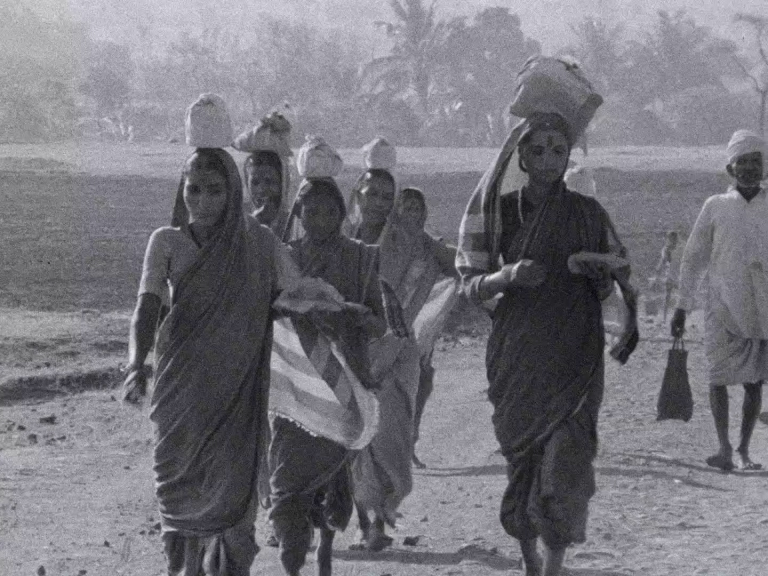
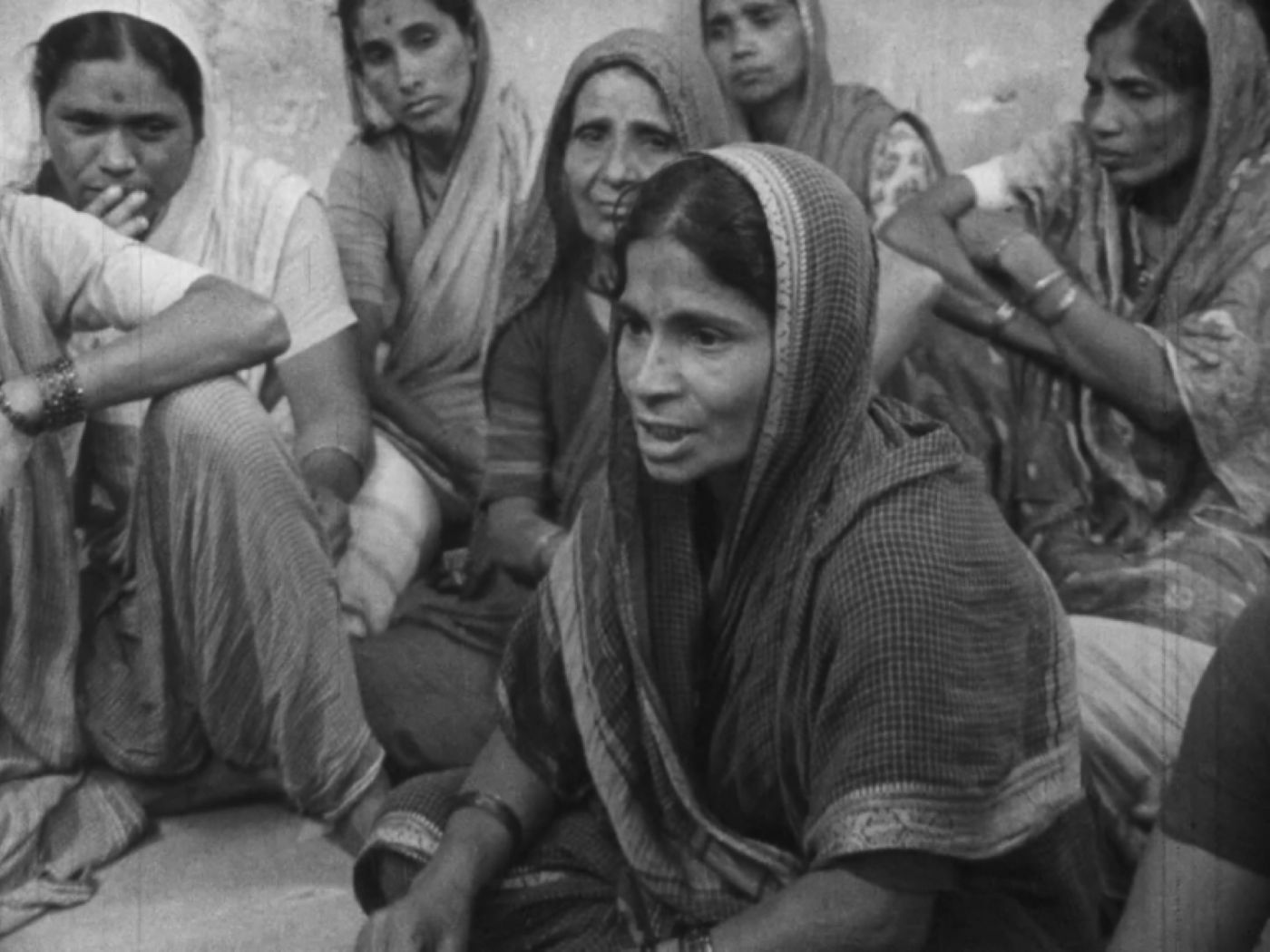
Yugantar Film Collective, a feminist undertaking that was forged from the revolutionary embers of the post-Emergency era, was founded by Deepa Dhanraj, Abha Bhaiya, Navroze Contractor, and Meera Rao. “Yugantar” directly translates to “New Era,” and it is not surprising that the group symbolized the air of left-wing activism that gripped the country in the early ’80s. While the four founders went on to have glorious independent careers across a host of vocations, together they made just four short documentaries in the early ’80s – Molkarin (Maid Servant) in 1981, Tambaku Chaakila Oob Ali (Tobacco Ember) in 1982, and Idi Katha Maatramena (Is This Just a Story?) and Sudesha (As Women See It) in 1983. All four of Yugantar’s films engaged with different groups of working-class women, documenting grassroots movements for women’s rights both in domestic spaces and in the work place, sensitively bringing to light the ways in which tradition, culture, and politics were manipulated to construct a violent system of oppression that Indian women consistently had to fight against.
For instance, Molkarin, which documents the oppressive working conditions of domestic workers in Pune and their subsequent unionising, exposes how the caste system intersects with the workers’ womanhood to create a complicated nexus of systematic suppression. Two instances from the film that emphasize this intersection are when one of the participants describes how at least three generations of women in her family work as maidservants. Another example arises when one of them says, “They [the employers] keep the plates and bowls that we eat in apart.”
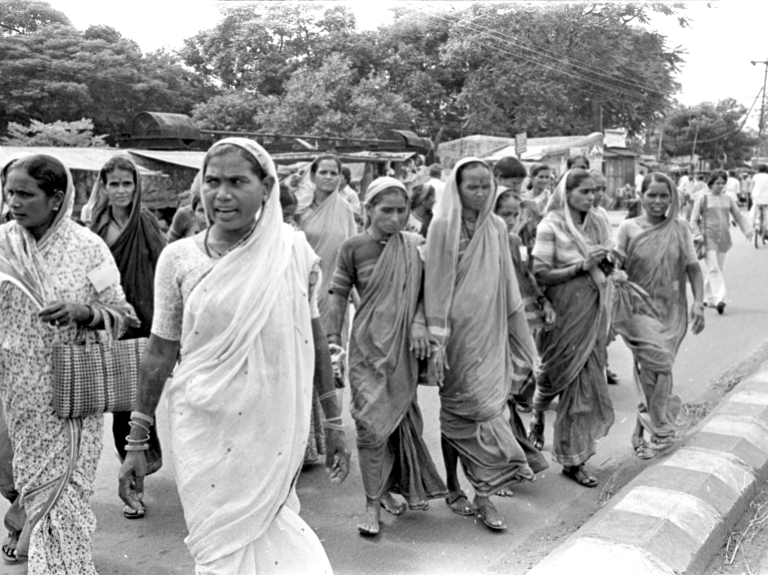
The Hindu caste system prescribes employment by virtue of one’s rank, where hierarchically “lower” sections are the ones that are forced into generational cycles of domestic, physical, and unclean labour, and are disallowed from pursuing education, careers, and lives beyond the ones scripted for them by religion. This separation of individuals, utensils, public spaces, wells, and much more is a practise that is inherent to the discriminatory nature of the caste system. While this form of oppression creates a master-slave relationship between the maidservants and their employers, who they subserviently refer to as maalkin, the equivalent to “mistress” or owner,” the women are expected to take care of their own domestic households as well.
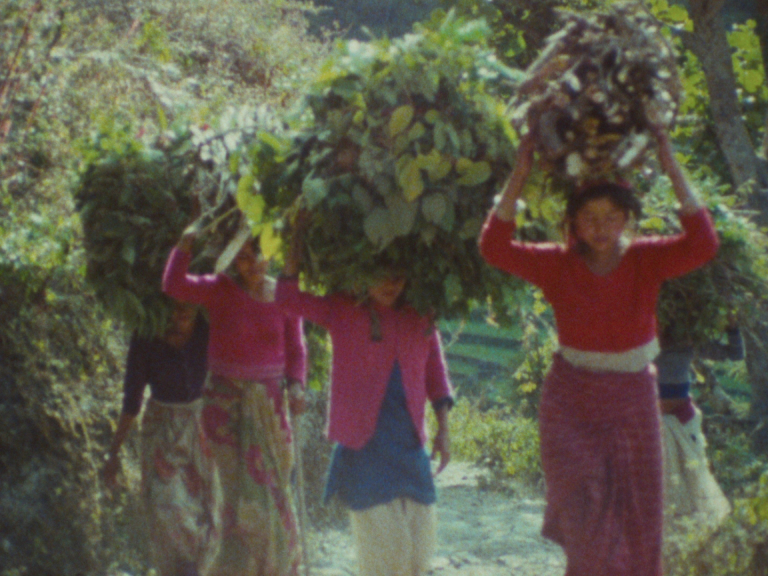
At several points in the film, the women express how they are caught between being answerable to their mistresses and their alcoholic husbands, delineating the two webs of oppression which viciously entrap them. Allowed to seek employment in order to sustain their families, the myth of the “independent” woman is ascribed to them but only outside the domestic quarters. They are granted the freedom to work but aren’t treated as employees. They are granted the freedom to run the house but aren’t allowed the autonomy to make decisions. This dilemma of being a woman in India is captured with great nuance in Yugantar films beyond Molkarin as well. For instance, in Sudesha, through the titular protagonist’s participation in the Chipko movement, one of the largest eco-protests in the country, the film explores how gender roles impact the ways in which women engage (and at times are allowed to engage) with political protests, domestic spheres, and work spaces.
In Tambaku Chaakila Oob Ali, which was made in collaboration with female tobacco factory workers, Yugantar documented the exploitative working conditions in these factories, centring the accounts of women. It is refreshing to see that in both Molkarin and Tambaku, the aspirations of unionization among these workers advise the storyline instead of the oppressive conditions by which they are bound. For instance, the heated discussions surrounding unions and workers’ rights in Tambaku privilege the defiance and strength of these employees in the face of oppression, which creates a different conversation regarding labour and exploitation that isn’t necessarily seen in films from that era. The image of a worker rallying her colleagues by stating that forming a union is, “the only way,” speaks volumes about how political and economic awakening in India has always occurred from a grassroots movement with workers’ consciousness in the face of the government’s inaction.
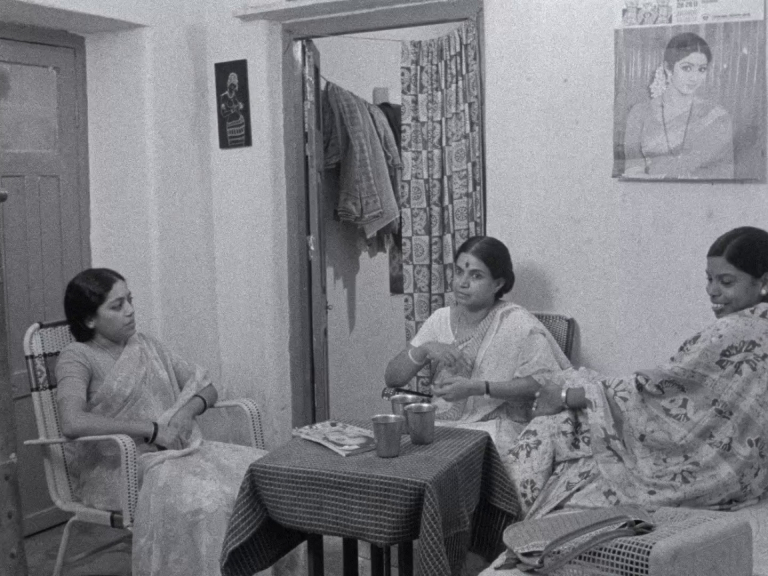
Idi Katha Maatramena expresses a similar conflict through Lalita, a married middle-class Indian woman, whose desires to work and study are forcefully displaced by her husband and his family. In doing so, the film centres the isolation that married women felt (and continue to feel) in India as they are left to balance personal and familial aspirations. Like other Yugantar films, Idi Katha Maatramena is grounded in a marriage of fact and fiction as the film is borne out of a collaboration with the research and feminist activist collective Stree Shakhti Sanghatana. While Lalita’s story is entirely fictional, reminiscent of the pressurized tales of Chantal Akerman, the narrative is spun from the authentic personal accounts of several women gathered through Yugantar’s association with the Sanghatana. This effect was present in the other Yugantar films as well where re-enactments were effectively blended in to buttress the narrative, and holistically capture the experience of being a woman in India. This experimentation with form increases the impact of Yugantar’s films as they forge a solidarity with their central subjects and invite the viewer to see these issues not merely in fact and statistics but rather through a perspective that remains unique to the four individuals who comprise Yugantar. Their voice solidified over their brief existence as the collective implicitly challenged the very structure of documentary filmmaking. By blending fact and fiction, the idea of revolution wasn’t merely limited to the content of what they documented but rather how it was documented and even why they chose to document it.
It is a virtue of Yugantar’s films that they are often less about the central issue that they’re exploring and more about the internalities of the people who suffer due to the problem being discussed. The films thus propose a different way to approach politics by understanding the myriad ways in which a single problem might affect a country and its constituents and how it is only by listening to those most affected that parties can deliberate to find a solution. In their design and discussion, Yugantar’s films indicate exactly what’s missing from the tentpole politics in India today, where there exists a great divide between the media’s presentation of a problem and how it impacts the country’s numerous towns, villages, and cities. This political discourse that I draw from Yugantar is not merely a side-effect of their films. Rather, this central preoccupation of Yugantar that is visible from their website, a nuanced archive of their history that tracks how the inception of the collective coincided with the development of the autonomous women’s movement in India. Currently, the Yugantar films aren’t streaming on any platform widely accessible by Canadians but one can request viewings from their website, and if you are to view just a singular document today, I request that it be the Yugantar website, solely for what it will teach you about the development of feminism in India. These stories will introduce you to the work of a truly remarkable filmmaking collective whose films–unfortunately for India’s development–continue to be relevant today.