



Roger, My Brother (Roger, Mon Frère)
(Canada, 88 min.)
Dir/Prod. Jean-Vital Joliat
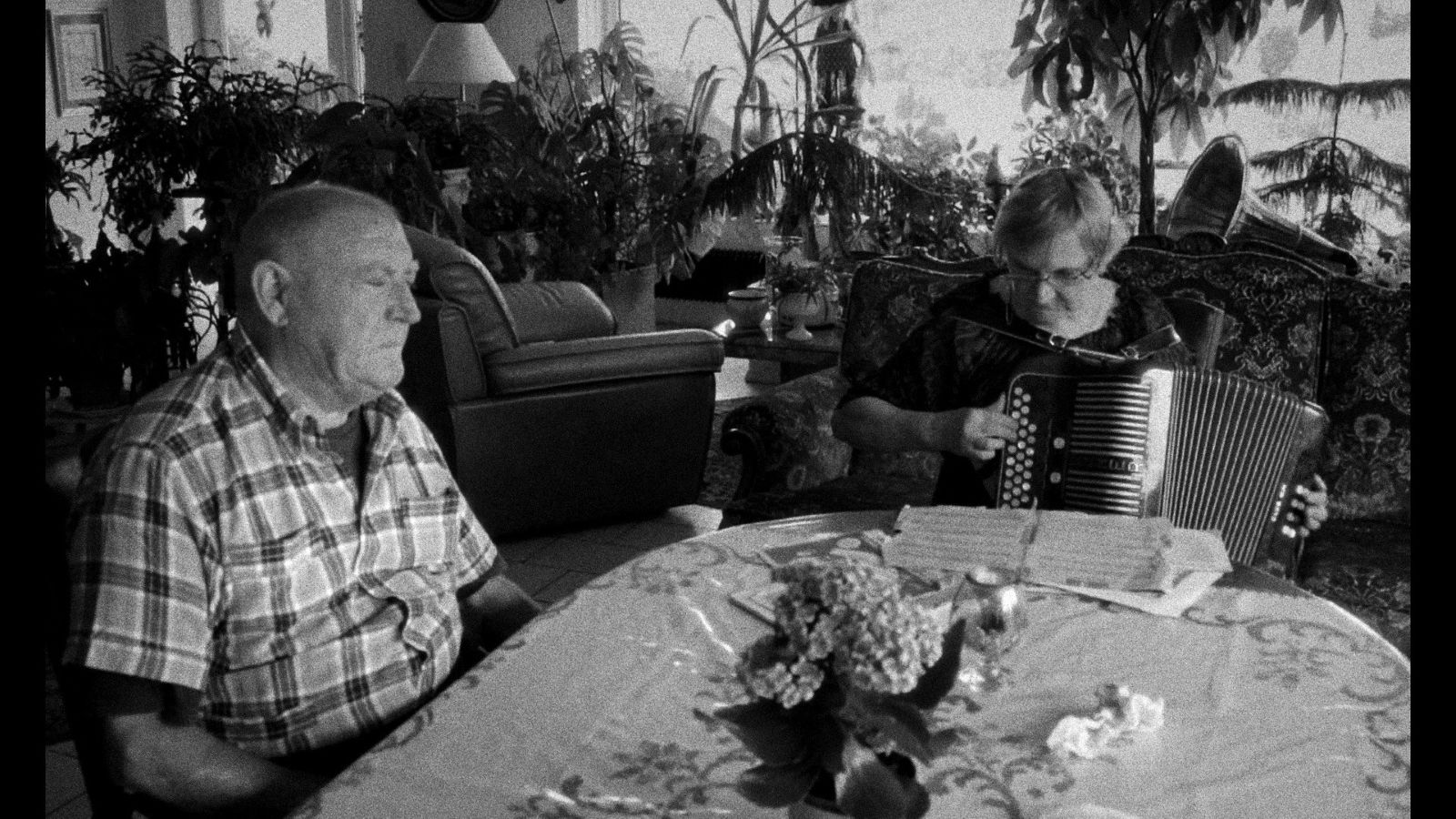
Paraphrasing from Jean-Vital Joliat’s director’s statement, Roger, My Brother does not tell you what Alzheimer’s is or what it does to a person. Instead, the film offers a sensitive observation of what the disease does to time, to bodies, and to one’s relationships. The film definitely upholds this aspiration in its visual construction. Shot entirely in black and white, the camera is often preoccupied with Roger, who suffers from neurocognitive disorders. His sister, Christiane, and her husband, Joseph, feature sparingly, as the viewer’s focus is concentrated on Roger’s behaviour and his interactions with those around him. The film veers away from sensationalizing Alzheimer’s or exaggerating the emotional and physical strain it has on a person, instead morphing into a visual study of Roger himself. At once, this becomes the film’s strength and weakness.
For the most part, the camera follows Roger, but we seldom hear from him, which creates a distance between the viewer and Roger. Despite him being in frame for most of the film, Christiane and Joseph speak for him. We hear of the lengths he has gone to avoid going to the hospital, his reluctance to taking his medicine, the gradual cognitive decline ushered in by the disease, and of his endearing relationship with Christiane.
This approach complicates the viewer’s relationship with Roger as he is presented to us as a case study rather than being afforded space to allow his experiences to play out in front of us. While visually the film depicts Roger carrying out tasks with great attention to detail, we hear from Joseph who describes them as “pointless,” and from Christiane how debilitating the disease has been for her brother, emotionally and physically. It is thus a conflicting portrait where we see a Roger largely at peace with himself and his surroundings but hear of tumultuous actions and reactions that he’s carried out due to the disease. Moreover, the visual focus on Roger but his near absence from the film’s audio narrative inadvertently constructs Roger as someone to be observed instead of understood.
Nevertheless, there is enough sincerity in the film’s construction to understand that the intended message is one of love and fraternity. At the heart of the film is the bond between Christiane and Roger, the younger sister caring for her elder brother. The manner in which Christiane and Joseph weave themselves into Roger’s life and daily routine becomes the film’s emotional fulcrum and a depiction of their infinite love for each other. The visual emphasis on Roger allows these tender moments of compassion to shine and the passion with which Christiane speaks for and of her brother grounds this relationship into something special. It is up to one’s interpretation to gauge the exact impact or intention of the monochrome cinematography, but what it certainly allows Christiane’s love for Roger to paint over the film’s neutral tone.
The film is also littered with tirades against hospitals and how they tend to disregard and offer poor care to patients with diseases such as Alzheimer’s. At several moments, Christiane passionately disparages the medical economy and claims, “Money rules the world.” These rants allow the film another angle towards Alzheimer’s, while the emotion radiating through Christiane’s voice reinforces the immense love she holds for her brother. Roger, My Brother works well as a portrait of a sibling relationship in an extraordinary circumstance but only when the protagonist is recognized to be Christiane and not the eponymous Roger, of whom we understand so little through the words of others.