



Memory
(France/Netherlands, 98 min.)
Dir. Vladlena Sandu
Prod. Yanna Buryak
Vladlena Sandu doesn’t like Lenin. It’s not because of his political views. Nor is it due to his dictatorial ways. She dislikes Lenin because he’s bald. Being follicly challenged means the man can’t be trusted.
Rest assured, however, that filmmaker Sandu probably doesn’t have an axe to grind against bald men in her adult years. These reflections come via her six-year-old self as she observes the collapse of the USSR in retrospect. As Sandu playfully navigates what it means to grow up as a child of occupation, however, one may forgive any grudge she holds against bald baddies.
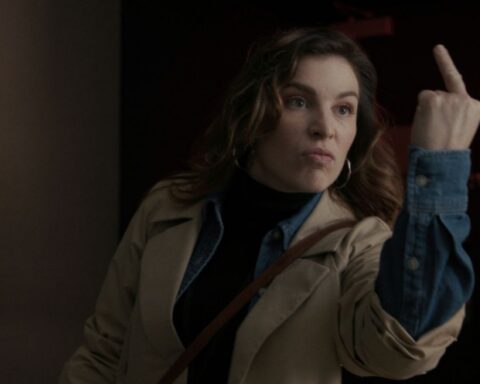
Memory offers a hypnotic exploration through trauma as Sandu creates a poetic and shape-shifting film that defies categorization. The adult filmmaker narrates her story in voiceover, while Amina Taisumova plays her during her childhood and then Selima Agamirzaeva assumes the role during her adolescence. Lenin’s influence hangs over Sandu like an omnipresent birthmark, too. She groans in voiceover about her strange name bestowed upon her by her father. An abbreviated and feminized portmanteau of Vladimir Lenin, the name signifies Vladlena the bastard child of Soviet ideology, which her largely absent parents challenged.
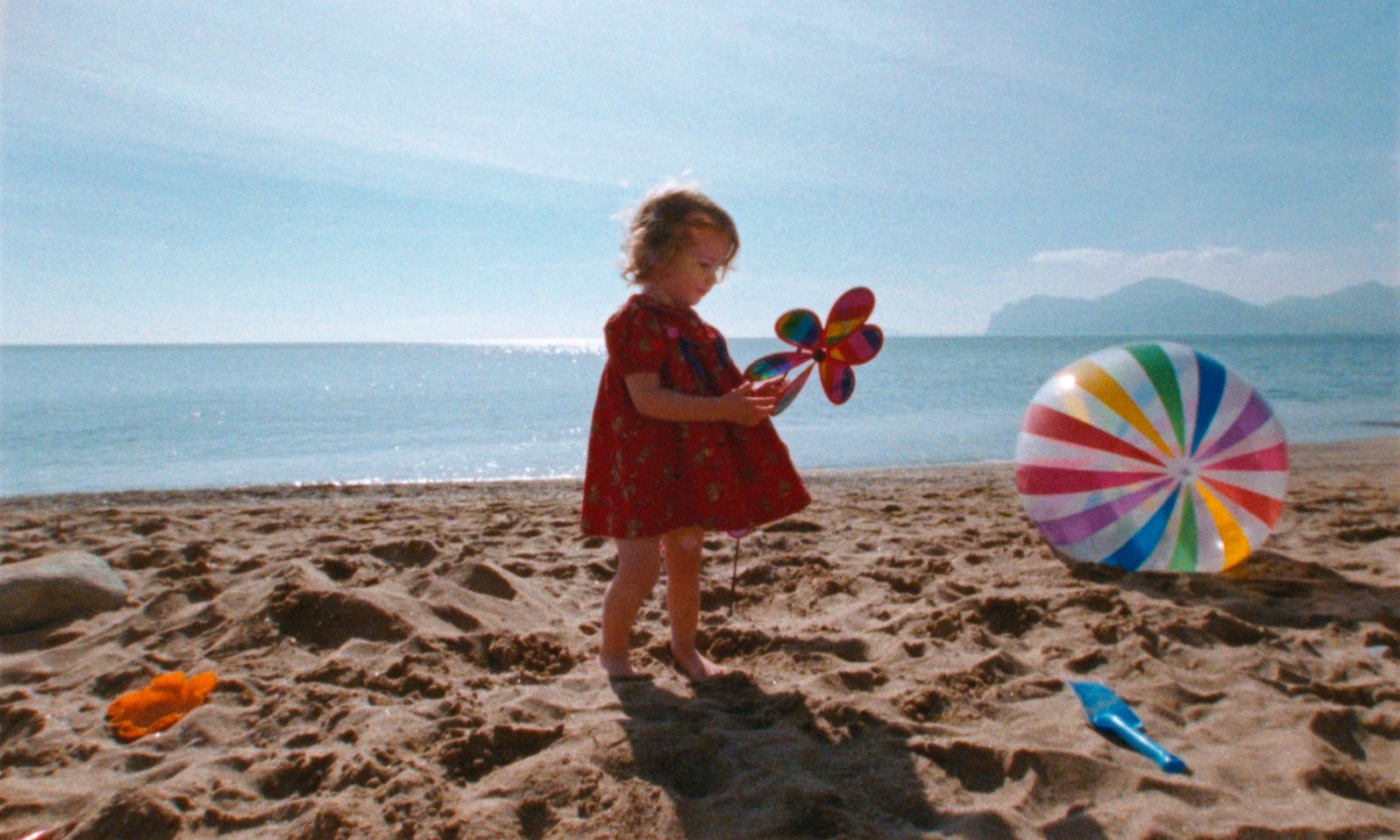
Sandu considers a peculiar upbringing marked by a kind of rootlessness. Born in Crimea in 1982, she has some fond memories of her earliest days. These are recollections of finer times and the dramatic interpretations with which Sandu presents them pop with candy-coloured hues. Her younger self plays in the sand as dazzling beach balls float and bounce around her. Dolls and plush animals evoke a world that’s her toy chest.
The joyous bubble pops when her parents get a divorce. They send Vladlena to live with her maternal grandparents in Grozny in the Chechen Republic. It’s there that Vladlena encounters the tyrannical Mikhail Alexandrovich. Her grandfather sports a full head of hair according to the family photographs, but she dislikes him anyways. The wariness is well-earned, however, since Mikhail Alexandrovich—always referred to by both names, lest viewers confuse him with another Mikhail—has backwards ways of disciplining a child. He beats Vladlena for being left-handed and strikes her whenever he needs an outlet for his rage.
Vladlena comes to learn of Mikhail Alexandrovich’s story though. She discovers that he too is a child of displacement. Escaping violence and assuming a new identity and life, Mikhail Alexandrovich’s path foreshadows his granddaughter’s journey. Sandu recognizes the ways in which trauma passes through generations as Mikhail Alexandrovich uses his granddaughter’s body as a means to expiate his long-carried burden. Filmmaking proves far more cathartic, however, as Sandu pieces through fragments of the past to make sense of her journey to the present as the USSR falls and her childhood echoes that of her grandfather’s story as violence surrounds her.
“I remember when the USSR collapsed in 1991,” she recalls in voiceover while finding images and events to transport the audience back to those turbulent days. The first Chechen War ensures that 1994 brings a particularly difficult Christmas, while the 2014 occupation of Crimea leaves Sandu feeling as if violence is the only constant in her life. Evening coming home feels strange because she must explain that Russia, for a while, was “home.”
Shards of childhood memories become filtered through creative re-enactments and subjective reclamations of the past, shot beautifully on 16mm. In one scene, her childhood self delights in a blue room stuffed to the brim with dolls. Violence cuts through the playroom, though, and a Barbie gets sliced and diced. The jarring slashes to the plastic doll resound with the violence that Sandu remembers being inflicted on neighbouring women. These idealised figures of female form don’t quite have the same delight when she understands how men use women for playthings.
Memory dexterously mines a child’s confusion as pleasure and pain walk hand in hand during Sandu’s formative years. She remembers escaping to the movies and seeing the original King Kong. But that monstrous figure looms over her, too. Maybe he represents Lenin or perhaps he signifies Mikhail Alexandrovich, but the hairy over-sized ape follows Sandu around literally and figuratively as she grows up and travels from one occupied territory to another. Kong is more present than her own father.
Similarly, vibrantly coloured landscapes whisk Vladlena back to the fields of red poppies that her father grew. The sight evokes Dorothy and her reveries in the land of Oz. Adult Sandu tries to discern if she’s waking from a dream or a nightmare, though. She now understands that the poppies were fuel for her drug-smuggling father. The most vivid descriptions she gives of the man dot the track marks on his arms. When absence defines so much of a person’s memory bank, one can only chart a journey through roundabout ways as Sandu boldly does here.
An effective collage of playful vignettes and haunting interludes, like an eerie thermal sequence reminiscent of Jonathan Glazer’s The Zone of Interest, collide for an unsettling yet deeply cathartic game of sense-making. The mixed form conjures an image of border-crossings, too, as Sandu considers the reality of navigating the arbitrary lines that distinguish territories, allies, and enemies.
Sandu valiantly yields the sense of play to the gravity of wartime. Photographs of children in wartime bring the film to a haunting close as Memory pays tribute to innocence lost. Images show children lying in hospital beds as they crack a smile while recovering from amputations. These images contrast sharply with the sight of young Vladlena growing up in the shadow of tyrannical men like Lenin, Mikhail Alexandrovich, and King Kong, but they illustrate the cyclical nature of warfare as it breeds new generations of children displaced and marked by war.
Memory offers a route for healing as it takes pause to understand and break that cycle. It haunts long after the credits roll—oddly and effectively for a film that begins with a run of the full credits in a shock of neon colours set to the Europop bop “It’s My Life.” Talk about taking ownership of the story through such a singular trip down memory lane.
Memory screened at RIDM 2026.
Please check your local listings for additional festivals, event screenings, and broadcast/streaming dates.