



“The challenge for me is to find something that is the essence of life in every story,” says filmmaker Gianfranco Rosi. “I have to work a lot with subtraction because every character and every story can be documentary on its own.”
The acclaimed filmmaker, speaking with press ahead of the release of Pompei: Below the Clouds, delivers another film rich with memorable characters, sights, and locations that could indeed fuel documentaries of their own. However, as the director distills many stories into an urban tapestry, Below the Clouds finds its power in the collective. This observational portrait of Naples captures stories about the people who live in the shadow of constant threat of Mount Vesuvius and the history that defines the region as iconic remnants of the tragedy of Pompeii fuel the city’s lucrative legacy.
Pompei: Below the Clouds, now streaming on MUBI, closes an unofficial trilogy in Rosi’s filmography that perhaps captures his best work. After his Golden Lion winning Sacro GRA, which took audiences on a circular ride around Rome’s ring road, and the Golden Bear winner and Oscar nominee Fire at Sea, which observed the encounters between locals and arriving migrants at Lampedusa Island, this evocative walking tour of Naples completes a trio of films that consider specific geographies of Italy and the histories embedded within them. It’s a living archive of a film that observes the ways in which past and present collide in this very specific site of memory.
Rosi notes that the three films have far more in common than their concertation with a specific place. “I wanted to make a film about time and all of them [are] about an invisible border, which we create, the relationship between the present, a hypothetical future, and the past,” he says. Rosi also notes that the films share an interest in institutions. Sacro GRA features an ambulance that careens through the busy traffic to save Romans’ lives, while Fire at Sea features gripping footage of migrants rescued from the choppy waters of the Mediterranean Sea by the navy.

Meanwhile, Below the Clouds finds its rhythm by returning to the emergency call centre where the fire department responds to queries from concerned Neapolitans. Humorously, the emergency calls that appear in Rosi’s film generally focus on the banal: people call to ask the time, get help rescuing a cat, or seek assistance in raising an overweight family member from the floor. Other calls offer tense play-by-plays of domestic violence while others captures citizens about earthly rumbles in the shadow of the volcano. Elsewhere in the film, voices debate how to make a perfect lasagna as life goes on despite the looming fear of annihilation.
“Mount Vesuvius is like a mythical figure in the film, like the destroyer and the regenerator,” observes Rosi. “If you think the way Pompeii was destroyed 2000 years ago, the act of destruction by Vesuvius is also an act of preservation because the ashes preserved that civilization for 2000 years. And then through archeology, there was this immersion in this space and they came to life again.”
The voices that filter through the call centre evoke a sense of unease that comes with living in a city with such tragic history, while the agitator of this violent past—the volcano—remains active. “We build constantly borders around us to make each other safe, but then there’s element that are much stronger than our fear and then our intentions,” Rosi continues.
As Neapolitans call the centre for information, or reassurance, Rosi says the first responders become “an actor of resistance against fear because they have this incredible gentleness and kindness towards the people who call them.” He finds the feeling of fear a universal sentiment for the world right now. Naples just presents a picturesque snapshot of a place with a very specific institutional memory and tremors in the ground that provoke immediate concerns.
“In all my films, there’s a very important element of institution, which bring us to the idea of Pasolini that says that institutions somehow are a means that preserve and pass our knowledge through memory,” observes Rosi. The film brings the excavation and preservation of history into its design. The film methodically returns to archaeologists digging for remains of Pompeii, as well as archivists and antiques dealers who preserve artifacts from centuries ago.

Along the way, Below the Clouds observes diverse labourers in complementary situations. A Japanese researcher leads a field team digging up bones, while a crew of sweepers directs wheat that passes through a mill. Each group gently brushes away grains in a city defined by the sands of time. Those contained grain mills find a counterpoint in vignettes with two Syrian refugees who work in a ship. Below the Clouds observes as they work out in the ship’s modest gym, talking about news from home and wondering about their friends in Ukraine, as the country that provided their early refuge now faces violence of its own. It’s like they can’t shake the violence they escaped.
“The most important element of all three [films] are the encounters,” notes Rosi. “First, there’s an encounter for me. My film is the [account] of an encounter with the story and people, who become part of the narrative, and so the encounter is with the place. Sacro GRA, it’s a kind of circular film. And Lampedusa [Fire at Sea], it’s more like a vertical film somehow. And this film here, it’s about stratification. The film in Naples is about finding that fine line between the present moment and the past, which is always there in Naples, this 2000-year of history and hypothetical future. All three films have an element of a space. Again, more than a film about the place, I wanted to make a film about time.”
This interplay with time arises frequently throughout Below the Clouds. As the banal phone calls with the emergency call centre signal the end of one day and the beginning of a new one, the vignettes sandwiched between them highlight a city where past and present co-exist. Besides the 2000-year old remains of the ill-fated citizens of Pompeii, the film visits an old cinema where archival clips of newsreels play. Rosi’s camera observes the light from the projector illuminating the dust that drifts through the empty theatre, like the ashes that scattered throughout the city during the volcano’s eruption.

The trips to the theatre intercut Below the Clouds with another iconic image of Naples. Snippets from Roberto Rossellini’s 1954 drama Journey to Italy echo the present-day scenes of the film. The movie theatre’s screen features Ingrid Bergman and George Sanders take a trip to Naples in the drama. Rosi presents the memorable scene in which the couple observes the excavation of human remains—a haunting metaphor for their strained marriage—and the old bones inspire an emotional reckoning they must confront.
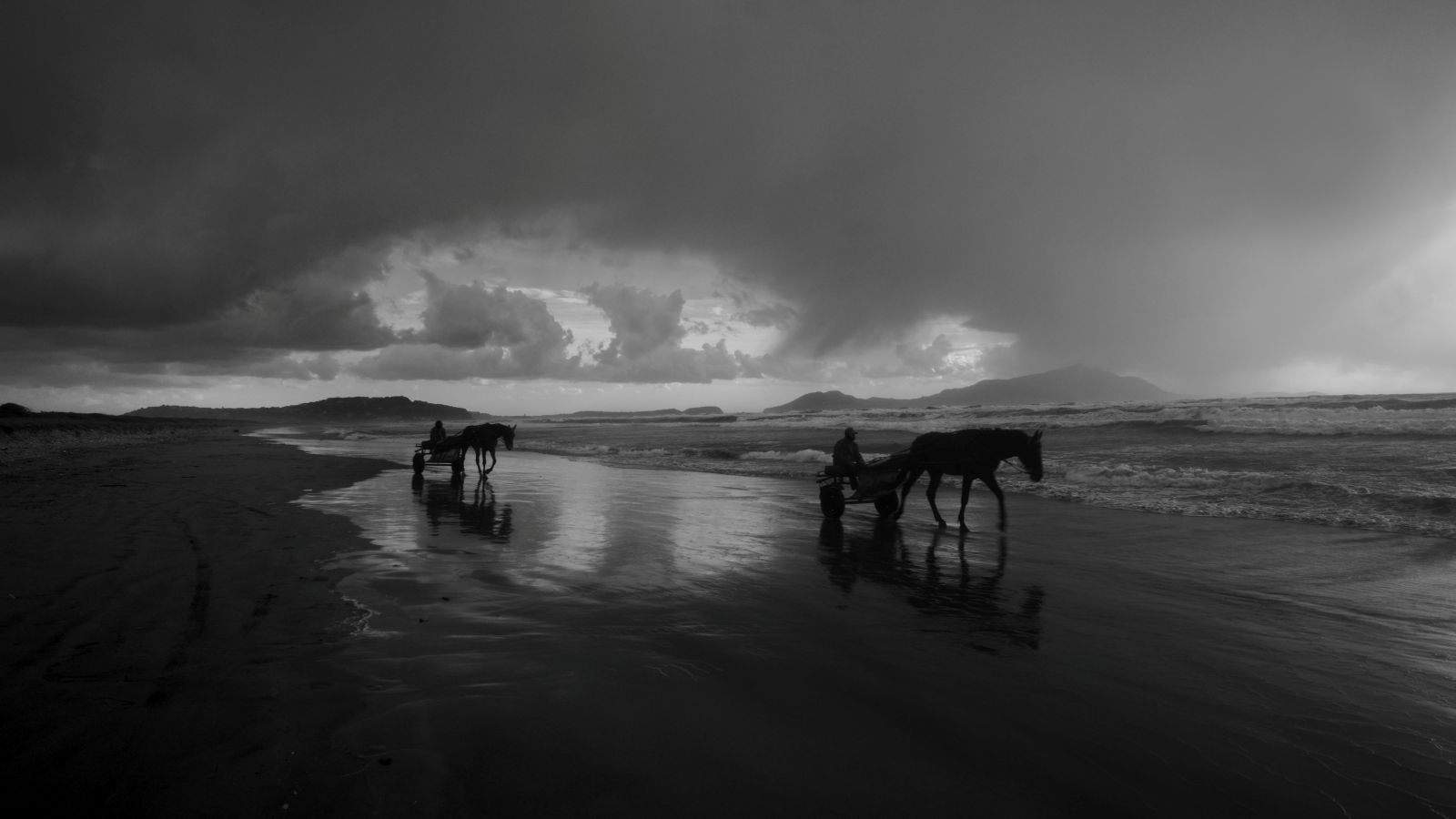
“I love very much Rossellini’s way of working, of interacting with reality and transforming reality into something else,” says Rosi. “For me, I wanted to shoot in black and white film, almost in a sense of creating in the present, creating reality that already was. Once you film in black and white, it becomes almost part of an archival.” Rosi adds that he didn’t want the archival excerpts to serve as a counterpoint to vérité scenes, but rather as a living element that informs the present.
“I wanted the archival to become part of a collective memory,” explains Rosi. “When I discovered this cinema, I felt immediately this space becomes like an archeological site. There was still a very strong element of memory coming from the screen. When I was there, I imagined this light coming from above with dust and things that looks like a projection. I was going straight to this: what was once before what was a screen. I started imagining that this screen was still alive through the memory of the past, so I decided to project it there, all my archival footage, and somehow this abandoned cinema would become alive with the memory of the past through this screen.”
Rosi observes that this interplay with the archives and the resurrection of the abandoned cinema reflects with process of observation and subtraction to create the story as life in the city unfolds. “Reality is infinity in front of us, and when you put a frame to it, you transform reality into something else,” says Rosi. “So for me, transformation of place, is very important. And then subtraction, which means [removing] information constantly. I don’t like to give too much information and I like to leave space for the audience. All my work is like a constellation of very different situations, and then the viewer has to discover the connections. I love to reveal the complexity of this world.”