



Ceremony
(Canada, 84 min.)
Dir./Prod. Slts’lani Banchi Hanuse
Programme: Canadian Spectrum Competition (Canadian premiere)
Back in 2023, POV contributor Liam Lacey remarked that British Columbia’s film scene might best be characterised by the slogan “The Beautiful and the Damned.” The line, a play on B.C.’s current tag “Beautiful British Columbia,” speaks to the flood of documentaries about rivers and dams. Dams be damned, though. The West Coast’s doc scene deeply considers bodies of water. They love films about waterways and not simply in relation to dams.
Add to the seemingly limitless well of West Coast water docs director/producer Slts’lani Banchi Hanuse’s handsome Ceremony. The film shares many traits in common with this body of water docs: an environmental factor serves sparks a wider consideration of Indigenous land rights and sovereignty. One shouldn’t take this observation as cynicism. Quite the opposite. The film situates itself within a conversation of docs with shared concerns. It’s a widespread problem and one that any single documentary can’t overturn.
And while these water docs share elements of sameness, a school of fish allows a tyee to distinguish itself from the minnows. Ceremony swims ahead of the pack with its elevated eye and emotional force that comes through succinctly conveying the interconnectedness between environmental concerns and Indigenous legacy. It’s a thoughtful character study rooted in concerns of the land and its history, driven by the voices of participants with real stakes in the rich cinematic geography it traverses.
Moreover, the lush West Coast greenery ensures that these movies all look beautiful. The license plate tag indeed proves correct. The cinematography by Luke Connor (who shot Hanuse’s Aitamaako’tamisskapi Natosi: Before the Sun) and Jean-Philippe Marquis (Silvicola) ensures that the B.C. landscape looks healthier and greener than ever. And while the trees, hillsides, and river may look serene, members of the Nuxalk Nation remain chilled by the disappearance of the ooligan. The small, slippery little black fish used to be a staple of Nuxalk trade and diets, particularly during the offseason. Participants in Ceremony recall how their elders would harvest barrels of ooligan from the river, which elders would then boil down and turn into grease.
The grease huts remain, but barely one percent of the ooligan population survives. That statistic shares an eerie parallel with the members of the Nuxalk Nation who survived the smallpox epidemic that decimated the community when settlers made contact. However, that history gives the Nuxalk reason to hope that the ooligan supply will rebound.
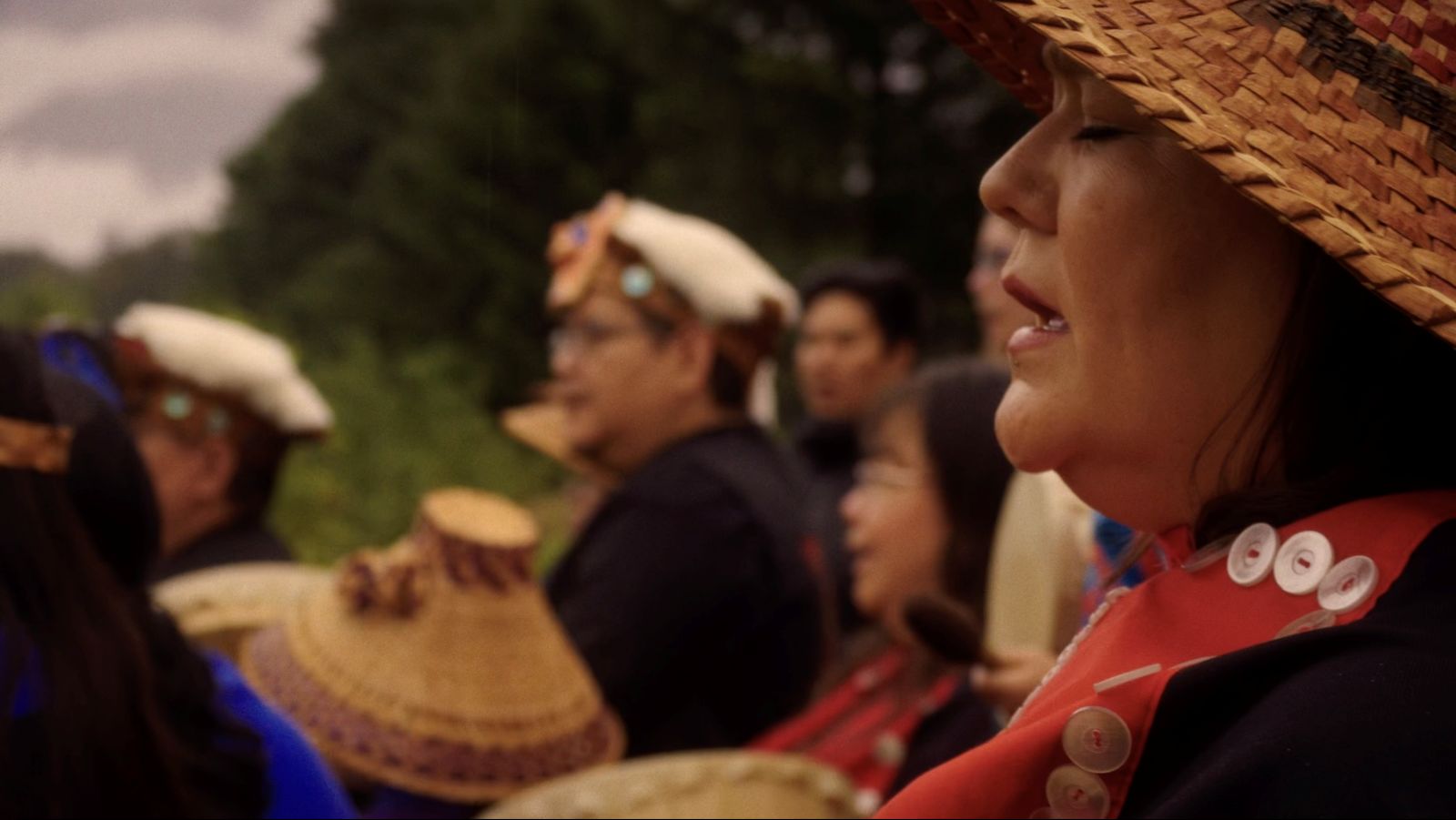
Hanuse observes various members of the Nuxalk community as they monitor the ooligan numbers. Qwaxw Siwallace, for example, uses his platform as host of Nuxalk Radio to interview elders and researchers about the ooligan decline and its significance. His guests include hereditary leader Snuxyaltwa “DJ Y” Deric Snow, who draws upon his experience with the 1995 stand at Ista when he and other Nuxalk leaders rallied to protect the rainforest from development. The devastated fish supply simply (or not so simply) evokes another strike against the landscape and the Indigenous population by settler practices that see the natural resources as riches to be plundered, not nurtured and preserved.
Meanwhile, siblings Megan and Jason lead a study into the ooligan population. They survey the area and look for any evidence of activity. As they find eggs on rocks, they excitedly make notes and keep their eyes peeled for any slithery black lines whizzing through the waters. Their research intersects with the stories of various Nuxalk elders and members from young generations. They return to the water with hopes of spotting the fish for reasons more personal than scientific. Tours bring Hanuse to the old grease huts where weathered shelters endure. They, too, await the ooligans’ comeback.
Searches through the archives also bring devastating confirmations about the recorded history of genocide. Written documents testify to systematic erasure of Nuxalk families. Hanuse deftly blends these artifacts into the design, acknowledging them without giving them authority. Alternatively, animated elements punctuate the story, but they inject a sense of history reclaimed: These images speak when no records exist to represent the past.
Ceremony branches off into the darker backstory of loss and resilience as Nuskmata Jacinda Mack walks through another part of the forest: the graveyard. She tells of the old stories in which the Nuxalk dug their own graves in anticipation of death by smallpox. No markers indicate the graves, but mossy stumps point to settler activity. She learns that this sacred site is among the pieces of Nuxalk land up for sale. The ooligan story becomes a minnow in an ocean of present-day iterations of colonial violence that continues to threaten the Nuxalk Nation on their unceded land.
The doc admittedly veers into a bit of a tangent as it follows Mack and her son, Kmalsuuncw Orden Mack, as he builds a home on ancestral land in Nusq’lst Village. He hopes to raise his soon-to-arrive baby there, but the area, deemed “Crown land,” becomes another flash in the ongoing fight for land rights against the settler state. The government intervenes, far more eager to serve an eviction notice than to protect the wildlife and the land they call their property, as well as the First Nations community to which they pay lip service with little follow-through action.
What Ceremony loses in focus narratively through this detour, it ultimately reclaims thematically as the various participants, each compelling in their own right, converge by the water. The Nuxalk practices and ceremonies endure regardless of what the government says, and the community rallies together to raise a totem and continues to protect the area while on the lookout for ooligan. Their strength in numbers offers a hopeful symbol.