



What is the relationship between photography and reality? In the first instance, it seems direct: photography, by its nature, documents reality. Photography alone among the visual arts is inextricably linked with some external reality, some particular arrangement of illuminated objects, that it has concretized in an aesthetic object. It is almost as scientific as it is aesthetic, landing somewhere between art and evidence.
Of course, it’s not as straightforward as all that. Reality can be constructed. Not every photographer is a pure documentarian, a Cartier-Bresson or Capa, patiently awaiting the decisive moment for their subject to reveal its essential character before they open the camera shutter. There are others, who can also uncontroversially be called documentary photographers, who are more blatantly aesthetic in their concerns, even if they stop short of manipulating either the material they are shooting or the camera and film: Ed Burtynsky, Bernd and Hilla Becher, Candida Höfer.
We can keep moving along the spectrum. Consider Hiroshi Sugimoto, whose photographs of movie theatres use extremely long exposures to render the movie screens blinding white, and whose photographs of seascapes are always composed in the exact same way with the horizon right in the middle, sky above and water below, bringing the aesthetic effect closer to Rothko than what one might think of as documentary photography. What is his art’s relationship with reality? Or that of Andreas Gursky, those spectacular, nightmarish, hyperbolic visions of modern capitalism constructed through seamless digital stitching of real shots?
Clearly, we have moved very far from the pure documentary impulse by this point. And yet, because these works are presented as photographs, they still bear some relationship to reality: no matter how contrived or constructed, they still contain a sense of having documented something real, their manipulations justified largely by the way they intensify that sense of reality.
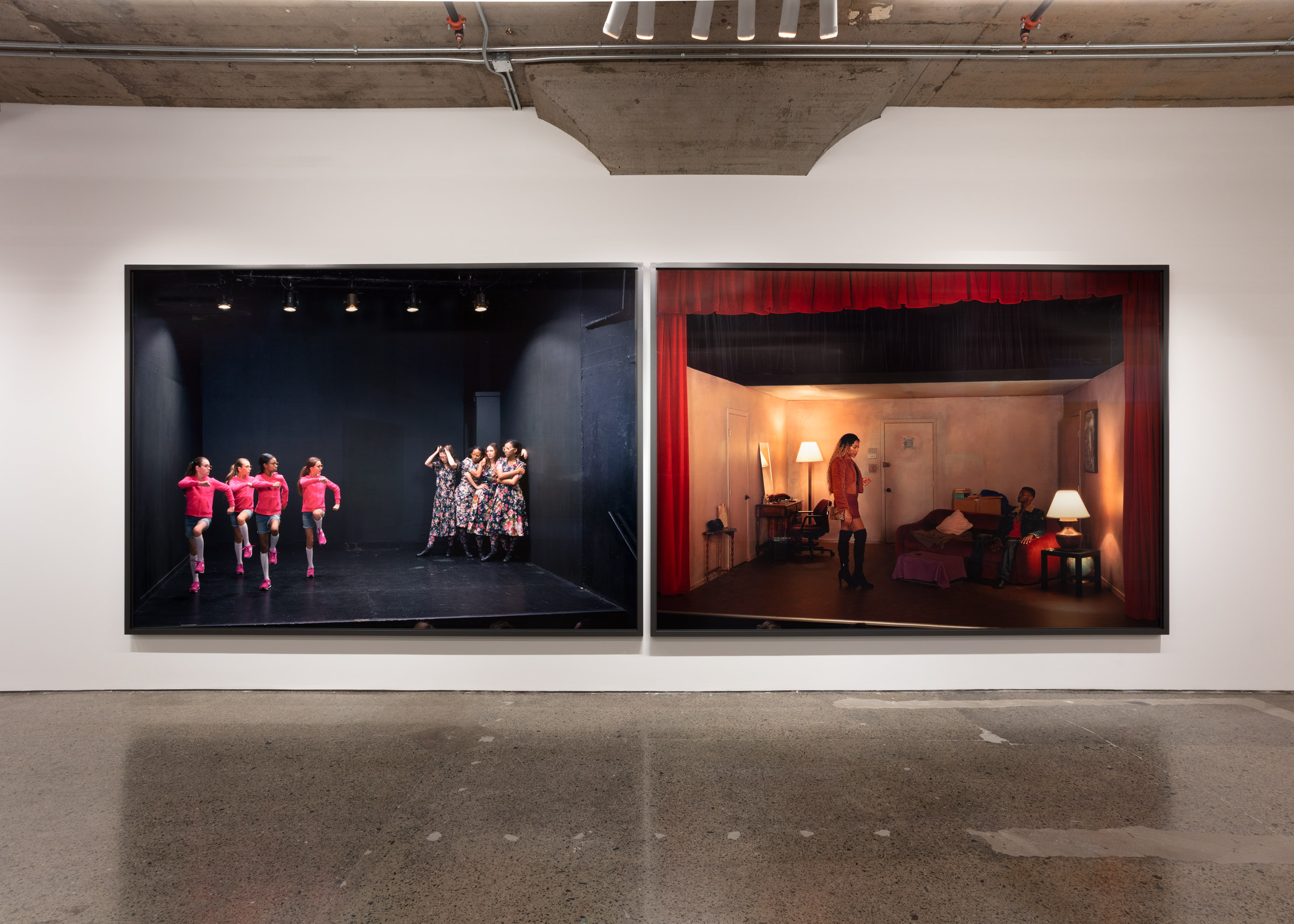
Then there’s Jeff Wall. Having built a reputation with photograph like The Destroyed Room, Picture for Women, and A Sudden Gust of Wind (After Hokusai) that explicitly take inspiration from famous paintings, restaging them in highly detailed modern settings (often in the peri-urban fringes of Vancouver, rendered anonymously suburban or post-industrial), making liberal use of post-production stitching to create striking compositions and presenting them as backlit transparencies for heightened spectacular effect, Wall’s work would seem a very long way from the original documentary photography form. He would seem to be not so much a photographer as a conceptual artist for whom photography merely offers a convenient set of tools for staging enigmatic tableaux.
But why use photography for such a purpose? Is it not precisely because it has some relationship with reality, however fraught, which Wall can mobilize toward non-realist ends? With Wall, we haven’t so much left documentary as problematized it. As I see his work, at least the work that seems to me the strongest and most resonant, in pieces like Insomnia, Boy Falls From Tree, Mimic, The Storyteller and Morning Cleaning, he constructs and composes his photographs with one eye on the traditional sensations of documentary photography—here is something that really happened—even as the other is focused on conceptual and indeed painterly considerations.
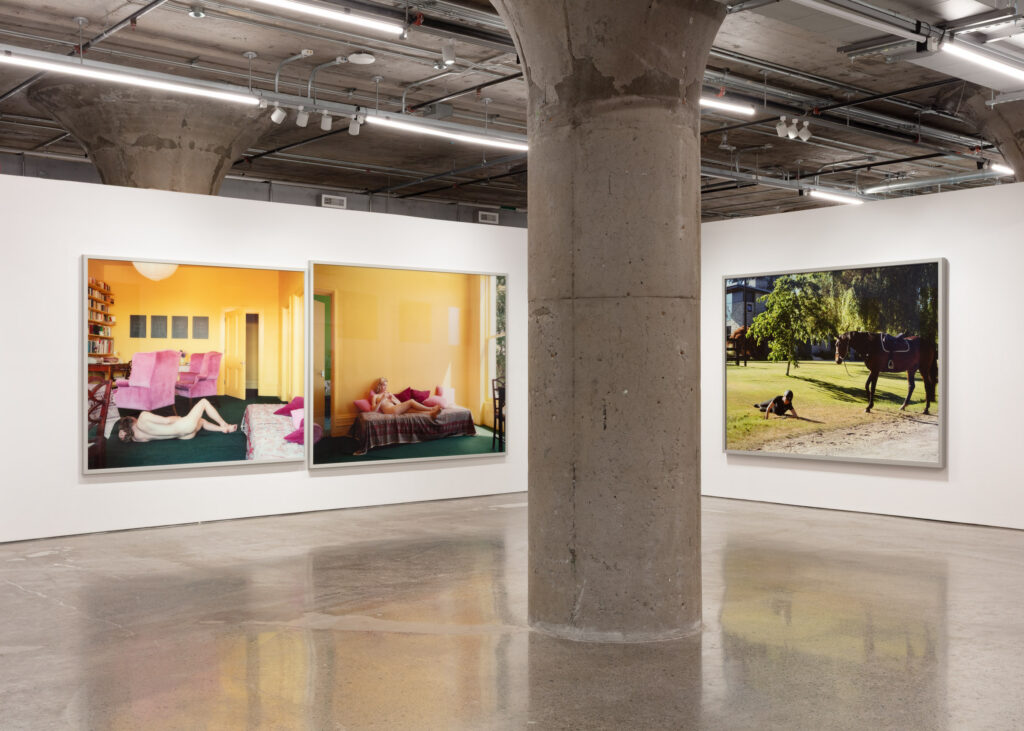
I saw two Jeff Wall exhibitions in the last eighteen months, the first at the White Cube Bermondsey in London, the second at MOCA in Toronto—the latter, inexplicably, Wall’s first major show in Toronto in thirty-five years, which makes it the first in my lifetime—giving ample opportunity to consider his work in its proper context: the gallery wall. As art critic Michael Fried notes, Wall, in the late 1970s and early 1980s, was one of the first photographers to explicitly create work primarily for the gallery wall, as opposed to magazines, newspapers and books. Both the large scale of his work and its lightbox presentation are lost in print reproductions.
All this to say that, in spite of knowing something of Wall’s international reputation—in fact, Fried and other critics of the 1970s and ’80s consider him not just one notable artist among others but a paradigm-setter who, in rendering photography painterly, reinvented the Western figurative pictorial tradition after the challenges of abstraction and pop art—I only really knew it in passing. Seeing two exhibitions in a relatively short span, I found myself compelled by many characteristic aspects of his art—his off-kilter staging of alienated figures in modern landscapes, his adaptations of classic paintings, the spectacular attraction of his lightbox technique—even as I remained ambivalent about how they all relate to each other and, finally, what they amount to.
Julian Stallabrass, in a lengthy critique of Wall published in New Left Review in 2010, points out that Wall always considers his work “indexical”—that is, no matter how controlled before the fact, composed during the fact and manipulated after the fact, the ultimate work still “indexes” some genuine external reality; it’s still photography. Stallabrass isn’t buying it and argues that Wall’s work delineates itself from documentary by virtue of the fact of artistic control: unlike photojournalism, at the extreme, but also unlike even a compositional documentary photographer like Ansel Adams or Ed Burtynsky, Wall’s work is composed down to the last detail.
I don’t think I agree with Stallabrass. In spite of appearances, it bears emphasizing that Wall’s practice isn’t purely imaginative but draws on memories, other works of art and photojournalism as well as scenes he has witnessed that compel him. There is, in this sense, a reconstructive, research-like element to his work that aligns his work with avant-garde documentary makers or documentary-adjacent artists ranging from Harun Farocki to Joshua Oppenheimer to Nathan Fielder. It is not traditional documentary by any means, but neither is it purely painterly. Rather, it seems to me that one set of criteria Wall’s work invites is, as he says, indexical—that is, do his manipulations undermine or intensify the basic reality being depicted?
One place to test this is with Dead Troops Talk, a phantasmagoria of mangled, bloody Russian and Afghan soldiers carousing on an arid hillside. In Regarding the Pain of Others, Susan Sontag’s 2003 follow-up to her 1977 classic On Photography, she cites this photograph as an example of praiseworthy war photography, because, as she sees it, it has no activist intent but instead, in its very artifice, reflects the full inhuman strangeness of war in a way that documentary photography never could. What is the “deeper reality” being depicted in this photograph? Is it that soldiers have more in common with each other than with the people they are ostensibly defending? Is this photograph then a nightmare version of the WWI Christmas truce?
Another way to test this is by tracing Wall’s great theme, alienation, as it is iterated throughout his work. This comes to the fore in his approach to staging, with characters often oddly spaced within the composition, not meeting each other’s eyes, and set against a landscape that dwarfs them and exceeds them. Even a boy falling out of a tree or a man backflipping in a pub somehow camouflage into the background in Wall’s work. Again, I am quite compelled by this. We are indeed dwarfed and oppressed by many of the landscapes we have created, and Wall at his best—in The Storyteller, for instance, in which a bucolic nature scene is rudely interrupted by a highway overpass—reflects this more forcefully than just about anyone.
Stallabrass concludes his 2010 NLR critique by counterposing Wall’s fine-art approach, elitist and even aristocratic, against the democratic image culture of then-incipient social media. Who needs all this big-budget high-modernist compositional photography when a bottom-up culture of photography creation and distribution is thriving? A decade and a half later, it seems to me that the demotic has thoroughly triumphed, and this has been largely a disaster. I find myself sympathetic to Wall’s project of constructing and composing images that are more real than real and presenting them in ways that demand attention. They will certainly outlast Instagram.