


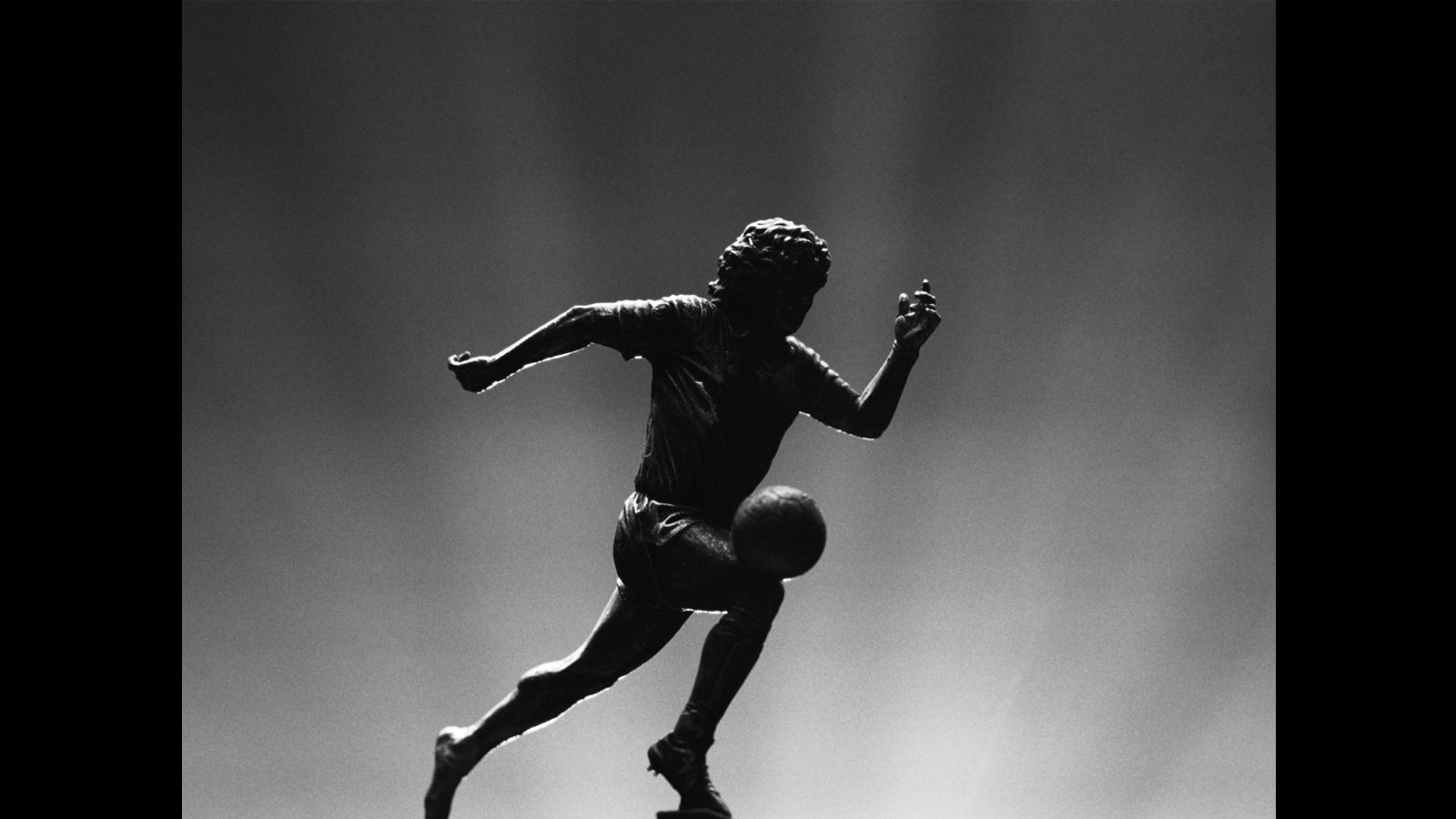

The Match
(Argentina, 91 min.)
Dir. Juan Cabral, Santiago Franco
Prod. Flora Fernández Marengo
If war is politics by other means, and sports is war on a different playing field, what happens when a match erupts in controversy that echoes for decades after the players left the field? One can view the events of the 1986 World Cup match between Argentina and England as a mere feat of competition, or one can view this showdown in Mexico through the lens of global conflict. It’s a rivalry that dates back centuries and covers oceans. Even the smallest touch connotes existential ramifications that transcend the sport.
Such are the magnified stakes at the heart of Juan Cabral and Santiago Franco’s fine work of non-fiction, The Match. The film dives deeply into both the surrounding context and on-pitch action of the titular game that took place on June 22, 1986 at Azteca stadium in front of a crowd of thousands and a television audience in the hundreds of millions. Far more than a single quarter final game, this was the culmination of years of animosity between the two nations, tied to the conflict over the Falkland Islands (aka Isla Malvinas), where a territorial battle earlier in the decade resulted in actual casualties, the tragic consequences far more significant than a blown call on the field.
Narrated by legendary English striker Gary Lineker, the former team captain is joined on screen by the members of both squads as they reflect upon their roles in sports history. They also consider how the spectacle of the event is seen through more aged eyes years later. Captured in black and white while they view archival footage and comment upon their plays, there’s a delightful charm as the likes of Julio Olarticoechea, John Barnes, Jorge Burruchaga, and Jorge Valdano speak of what it was like playing that match and commenting upon its more nefarious aspects, but also take time to admire the beauty of differing aspects of the game regardless of the team making he play.
The match is notable for two goals secured by Diego Maradona, himself already the direct subject of innumerable portraits including Asif Kapadia’s 2019 film that also saw its premiere here in Cannes. The first, the so-called “hand of God” goal, is handled with appropriate bemusement, situating both the call and the reaction within the context of what transpired, while also using it as a modality to view future changes in how the game is refereed. (This point is made even more intrinsic given ties to previous Eng/Arg matches that birthed the use of coloured cards to indicate penalized behaviour.)
The second, a whimsical run past most of England’s side that still is considered one of the great goals of all time, rises to levels of near-sanctified admiration by players from both teams. It’s this contradictory aspect of this particular event, where the best and the worst of the game collide, and where the vagaries of sport occupy the opposite sides of the field between the apotheosis of achievement and the scruffy behaviour that falls on the wrong side of cheating, that makes this particular match the perfect one through which one can reflect upon issues beyond the pitch.
Soccer fans will have a blast with the well-assembled archival footage, and even those who don’t like the damn will find plenty to be stimulated by. It’s rare to have such an intellectually nourishing sports film that also provides excitement even for the uninitiated. (Kapadia’s Senna comes to mind, as do ESPN’s stellar 30 for 30 works.) This wonderful balance between the wider perspective and the intricacies of the game makes the film so successful.
The Match is a delight, managing to merge its tonally disparate elements into a work of great coherence and impact. Historically relevant, politically astute, and gloriously celebratory of the beautiful game, this is an unabashedly commemorative film that works its best when it shows the complexity and contradictions of the sport, especially at that time. It shows how by the smallest of margins and the most surreptitious of touches, the history of two nations—both in the stadium and in the halls of power—can be reshaped for generations to come.