



Gabin
(France/Germany/Switzerland, 105 min.)
Dir. Maxence Voiseux
Prod. Cécile Lestrade, Elise Hug
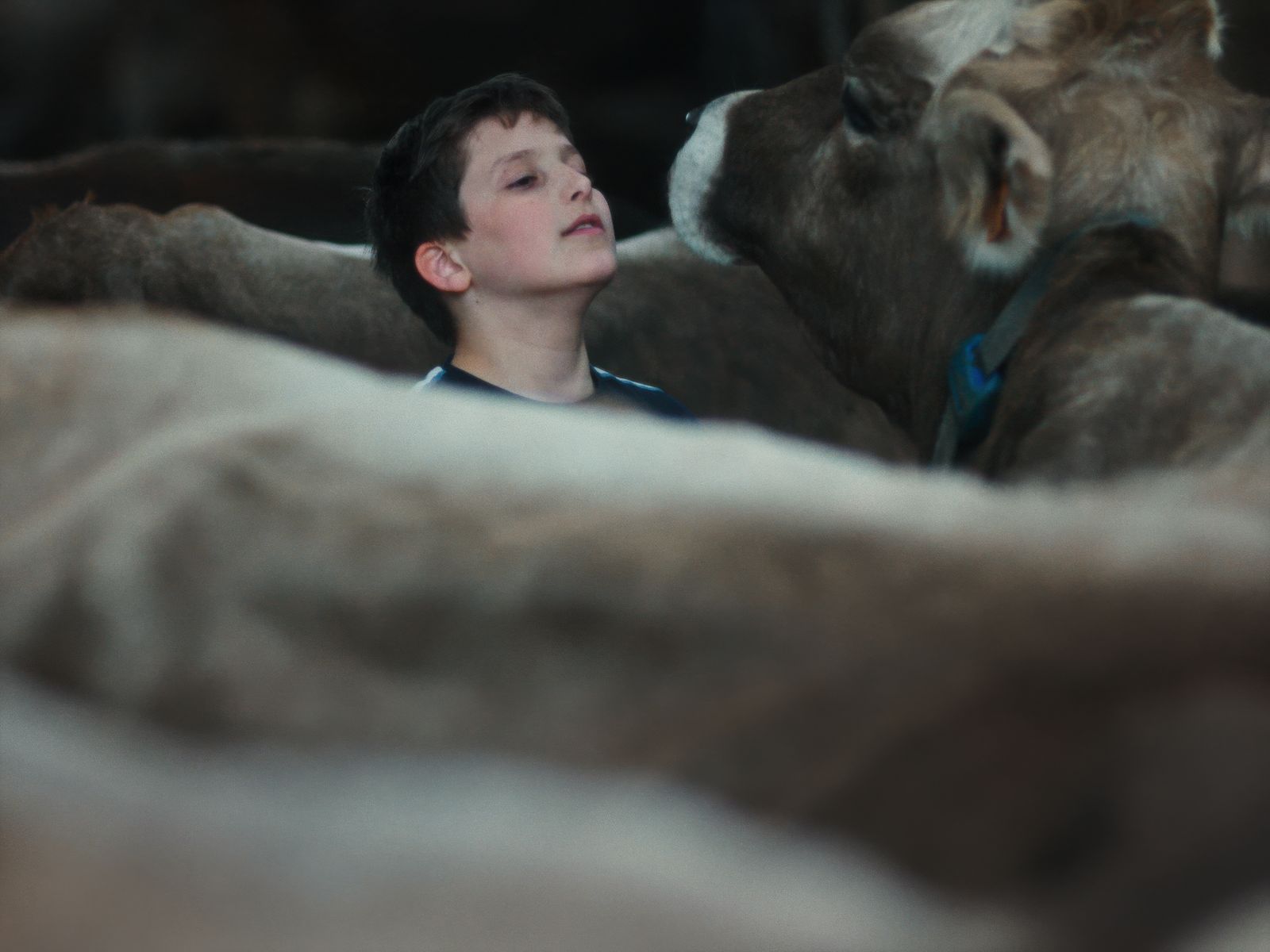
In Artois, nestled in the northeastern region of France near the Belgian border, we meet a young boy named Gabin. The eight-year old is precocious and well spoken, the youngest child of Dominique Jourdel, a butcher, and Patricia, who raises and cares for dairy cattle. Theirs is a seemingly simple life filled with the regular struggles of most small-scale operators in the agricultural industry. Their son’s enthusiasm for finding his own way while caring for animals but eschewing the path of his parents lays at the heart of his youthful dreams.
What sets Maxence Voiseux’s portrait of this family apart is the sheer scope of its timeline. Like Richard Linklater’s Boyhood, to which the film will inevitably be compared, or the even more salient example of the Almond/Apted/Kapadia 7-Up series, much of the film’s power comes down to the fact that Gabin’s story is recorded over a decade.
We see the young boy grow, his voice drop, and a smattering of whiskers eventually appears on his upper lip. There’s no overt messaging about time passing save for the greying at the temples of the parents, and the weed-like growth of the boy into early adulthood—his academic, social, and familial struggles assuming differing impact as he grows up.
We hear at one point that Patricia’s dream of winning the lottery was to use the earnings to go to Canada, and even the son thinks this a ridiculous wish, suggesting instead some locale with sun and sand. Yet this quest is mirrored by Gabin’s own potential decision to come to Canada to extend his education, making for one among many interconnected elements that the epic shooting schedule allows, where in was as overt as this and at other times more subtle we see the echoing of parent and child’s moods, behaviours, and emotions.
Shot in a spare, intimate way, there’s a sense of a total lack of self-consciousness with the camera’s intrusion, no doubt the result of literally years spent having one thrust into even the most challenging of personal circumstances.
Save for a few conversations with the adults and other members of their family, the rest of group, especially the other two sons, are notable with their complete absence. On the one hand, that observation emphasises the film’s focus on the titular subject. On the other, it makes even more manifest that despite the film’s credentials as a work of documentary, there’s far more discernable sanctioning off of this particular storyline, with many of the additional family questions and concerns left unconsidered.
Charitably, this can be seen as keen filmmaking to focus on the relevant aspects of Gabin’s story, while the more cynical viewer could see these editorial perspective as the kind of manipulation better ascribed to straightforward fiction, bending the hybridity of the documentary far more in the direction of staged drama with only the trappings of the form to add a sense of verisimilitude.
A dose of this complicated connection between actuality and simulation is seen as Gabin plays a video game, with a virtual farm at the same French location being the locale for his imagined animal husbandry. It’s a strange collision of fact and fiction, amplified at one point when his father’s shop is burned down in the virtual space, an act of mental arson that speaks to the heightened emotions rather than the actuality of catastrophic behaviour.
The complex conversation around hybrid docs is beyond the scope of this particular project, but it may highlight both the positive and negative elements for those wishing to do a deeper exploration. As a standalone film, its bucolic nature, the comfort for which the subjects are free to express their feelings and thoughts, and the almost dream-like way the images are captured, make for a compelling project regardless of how one characterizes it.
Gabin’s story isn’t fully told, of course, and the film ends with him on the cusp of the journey of adulthood, with decisions about the fate of both the farm and shop very much up in the air. Time will tell if another set of chapters for his life will continue, but Voiseux has crafted a work of remarkable accomplishment, one that shows a decade of transformation as effectively as few films before it.