



Maybe another title card could have been the answer. “It is estimated that at least 50,813 Ukrainian forces have been killed since Russia’s illegal invasion started in February 2022,” Russians at War could have begun. Maybe even one more title card about the countless civilian deaths, persons reported missing, or the overall ambiguity of statistics could have made the framing even clearer.
Maybe those solemn words could have been followed by another card noting 578,120 casualties among Russian personnel as of July 31, 2024. But again, that number also varies so widely among sources that it likely won’t be known for years.
Those hypotheticals, however, underscore a chilling reminder that Russians at War proudly embodies: truth is the first casualty of war. Perhaps it’s naïve to assume media literacy among audiences in 2024-2025, even among elected public leaders, but a few words might have made the documentary’s anti-war stance indisputable, at least for those who actually watched it. Although it doesn’t feature statistics in the opening number, it does begin with a note about Russia launching “a full-scale invasion of Ukraine,” “the deadliest conflict on European soil since WWII,” and “war crimes.”
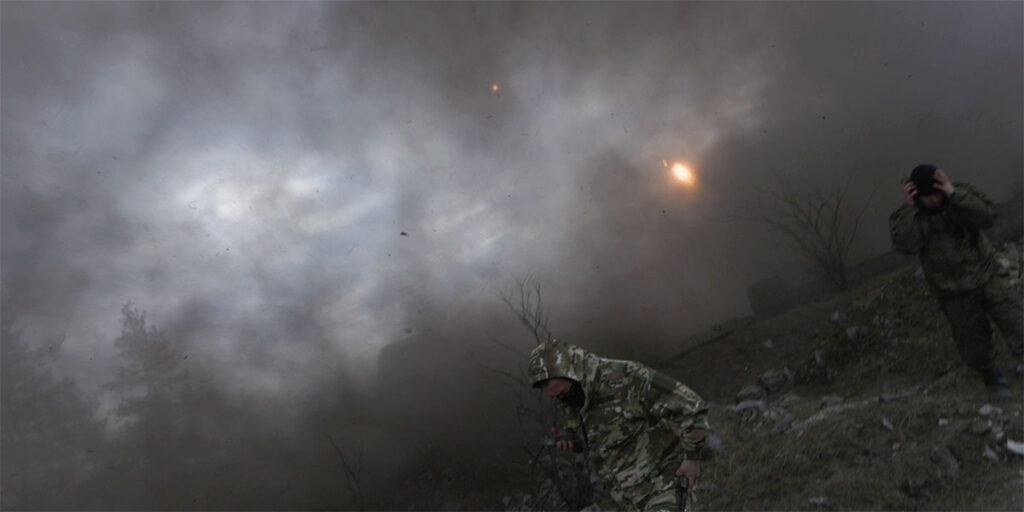
Russian-Canadian director Anastasia Trofimova also begins the film with a sombre and reflective voiceover in which she sets up her desire to make this tough film. She wishes to understand why her country embroils itself in a deadly war that nobody but Putin seems to want. She also seeks to probe the mindset of the people fighting this futile battle, especially since depictions of Ukrainian and Russian soldiers don’t jive in reports from country to country. Russians at War offers an attempt to find the truths of these titular soldiers whom the government deems heroes but everyone else considers monsters. “The fog is so thick, you can barely see the human stories it is made of,” the director notes.
Russians at War finally sees the light of day after igniting one of the biggest controversies ever in Canadian film—and documentary more broadly—before its scheduled premiere at the Toronto International Film Festival last fall. It’s the flashpoint film about the Russo-Ukrainian War, and probably one of the most difficult movies you’ll ever see. It’s also an essential doc about what it means to report on wartime, what it means to understand the complexities and nuances of war, and what it means to remember how empathy makes us human.
The film reaches audiences beginning August 12 with a self-release on streaming, the route that seems to be the only pathway these days for controversial in a risk-averse field. One could cry cowardice, certainly towards the board at broadcaster TVO after they disowned the film—blindsiding the filmmakers and even people at the station—when charges erupted during last year’s campaign to brand the film Russian propaganda. That charge was one of the swiftest, most chaotic, most baseless, and most alarming takedowns in social media history. (The film screened at TIFF following the festival when it was safe to do so following threats to the filmmakers, festival staff, and to public safety.)
We’ve written enough about that story, so here’s more on the one that was lost.
The monsters could not be put back in Pandora’s box even though the film hadn’t even screened in Toronto and the few of us who’d actually seen it—and had agreed to industry-standard publication embargoes—generally agreed it was a compelling and nuanced, if imperfect, view of Russia’s invasion of Ukraine. If documentaries have the power to provoke and inspire conversation, Russians at War serves as a battleground for freedom of speech and journalistic integrity.
Go into Russians at War with a willingness to wade through the fog and see the bigger picture. By doing so, you’ll find a remarkably courageous feat of documentary filmmaking. The access that Trofimova gets while hunkering down with soldiers is indeed impressive—doubly so that it was captured without authorization or press credentials. (An argument that Trofimova’s critics have used as evidence of propaganda, but one that could be chalked up to good journalism.) Beyond the feat of access, what makes the film so compelling is the raw insight into the minds of Russians on the front lines. The film burrows deep into the psychology of war, and that’s what makes it so unsettling and effective.
Trofimova finds a great hook into the complexity of why these men fight thanks to an encounter that begins the film. She meets a Russian soldier named Ilya on a train, and finds herself amused by the sight of his uniform protruding from a Santa suit—evidence that he needs a side hustle to pay the bills. That amusement turns to intrigue when Trofimova learns that 49-year-old Ilya is Ukrainian. His defection amid a polarized situation inspires her to follow him to the battlefields.
When Trofimova gets to the barracks with Ilya, she encounters a group of adult men broken by war. They’re visibly shaken by their experiences. They shed tears while noting that only 300 of 900 comrades returned from battle, with half of the survivors crippled by injuries. If there’s a rousing call to arms, Russians at War doesn’t find it.
These men, Trofimova learns, have different reasons for enlisting. Some soldiers just need a job and recognize that war’s fatally high turnover rate boasts better prospects. A soldier named Vitaly says he came “for patriotism,” while Cap says he wants to avenge fallen comrades. Another, a young 20-year-old named Cartoon, tells Trofimova that he joined to “fight Nazism.”
“How do you know they hate Russia?” Trofimova asks him, inquiring about the alleged Ukrainian Nazis they might encounter. Cap shrugs. It’s the same in a later scene when she asks him pointedly if he’s heard reports of Russians committing war crimes. He dismisses the notion. Again, he’s not really sure how to back up the lingo he gleaned from the fake news machine. He also can’t hide his fear and naïveté behind a brave face.
Perhaps the most telling motivation comes late in the film. Trofimova joins the soldiers as they traverse a bombed-out village. It’s a ghost town, an empty shell of a once vibrant community. All that remains are charred ruins of apartment complexes and a few derelict shelters with messages scrawled that someone lives there. While touring the desolate community, however, Ilya reminisces how he yearns for the “brotherly union” between Ukraine and Russia. But if he thinks this method will repair the sibling rivalry between nations, he’s clearly mistaken. And he increasingly seems to know it.
That sentiment proves equally telling in the footage that Trofimova gets from the front. She accompanies battalions to the Krasny Liman front and Bakhmut front, where the latter (coincidentally the same front featured in Mstyslav Chernov’s equally harrowing 2000 Meters to Andriivka) was too violent for her to go all the way to the trenches. In images shot by soldiers themselves on GoPros affixed to their bodies, Russians at War observes an army being sent to slaughter. The film sombrely captures a generation of Russians lost to the false call of patriotism as they serve as pawns in Putin’s game. They have shoddy equipment and poor training. The most effective strike by the Russians comes when they load a drone and accidentally drop a bomb on themselves. They’re literally blowing themselves up, and nobody knows why.
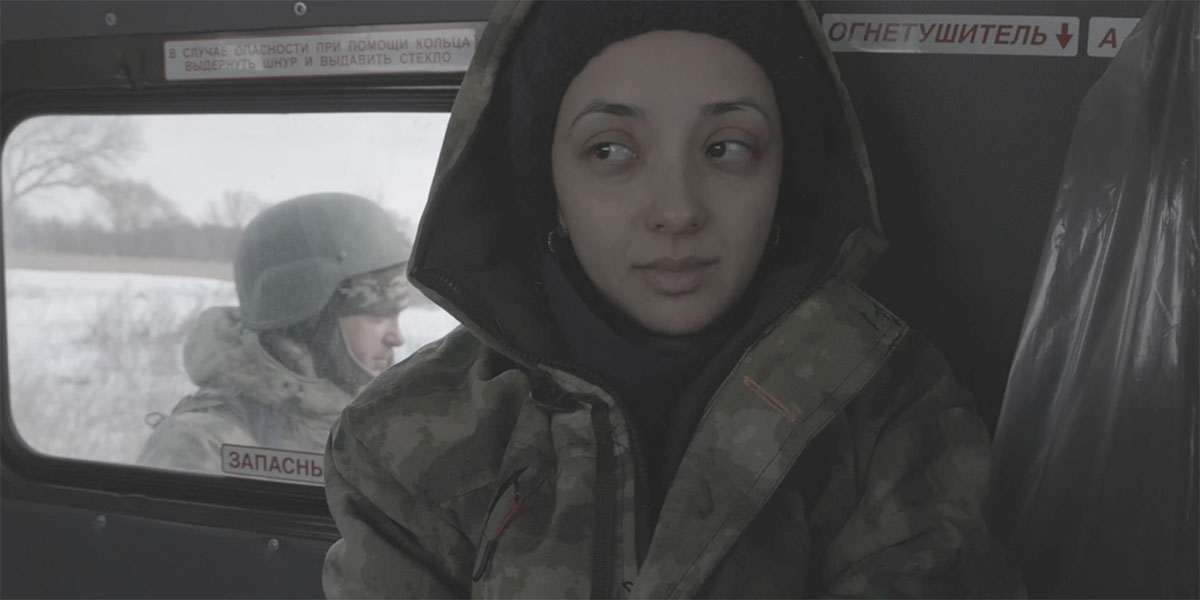
Trofimova later asks that question to Anchar, a young woman who works as a medic with the Russian corps. “I don’t know,” she shrugs. But her blossoming relationship with a fellow soldier reflects a far more effective tool than the misdirected anger that fuels Ilya, Cap, and Cartoon.
As Anchar echoes Cap with her sense of uncertainty, Russians at War expands its scope from the squadron to the overhanging fog of war. Propagandistic messaging sits at the heart of Trofimova’s documentary, but it’s a route of inquiry, rather than an endgame. The camera routinely observes billboards of clean-cut, healthy, and smiling soldiers that advertise the strength of Russian forces. The pictures offer stark contrasts to the tired and disillusioned soldiers run ragged.
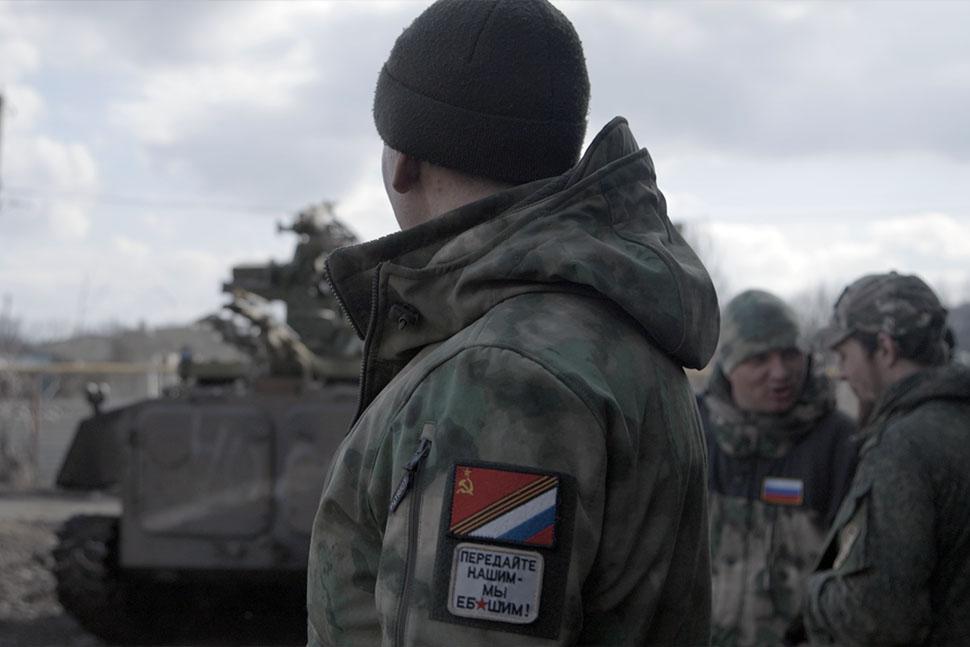
Other subtle glimpses consider the power behind messaging. “Don’t follow me. I’m lost myself,” reads a badge affixed to a soldier’s uniform. And in a welcome note of levity, one bit of graffiti advises: “The world’s not crap, people are!”
As Russians at War witnesses the soldiers and medics wrestle with the physical, emotional, and psychological tolls of this war, the film considers the individual mindsets echoed by the observant graffiti artist. Some soldiers fall and leave wives and children behind, while survivors get wake-up calls from their proximity to tragedy. Deferred pay and bad work conditions inspire some to abandon their posts. Meanwhile, responsibilities of love and family leave others reconsidering their involvement. Others become doubly motivated in their hatred towards Ukrainians and fuelled to fight. The violence they narrowly survive emboldens them. The only one who doesn’t seem completely broken and defeated is one who leaves for love.
While the survivors and soldiers get their say, Trofimova also gives voice to another party: the fallen. Russians at War poignantly visits the graves of soldiers who died in battle, including men whom viewers encounter throughout the journey. Left behind are grieving wives, parents, and friends, none of whom can articulate what purpose was served by the loss of their loved one.
Trofimova finds the answer to her inquiry about what’s going on in her country not in the trenches, but in the graveyards. It might not be easy to process the anti-war sentiment conveyed through images of grief from the occupying nation, but Russians at War asks us to wrestle with these complex and uneasy emotions. It’s hard not to share their grief and anger, as well as their desire to end the slaughter, amid a plea for peace. Ironically, those who condemn the film express a similar sentiment.