



Peter Hujar’s Day
(USA/Germany, 76 min.)
Dir. Ira Sachs
How much drama occurs in any given day? The question of the quotidian fuels Ira Sachs’ revitalizing hybrid drama Peter Hujar’s Day. Details large, small, professional, and private pepper an engaging recap of photographer Peter Hujar’s previous day as he relates the events of those 24 hours to non-fiction writer Linda Rosenkrantz. Sachs’ film brilliantly adapts a 1974 interview that Rosenkrantz conducted with Hujar for a series about a single day in the lives of various artists. That interview was never published until a researcher discovered it in the archives of a New York library in 2019. Those words, later published in an edited version, find a dynamic reinvention as Sachs dramatizes the conversation akin to verbatim theatre. It’s an exquisite portrait.
Sachs, speaking after a screening at the New York Film Festival, relates Peter Hujar’s Day to old advice from the late Robert Altman: “The film you’re about to make is not a documentary.” That’s true of Sachs’ film, but the documentary-adjacent nature of Peter Hujar’s Day illustrates its genius in honouring lived experiences of working class artists. It’s an authentic and lived-in portrait an artist of whom few, if any, video interviews exist.
The interview takes place in Hujar’s Greenwich Village apartment. It’s not so much an interview as it is a monologue. Rosenkrantz interrupts infrequently to make some tea, or maybe to ask a follow-up question. But her queries are less routes of journalistic probing than the sort of everyday inquisitiveness that punctuates conversations between friends.
No minutiae is too small for the account of Peter Hujar’s day. The wheels on Rosenkrantz’s recorder spin as the photographer remembers waking up with someone in bed, kicking them out, and going back to sleep. Then it’s a story about getting dressed—insert a query from Rosenkrantz to clarify Hujar’s previous statement that he hadn’t taken any clothes off—and then come details about toast and jam.
The main action for the day includes setting up a portrait session with beat poet Alan Ginsberg. With a phone call timed right at noon to work around Ginsberg’s spiritual practices, Hujar relates to Rosenkrantz the idiosyncrasies of various New Yorkers as their days intersect with his own, sometimes by design and sometimes by chance. The photographer drops about 50 names throughout the conversation. He spills tea about a blowhard colleague who doesn’t listen—and directly asks Rosenkrantz to print the name with that part—and he dishes on colleague’s invitation that William Burroughs might welcome some oral sex. Hujar admits he finds the Naked Lunch writer handsomely attractive, but might prefer to hire a coed for the job depending on the favour he wants Burroughs to reciprocate. (He makes no request for Rosenkrantz to strike that from the record, nor anything else, really.)

Sachs’ honours the creative spirit of both Hujar and Rosenkrantz, and their contributions to New York artistic life, however famous or obscure. His screenplay realizes the transcript without altering a word. Peter Hujar’s Day unfolds the conversation over 33 scenes across the course of a waking day. Sachs’ changes no words, but merely edits the transcript for Whishaw and Hall to interpret. It’s more an act of curation. The selections from the text illuminate facets of both characters, their relationship, and their place in metropolitan life.
One memorable exchange, for example, appears not in the published version of the interview. In a scene that Sachs rescues from the archive, Hujar turns the query back on Rosenkrantz. He makes a playful digression while recapping aspects of urban life, noting how he navigated a mob of people on the sidewalk trying to gawk at a star. He thinks it may have been Joan Crawford. “You wouldn’t want to see Joan Crawford?” he asks Rosenkrantz. She laughs at the idea of spending so much time trying to snag a look at a fading icon. It’s a funny reaction from an author crafting a book about the quotidian details of people with varying degrees of celebrity. “I might stop for Bette Davis,” she admits. Some famous people, perhaps, are more worth our time than others.
Hujar and Rosenkrantz, however much familiarity with them one brings to the film, certainly merit one’s time. Using this intimate excavation of lost records, Sachs intimately examines dynamics of working class life among artists. Hujar details the painstaking efforts entailed in making prints, and the heartache that arises when he sees a hairline on a portrait or a blemish on a print. Meanwhile, Rosenkrantz lets slip a gobsmacked “gosh” when Hujar tells her he added a penny to his purchase of a pack of cigarettes. He says the corner store hiked the price of to 56 cents. Their accounts of every penny spent on cigarettes, Coca Cola, and Chinese food offer a slice of la vie bohème in New York.
There’s a wonderful sense of presence to this snapshot of past lives, too. Sachs, working with cinematographer Alex Ashe, shoots the drama on 35mm Kodak with Academy ratio images capturing the interview with natural light that reflects the rising and fading glow coming through Hujar’s windows. The film unfolds not in real time, as slight ellipses mark transitions from one edit in the transcript to the next.
In these moments, Hujar and Rosenkrantz change location, moving to the roof, shifting to the bed to lie down for a bit, or going back to the table and making Nutella sandwiches, all the while refreshing the seemingly endless supply of cigarettes that feeds the starving artists. (The shifts in location offer elements of dramatic license, as Rosenkrantz supposedly recalls conducting the full interview at Hujar’s table.) The conversations in these moments, however, unfold naturally as the wheels on Rosenkrantz’s recorder attune themselves to the patient cadence of Hujar’s voice.
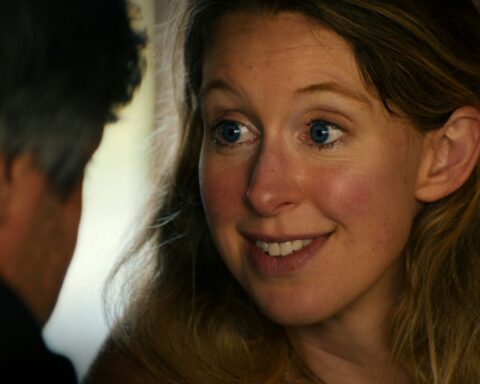
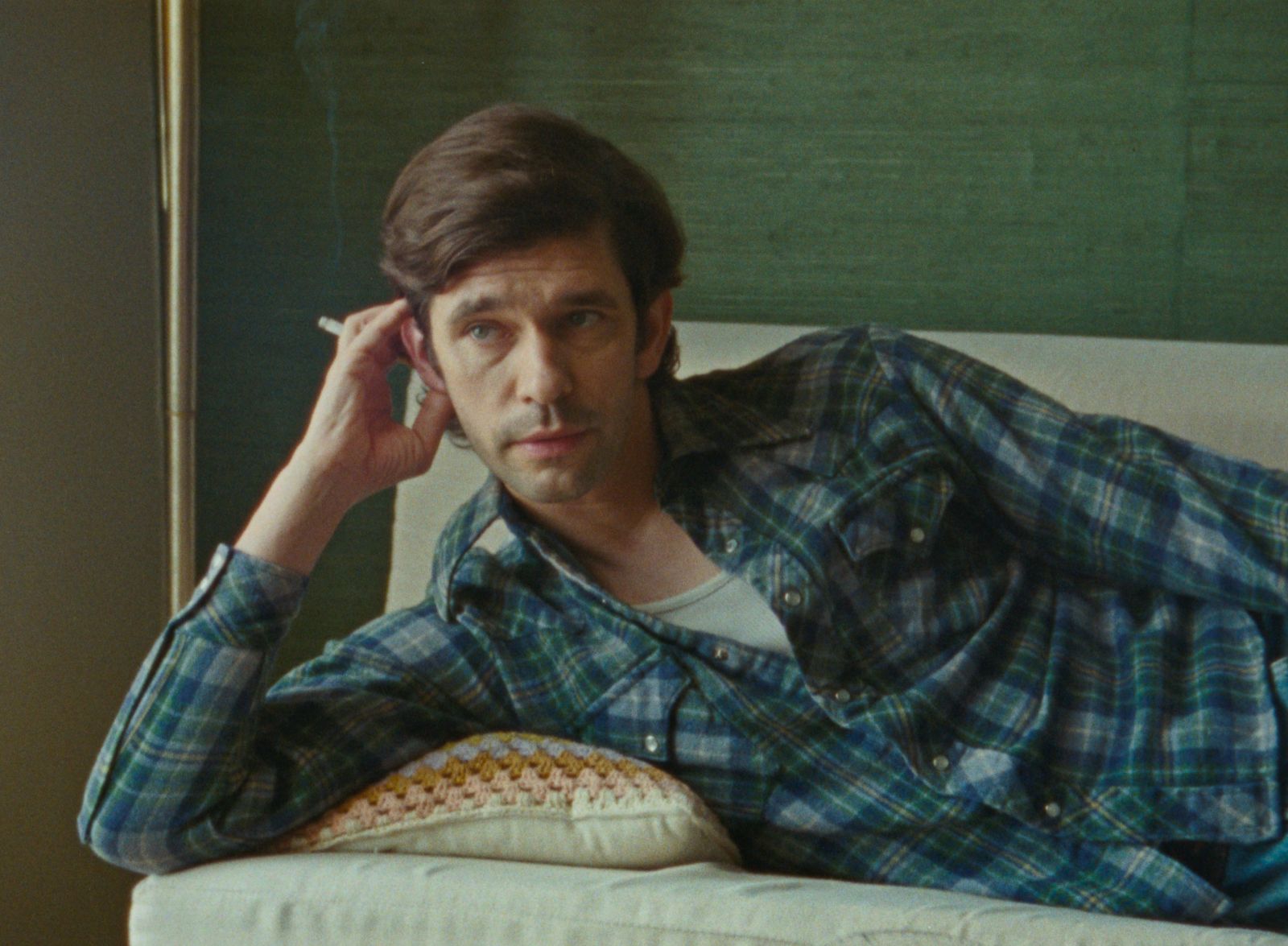
Whishaw and Hall—both Brits—create wonderful portraits of the New Yorkers. Peter Hujar’s Day offers a delicate two-hander as Whishaw holds court by interpreting Hujar’s words with a laissez-faire cadence, never quite convinced that his own story seems interesting enough for people to read. However, Whishaw injects a tone of playfulness here and there to suggest the slightest hint of dramatic embellishment. Hall, meanwhile, creates a captivated receiver, and their dynamic shares the art of active listening and reacting—two acts deftly engaged in Sachs’ experiment in portraiture. The naturalism of the performances finds poetry in the mundane.
The film ultimately offers a portrait of portraiture as Sachs gives audiences a cinematic equivalent to the photographs with which Hujar would capture everyday lives and to the words with which Rosenkrantz would do the same. Some scene breaks directly evoke the filmmaking process with clappers and boom mics entering the frame, while one ellipsis comes via a stubborn shift in focus as a very blurry Hujar introduces a new segment of his day. It’s the kind of image one can only get on film—another charming layer to this portrait of a man who put a lot of stock in celluloid. The film’s a living testament to the impact that seemingly inconsequential events in the lives of artists can have for subsequent generations.