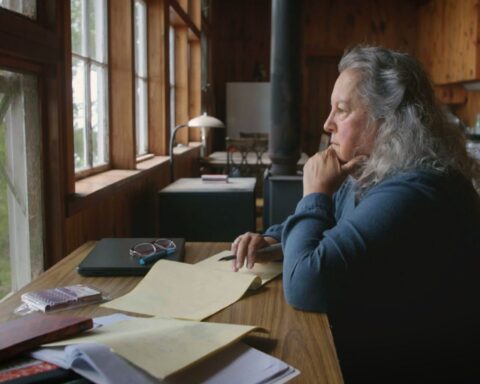

Kim A. Snyder’s documentary opens with a disturbing image. An interviewee sits in a room. She’s obscured in silhouette, rendered anonymous. She begins to tell her story, and it’s about books. The woman is a librarian, masked and anonymous to protect her safety as she shares her story.
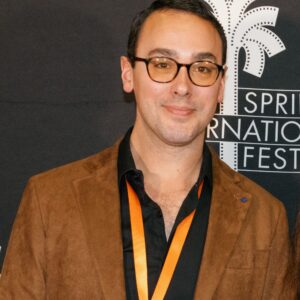
“That is not something that you expect in the happenstance of documentary filmmaking, in terms of storytelling,” Snyder says when POV asks her if masking a librarian for a film is something she ever expected to do. “That is not something in my lifetime that came into my head.”
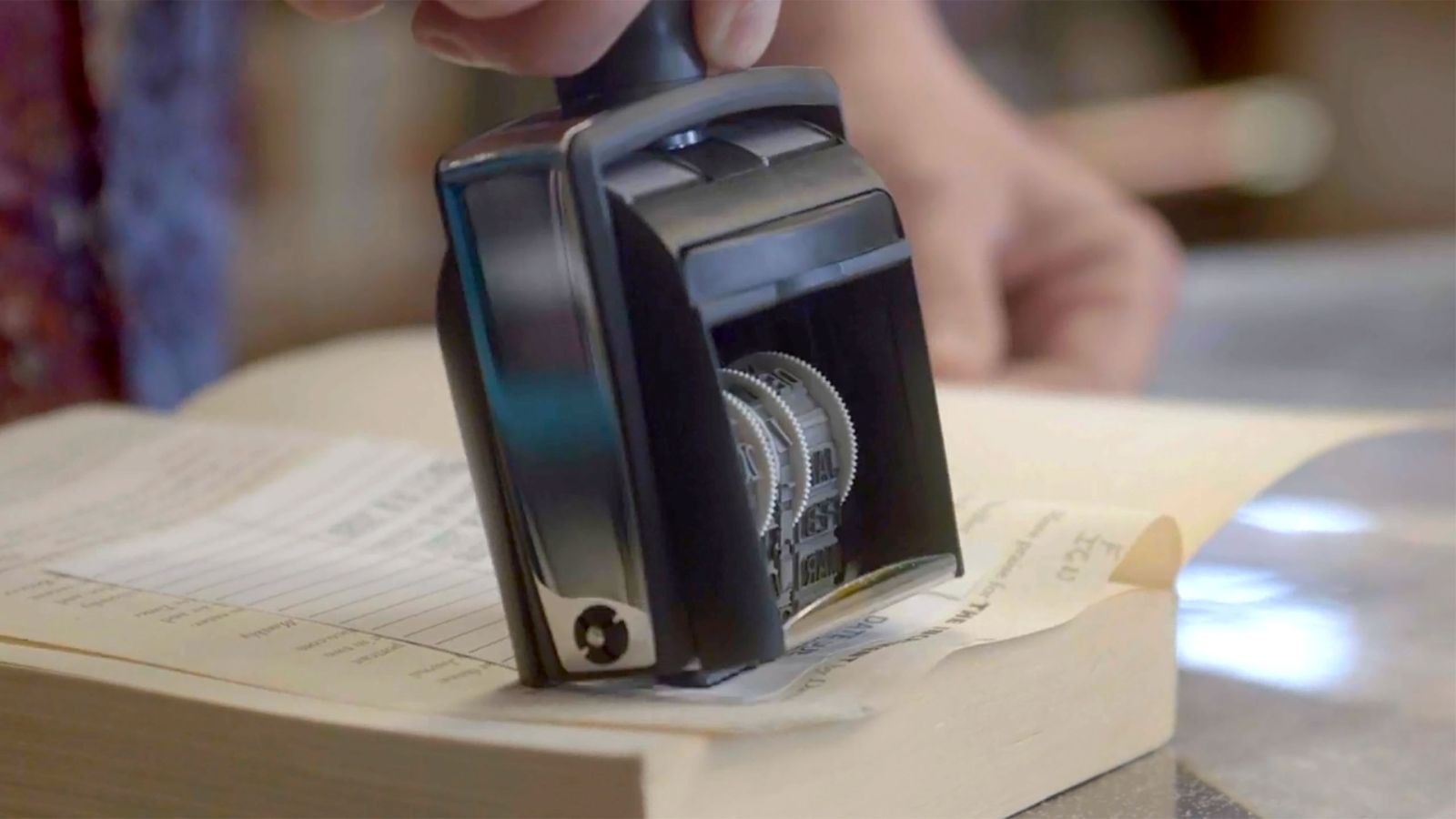
The Librarians, which kicks off the fall season of Doc Soup at Hot Docs Ted Rogers Cinema on October 8, brings an essential portrait of the culture wars playing out in hotly contested territory: libraries. The documentary follows several librarians who fight to protect freedom of speech and access to information amid escalating book bans in the U.S.A.’s increasingly polarised climate.
Snyder says the topic caught her interest back in 2021 when Texas Republican State Representative Matt Krause issued a list of 850 books he wanted banned from school libraries. Krause’s list seeks to protect children from allegedly harmful ideologies like anti-racism and queer-positivity. Books on the list run the gamut from John Irving’s The Cider House Rules, the graphic novel edition of Margaret Atwood’s The Handmaid’s Tale, Stamped from the Beginning by Ibram X. Kendi, eight volumes of Takako Shimura’s Wandering Son series about a young trans girl, and just about any book that might pop up in a search with keywords like “queer,” “gay,” or “trans.” The documentary sees this fight from the perspective of the devoted librarians fighting to protect America’s youth.
“I learned about this small group of librarians calling themselves the FReadom Fighters that were speaking up and also connecting and organizing in this state of trauma and shock,” says Snyder. “It was a very seminal moment for the librarian community, not just in Texas where it happened, but they were finding out that, in fact, this was already brewing and happening in so many places across Texas and beyond. I immediately went to Texas, started following them, and then the story evolved into a much more national one.”
The film’s fearless librarians include Suzette Baker, who protects a stash of books that didn’t make the list. She shares books like A Day in the Life of Marlon Bundo, about two male bunnies in a happy relationship. She welcomes Snyder into the children’s section of the library where the picture book resides. “Where we keep our pornography,” she shares with a conspiratorial laugh, noting the absurd charge with which book banners label stories they fear.
Snyder’s documentary continues her body of work that observes the rights of America’s young people, particularly in the face of school shootings and gun violence, including the short doc Death by Numbers, which was nominated for an Oscar earlier this year, and the Peabody Award winner Newtown (2016). Snyder and the librarians observe that it’s important to preserve a vast collection of stories for minds an impressionable ages.

“Some of the emotion around people’s memories and early experiences in libraries and with books is wonderful feeling of freedom, of discovering, ‘Who am I? What do I gravitate towards?” she notes. “It’s that freedom to find out who you are, what you want to be, and what worlds you want to explore.” The war on books merely serves as the preamble for wider conversations about equity, inclusion, and human rights under siege across the States.
“I started seeing it as not just a mosaic but an odyssey that each story would propel us further into taking this journey that I took as a filmmaker, as a storyteller of entering with the same state of shock that we were living in a time where the prospect of criminalizing librarians was on the table,” says Snyder. “They were canaries in the coal mine.”
Snyder says as the story expanded like a needle pulling thread, as the book banning movement grew from Red States like Texas and Florida to perhaps unexpected places like New Jersey. It’s there that The Librarians introduces Martha Hickson, who started her own investigation following an attack. “Martha realises this was organized, it was not organic,” says Snyder. “And so we took that journey of starting to uncover, expose, and hopefully show a certain empowerment and hope in seeing that, in fact, these individuals did take agency in standing up for their integrity, for what they are trained to do, and what they believed was right.”
As The Librarians follows this story through the perspectives of multiple women, one also can’t help but notice the strong feminist perspective on the culture wars. Books on the banned list include several titles pertaining to abortion, Roe v. Wade, and women’s reproductive rights as lawmakers, mostly men, see books as another tool with which they can police women’s bodies. Snyder notes that, on one hand, the feminist perspective of the film simply comes from the higher number of women in the position. At the same time, she observes an undercurrent to the story that’s too strong to ignore.
“They [the librarians] will say that they do think there was a very strong element of misogyny that goes under that,” says Snyder. “For a lot of the personal attacks and assault, I just kept thinking of the Salem witch hunt. They also will say that librarians are often easy to scapegoat because it is one person in a building. There’s a lot of teachers, but there’s usually the school librarian, who is easier to single out and attack, especially in social media. The misogyny is strong in the fact that all of these incredible women were targeted. I think the feminist in me also took particular offense to some of the attacks on the books themselves. They were often books like Toni Morrison‘s Beloved.”

While Beloved doesn’t appear on the Krause list, Synder notes that her passion for the book drew her attention to the 2021 Virginia gubernatorial race where Republican candidate and eventual winner Glenn Youngkin directly targeted Morrison’s book in campaign ads. “The other thing that really piqued my initial interest in this story was that during the pandemic, knowing how politicized the pandemic and the masking and the vaccinations were, there was this very deliberate attempt to take a certain amount of the electoral public and shift the focus towards these culture wars and towards the books and the book banning,” Snyder notes. Youngkin’s campaign precedes the Krause list by a few months and illustrates a wider movement among the Right to target books, particularly anything by BIPOC authors, women, and LGBTQ+ people.
“The example of Beloved, which is a national treasure for most people in terms of literary treasures, is that their objections were about a scene of sexual assault, which yes, is challenging and difficult and one can have a very legitimate conversation about what age one should be and when that book whether it should be on the ninth grade shelf. But this wasn’t about that,” says Snyder. Youngkin’s campaign against Beloved stems from a mother’s charge that the Pulitzer Prize winning novel gave her son—a high school senior—nightmares.
“Parental rights have always been ensured. There was always a process that worked, so this idea of parental rights became so misused and was an excuse to defy the First Amendment and the processes that were there. Parents could always challenge a book—that was never a problem for librarians to sit down and have a conversation about your kid and the ninth grade shelf. There was a way to do that in any said community. The idea that they would pick out of several hundred page novel a particular two lines about a disturbing part of history and personal experience, which is very real, was particularly offensive—the idea that sexual assault would be labelled under state penal code as pornography or obscenity. That part of it as a human being as a feminist is particularly disturbing.”
As The Librarians observes town halls and public forums in which lawmakers and community members trade obscenity charges over books, it becomes clear that many parties object to books they haven’t actually read. Snyder sees that aspect of the story as evidence of the wider organization at work. “I think it has more to do with misinformation in that it lends evidence to what we expose in the film, which is that this is a much more nefarious organized effort to equip people to go to school board meetings with scripts about books that they’ve never read, and to have these two lines that say, ‘Aha, here’s the bad bits, and this is porn,’” says Snyder. “Then they get to put out misinformation that there’s obscenity in the school libraries throughout the heartland of America where these librarians are actually trained to know what obscenity and porn is.”
However, The Librarians also observes that minds can change with the power of education. For example, mother and school board member Courtney Gore initially pushes the party line that says schools need to protect kids from these harmful books. But after she does her own research to educate herself, she recognizes a web of misinformation. “I think it says more about a concerted effort to misinform and to send this growing band of more extremist voices into spaces to try to convince Middle America that somehow our libraries have become full of obscenity for children,” says Snyder.
The film also shows how the coordination includes groups like Moms for Liberty, but also aggressive members who cross state lines to assault librarians, as Martha in New Jersey survives an attack by the same person who targets librarian Amanda in Louisiana. The film doubles down on the strength of these women as they risk their personal safety, fracture relationships, and in some cases lose their jobs defending the kids’ right to read.
“The job of a good librarian is to keep a thriving dynamic library that represents the entire community and has something for everyone. That is their job,” says Snyder. The director says that extends to librarians in the film who provide sections of Christian literature for people of faith in the community, while others might recognizes that only two percent of twenty thousand books in the library have LGBTQ+ representation. “This is not about making some cisgender white kid get up and give a book report about Gender Queer [Maia Kobabe’s memoir on the Krause list]. Nobody’s doing that,” says Snyder. “This is about representation and keeping the libraries open and keeping diversity. As our wonderful librarian, Martha Hickson says so beautifully, ‘When they go after those books, they’re really going after those kids. And I cannot abide by that.’”
If the librarians in the film serve as canaries in the coal mine, one can’t help but ask Snyder about the war on storytelling in the States that’s turned its focus to documentary itself. The ban on books finds clear parallels in the documentary sphere with the Trump administration defunding the Corporation for Public Broadcasting, a lifeline for American documentary via PBS and ITVS, on the heels of sweeping cuts to the National Endowments for the Humanities and the Arts.
Snyder cites her own relationship with PBS’s Independent Lens, which has supported three of films, as something worth fighting for. “That is the last place where a filmmaker can actually be truly independent,” she says, noting that Independent Lens requires filmmakers to retain copyright. “There’s nobody censoring me and telling me what movie to make. There’s a competitive process and they buy into which stories need to be told and they curate beautifully a swath of all aspects of American society. But I’m concerned that as those pipelines are being cut off, there is a chilling effect and how we’re going to sustain ourselves as documentarians to chronicle the current history that’s unfolding.”
“We talk a lot about the chilling effect in our own story about book banning,” Synder continues, “but one of our librarians says, ‘We have to be out in the front telling this story. It’s about us.’ So it’s about librarians under siege and by the end she says, ‘I don’t know what’s going to happen, but I do know that our story’s being still written and now it’s everyone’s story.’
“That was so prescient when she said it because now we’re seeing this in the space of museums and our Library of Congress and our late night television. All of these aspects of society that involve freedom of expression are so much beyond the libraries. It’s such a bigger story. We are not immune to that in the documentary film space. I’m concerned about the chilling effect that we as filmmakers are feeling as the opportunities to tell social impact non-fiction stories are becoming less and less because a lot of the streamers are nervous about them, about distribution channels in general being more monopolized.”