


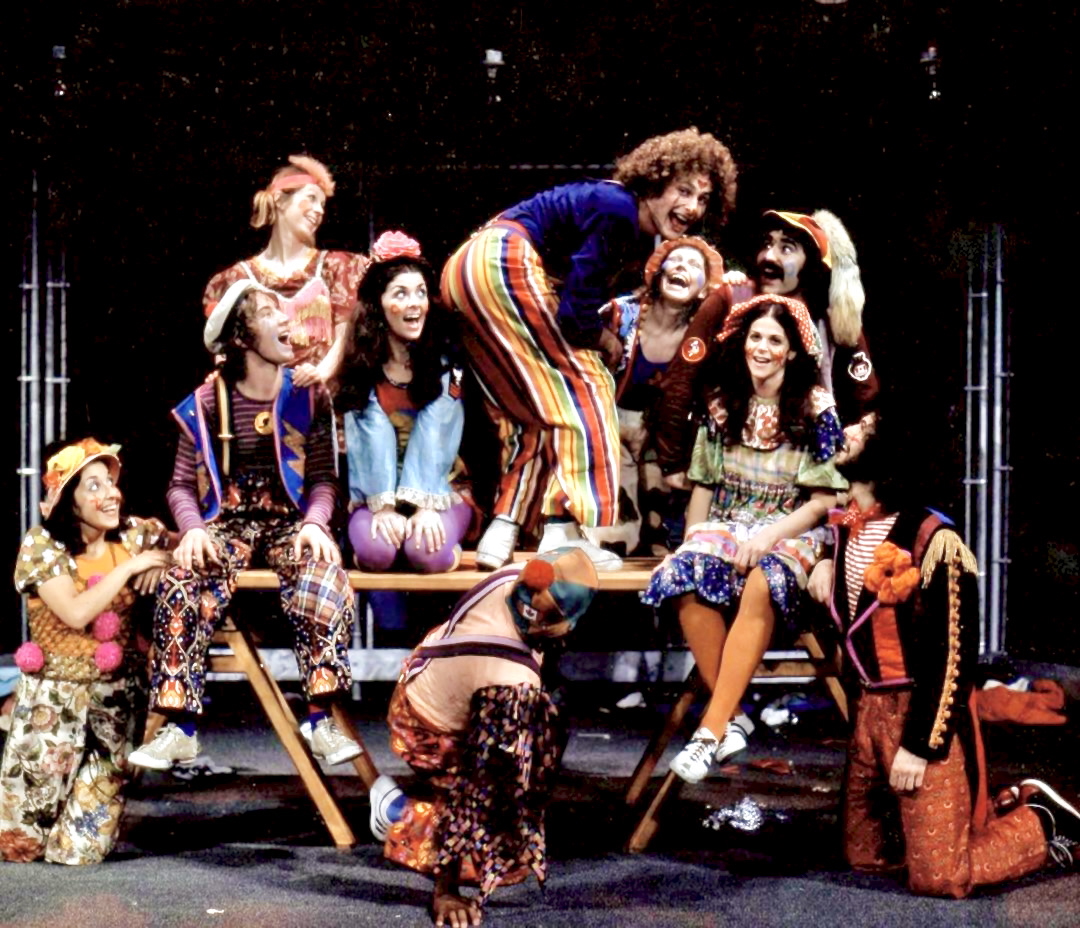


As part of our look at the playfully titled documentary How the Toronto Godspell ignited the comedy revolution, spread love & overalls, and created a community that changed the world (in a Canadian kind of way) following our discussion with the film’s director Nick Davis, we spoke over Zoom to two of the 1972 musical’s more legendary contributors, Victor Garber and Paul Shaffer
Garber’s career was ignited by his appearance as Jesus in the Toronto production of Godspell, but he’d already had a bit of a popstar career as a member of the Sugar Shoppe well before joining the ensemble. His brief but memorable contributions to the stage show led to his departure six weeks into the run to perform the role in the film version, which would in turn brings decades of roles on both the big and small screen, including a memorable turn in fellow Canadian James Cameron’s tiny boat sinking movie, Titanic.
Shaffer was plucked by Godspell’s musical deity Stephen Schwartz to emerge from his role as the rehearsal pianist for a few of his friends in order to staff the show and become musical director. This spark led to a lifetime of performing for just about everything living legend, both from his decades-long run on David Letterman, but also behind the scenes on musical events too numerous to count.
POV spoke via zoom with both musical mensches prior to the premiere of You Had to Be There at this year’s Toronto International Film Festival.
POV: Jason Gorber
PS: Paul Shaffer
VG: Victor Garber
The following has been edited for brevity and clarity.
POV: Prepare ye the way for this interview!
PS: I can’t believe we have a Gorber and a Garber.
VG: There’s a song there, Paul!
POV: Paul, your life was changed when Stephen Schwartz heard you play. You were obviously a very accomplished musician, channelling your Leon Russell and your Elton John and your Paul Shaffer. Stephen saw something in you: Sid you know in that moment that your life was about to change?
PS: No, I had no idea. Speaking to Eugene Levy, our dear friend after all of these years, he was saying that when he and Marty Short, who were in school together in Hamilton, [they] were celebrating passing the audition. They said I must have been celebrating too, and I said well I wasn’t even auditioning for anything! I went as an accompanist, with two different ladies that I knew. One was Virginia, whom I was going out with at the time, and then Avril Chown, whom I had just met. Avril sang a song from the show, “Bless the Lord,” and she and I learned it together from the cast album.
Stephen Schwartz heard me play his song, and then Virginia sang one by Dusty Springfield. When he heard that one, he said, “I want to talk to that piano player.” I couldn’t believe it. It was like Lana Turner in Schwab’s, you know? At first he asked if I could play for the rest of the auditions. Everybody was singing the same songs anyway. Many sang “Heart of Gold” by Neil Young and then “Aquarius” from Hair, which is what Eugene sang. Victor needed no accompaniment.
I stayed on for the rest of the day, and at the end of it, Schwartz asked if I could get a band together and conduct this show. And now I was in show business!
My life was really changed at that moment. Yet I didn’t know what this show was going to be. The music was very familiar and it had those influences you just mentioned. It was all about Elton John piano. It had Laura Nyro in it. I was playing those records over and over again myself. But lyrically, it had some crazy things in it. There’s going to be a crucifixion!
Anyway, I was worried, what’s it going to be like? All of the songs were on the record, so I was home free. I could learn these things by ear. But there was a thing called the Prologue that starts the show. It’s just piano and all of the players sing their parts. They’re playing the parts of the philosophers before they cast off their dull grey things and become the clowns of Godspell. This was a thing that I had to learn note by note from them, puzzling over [he sings]: “Doo doo da dee dee.” I had it going at this medium tempo [he sings, demonstrating the tempo] and I’m learning it like a piano lesson. Then a guy named Steve Rheinhardt, a lovely gentleman, came up to teach us not only how to do the music, but the choreography too. He was a dancer, and he sat down and played it at about four times my speed! And I said, “Oh, my God. I’d better, I had to catch up to this speed and that was just the beginning. Yes, my life changed.
POV: Were you a monster reader back then?
PS: No, and I’m still not. I can read, I can arrange, I can do lots of things with written music, but I can’t sight read. I just never put in the time. I was putting in the time developing my ear. Learning what that chord was on that record. “How do you voice that, I wonder?” Learning that myself, sight reading has always held me back. I’ve been faking it all these years and well, yes, I’m admitting it now.
POV: Paul, you mentioned Laura Nyro, so [holds up a record to the camera] here’s a 7”— a single from the Sugar Shoppe covering “Save This Country.” And then there’s this [holds up a record by Canadian Rock Ensemble], where Victor recorded songs from Godspell well before being cast. The shows of that era, unlike modern shows that are highly structured, allowed you to make each production your own.
VG: That was the concept of the whole production and that’s why it was set in different places in the world. They wanted the sensibility of those places to be informed by the actors and ironically, Toronto, which we never thought much of as being an iconic city, became much more than any of us realized.
POV: Could you talk about the three different iterations of performing these songs: prior to your casting, on stage, and on the film?
VG: Well, there’s no question that I got the role because I had been in the rock theatre doing the song.
POV: You got the role because you’re really good. I will not abide that.
PS: That’s true. Things came together.
VG: But honestly, I walked out for the audition for the stage show with my guitar. I still had a lot of hair then and I was young and I could sing. It wasn’t that I thought I was going to get the role, but I certainly thought, “I’ve got a shot” because this is something that I thought might go against me, but obviously, it didn’t, and definitely my life changed too that day.
POV: So, after six weeks at the Royal Alexandra Theatre, you got called away to do the movie?
VG: Yes, it was very brief. I went to the producer Edgar Lansbury because I was so in love with this group of people and I was their leader, so to speak. I couldn’t bear the idea of leaving them, even though it was to star in a movie. I have a friend named Don Scardino, who I knew would be the perfect replacement for me, and I had him meet with Edgar and he was given the role. He was the only person that ever got into Godspell without an audition. All because Jesus told them to hire him. [Laughs.]
POV: There’s another line throughout your connection between Sugar Shoppe and the Canadian Rock Ensemble, right through to Godspell. Victor, do you remember who the piano player was on this?
PS: I can clear this up, Jason, because I’m a student of this history. I study this history like you. This band that Victor had, The Sugar Shoppe, which became The Shoppe, was led by that gentleman, the late Peter Mann.
Because Jesus Christ Superstar and Godspell were so big and they were both similarly themed, he said, “Let’s do a concert version of all of the music from both of those [shows], and go to L.A. with it.” And he called it “Canadian Rock Theatre,” and that’s what that recording is. Al De Lory, a very well-known pianist in L.A., played on all of the Phil Spector stuff, produced this record for them, and they were doing this show. I think Peter may have forgotten to get the rights to the music or something because they got stranded in L.A.
VG: Las Vegas, I think!
PS: Oh, my God, what a place to be stranded, Victor.
VG: It was a nightmare. [Laughs.]
PS: You notice Victor is still guilty about leaving our company of Godspell, leaving the Royal Alex after six weeks. He still talks about it.
VG: Yup.
PS: He wants to make sure, yes, he found us a wonderful replacement, Don Scandino, but he carries it with him to this day. Victor, it’s ok, let it go. Jesus, let it go.
VG: Thank you and thank God I have therapy next week so I can really get into it again.
POV: Paul did you know about the legacy of the piano that you were playing at that Soho apartment we see in the documentary?
PS: Yes, I sure did, because we got a little speech before cameras rolled. And it was explained to us that this was the piano of Richard Rogers who wrote “My Funny Valentine.” So they said, “Just don’t pound on the piano.” Well, you saw it, right? That went right out of my head. I pounded the hell out of Richard Rogers’ piano. I shouldn’t have. Now I understand why you asked the question. [Laughs.]
When this music starts, you’ve got to pound the piano. And that’s what Stephen Schwartz said. I said to myself, “There must be a million piano players in New York.” But he said, “Most of them are theatrical, and they don’t hit the keys like you and I do.” Because Schwartz himself plays the piano that way. He’s a great piano player. He’s got chops.
POV: It’s game recognizing game. In the interview I did with Nick, he talked about how it’s like when Paul met John at the fête, and I’m like no, “It’s like when they brought George onto the top of the bus and they knew he had something special going on.”
PS: Well, he found a piano player that day, but he also cast this brilliant company, which Nick Davis has made a documentary about. We were all of 22 and stuff, and Schwartz was 24 [or] 23, when he put that company together in that one day. But boy, did he find some talent. When Victor walked on, he had such confidence. He had been playing on the road and was stranded in Las Vegas, singing “Save the People” every night and accompanying himself on guitar. So when he walked up to sing it, he had the confidence that nobody else had that day. It was like he had a halo, and when watching his audition, he transformed.
POV: Victor, sometimes when people play Jesus, they get slightly messianic. Did you have a hard time coming out of this character after playing it for so long?
VG: [Laughs.] The only problem I had was that I’m a Bar Mitzvah’d Jewish boy. I remember I was afraid to tell my parents I was doing this. I’d never really read the Bible, and still haven’t, but everything that he said was kind of exactly how I felt about life. I always cared about other people more than myself, and that could be psychological problems, and part of it is, but the other thing is it’s just the way I’ve always lived and I still do.
POV: There’s some pretty interesting melodic elements going in what Stephen wrote. Can you think of anything specific about the score that really allowed you to live with it for the year that you were there?
PS: What you said earlier about the nature of the show itself. Victor confirmed that people could contribute what they had in themselves. And I could too. As a pianist, I’d never heard of such a thing, It was my first show, so I didn’t know what to compare it to, but I was putting in my little licks because I was learning it myself, from the record as all garage band musicians do. I could hear the chords, and analysing it, learning it that way, and then putting in my own shit, and Stephen liked it.
That’s the nutty thing, and he said, “I’m doing the movie, and grabbing Victor out of your company and he’ll feel the guilt of it for the rest of his life.” He brought me to New York to play for the first time on that movie’s score. He wanted some of my licks in the movie. And there they are!
So I was sort of cloud nine, my goodness, I couldn’t believe it. When we did some of the underscoring for the movie, it was Stephen and I on dual pianos in the studio. He pictured me playing the whole thing. I said, I can’t, you play the lick and I’ll play the right hand, and that’s how we did a lot of it because it was so, that stuff when Victor is playing the piano for the silent movies, that’s the two, me and Schwartz playing on the underscore to get that.
POV: One of the things that the film touches upon is that some members of Godspell ‘72 have gone on to great success, including the two of you. Others have less so, or have taken paths that weren’t necessarily the most direct. Does this film make you reflect on the paths that weren’t taken? Or are you both incredibly comfortable with where everything ended up?
VG: I’ve never thought about it. I was stunned and it was my introduction to making a movie. I had no idea how incredibly tedious and difficult it is to make a movie, [which is like] “We’re doing it again? We’ve done it 25 times.”
POV: Paul, are there any paths that you get mildly nostalgic about? You had such an incredible career and played with some of the greatest musicians of all time– but do you ever get that “20 feet from stardom” feeling in that you’re not Springsteen, you’re Roy Bittan? Which is not a bad thing…
PS: With me, it’s happening all the time. I fear that they’re going to send me back to Thunder Bay after they find out I can’t sight read!
The most amazing thing about this documentary is that after we all sat down together, reminisced, and then [the filmmakers] said maybe, after [the stars] get comfortable, they might run through some of the songs from the show. Well, this cast ran for the piano to sing! It’s been a fantasy of mine and Martin Short and Eugene Levy. Whenever we get together, which we sometimes still do, I sit down at the piano and we start from the top of the score and run it down. Without even discussing it. But this time we got to do that with the whole cast! Except, of course, for those missing, those fallen soldiers who are no longer with us, but my goodness it was an experience I’ll never forget, like having a time machine.
POV: Paul, they talk about you putting the band together. Is there anybody specifically in that band that you want to give a shout out to? I know that wasn’t what the movie was about, but I’m intrigued how you, out of Thunder Bay, knew who to assemble and what was it like assembling that pit crew?
PS: First of all it was a four-piece band. And Stephen Schwartz, now when he works [on things like Wicked], he’s got an arranger, he’s got a copyist, he’s got a contractor. For Godspell, he put a band together on Long Island. The girl who sings “Bless the Lord” knew a drummer, so that’s how he came in. He knew a guitar player, and so on.
I kind of did the same way, just starting out. I met a drummer named Lance Vaughan. He’s still in show business [and] also does a thing where he promotes tour buses for rock bands. He impressed me as being a similar type of player as Ricky Shutter on that red covered cast album. It’s all derivative of Nigel Olsson from Elton John’s band, and in turn it all comes from Ringo!
On bass, Mark Lambs, who played a session with Tony Kosinec, a big Canadian artist and he seemed right again, reminding me of the record. And then I got a call from a guy, Gene Martynec. He was kind of famous in the rock scene having played in Kensington Market, one of my favourite bands as a kid from the Toronto scene. He was also in Bobby Chris and the Imperials, and he had played in the pit for Hair at the Alex.
So those were the original four guys. Later on, my friend Dave Smythe came into it [and so did] a jazz player named Tisziji Munoz with whom I still play. He was a Hare Krishna monk when I hired him, but all props: in the show, in full view of the audience, he’s on a platform playing guitar, burning incense, with the shaved head and tasselled and orange [outfit].They said it was a show about spirituality. God bless him.
POV: The title of the film is You Had to Be There, and you were both there. What does it mean to both of you, and what does mean for this film to be debuting where the show took place?
PS: We spent a few months at the Royal Alex playing it, and then moved to the Bayview Playhouse, a smaller theatre, farther north in Toronto. The Alex was so new to me, everything about it was new. Having a band, my goodness, leading a band, coordinating with singers, being 10 feet in the air! But in the Royal Alex, things were moving so fast, I don’t have much of a memory of that. When we settled into the Bayview Playhouse, a lot of things happened, and a lot of bonding happened and stuff. But at the Royal Alex, man, I don’t have many recollections, funnily enough.
VG: When I first met these cast members I knew that it was something different. We liked each other so much, but I certainly had no idea it would become what it became. It’s influenced all of us in our lives.